
Quick Take
- The sloth bear wins more categories than the elephant, yet it still loses the fight. The reason why reveals something surprising about how raw power overrides individual advantages. See why size wins →
- Despite its name, the sloth bear can outrun the elephant. Speed alone, however, turns out to be a dangerous trap in this matchup. Check the speed comparison →
- A bite force between 550 and 650 PSI sounds devastating, yet landing it on the right target is a different problem entirely. See the bite force breakdown →
No modern bear species has a natural distribution in Africa that aligns with the current habitat of African elephants (Loxodonta). The Atlas bear (Ursus arctos crowtheri) historically had a distribution similar to the African elephant before becoming extinct in the latter part of the 19th century. The sloth bear (Melursus ursinus) has a distribution that overlaps with the Asian elephant (Elephas maximus), as both are primarily found in the forests and grasslands of the Indian subcontinent, including India, Nepal, and Sri Lanka. They share habitats like dry and moist forests. Therefore, this match will be between an Asian Elephant and a sloth bear. To determine which animal will win the fight, six factors will be considered: size, speed, bite force, defenses, offense capabilities, and predatory behaviors. Continue reading to discover which animal will be the victor.
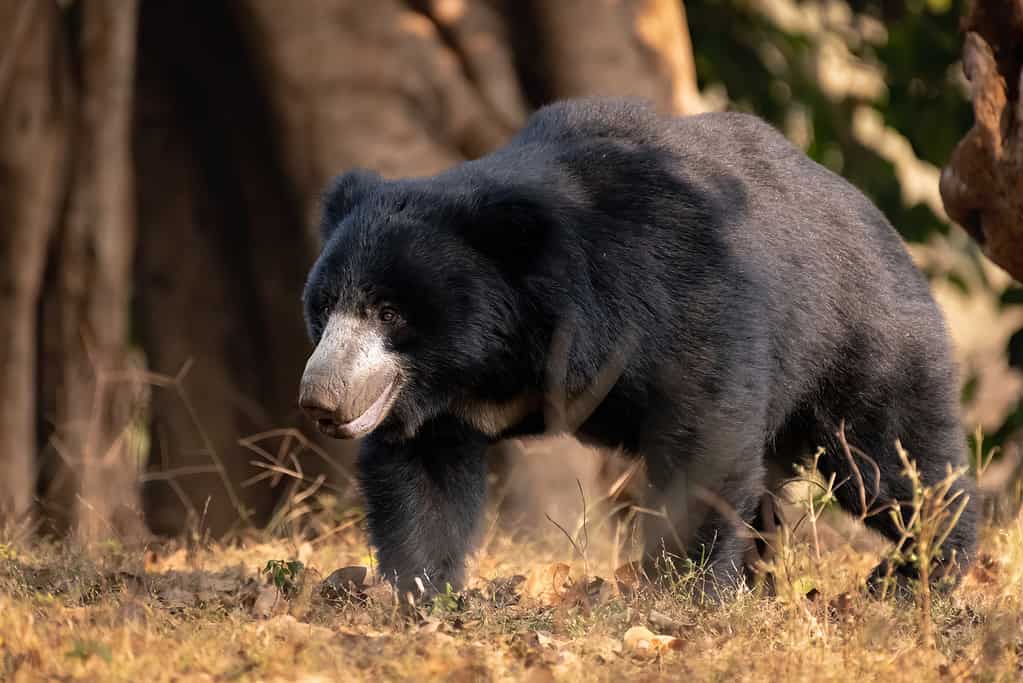
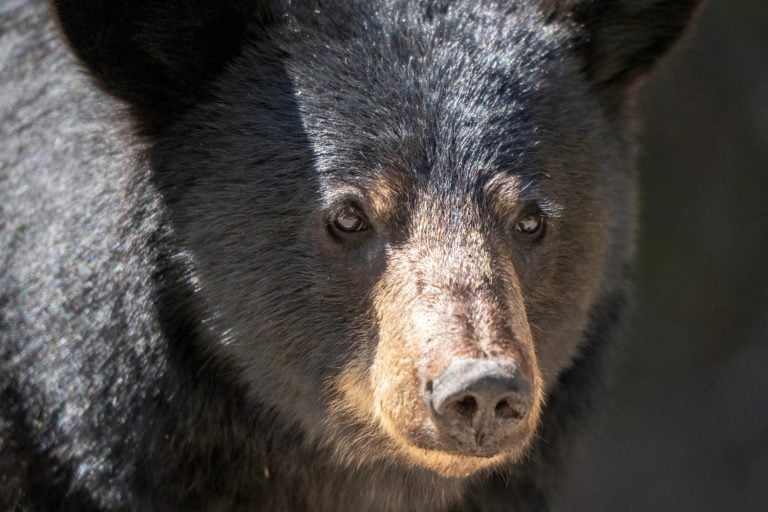
A large male adult Sloth bear can weigh over 300 pounds.
©Malcolm/iStock via Getty Images
Bear vs. Elephant: Size
Asian elephants are the largest land mammals in Asia, typically standing 6 to 10 feet tall at the shoulder and weighing between 6,000 and 12,000 pounds. They are significantly larger than the sloth bear.
Male sloth bears weigh between 176 and 320 pounds and stand 2 to 3 feet tall at the shoulder (with a body length of 4.5 to 6 feet), while females weigh 121 to 231 pounds and are of similar height.
Size Advantage: Elephant
Bear vs. Elephant: Speed
Elephants are large, but they are also swift. Elephants can reach speeds of 15 miles per hour (mph) in short bursts, as when they are charging toward a predator/threat.
Despite their misleading name, sloth bears are not slow. They are agile and fast, capable of reaching speeds of around 20 and 35 mph. They often use this speed for quick attacks or to escape danger.
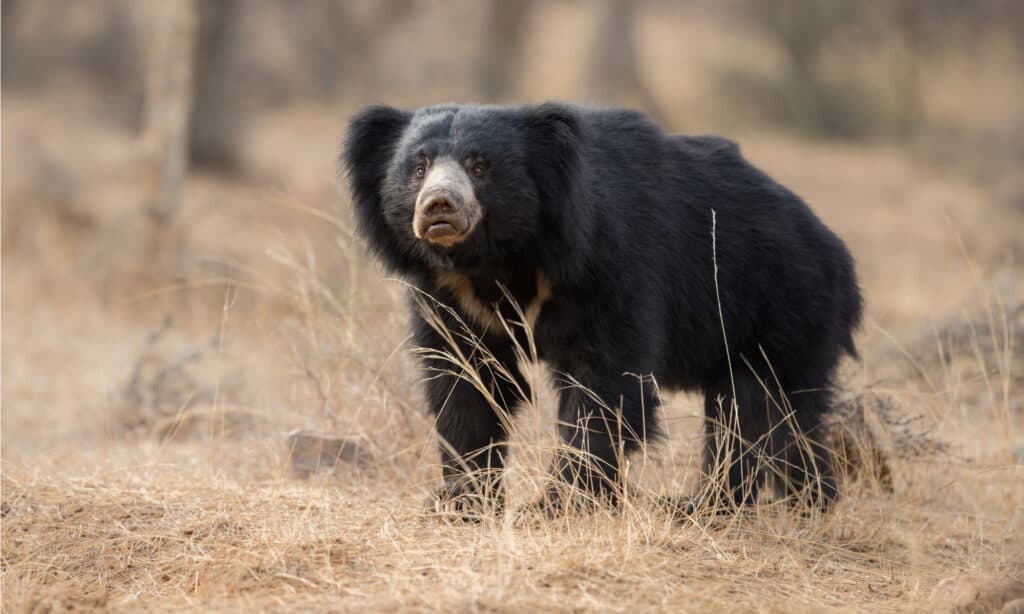
Despite their name, sloth bears are not slow.
©PhotocechCZ/Shutterstock.com
Although Asian elephants can charge at higher speeds for very short distances, their sustained running speed is generally slower than that of a motivated sloth bear.
Speed Advantage: Sloth bear
Bear vs. Elephant: Bite Power and Teeth
The elephant only uses its mouth to chew food, which consists of various plant matter. It does not possess significant biting power.
Sloth bears possess a powerful bite estimated to be between 550 and 650 pounds per square inch (PSI), designed for breaking into termite mounds and for defensive fighting. Despite their insectivorous diet, this bite force, paired with long claws, makes them highly dangerous and one of the most aggressive bear species.
Bite Force Advantage: Sloth bear
Bear vs. Elephant: Defenses
Asian elephants rely on their immense size, social cohesion, and intimidation tactics for defense, as adults have no natural predators. Key methods include mock charges with flared ears to intimidate threats, forming protective, tight circles around calves, and using trunk strikes or stomping.
Sloth bears rely on an aggressive defense strategy using intense posturing and swift, brutal violence to neutralize threats from predators. When startled or threatened, they stand on hind legs, huff, and roar, often charging to intimidate before resorting to vicious clawing and biting.
Both species are apex animals within their respective habitats, largely protected from predators by their massive size, strength, and specialized defensive behaviors.
Defensive Advantage: Tie
Bear vs. Elephant: Offensive Capabilities
The elephant uses a variety of visual cues and postures to signal aggression, dominance, or an impending attack. These behaviors often escalate from mild warnings to full charges. Unlike its defensive strategy, when an Asian elephant is on the offense, it becomes streamlined and quiet as it prepares to attack.
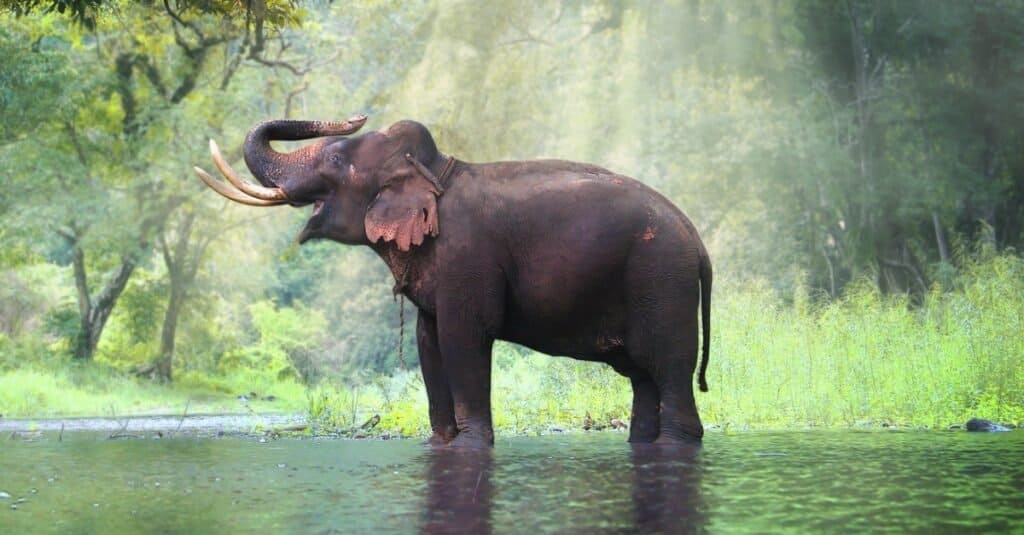
Asian elephants are one of the most intelligent animals. They are capable of using tools and showing grief and compassion.
©iStock.com/goodze
Sloth bears are recognized as highly aggressive and unpredictable, often choosing to launch explosive attacks rather than flee when startled or threatened. Their offensive behavior consists of swift charging, loud vocalizations, and the use of long claws and teeth to cause severe damage to the face and head.
Offensive Advantage: Tie
Bear vs. Elephant: Predatory Behaviors
Elephants are somewhat docile creatures that spend most of their day grazing. They do not like to be disturbed. As such, they do not have any predatory behaviors.
Sloth bears are not predators, per se, but specialized insectivores that feed on ants and termites.Their predatory behavior is strictly focused on using sharp claws and a long muzzle to dig into termite mounds and suck up insects. They are, however, incredibly aggressive and defensive, often attacking seemingly unprovoked and unexpectedly.
Predatory Advantage: Sloth Bear
Who Would Win a Fight Between a Bear and an Elephant?
An Asian elephant would beat a sloth bear in a fight. E
A fully grown bull elephant would most likely smell or hear a bear coming long before it showed up. Even if the bear sprinted at the elephant at 20 to 35 mph, it would not be able to charge and overwhelm or otherwise get into a position where its claws or teeth could inflict fatal damage on an animal the size of an elephant. It might bite and scratch the stomach or shoulders of the elephant, but doing so would leave it vulnerable to a powerful counterattack.
In this scenario, the elephant would likely knock over the bear, gore it severely, and possibly throw it through the air. The result would be an elephant with a few new scars and a badly defeated bear at its feet.
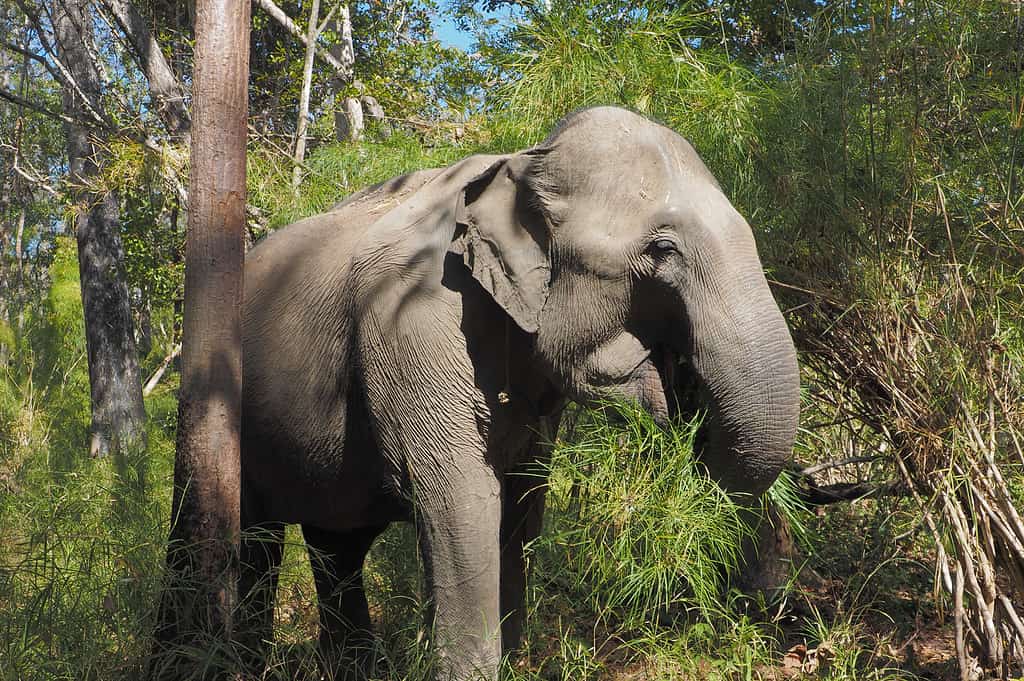
Wild Female Asian Elephant in Yok Don National Park, Vietnam
©DorSteffen/Shutterstock.com