Quick Take
- African wild dogs are among the most successful hunters on the planet, with an 80% kill rate that far outpaces lions. They don’t need to scavenge. They earn their meals the hard way.
- Elephants don’t bluff. When a bull elephant spreads its ears, trumpets, and charges, it’s not a performance. It’s a warning from a 12,000-pound animal that has the size of a semi-truck behind it.
- Wild dogs have been known to target elephant calves, which likely explains exactly why this particular bull wasn’t interested in sharing the watering hole — and wasn’t taking any chances.
In this YouTube video, a pack of African wild dogs has caught a kudu near a watering hole. They have nearly finished devouring the carcass when a lone bull elephant turns up to take a drink. The elephant is irritated by their presence and trumpets loudly before charging at them. Even though there are other animals, including zebras, moving around nearby, it is the African wild dogs that are causing the elephant some problems. Keep watching to see how it deals with the pesky canines.
What Do African Wild Dogs Normally Eat?
The African wild dog (Lycaon pictus) inhabits mostly savannas and arid zones, generally avoiding forested areas. This preference is likely linked to its hunting habits, which require open areas that do not obstruct vision or impede pursuit. These days, African wild dogs typically roam the open plains and sparse woodlands of sub-Saharan Africa. Their largest populations can be found in Botswana, Zimbabwe, Namibia, Zambia, Tanzania, and Mozambique.
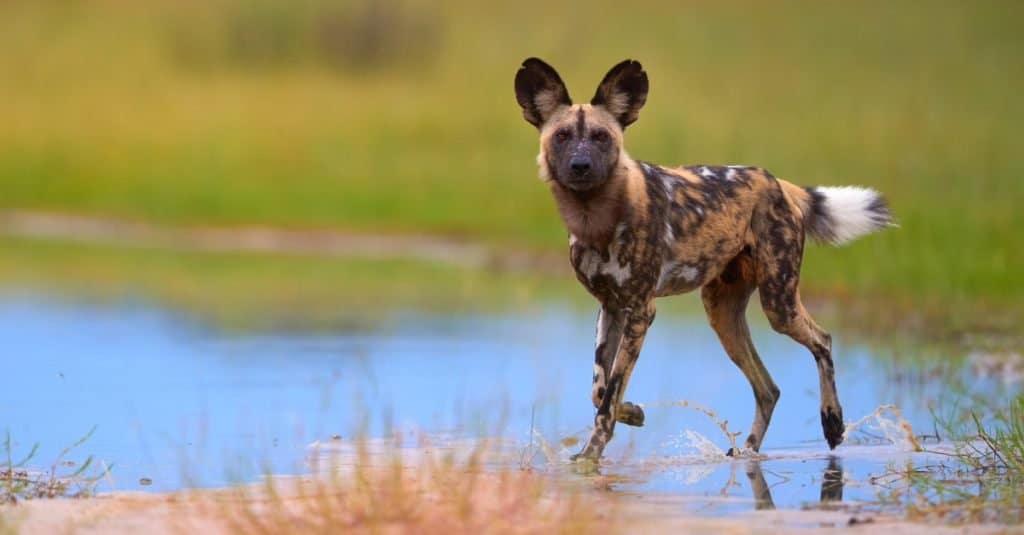
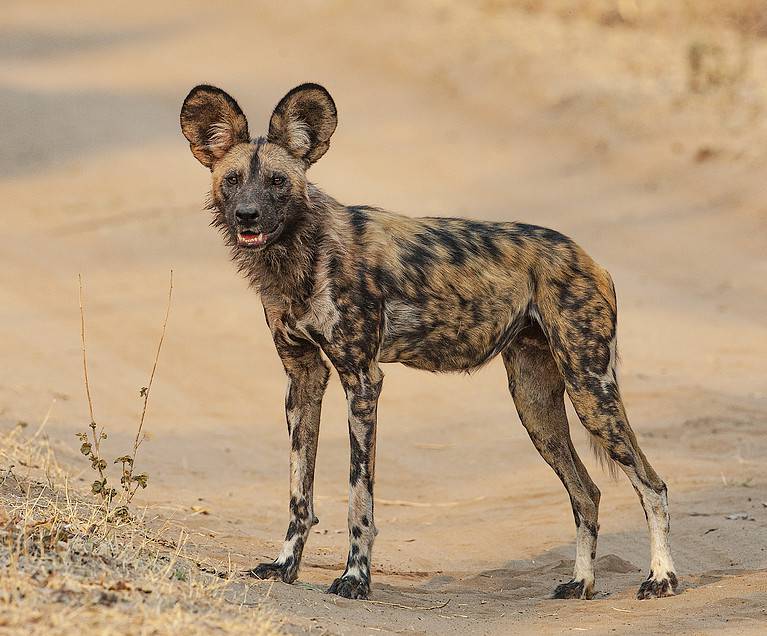
African wild dogs will target sick, old, young, and injured animals of larger species.
©Martin Mecnarowski/Shutterstock.com
African wild dogs live in packs averaging from seven to 15 members and sometimes up to 40. Within the pack, these canines have a unique social structure: there is a general lack of aggression between members, and every hunting pack has a dominant breeding pair. The African wild dog is a primarily diurnal predator that hunts by approaching prey silently, then chasing it in a pursuit at speeds of up to 41 mph for 10-60 minutes. They favor the early morning and late evening for hunts, and will occasionally hunt at night during a bright full moon.
Wild dogs will hunt anything from a warthog to a wildebeest, but their preferred prey are medium-sized antelopes such as impala that are no more than twice their own weight. Individual dogs will also opportunistically catch and eat smaller animals such as hares and birds. In the case of larger species such as kudu and wildebeest, calves are largely but not exclusively targeted.
They have been observed attempting to catch elephant calves on occasion, which probably explains why this bull elephant is so unhappy about their presence near the watering hole.
Are African Elephants Aggressive?
Elephants are generally considered peaceful animals. Having said that, there are examples of elephants being aggressive toward other species and toward other elephants. Aggression is most often seen between males — particularly during musth, a periodic hormonal surge — and is also displayed by females when they are protecting their calves.
When an elephant shows aggression, it turns toward the target with ears spread wide, standing as tall as possible. It nods, jerks, and shakes its head while swishing its trunk back and forth. This display is often accompanied by loud trumpeting, as we can hear in this clip.
The Incredible Size of African Elephants
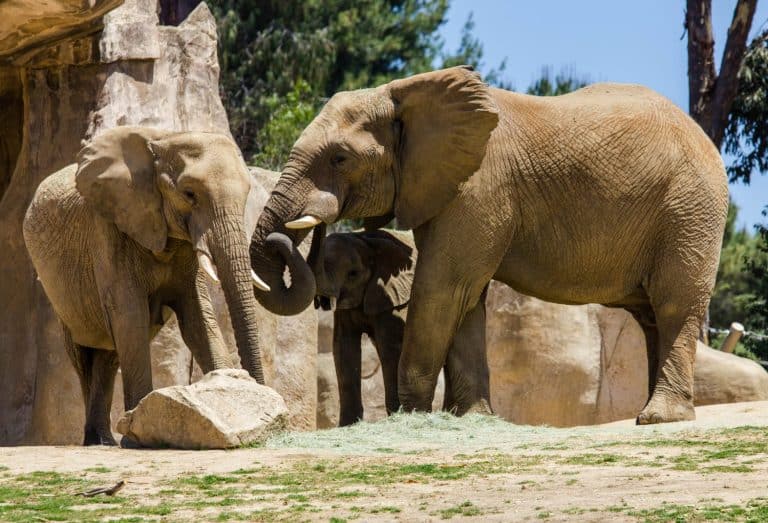
African elephants are the largest land animals on the planet. African elephants are 10-12 feet tall and weigh 8,000–12,000 pounds, while Asian elephants are 7-10 feet tall and weigh 6,000-11,000 pounds. Asian elephant males, however, can reach up to 3.5 meters (11.5 feet) tall, with the heaviest reaching up to 13,000 pounds. When born, elephant calves can already weigh up to 200 pounds (90 kg) and stand roughly 3 feet tall — making them larger than most adult dogs from the very first day of life.
In terms of sheer mass, a large bull African elephant is comparable to a fully loaded semi-truck, dwarfing lions, gorillas, and grizzly bears. It’s no wonder other animals — wild dogs included — think twice before standing their ground.