

Quick Take
- Your dog may be tracking exactly how long you've been gone, and the method it uses has nothing to do with sight or sound. How smell tracks time →
- Scientists think dogs might actually experience time moving at a different speed than humans, though perhaps not in the way you would expect. Dogs' perception of time →
- Most owners assume a guilty-looking dog remembers what it did wrong, but that assumption doesn't match how canine memory actually works. How canine memory works →
- Leaving your dog alone for what seems like a reasonable amount of time could quietly trigger a behavioral spiral. Here's where the line actually sits. Find the safe time limit →
How dogs perceive time is a fascinating concept that we only partially understand based on current science. Dogs don’t understand time like humans. They can’t read clocks or calendars; however, they do feel time passing and recognize their routines. Scientific studies suggest that dogs can process visual information faster than humans, which may allow them to perceive more details in a given period. However, whether this means dogs experience time as moving more slowly is still debated among scientists. Continue reading to learn more about how man’s best friend experiences our daily schedules, departures, and reunions.
How Do Dogs Experience Time?
Dogs rely on innate capacities to experience the passage of time. Dogs experience the world primarily through their sense of smell, which provides important cues about their environment. When you leave for work, your scent lingers in the house, but it steadily decreases throughout the day. Some scientists hypothesize that dogs may use the fading intensity of your scent as a cue to estimate how long you have been gone and to determine when to expect your return, but this idea has not been conclusively proven.
Dogs also rely on their natural biological clocks and daily habits, such as the predictable fading of scents, changes in household lighting, and feelings of hunger.

Dogs don’t understand time in minutes and hours, but they do understand time has passed.
©Javier Brosch/Shutterstock.com
Some studies and anecdotal reports suggest that dogs may react more enthusiastically to their owners after longer separations, indicating they might sense the difference between shorter and longer absences, but the extent of their ability to distinguish specific time intervals is not fully understood.
Do Dogs Understand The Concept of The Past and The Present?
Dogs are highly attuned to the present moment through their immediate environment, but they lack the human ability to mentally categorize events as past, present, or future. Instead, their understanding of the past is driven by associative memory.
They associate smells, sights, and physiological rhythms with past outcomes, using these patterns to anticipate what will happen in the present. While dogs can remember long-term routines or previous experiences, they do not consciously reflect on the past or plan for the future as humans do.
They live primarily in the moment, navigating life through learned cause-and-effect.

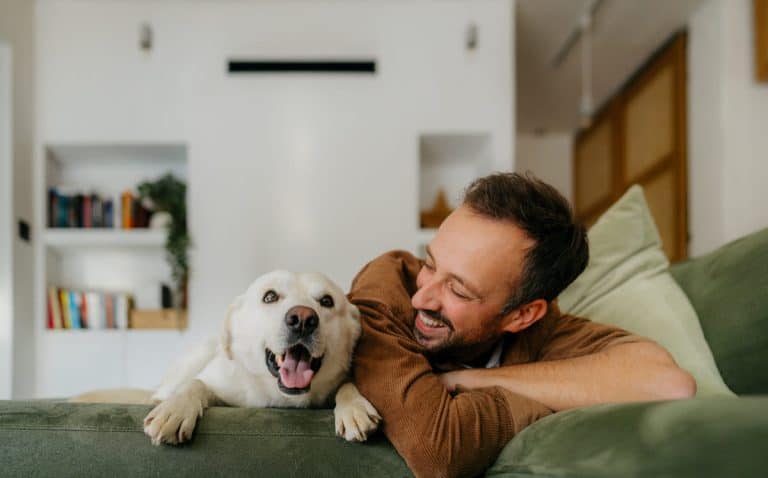
Dogs feel excited when owners come back because time feels longer to them than humans.
©iStock.com/Irina Kashaeva
Dogs are Affected by Time Spent Alone
It can be stressful for dogs to be left alone for long periods. The length of time a dog can be left alone depends on factors such as age, breed, and individual temperament. Many experts recommend that adult dogs should not be left alone for more than 6-8 hours, while puppies and some breeds may require much shorter periods. If you work full time, consider arranging for a dog walker or pet sitter to provide companionship and breaks during the day.
Some dogs adjust better to time alone than others. Breeds developed for close human companionship, such as lap dogs or some hunting breeds, do best in homes where someone is present most of the day.
Leaving your dog alone for longer periods than they can handle makes them susceptible to separation anxiety.

Separation anxiety in dogs can be shown in destructive behavior because the dog feels alone and/or bored.
©iStock.com/Wavetop
If dogs are left alone for long periods, they may become bored. This often manifests as destructive behaviors like chewing or attempting to escape confinement, repetitive stress behaviors like pacing or excessive panting, or vocalizations such as barking, whining, or howling.
If your dog misbehaves while you’re away, try to respond with compassion and address the underlying issue.
Usually, this behavior indicates your dog hasn’t had enough exercise, mental stimulation, or attention.