Most yellow labs have black skin, giving them black noses and black-lined eyes. Dudley labs are slightly different. They lack pigment in the skin around their eyes, nose, and feet. These pups are most known for their pink noses that pop out against their yellow locks.
All puppies are born with pink noses, but usually, they get darker as they age. Black and yellow labs typically have black noses. Chocolate labs have brown noses.
A Dudley lab puppy’s nose will not change color as it ages, staying pink for its whole life.
Dudley Labs also tend to have light blue or teal eyes.
Besides their coloring, Dudley Labs are the same as other labs — they are not a separate breed. Since they are the same, Dudley Labs have the same friendly and playful personalities that we know and love labs for.
Labradors are some of the most intelligent and loyal breeds you can have, no matter the color variation.
Lab Genetics
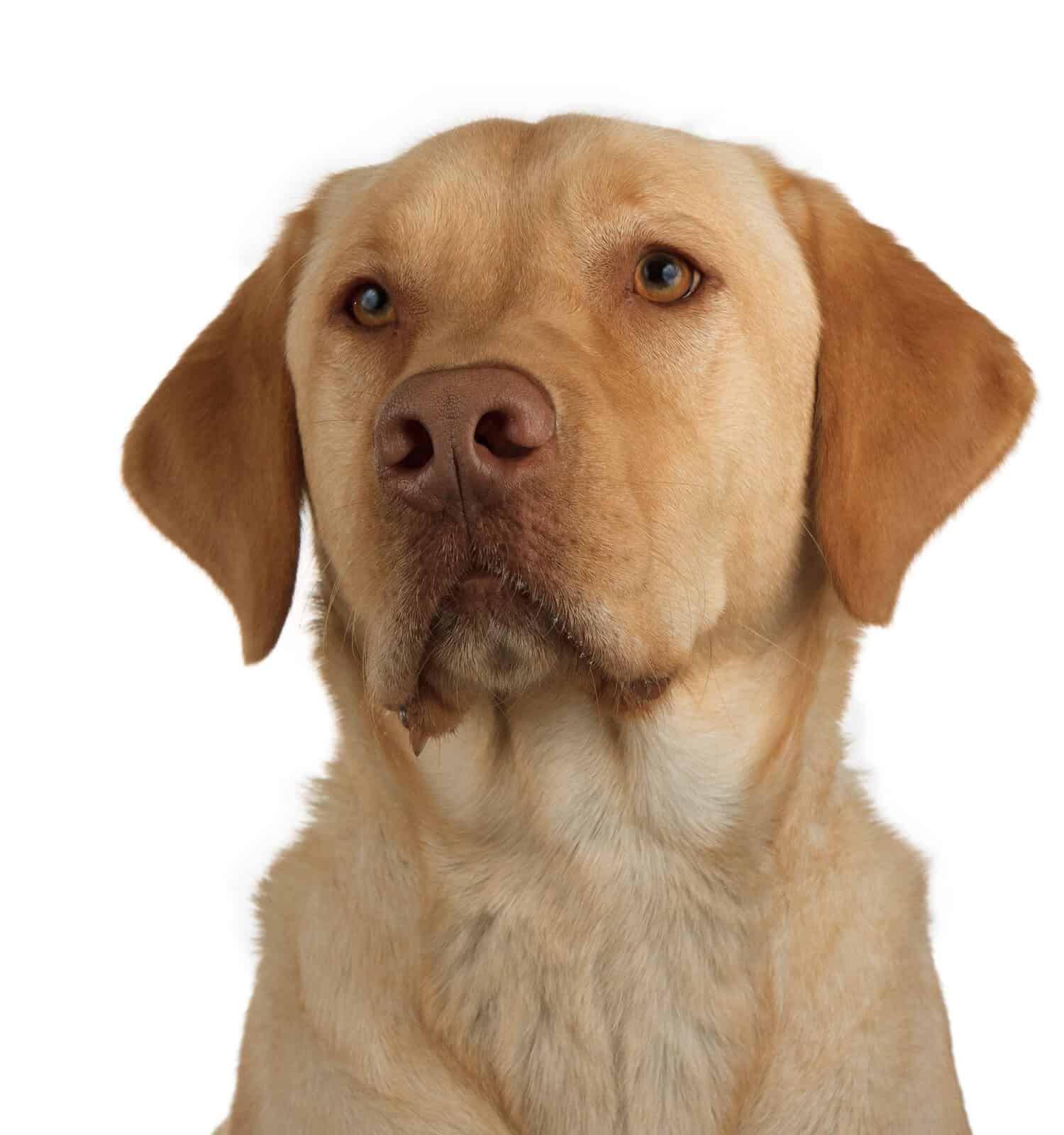
Dudley Labs have distinctively pink noses.
©Mike Truchon/Shutterstock.com
How much pigment a lab has depends on the amount of melanin in its skin. The amount of melanin is controlled by an enzyme called Tyrosinase.
Puppies inherit genes from their parents that decide what color they will be. The gene that creates yellow labs masks the genes that produce chocolate or black labs.
Dudley labs are a special case. Most yellow labs still have dark skin. Dudley labs have light skin around their eyes, nose, and feet.
Those wishing to breed Dudley puppies can test their dogs’ DNA to see if it’s possible. It’s more difficult to breed Dudley labs than other variations.
Conversely, owners who show their labs will often have their DNA tested for other reasons. The AKC won’t allow Dudley labs in their shows. So, many owners don’t want to breed puppies without pigment.
Genes that Affect Color
To understand this better, let’s look at the genes more closely. There are two parts to the genes that control color in labs: the B and E loci.
The B and E loci decide whether a lab will have a yellow, brown, or black coat.
There are two parts to each loci. So, a lab will inherit “B’s” or “b’s,” and “E’s” or “e’s.”
The “B’s” mask the “b’s.” A lab must inherit two “b’s” to be brown.
A dog with the “BB” gene will be black or yellow.
In a dog that has a “Bb” gene, the “B” masks the “b,” also meaning the dog will be black or yellow.
The E loci determine the coat color when a dog has a “BB” or “Bb” gene. It determines whether the lab will have a black or yellow coat.
The E loci don’t matter for chocolate labs (i.e., those with a “bb” or gene).
Similar to the above, the “E’s” masks the “e’s.”
So, if a lab has an “EE” or “Ee” gene, they will be black.
But, a lab with an “ee” gene will be yellow.
Confusing, right?
Well, “ee’s” have the power to mask “B” genes. So, a lab will have a yellow coat, even if they have the “BB” or “Bb” genes that characterize black labs.
Despite having yellow coats, Dudley Labradors are extra special because they have both the “bb” and “ee” genes. This combination results in a dog with a yellow coat and pink skin around the eyes, nose, and feet.
| Black Lab | BBEE | BBEe | BbEE | BbEe |
| Chocolate Lab | bbEE | bbEe | — | — |
| Yellow Lab | BBee | Bbee | — | — |
| Dudley Labs | bbee | — | — | — |
Are Albino Labs and Dudley Labs the Same?
No, albino and Dudley labs are not the same. Dudley Labs still have some pigment in their skin. They only lack that pigment around the rim of their eyes, feet, and nose.
Albino labs completely lack pigment in their skin. Their fur is also often lighter than Dudley Labs.
Plus, albinos almost always have red eyes. Dudley Labs usually have light blue or teal eyes. The lack of pigmentation throughout the entire body causes the red eyes in albino labs.
Is a Dog a Dudley Lab if Their Nose is Sometimes Pink?
No, a lab is not a Dudley lab just because its nose becomes paler under certain circumstances.
Dudley Labs are unique because they have had pink noses their whole lives, from puppyhood until death.
A lab’s nose may change color for a few reasons, including age, season, injury, or illness.
Age
Many dark-nosed labs begin to lose pigment in their noses as they age. It’s a natural process as the melanin-producing gene becomes less effective.
Still, just because your black lab’s nose is becoming pinker with age does not mean it’s a Dudley lab.
Injury or Illness
If a lab gets a cut on their nose, the cut is usually pink while healing. The skin usually returns to its original dark color once the cut is healed.
Even if the scar remains pink, it does not mean the dog has magically become a Dudley Lab.
Some health conditions can also cause loss of pigmentation in the nose. Some of these issues include bacterial infections, skin conditions, and allergies.
Changes in the Seasons
Many labradors lose some pigmentation in their noses when the temperature drops. People often refer to this change as “winter nose” or “snow nose.”
A “winter nose” is temporary; the dog’s nose will regain its color once the temperature warms up.
Are There Health Problems Associated with Dudley Labs?
These pink-skinned labs are the same as other labs except for the skin color around their eyes, nose, and feet. So, there are no major health concerns linked specifically to Dudley labs.
But, Dudley Labs are far more likely to experience sunburn because of their pink skin. You’ll have to be more careful about taking your dog outside in the sun for long periods.
It’s best to talk to your vet about preventing sunburn. They’re likely to recommend a dog-safe sunscreen.
Dudley Labs Come Dudley, England

These labs get their names because they come from the town of Dudley, England.
©Buddha1920/Shutterstock.com
Dudley Labradors get their name because they were first bred in the town of Dudley,
England. Dudley Labs were not well-recorded throughout history. The consensus is that Dudley Labs likely appeared in the early 1900s.
Here’s How Rare Dudley Labs Are
These pups are relatively rare, though not as rare as some claim.
The gene that causes a lack of pigmentation is recessive. The brown or black gene usually covers the recessive gene, giving the pup typical brown or black skin.
A puppy must get the gene that causes a lack of pigmentation from both parents to be a Dudley Lab.
Where to get a Dudley Lab
I always recommend looking at rescues before deciding to buy from a breeder.
Dudley Labs are rarer than other kinds of labs. So, finding one in a shelter is more challenging but not impossible.
Your best bet is to find rescues that specifically rescue labs.
Some good rescues include:
If you are specifically looking for a Dudley Lab, the easiest option is to find a breeder.
Be sure to always vet potential breeders before buying from them. Make sure they have a good reputation. They should follow ethical breeding practices and take good care of their dogs.
The breeder should be knowledgeable about their breed and individual puppies. They should be able to tell you what the breed is like and be able to tell you about each puppy’s temperament and health.
Most reputable breeders will allow you to see the parents and the housing facilities. It’s typically a “red flag” if they won’t let you see these things.
Good Names For Dudley Labs
| Names for Their Pink Noses | Names for Their Yellow Coats | ||||
| Azalea | Coral | Rudolph | Primrose | Buttercup | Aspen |
| Cotton Candy | Rhubarb | Babe | Dusty | Nugget | Lemon |
| Carnation | Piglet | Pink | Star | Banana | Caramel |
| Dahlia | Petunia | Sprinkles | Blondie | Nacho | Sunny |
| Rose | Barbie | Watermelon | Daisy | Sunflower | Daffodil |
| Bubblegum | Berry | Peachy | Cheddar | Marley | Goldie |
| Salmon | Pink Floyd | Piggy | Goldy | Corn | Goldilocks |