Quick Take
- The secret to the fastest spin in the animal kingdom comes from a hidden body part most people have never heard of. Discover the hidden mechanism →
- No matter how scientists provoked these springtails, even poking them from behind, the animals always escaped in the same unexpected direction. See the escape direction findings →
- A body part springtails normally use for grooming turns out to play a completely different role the moment they hit the ground. See the collophore in action →
- The fastest-spinning creature ever documented doesn't live in some remote rainforest. It's almost certainly in your backyard right now. Find them in your backyard →
A creature smaller than a grain of rice may be the fastest backflipper on Earth, which is exactly the kind of fact that makes me want to go outside, scoop up a handful of leaf litter, and look a little closer at what’s been living underfoot this whole time.
Most of us walk past springtails without ever noticing them. They are tiny, soil-dwelling creatures that look almost too small to be doing anything dramatic. But under a high-speed camera, they turn out to be backyard acrobats.
Slow-Motion Close-Up
Biologist Adrian Smith, from the Ant Lab and North Carolina State University, filmed the globular springtail Dicyrtomina minuta at nearly 11,000 frames per second. That’s slow motion so extreme it can catch movements our eyes would completely miss.
What he saw was astonishing: during takeoff, these tiny animals can spin at rates up to 368 backflips per second. Some completed more than 20 backflips in a single jump, all while airborne for just 161 milliseconds.
Springtails used to be grouped with insects, but scientists now place them in Hexapoda alongside two other groups that are insect-like but not true insects. Genetic evidence and body-structure studies show that springtails split away from the insect family tree very early in arthropod evolution.
They are also everywhere. More than 9,000 species have been described, and most live in soil and leaf litter. There, they feed on decaying plant material, fungi, and microorganisms. In temperate soils, they are among the most common arthropods around, with numbers often topping 100,000 springtails per square meter.
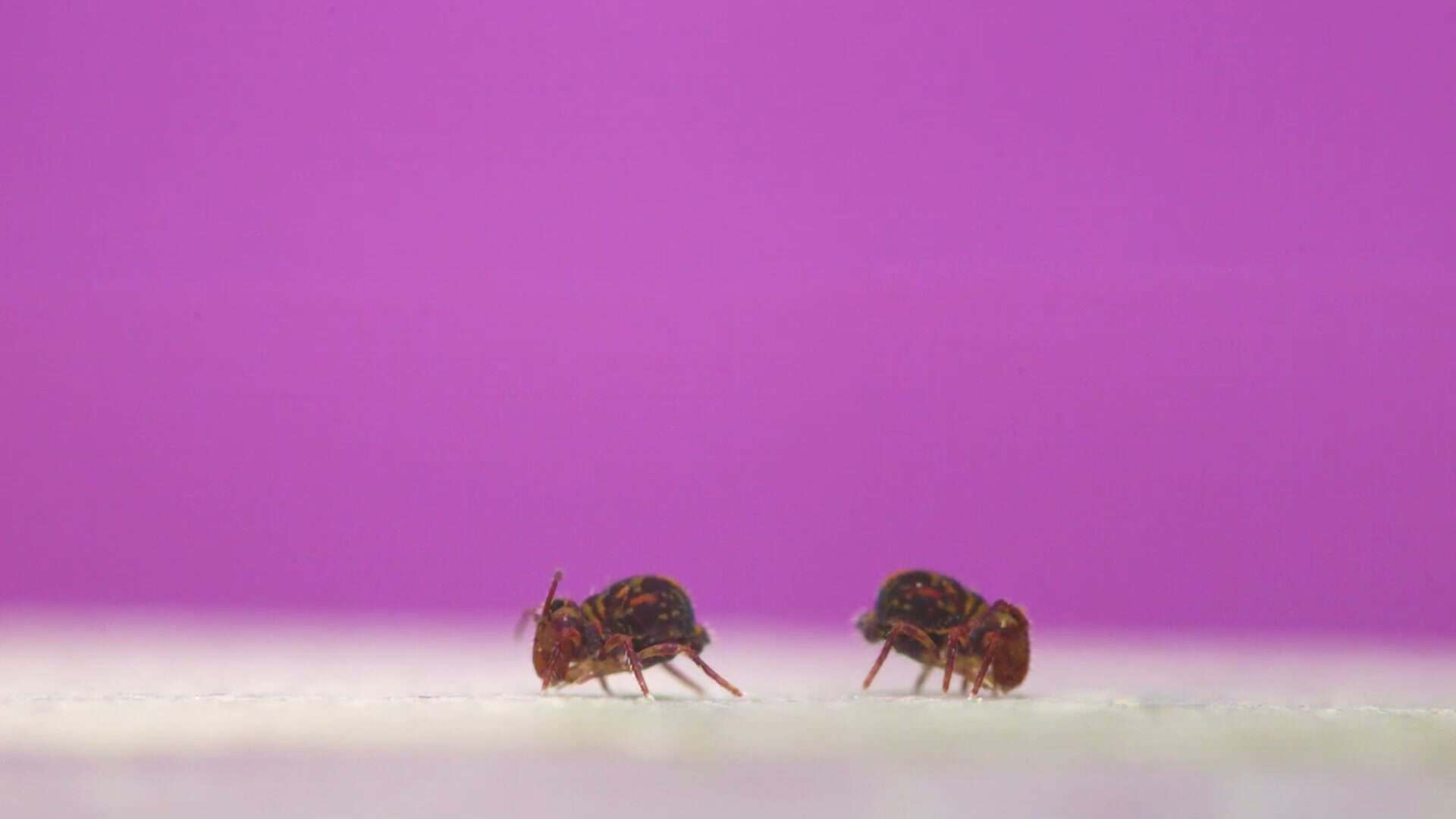
Springtails have the fastest back flip of any living creature.
©Ant Lab via YouTube — used under fair use – Original / License
It’s All About the Furca
The secret to this incredible flipping ability is a spring-loaded body part called the furca.
Think of it like a tiny forked tail tucked underneath the springtail’s belly. Most of the time, it is folded up and held in place by a little latch. When that latch releases, the stored energy snaps the furca downward against the ground, launching the animal into the air.
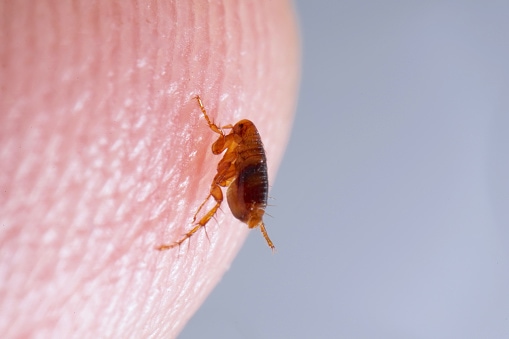
Smith’s high-speed footage showed that takeoff happens in an average of just 1.7 milliseconds. The acceleration is around 1,600 meters per second squared, which is in the same ballpark as a flea.
Then the researchers zoomed in even closer.
Under a scanning electron microscope (a tool that reveals tiny surface details), they looked at the tip of the furca. This tip is called the mucro, and it is covered with backward-pointing, saw-like spikes on the side that touches the ground.
Footage taken from underneath clear platforms showed that the whole furca does not push against the surface, only the tips do. On smooth glass, those tips slip, and the springtail does not launch properly. That shows the little spikes work like grip points, helping the animal get traction before it blasts off.
A related body-structure study used microCT scanning, which is basically a very detailed 3D X-ray scan of tiny anatomy. That scan revealed plates and rods in the abdomen that seem to work as part of the spring system, storing energy and releasing it during the jump.
When you pull back and watch the full jump, the scale is incredible. This animal is only about 1 millimeter long, but it can jump more than 60 millimeters straight up. That’s about 60 times its body length! Most jumps landed around 30 millimeters away.
And during the entire arc, the springtail keeps spinning. It does not pause or steady itself midair. It just flips and flips and flips, usually between 14 and 29 backflips in one jump.
What About Direction?
Here’s where the story gets even stranger.
Every jump the researchers tracked from above went backward compared with the direction the springtail was facing. Even when the researchers gently poked the rear of the animal with a paintbrush, the escape jump still went backward. Never forward.
That means the wedge of space directly in front of the springtail, which is about a 90-degree zone, seems to be out of reach when it jumps from a flat, solid surface.
That is especially interesting because Smith has previously filmed aquatic globular springtails jumping from the surface of water, and those animals launch forward. So land-dwelling and aquatic springtails may be using their bodies in different ways. A follow-up study on jump direction is now in progress.
How They Stick the Landing
Landing is where these little acrobats reveal another surprise.
Some jumps end in pure chaos. The springtail bounces, tumbles, and sometimes ends up stranded on its back. But in other landings, the animal does something clever. Just before impact, it extends two tiny tubes from the underside of its body and sticks them to the surface.
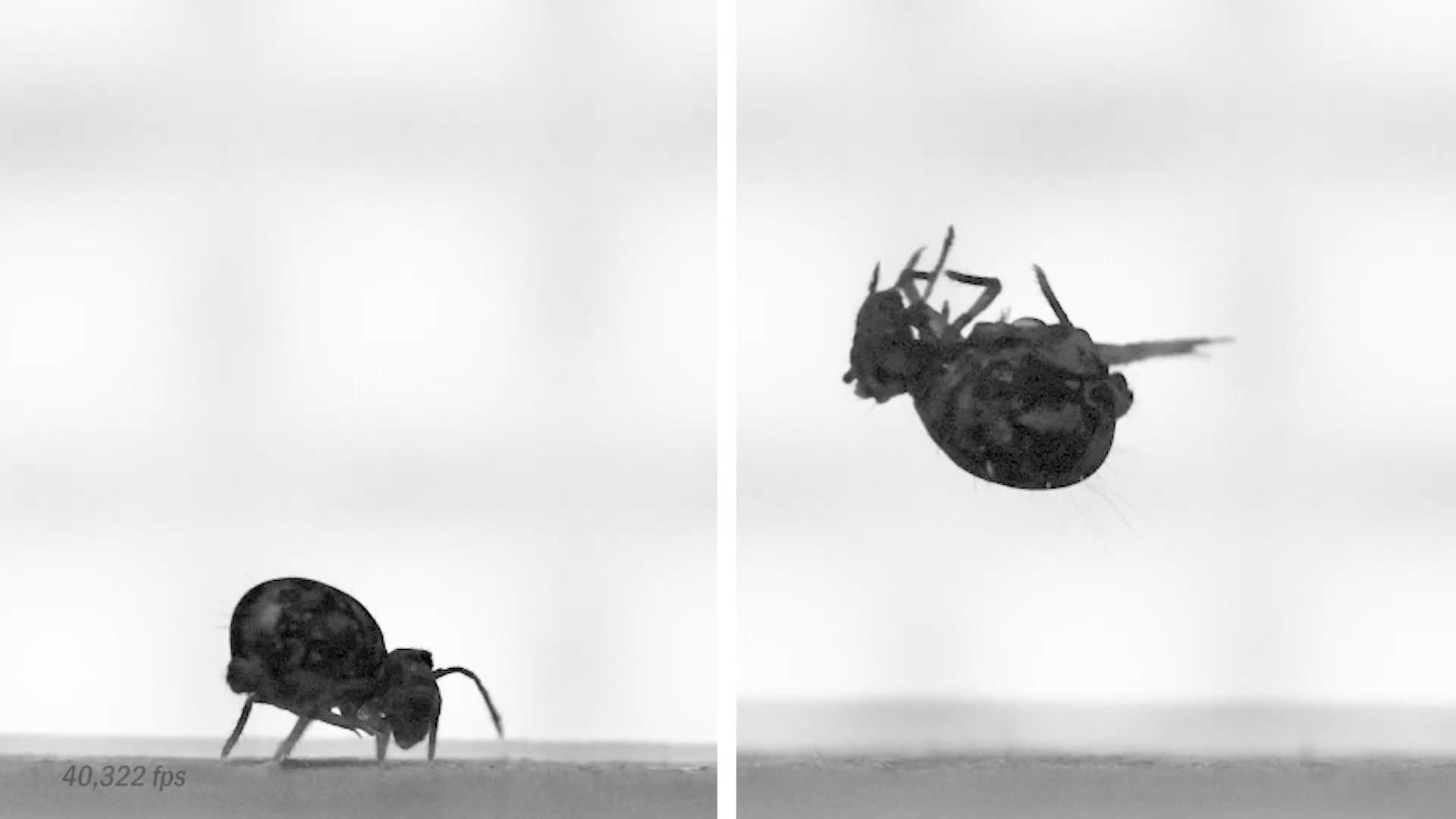
The springtails’ jumps were always backward, never forward.
©Ant Lab via YouTube — used under fair use – Original / License
Those tubes help soften the bounce and can keep the springtail upright.
This body part is called the collophore, or ventral tube. Normally, it is tucked against the underside of the abdomen. Springtails are already known to use it for self-grooming and managing water balance. But using it like a landing anchor appears to be a newly recognized behavior for this organ.
It does not work every time. In some videos, the tubes come out but fail to stick, and the springtail tumbles anyway. So this does not look like perfect aerial control. It looks more like a built-in safety system, one that helps when it catches, but does not guarantee a graceful landing.
Where to Find Springtails
What makes this discovery especially wonderful is how close to home it is.
Smith collected every springtail he filmed from leaf litter in his own backyard, sifted from a handful of soil. In other words, animals capable of the fastest spinning movement yet documented in any organism are not tucked away in some remote rainforest or deep-sea trench. They are living by the thousands — maybe hundreds of thousands — in ordinary gardens, backyards, and leaf litter across much of the temperate world.