
Have you ever driven through Pennsylvania and seen some of the most lush and magnificent trees stretching to the sky, creating an enchanting scene? Pennsylvania is home to some of the most iconic trees in North America, such as maple trees and eastern hemlock.
Let’s delve into the wonderful world of trees and explore the most iconic trees native to Pennsylvania!
What Trees Are Native to Pennsylvania?
So, what trees blanket the landscapes of Pennsylvania? Over 60% of green forests are spread throughout the Keystone State, comprising 16.6 million acres of land! Pennsylvania is rich with mixed oak forests, such as chestnut, red oak, and northern hardwoods, like black cherry and birch. The following are Pennsylvania’s most iconic trees native to the area.
1. River Birch
River birch (Betula nigra) is native to the eastern parts of the U.S. This towering multi-stemmed tree can grow 40-70 feet tall and 30-50 feet wide. Also known as water birch, the cold-resistant trees will thrive in hardiness zone 4-9. Pennsylvania is home to these tall, deciduous trees.
River birch trees have pink, brown, or gray peeling bark and beautiful dark green leaves that turn yellow in the fall. What’s great about river birch trees is how fast they mature. They can grow to three feet annually and live 50-75 years. However, those that grow too fast can have a shorter lifespan. River birch trees are great ornamental trees that will complement any landscape.
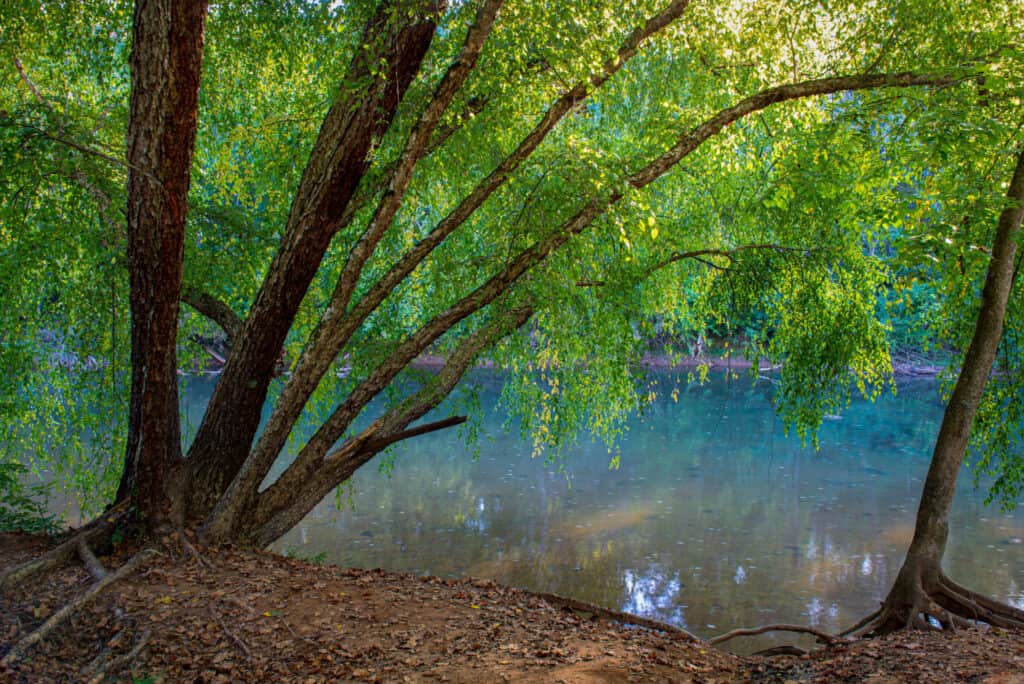
Also known as black birches, river birch trees thrive in wet conditions.
©Gerry Bishop/Shutterstock.com
2. Shagbark Hickory
Shagbark hickory (Carya ovata) can grow 60-80 feet tall. However, some can reach an impressive 120 feet. These Pennsylvania natives have peeling strips of bark which give them their shaggy name. Additionally, these deciduous trees can thrive for more than 200 years!
Shagbark hickory trees are part of the walnut family and produce nuts each fall. You may find rabbits, foxes, and black bears feasting on them when they are in season. In addition, they have an iconic pyramidical or conical shape with small green needles that give them a defined look.
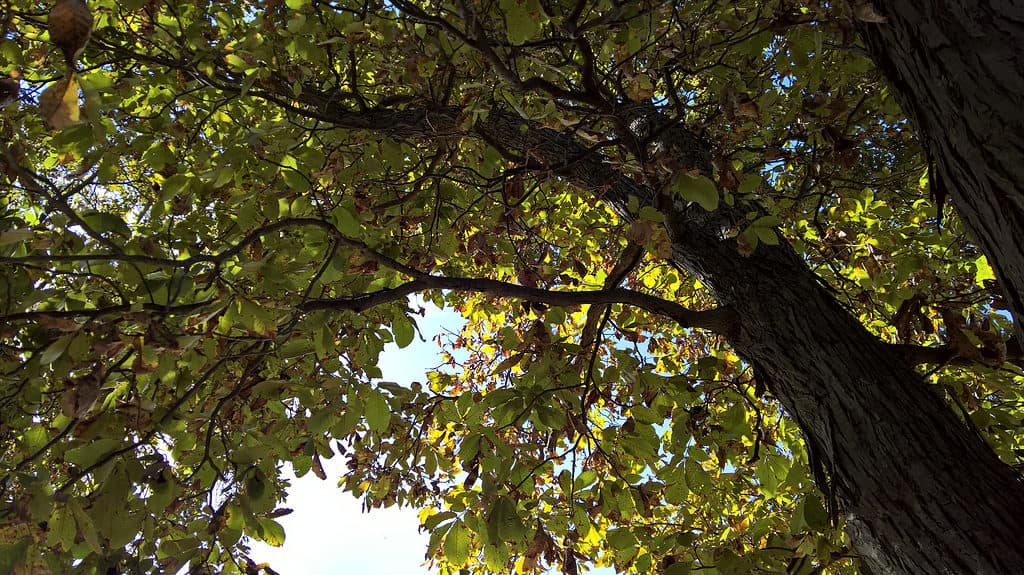
The beautiful shagbark hickory gets its name from its peeling bark which gives a shaggy appearance.
©iStock.com/Ethan R.
3. Red Maple
Red maple (Acer Rubrum) trees are magnificent, shady medium-to-large trees native to North America and stretching up to about 33–148 feet. Because they grow and thrive over a wide spectrum of soil conditions, they are also known as swamp, water, or soft maples.
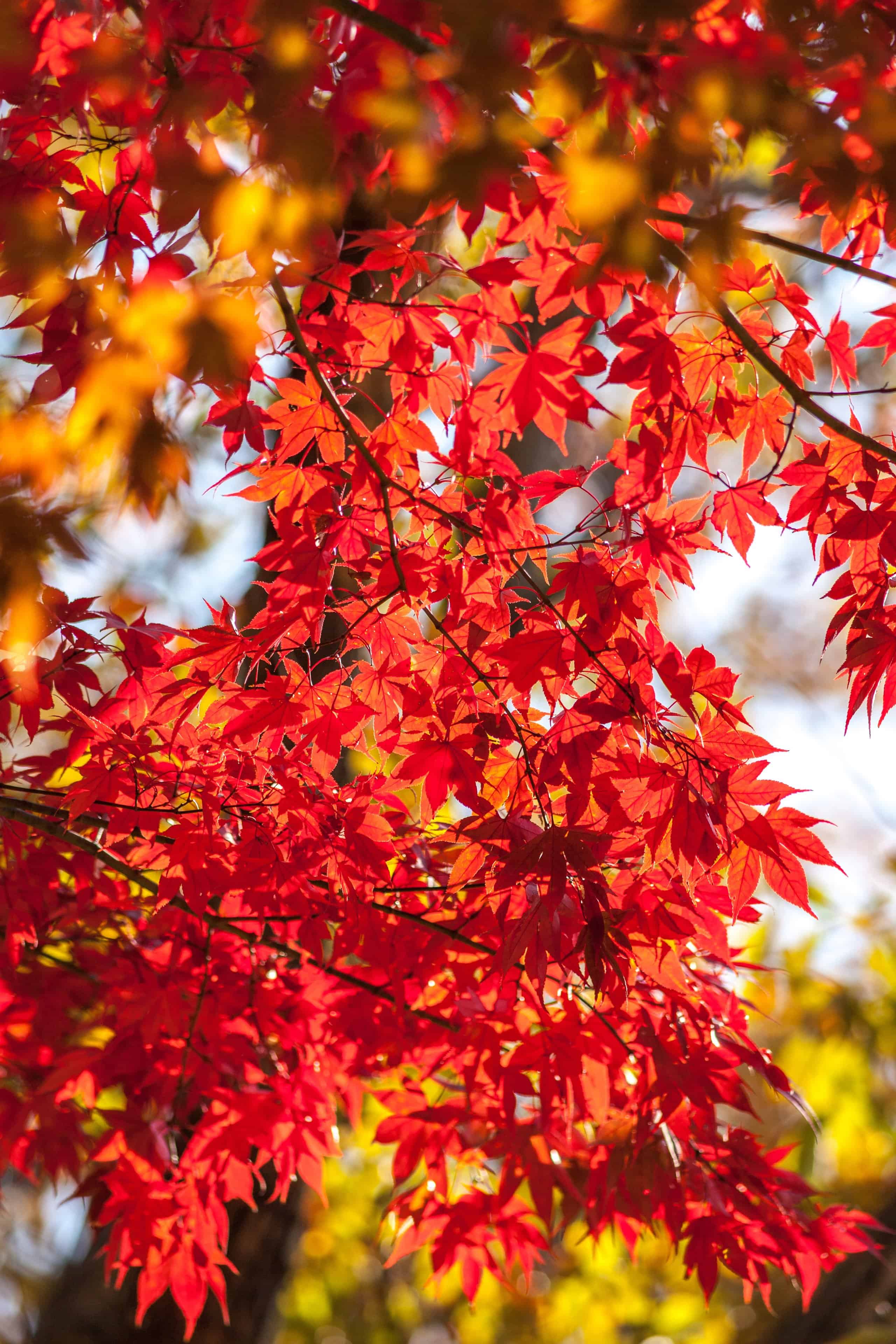
In abundance in Pennsylvania, these exquisite, shady deciduous trees swap their green spring/summer leaves for majestic gowns of orange-red leaves, flowers, fruit, and twigs in the fall.
The red maple tree has a rounded crown. The young tree has a smooth, gray bark but darkens and becomes scaly as it ages. These trees flower fragrantly in pinkish–red droopy clusters, and the fruit in yellow, pink, or red are paired-winged samara.
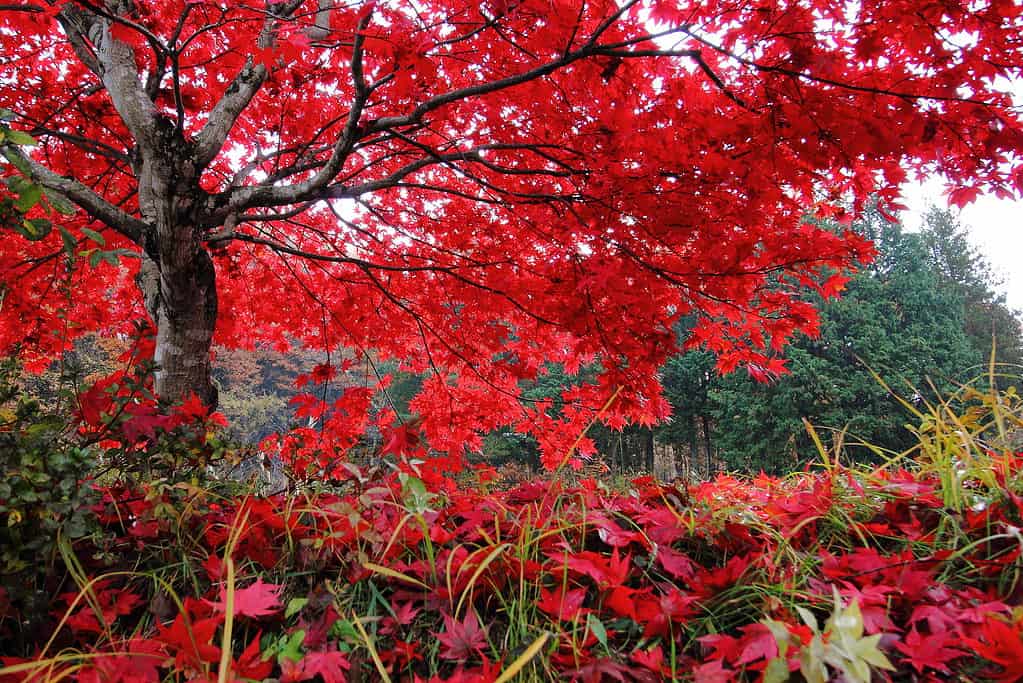
The red maple tree shows off stunning orange-red leaves, twigs, flowers, and fruit to brighten any landscape.
©KungChuyada/Shutterstock.com
4. Chestnut Oak
The Chestnut oak (Quercus montana), part of the white oak family, are stately, sturdy trees that grow rapidly on steep rocky hills of the eastern U.S. They reach a height of 60 to 70 feet with a similar girth presenting with a crown as round or oval. The trunk of this tree is like a column reaching up to the skies and covered in thick bark rich in tannin. Also, the colors range from grayish-white to almost black, with ridges and grooves that give it a bold, scaley texture.
The leaves on this beautiful shady tree are long chestnut-shaped with saw-tooth-like edges. They are green and turn orange-red or rust-brown before they drop off in the fall. Many species of wildlife, like deer, squirrels, chipmunks, turkeys, and mice, are all the lucky recipients of tasty acorn meals from the chestnut oak tree.
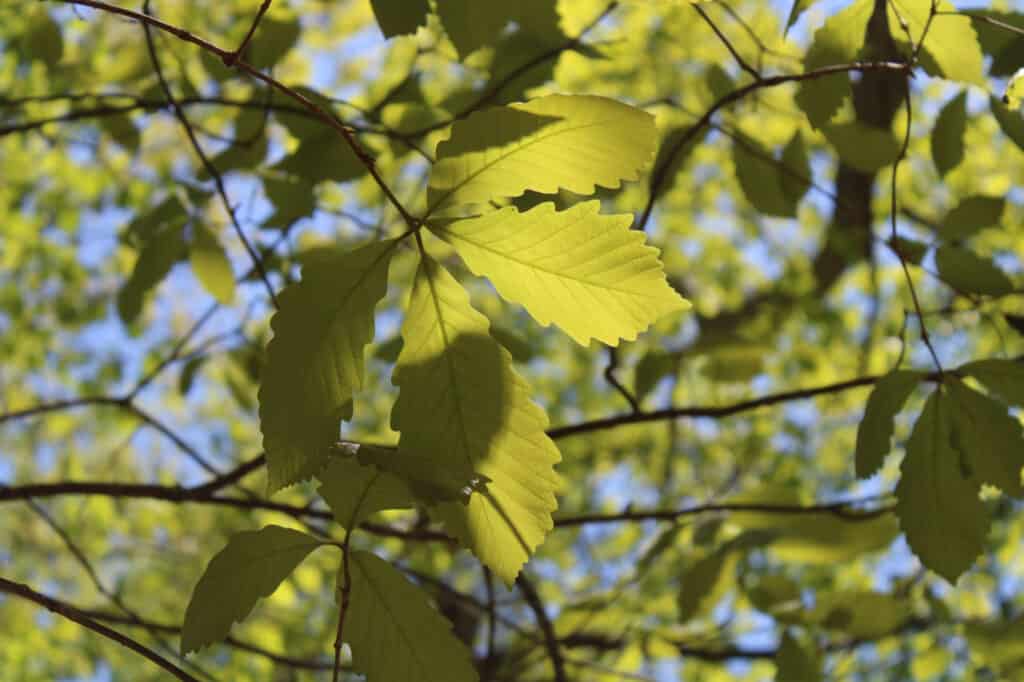
Attractive and producing large acorns, chestnut oaks have distinct leaf and bark patterns.
©Roca Mharas/Shutterstock.com
5. Red Oak
Red Oak (Quercus rubra) are deciduous hardwood trees among North America’s most widely spread oaks. This fast-growing, pristine beauty, often cultivated as an ornamental tree, grows to heights of 80 to 100 feet with a straight trunk. It has a round crown and wide spreading branches offering its shade generously. It is clothed in magnificent russet-red to bright-red colored, 5 to 8 inches long, with 7 to 11 lobed bristle-tipped leaves in fall and winter.
In the young red oak, the bark is smooth and greenish brown but turns to brownish-gray as it matures and is broken into wide ridges that look like ski slopes with intermittent dark and light color down the trunk. The acorns on this tree are about ¾ to 1 inch long, rounded, and encased at the base in a shallow cup. These acorns are a food source for wildlife.
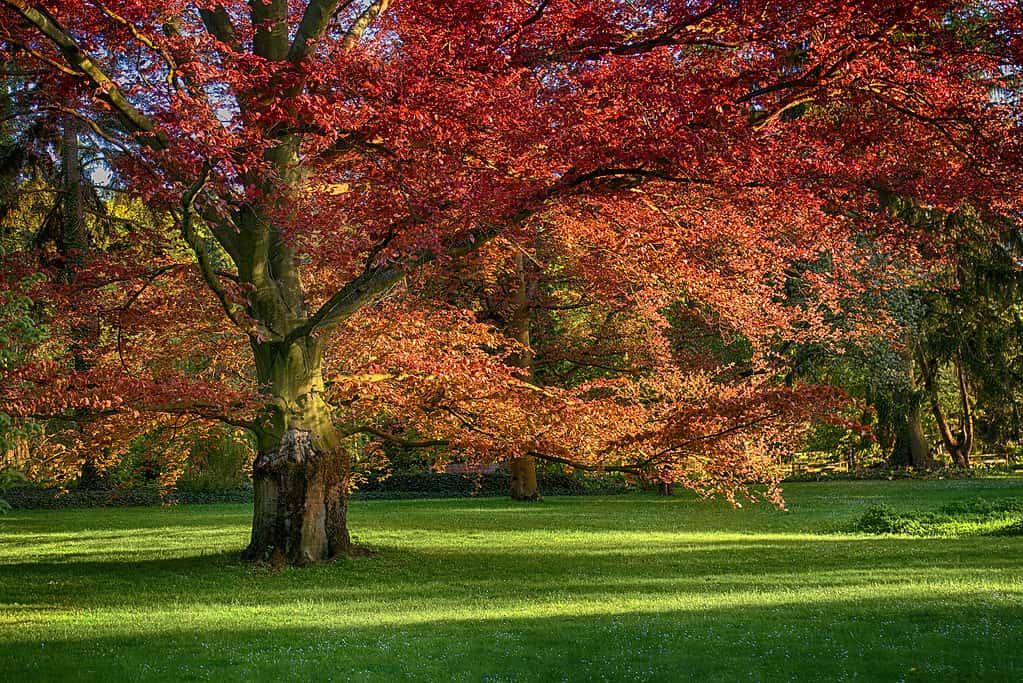
The red oak tree has matured bark with intermittent dark and light ski-sloped-looking ridges down the trunk.
©Pawel Horazy/Shutterstock.com
6. Gray Birch
Gray Birch (Betula populifolia) are medium-sized, fast-growing trees that grow throughout Pennsylvania from 20 to 30 feet and, very rarely, to 40 feet. This shade-giving tree sports an irregular pyramid-like crown formed by flexible slender branches hanging almost to the ground, covered in long triangular glossy dark green leaves fluttering in the wind. Its lifespan is about 30 years.
The bark of this deciduous tree is gray or red-brown when young but whitens as it ages and becomes red-orange on the inner surface. This tree often has multiple stumps that branch off from an old stump. There are four other species of birch native to Pennsylvania, namely, black, paper, river, and yellow birch.

The bark of this deciduous tree is gray or red-brown when young but whitens as it ages.
©Laval University, CC BY-SA 4.0 <https://creativecommons.org/licenses/by-sa/4.0>, via Wikimedia Commons – Original / License
7. Black Cherry
Black cherry (Prunus serotina) trees, also known as “wild cherry,” are medium-sized, fast-growing hardwood trees common in Pennsylvania and reaching heights of 50 to 80 feet. In spring and summer, its crown forms a blossoming canopy of white flowers, giving rise to reddish-black berries that birds feed on.
The young tree’s bark is reddish-brown and smooth, but as it matures, it becomes dark gray to black and coarse and scaly. The bark and leaves have a distinct bitter taste and sour odor. The wood is sought after for furniture manufacture. In addition, the fruit and bark are for medicinal use and flavoring of some alcoholic drinks.
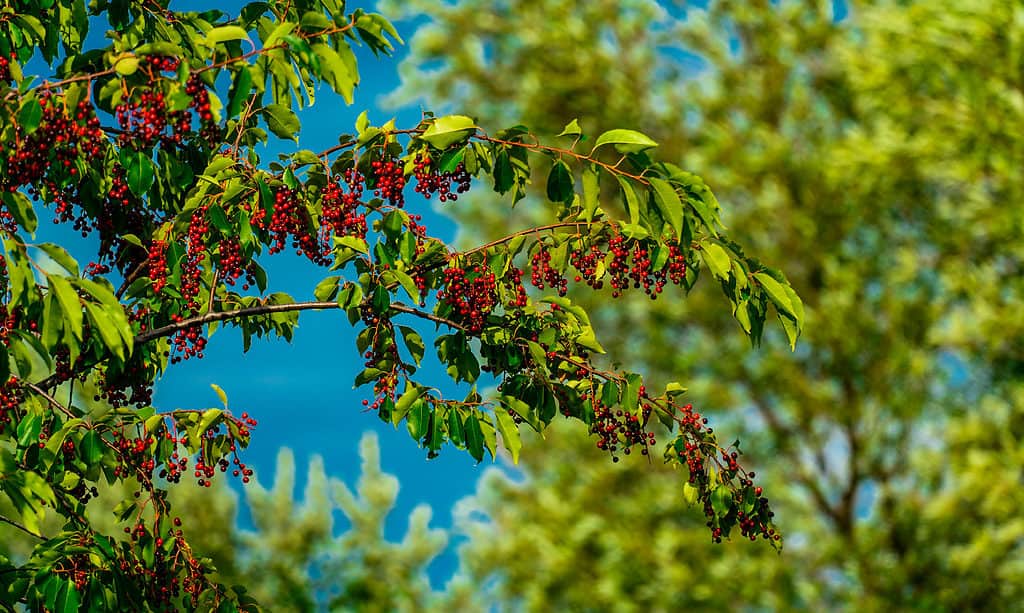
The infamous black cherry tree produces delicious red and black cherry fruit.
©iStock.com/TeleMakro Fotografie (Ina Hensel)
8. Eastern Hemlock
Eastern hemlock (Tsuga canadensis), the state tree of Pennsylvania, is a graceful, evergreen, coniferous tree belonging to the pine family. Oddly, this conifer droops rather than having a pointed top. The general height is about 60 to 100 feet, and a trunk of about 4 to 5 feet in diameter. Eastern hemlock can live for several hundred years, with the oldest recorded being at least 554 years old in Tionesta, Pennsylvania.
The leaves (shiny green on top and green-yellow on the underside) are short and blunt, growing from woody cushion-like outgrowths on the twigs. They produce flowers in the spring, with cones ripening in the fall and releasing seeds during the winter.
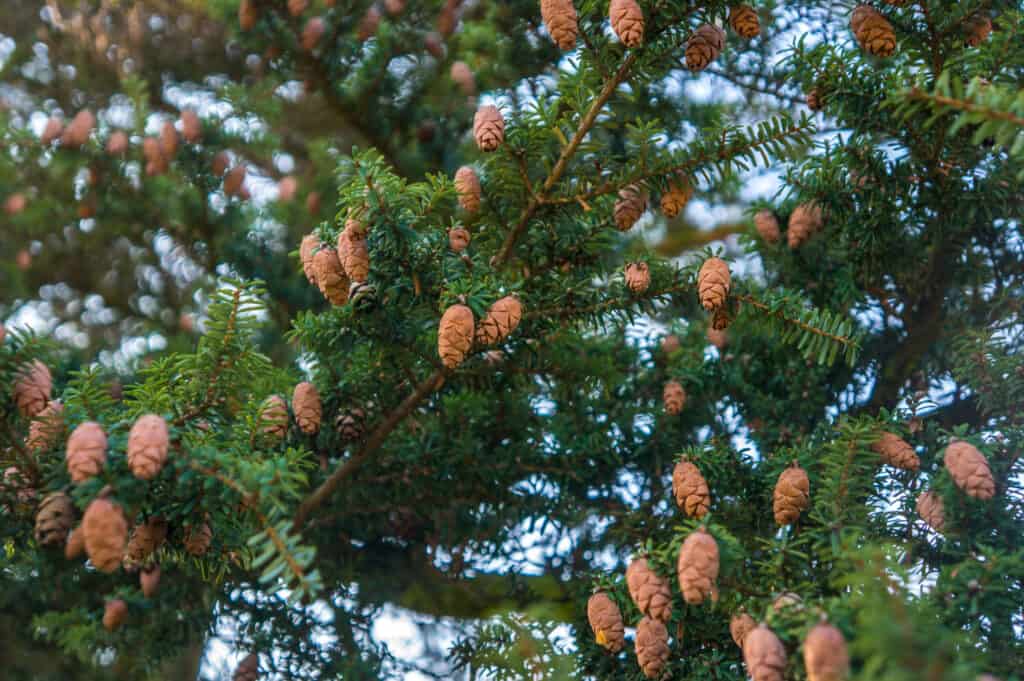
Hemlock trees can endure heavy snowfall and even ice storms.
©iStock.com/Sara Lissaker
9. Flowering Dogwood
Flowering dogwood (Cornus florida) is a small multi-trunked tree that grows 25 to 30 feet tall. They have a blossoming crown spread of 25 to 30 feet of long-lasting white and pink flowers in the spring. This deciduous tree is mostly ornamental and produces bright red fruits.
The bark resembles alligator skin, as it’s scarred and deeply ridged. But when in full bloom, this native to Pennsylvania is gleaming in a beautiful spray of color.
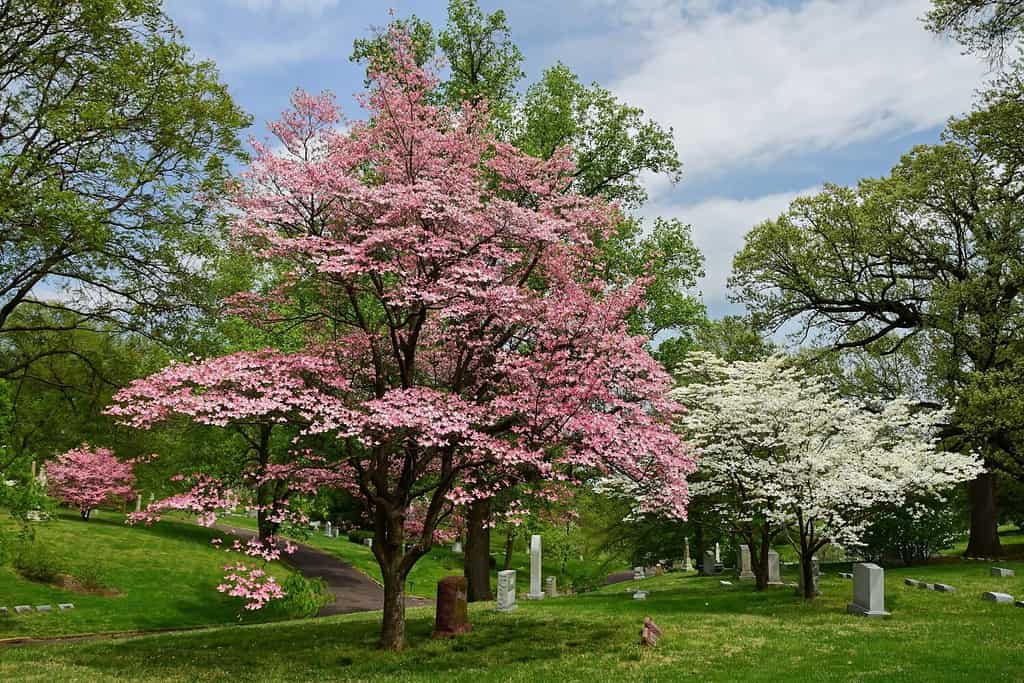
The flowering dogwood produces radiant white and pink flowers.
©Nina B/Shutterstock.com
10. Sweetbay Magnolia
Sweetbay Magnolia (Magnolia virginiana) or swamp magnolia is a beautiful tree flower at the end of spring and summer, emitting a sweet-spicy fragrance. It is native to North America and could be either deciduous or evergreen, depending on what climate it grows in. In addition, they reach heights of 40 feet to 50 feet with a spread of 15 feet to 25 feet.
It has large, glossy green leaves and fragrant creamy white flowers. The bark of the Sweetbay Magnolia tree is smooth and green when young but becomes a silvery gray as it ages. This tree is a ravishing beauty whose flowers open to the morning light. Then, they close at night and fall off after two or three days.
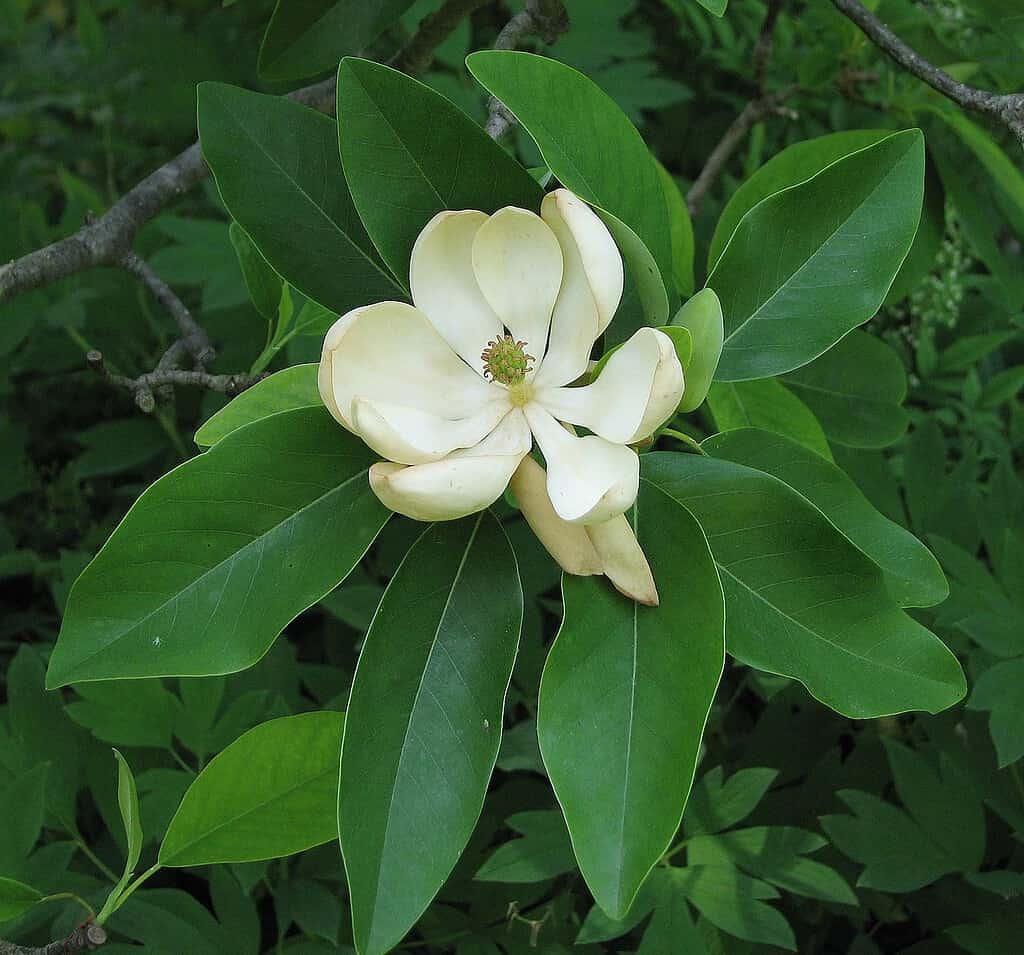
Sweetbay Magnolia has large, glossy green leaves and fragrant creamy white flowers.
©Photo by and (c)2008 Derek Ramsey (Ram-Man). Co-attribution must be given to the Chanticleer Garden., CC BY-SA 3.0 <http://creativecommons.org/licenses/by-sa/3.0/>, via Wikimedia Commons – Original / License
Summary of the 10 Most Iconic Trees Native to Pennsylvania
| Number | Tree | Scientific Name | Height |
|---|---|---|---|
| 1 | River Birch | Betula nigra | 40-70 feet |
| 2 | Shagbark Hickory | Carya ovata | 60-80 feet |
| 3 | Red Maple Tree | Acer rubrum | 33-148 feet |
| 4 | Chestnut Oak | Quercus montana | 60-70 feet |
| 5 | Red Oak | Quercus rubra | 80-100 feet |
| 6 | Gray Birch | Betula populifolia | 20-30 feet |
| 7 | Black Cherry | Prunus serotina | 50-80 feet |
| 8 | Eastern Hemlock | Tsuga canadensis | 60-100 feet |
| 9 | Flowering Dogwood | Cornus florida | 25-30 feet |
| 10 | Sweetbay Magnolia | Magnolia virginiana | 40-50 feet |
What Is the State Tree of Pennsylvania?
The official state tree of Pennsylvania is the eastern hemlock. Since 1931, this luscious tree has been an iconic staple for the state. The striking, evergreen leaves and massive trunk provide a comforting and tranquil presence to the landscape.
Are Fruit Trees Native to Pennsylvania?
There are a few fruit trees native to Pennsylvania, the most well-known being pawpaw (Asimina triloba). You can eat raw the large, yellowish-brown fruit from the small deciduous tree.
The wild plum (Prunus americana), the red mulberry (Morus rubra), the black cherry (Prunus serotina), and the American persimmon (Diospyros virginiana) are also native to the Keystone state.
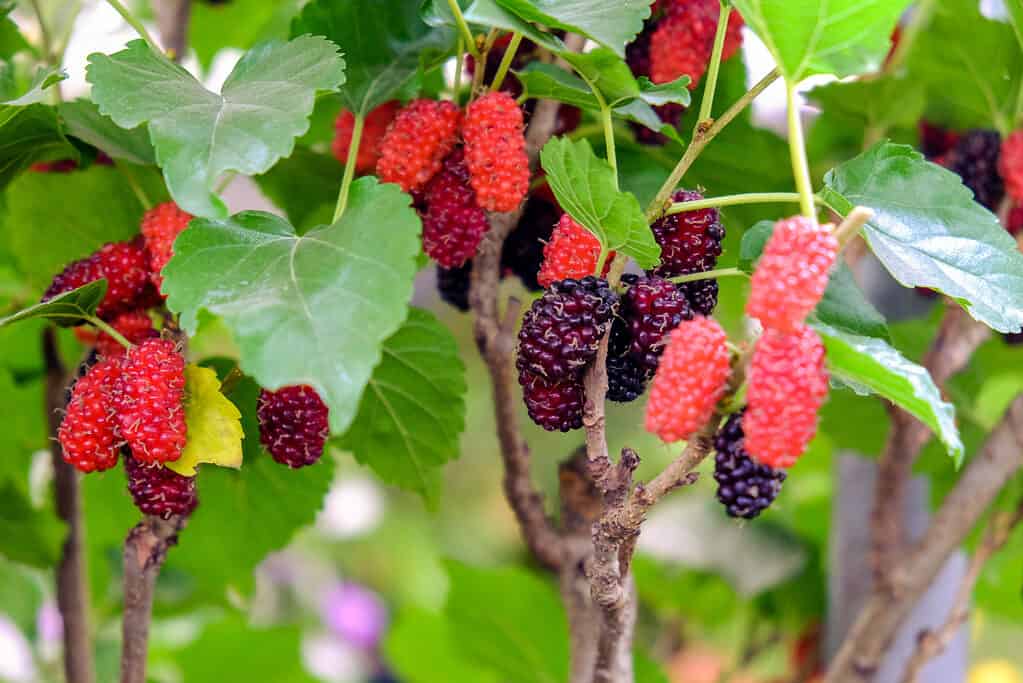
Red mulberry trees grow delicious edible red and purple fruit.
©Aunyaluck/Shutterstock.com
Are Hickory Trees Native to Pennsylvania?
There are 18 species of hickory trees. North America is home to 12 species. There are four types of hickory trees, each with their own distinctive characteristics that are native to Pennsylvania and that make up the beautiful landscape of the Keystone State.
These include:
- Shagbark hickory (Carya ovata)
- Pignut hickory (Carya glabra)
- Mockernut hickory (Carya tomentosa)
- Bitternut hickory (Carya cordiformis)
Final Thoughts
Pennsylvania, the 33rd largest state in North America, is a total of 44,817 square miles, of which a good part is water in the form of bays, rivers, lakes, and canals.
The landscape of the Keystone State is diverse, with a range of farmland, rolling hills, and rugged mountains of the Poconos. More than half of the Keystone State is covered in forests that boast the magnificent trees native to the state and paint the landscape into a work of art resplendent in color and texture. A truly stunning sight to behold!