
Quick Take
- The elephant clocks in faster than the triceratops, though speed alone doesn't decide who walks away from this fight. See the speed comparison →
- Six categories separate these two titans, and the results are closer than you'd expect. That is, until one factor tips the whole fight. See the deciding factor →
- The triceratops carried a built-in weapon on its skull that made it nearly impossible to attack head-on, something elephants have no equivalent of. See the triceratops defenses →
- Both animals use the same kill strategy, and that shared tactic is exactly what makes this matchup so unpredictable. See the shared kill tactics →
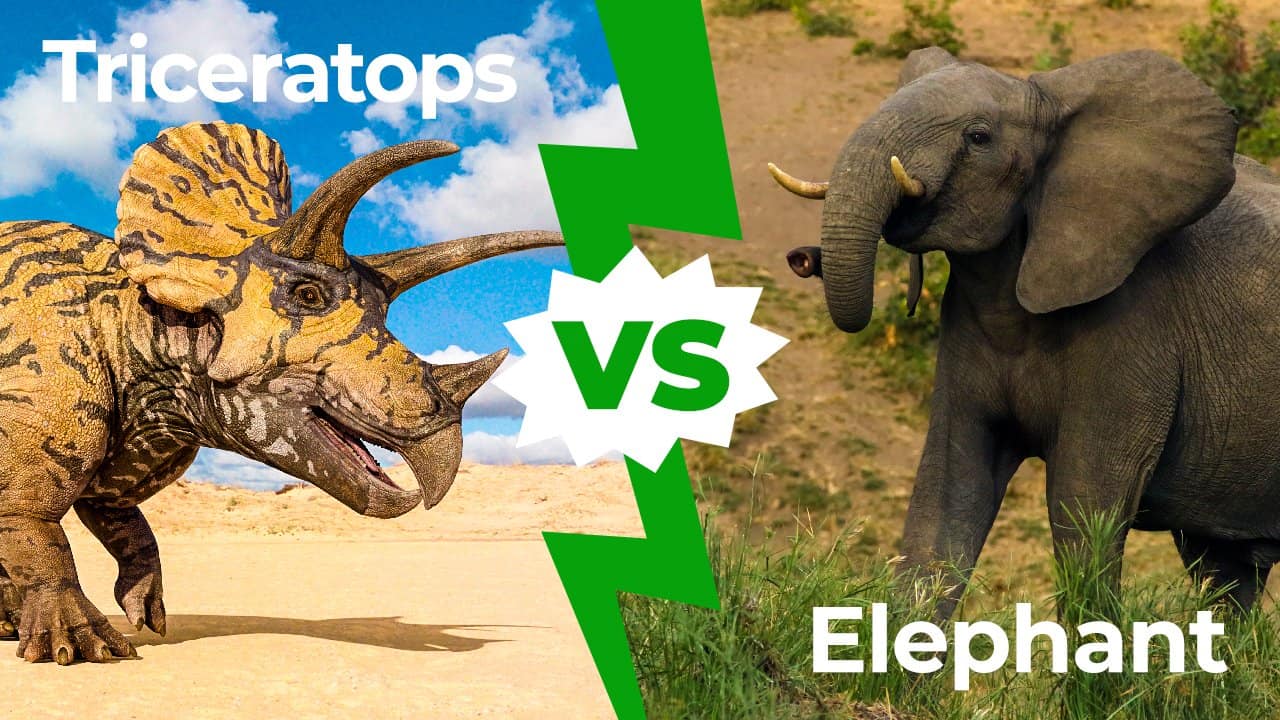
The African bush elephant (Loxodonta africana) or savanna elephant, is the world’s largest terrestrial animal. They inhabit sub-Saharan savannas, grasslands, and deserts across Africa, originating from ancestral proboscideans in Africa millions of years ago. Triceratops was a massive, three-horned herbivorous dinosaur that lived in Western North America during the late Cretaceous period, approximately 68–66 million years ago. Triceratops became extinct before the appearance of the African bush elephant, but what if these two behemoths had lived at the same time and in the same place? Which one of the animals would win a one-on- one match? Six factors will determine the victor of the fight: size, speed, tusks and horns, defenses, offensive capability, and predatory behavior. Continue reading to discover which animal is stronger: a Triceratops or an African bush elephant.

African Bush Elephant in Mikumi National Park, Tanzania
©Taken by Oliver Wright, Public domain, via Wikimedia Commons – Original / License
Triceratops vs. Elephant: Size
The African bush elephant is the largest species of elephant, with males standing 10 to 13 feet tall at the shoulder and weighing between 10,000 and 13,000 pounds.
Triceratops measured between 26 and 30 feet in length and weighed between 6 and 11 tons.
Size Advantage: Triceratops
Triceratops vs. Elephant: Speed
These creatures use their speed to knock enemies over in battle and then finish them off. A charging elephant can reach speeds of 25 miles per hour (mph), while a triceratops could only reach speeds of 20 mph.
Speed Advantage: Elephant
Triceratops vs. Elephant: Tusks And Horns
The Triceratops earned its name from the three horns on its head: two longer horns measuring 4 feet in length and a third, shorter horn between 1 and 2 feet long. These facial horns were used for defense against predators like Tyrannosaurus rex and when competing for mates or dominance.
Elephants have two large, heavy tusks that can reach over 10 feet long and weigh more than 200 pounds each in exceptional cases, though average tusks are typically 5 to 8 feet long and weigh 50 to 99 pounds.
The elephant’s tusks function as vital tools for digging water/minerals, foraging (stripping bark), lifting objects, and defense. Tusks also serve in social signaling and territorial displays.
Tusk/Horn Advantage: Tie
Triceratops vs. Elephant: Defenses
Triceratops and elephants have similar defenses, relying on their massive size, speed, and tough skin. However, Triceratops had a uniquely structured skull that provided additional protection. Its head acted as a passive shield, composed of three key elements: a massive bony frill, long, sharp horns, and a powerful, hooked beak.
Defensive Advantage: Triceratops
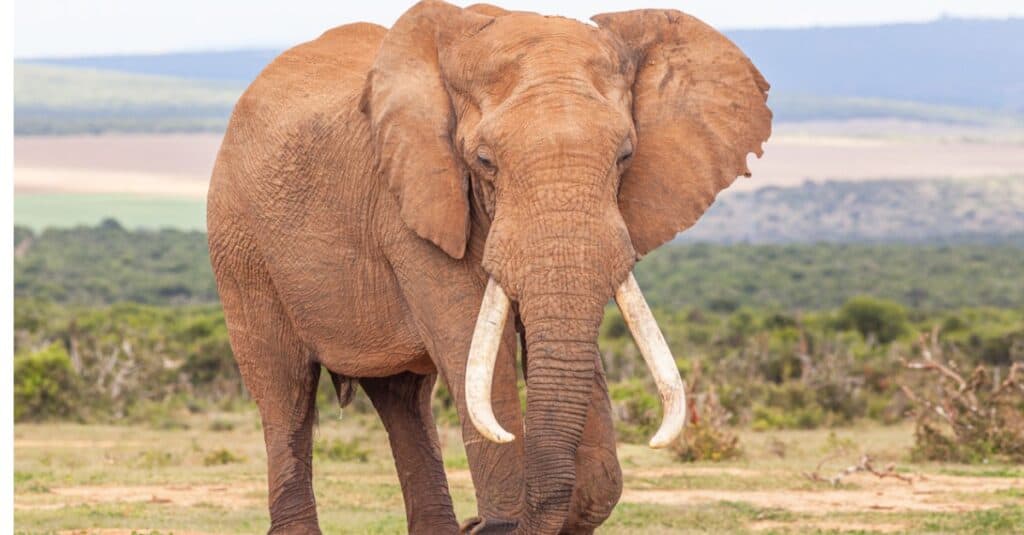
Elephants and Triceratops ram into their enemies, roll them over, and then move in for the kill.
©David Steele/Shutterstock.com
Triceratops vs. Elephant: Offensive Capabilities
Fossil evidence indicates that Triceratops fought among themselves, likely engaging in horn-to-horn combat to establish dominance or compete for mates.
Elephants are remarkably similar in this respect. They stomp on enemies or use their tusks to gore them.
Offensive Advantage: Tie
Triceratops vs. Elephant: Predatory Behaviors
Triceratops was not predatory in nature, but that doesn’t mean it didn’t know how to defend itself from others. It is unclear whether Triceratops used warning displays to deter foes or if it simply attacked when threatened.
Elephants have a threat display that includes bluff charges, but they are not afraid to follow through with their threats either.
Predatory Advantage: Tie
Who Would Win a Fight Between a Triceratops and an Elephant?
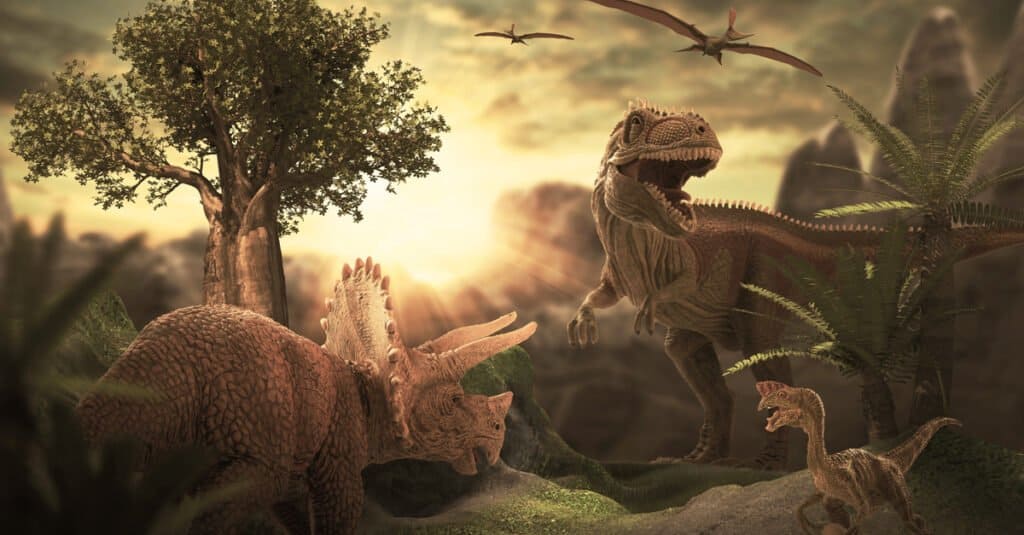
The Triceratops would beat an elephant in a fight.
©metha1819/Shutterstock.com
A Triceratops would win a fight against an elephant. The elephant is a large creature, and its long tusks could make first contact with a Triceratops, injuring it quite severely. However, to cause fatal damage, one creature would need to topple the other and then stomp or gore it to death.
In other words, we need to know what creature can exert a greater force that would allow it to topple the other creature by ramming it at full speed.
Given the Triceratops’ weight and speed, it would likely win the initial ramming match, driving the elephant to the ground and killing it in most cases.
That’s not to say the elephant couldn’t do the same under certain circumstances; it is a very intelligent animal. However, in most cases, a Triceratops would win the fight.