
At a quick glance, you may not be able to tell the differences when it comes to the Morkie vs. Yorkie. They’re both toy breeds and can look quite similar. So today, we’ll compare the Morkie and Yorkie and discuss the different characteristics that set these two toy breeds apart. Learn more about their backgrounds and personalities, as well as specifics about their size and appearance. If you’re considering these two breeds as potential pets, understanding their differences will help you determine which breed is a better fit for your home.
Comparing a Morkie vs. a Yorkie

The Yorkie was bred to hunt small animals, while the Morkie (pictured) was bred as a lap dog.
©Benny Marty/Shutterstock.com
| Morkie | Yorkie | |
|---|---|---|
| Average Size | 7-9 inches tall; 5-7 pounds | 6-8 inches tall; 4-7 pounds |
| Appearance | Common colors include white, black, tan, brown, or combinations; long, silky coat and feathered tail; pointed or floppy ears; round heads with short snouts, small black noses, and large, dark eyes | Only comes in blue/black and tan/gold; long silky coat; rounded head that can be flatter on top, short muzzle, pointed ears, small black nose, and dark, medium-sized eyes; tail is usually docked. |
| Ancestry | Originated in the United States in the 1990s; bred to be a lap dog | Originated in England and Scotland in the 1860s; bred to catch small pests in mines and mills |
| Behavior | Friendly, affectionate, and high-energy, although it can also be calm; loves attention, may be prone to separation anxiety if left alone; can be stubborn | Energetic, friendly, and fiercely loyal; very protective and can be territorial; frequently barks at unfamiliar people and noises; independent |
| Health | Prone to conditions such as collapsed trachea, glaucoma, patellar luxation, portosystemic shunt, hernias, periodontal disease, and obesity; lifespan 10-15 years | Prone to conditions including collapsed trachea, glaucoma, patellar luxation, portosystemic shunt, hernias, and periodontal disease; lifespan 13-16 years |
Morkie vs. Yorkie: Key Differences
The Yorkie (pictured) is officially recognized as a breed by the American Kennel Club, while the Morkie is not.
©AJR_photo/Shutterstock.com
The main difference between Morkies and Yorkies is that the Yorkie is purebred while the Morkie is a hybrid of a Maltese and a Yorkie. The Yorkie is recognized by the American Kennel Club (AKC), but the Morkie is not. The Morkie and Yorkie do have quite a bit in common. A Morkie can take after either its Yorkie or Maltese parent, so their appearance and temperament can be somewhat unpredictable. However, Morkies generally have characteristics that set them apart from Yorkies, including differences in size, appearance, ancestry, behavior, and health. Let’s go into more depth about these differences now.
Size

The Morkie (pictured) is often taller and heavier than the Yorkie on average.
©BGSmith/Shutterstock.com
Morkies and Yorkies are similar in size and they are both classified as toy breeds. However, Maltese are larger than Yorkies, so Morkies are often taller and heavier than Yorkies on average. Morkies are typically 7-9 inches tall and weigh 5-7 pounds, but some can grow up to 10 inches tall and weigh as much as 10-13 pounds.
Yorkies are typically 6-8 inches tall. They only weigh 4-7 pounds, with 7 being the maximum. They are tiny, but compact and well-proportioned.
Appearance

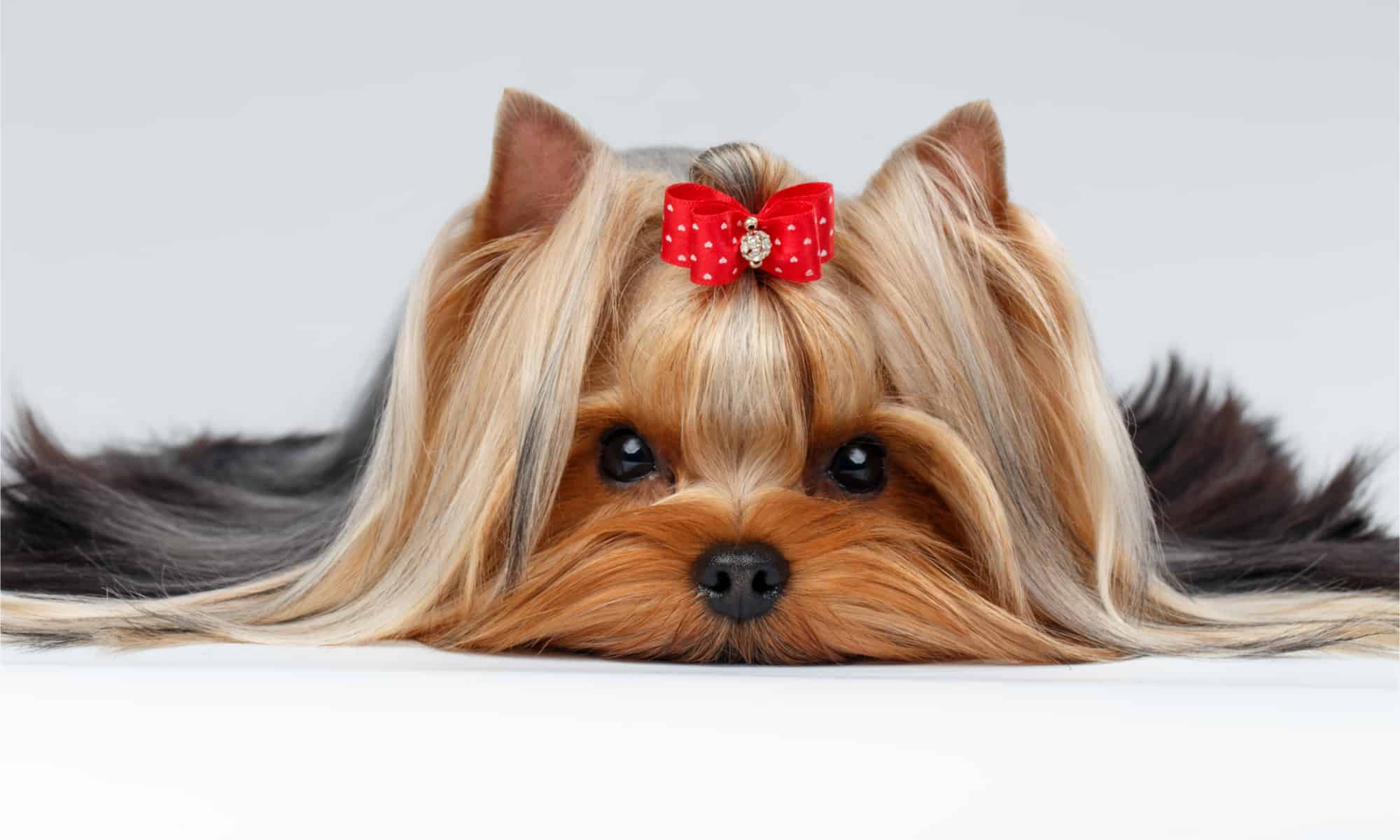
Yorkies have steel blue hair on their bodies and golden tan hair on their heads, chests, and legs.
©tsik/Shutterstock.com
Given that the Morkie is half-Yorkie, it’s only natural that the breeds look similar. However, the Morkie can vary widely in appearance depending on whether it expresses more Maltese or Yorkie traits. Morkies come in a more diverse assortment of colors than Yorkies. Common colors include white, black, brown, tan, or combinations of these colors. They typically have long, silky and/or fluffy coats and long feathered tails. They may have pointed ears like Yorkies or floppy ears like Maltese. These dogs have round heads with short muzzles, small black noses, and large, dark eyes.
The Yorkie is a purebred dog. According to AKC breed standards, adult Yorkies should have long, fine, silky coats that are steel blue on the body and golden tan on their heads, chests, and legs. Yorkie puppies often have some black fur, but it turns blue by the time they’re adults. Yorkies’ coats grow continuously, so they can reach floor length. They have rounded heads that can be flatter on top, short muzzles, small black noses, and dark, medium-sized eyes. Their ears are pointed. Breed standards in the U.S. require tails docked to a medium length. However, both docked and natural tails are carried higher than the back.
Ancestry

The Yorkie originated in England and Scotland, while the Morkie (pictured) originated in the United States.
©shymar27/Shutterstock.com
The backgrounds of these two breeds are quite different. Of course, the Yorkshire Terrier is the older breed, as it is a parent breed to the Morkie. Unlike the Yorkie, the Morkie was meant to be a lap dog from the beginning. Designer breeders in the United States intentionally mixed Yorkshire Terriers with Maltese to create this breed in the late 1990s.
The Yorkie was originally bred by workers in England and Scotland, who bred the Clydesdale Terrier with other local terriers in the 1860s, giving rise to the Yorkie. The Yorkie’s original purpose was to catch small pests, such as rodents, in the mines and mills where these workers earned their living. However, this changed when the breed was brought to America. Upper-class Victorian ladies liked the Yorkie’s appearance and personality; the Yorkie then became a well-known lap dog.
Behavior
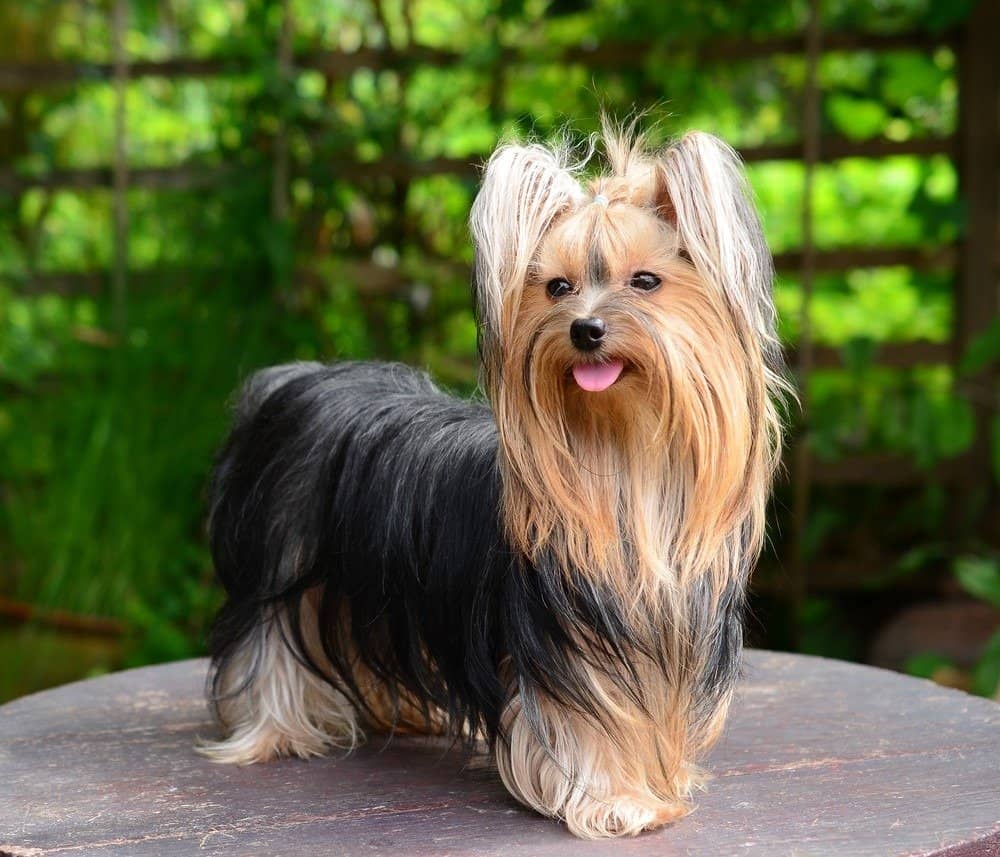
Morkies and Yorkies (pictured) are both friendly, energetic, and good watchdogs, although some Morkies may be calmer than Yorkies.
©Mr. SUTTIPON YAKHAM/Shutterstock.com
Both Morkies and Yorkies are very friendly, energetic, and brave. They are also good with children. However, Morkies are more prone to separation anxiety if you leave them alone for long periods of time. The Morkie is also known to be stubborn, so training should focus on positive reinforcement to overcome this trait. Morkies may be calmer like their Maltese parent. It’s difficult to predict which parent breed an individual Morkie will take after.
Yorkies are known for being very playful, spunky, and fiercely loyal. They are more independent, so they are less prone to separation anxiety. Yorkies also have strong protective instincts, and they are good with children. Both breeds are good watchdogs, although Yorkies tend to be more territorial and will frequently bark at unfamiliar sounds or people. Consistent training is required to manage their protective instincts and tendencies to vocalize.
Health

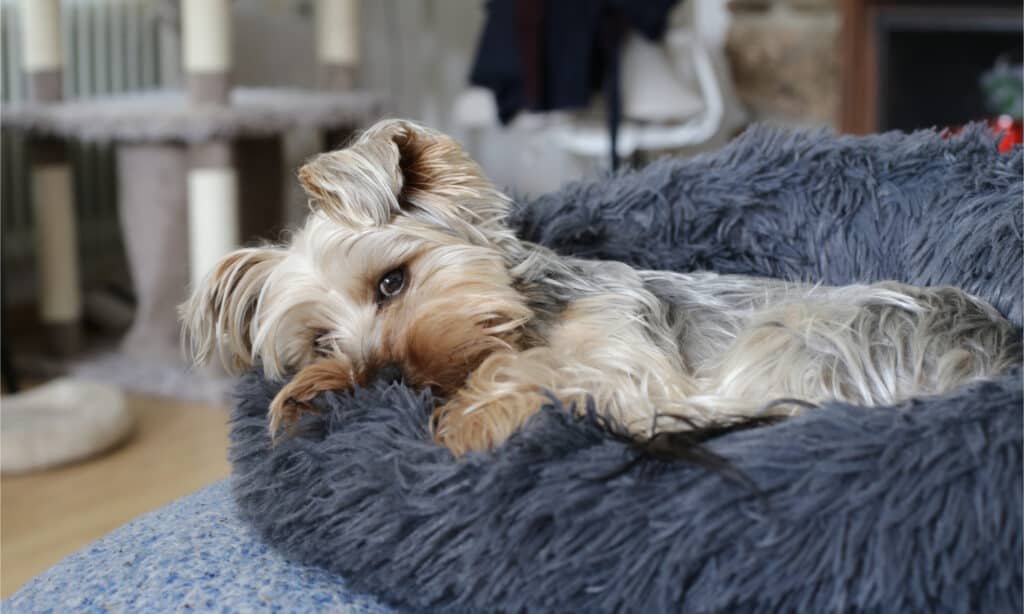
Morkies (pictured) and Yorkies tend to be healthy, but they are also prone to several conditions.
©alexmillos/Shutterstock.com
Both Morkies and Yorkies are generally healthy dogs. However, they are both prone to certain conditions, including collapsed trachea, glaucoma, reverse sneezing, patellar luxation, portosystemic shunt, hernias, and periodontal disease. The Morkie is more prone to obesity, so it may be more likely to suffer from conditions associated with being overweight. Whether you have a Morkie or a Yorkie, it’s a good idea to take the dog to the vet for a checkup at least once a year.
Another difference between the Morkie and the Yorkie involves the lifespans of these two breeds. The Yorkie lives a little bit longer than the Morkie on average, although of course the lifespan of each individual dog depends on many factors. The average lifespan for a Morkie is 10 to 15 years, while the average lifespan for a Yorkie is 13 to 16 years.