
Quick Take
- Dogs hear in a frequency range so far beyond yours that it reframes what "barking at nothing" actually means. See the full frequency range →
- Scientists found a way to measure exactly what dogs hear, relying on no guesswork and no lever-pushing but simply hard data, and the method is surprisingly simple. See the BAER test method →
- Your dog isn't actually afraid of the vacuum itself, and knowing the real reason changes how you can fix it. Find out the real cause →
- Talking to your dog in a certain way measurably improves their attention, and most owners already do it without realizing why it works. Discover what actually works →
Dog ears are much more sensitive than ours. This is why your dog reacts to noises that you might not think are a big deal, like the vacuum, fireworks, or even things you can’t hear at all! If your dog barks “at nothing,” consider that they might actually be hearing a noise you can’t. Below, we’ll discuss what sounds only dogs can hear, how to help dogs cope with sounds they hate, and more.
Dog vs. Human Hearing
Dogs can hear sounds at frequencies that humans cannot. The average human can only hear sounds up to 20,000 hertz (Hz), although babies and young children can hear higher-pitched sounds much better than adults. However, dogs can hear very high-pitched sounds up to 47,000-65,000Hz.
That’s not the only advantage dogs have over humans when it comes to hearing. They can also hear quieter sounds than we can, and from farther away. Humans can hear sounds that are as quiet as 0 decibels (dB). Sounds too quiet for humans are given a negative decibel rating. Dogs can hear sounds as quiet as -5 to -15dB when those sounds are between 3000-12,000Hz. Since noises tend to sound louder to dogs, they can also sound scarier. This might be why so many dogs are afraid of fireworks and other loud noises.

Dogs’ hearing is much more acute than ours.
©Mary Swift/Shutterstock.com
How Do We Know?
You might be wondering how we even know what dogs can hear. How can you test it without having dog ears yourself? The answer is actually pretty simple: scientists give them hearing tests. While they used to give traditional hearing tests, where the dogs pushed a lever when they heard noise, we now have technology that makes hearing tests for dogs even more accurate.
Instead of relying on the dogs’ reporting, scientists place electrodes on a dog’s head so that they can detect electrical activity in the brain. They then play sounds through headphones and look for activity. If they see any, it means the dog is hearing the sound. This test is called the Brainstem Auditory Evoked Response or BAER hearing test. It doesn’t hurt the dog, and it can also be used for hard-of-hearing or deaf dogs to determine whether they can hear in one or both ears, though it cannot precisely measure how much hearing they’ve lost.
What Sounds Can Dogs Hear That Humans Can’t?
There are whistles that only dogs can hear. These are typically used to get a dog’s attention in order to give them a command. For instance, you might use a dog whistle to call your dog back to you on an off-leash trail if they get too far ahead. Dog whistles won’t normally hurt dogs, but they can if used improperly. Imagine someone blowing an athletic whistle near your ears. You can understand why you should not blow a dog whistle right by your dog’s ears or blow it at full strength.
Dogs can also hear the high-pitched hum of electronics and ultrasonic gadgets to deter rodents or insects. While we cannot hear these devices, they produce sounds that can be annoying or stressful for your dog. Dogs can hear the high-frequency squeaks and movement of small mammals like mice, rats, rabbits, moles, guinea pigs, and bats. They can even hear certain insects that humans cannot.
Why Do Dogs Hate Certain Sounds, and How Can You Help?
Dogs, and even most humans, tend to hate high-pitched, loud noises. This may be because the sound is grating to their ears, it hurts them, or they’re afraid. When you can, turn off sounds that bother your dog. This is easy if it’s something specific on the TV, but impossible if your neighbors are shooting off fireworks or mowing the lawn. Many dogs even require veterinarian-prescribed medication to keep them from getting too stressed around Independence Day.
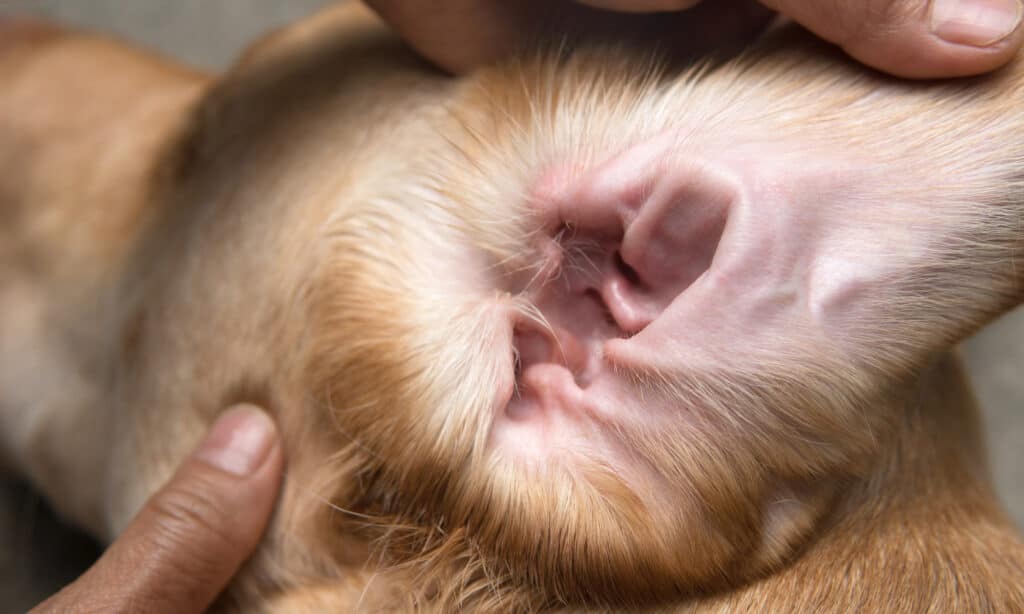
Because they can hear at such high frequencies, many sounds are too loud for dogs.
©9gifts/Shutterstock.com
However, there are some things we do day-to-day in our own homes that are unavoidable, like vacuuming, running the dishwasher, or using a blender. Fortunately, normal household sounds are not harmful to your dog’s ears. It is more likely that they are fearful. Loud noises can be startling, and it’s even scarier if your dog doesn’t know where they’re coming from.
The best way to handle these cases is by desensitizing your dog to the sounds. For instance, you might offer your dog their favorite treat when you start the blender or dishwasher to show them it’s not scary. They’ll then come to anticipate the blender turning on so that they can have their snack.
Another method that works well is to play sounds on your phone or TV at a low volume. Turn it down low enough that your dog doesn’t react, then gradually increase the volume over days or weeks. You don’t want your dog to be in a constant state of stress, so watch their reactions carefully and only increase the volume if they’re comfortable. Turn it back down if they become fearful, and make sure to give them breaks from the noise. This method can work for fireworks, baby cries, and other loud, ongoing sounds.
Do Dogs Have Trouble Hearing Human Speech?
Dogs do not have trouble hearing human speech, but they can have trouble deciphering different words that sound similar. For instance, if you have two dogs with similar names, they might get confused or have to listen very carefully to understand which dog you are talking to.
Dogs also sometimes only listen to parts of what we say. For instance, you shouldn’t teach a dog “lie down” and “sit down,” because that can be confusing. Instead, most people use “sit” and “down.” (Down meaning to lie down.)

Dogs respond best to a higher-pitched voice talking about dog-related subjects like treats.
©N K/Shutterstock.com
Interestingly, it also matters how we speak to our dogs. Like human babies, dogs respond best to a high-pitched voice with exaggerated intonation. Dog-directed speech (DDS) is similar to “baby talk.” Researchers found that the acoustic properties of DDS and the dog-related content, such as talking about walks and treats, improves dogs’ attention. However, it is unknown whether puppies have a natural preference for higher-pitched vocal sounds, or whether they learn to associate this kind of talk with positive situations.