
Quick Take
- A starving, panicked flea may be the plague's deadliest weapon.
- Your own pet could be the hidden doorway for plague into your home.
- Plague still exists in the U.S., but only in certain places. Does your region make the list?
With talks of the plague surfacing on social media and in news outlets across the country, many people are naturally concerned about a pandemic. Modern medicine has come a long way since the 1300s, when the plague known as Black Death took millions of lives, but the disease is still around across the globe today. Thankfully, it’s not nearly as common, nor is it as much of a looming threat as it used to be. However, it’s important to understand how the disease is spread so that you can limit your exposure and prevent transmission.
In this article, I speak with a specialist wildlife veterinarian/epidemiologist and an infectious disease physician about how the plague spreads, where cases are most commonly reported, and how we can help mitigate the risks.
How the Plague Spreads
According to the CDC, the plague is caused by a bacterium called Yersinia pestis. This pathogen is often transmitted by fleas, especially the oriental rat flea (Xenopsylla cheopis).
“The plague persists in nature by infecting wild rodents—including mice, rats, squirrels, chipmunks, groundhogs, and prairie dogs—and their fleas,” says Felicia Nutter, D.V.M., Ph.D., DACZM, an associate professor of infectious disease and global health at Cummings School of Veterinary Medicine at Tufts University. “Fleas that have fed on infected rodents can spread the infection to humans and other animals by biting them.”
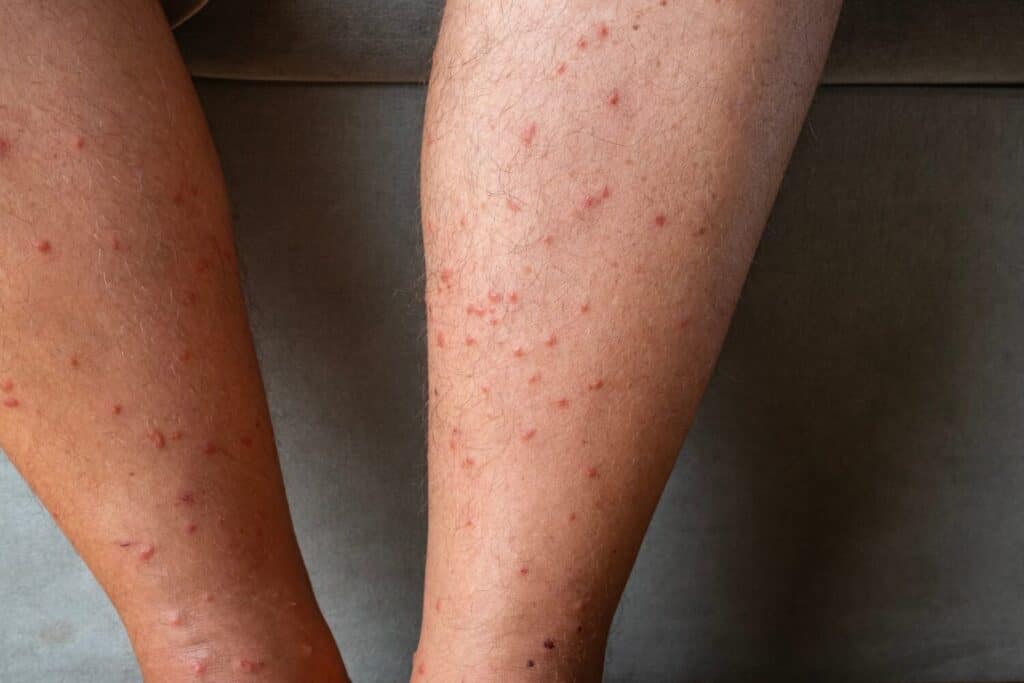
Infected fleas can transmit the plague to humans by biting them.
©Sergey Dudikov/Shutterstock.com
Unfortunately, simple handling of infected animals can also transmit the bacterium.
“Humans can get the plague through direct contact with infected animals, both living and dead,” Nutter says. “This includes handling infected animals, coming into contact with their tissues or bodily fluids, eating infected animals, being bitten or scratched by infected animals, or inhaling infectious respiratory droplets.”
In some instances, our pets can also bring infected fleas into our homes. If these fleas bite you, they can transmit the bacterium.
“People can be exposed to plague via their pets if they’ve acquired fleas from infected wild animals or been infected themselves,” Nutter explains.
‘Blocked Flea’ Mechanism
Perhaps one of the most disturbing ways the plague is transmitted from fleas to mammals is the “blocked flea” mechanism. Essentially, when fleas contract the bacterium, it clogs their gut. This causes the starving flea to repeatedly bite and infect mammals.
“[The blocked flea mechanism] describes a biological process in which Yersinia pestis multiplies inside a flea’s digestive tract and forms a layer of biofilm,” says Dr. John Lieberman, an infectious disease physician with a degree in animal law and expertise at the intersection of human health, animal welfare, and public policy. “This process eventually causes the flea to be unable to eat and digest food, so they become starved and panicked, and begin biting hosts, thus spreading the disease.”
The Plague in a Modern-Day Context
Most of us are familiar with the plague through the context of the Black Death. This plague pandemic devastated Eurasia and North Africa between the years 1346 and 1353. By the end of the pandemic, more than 50 million people had died, a whopping 30% to 60% of Europe’s population.
Thankfully, the plague is not nearly as prevalent today. However, it’s still a (rare) threat in many areas of the world, including the U.S.
“Worldwide, plague is naturally found on all continents except for Australia and Antarctica, and there is a risk of humans contracting plague anywhere that they co-exist with a rodent reservoir and a vector such as a flea that can spread the disease between humans and animals,” says Nutter. “The World Health Organization estimates that 551 cases of suspected plague and an average of 378 confirmed cases of plague occur annually, with most cases reported from Africa (Democratic Republic of Congo and Madagascar). The last large outbreak occurred in 2017 in Madagascar, with 2,348 cases reported.”

Rats are common disease carriers.
©Ernie Cooper/Shutterstock.com
According to the CDC, an average of just five human plague cases are reported each year in the U.S. These cases occur in the Western portion of the country.
5
human plague cases reported each year in the U.S., on average, all in the West
“In the U.S., the Centers for Disease Control and Prevention (CDC) reports that plague occurs in wild animals and their fleas in all states west of the 100th meridian,” says Nutter. “That includes western parts of North and South Dakota, Nebraska, Kansas, Oklahoma, and Texas, as well as the entirety of Montana, Wyoming, Colorado, New Mexico, Idaho, Utah, Arizona, Nevada, Washington, Oregon, and California. It’s most common in northern New Mexico, northern Arizona, southern Colorado, California, southern Oregon, and western Nevada—and these areas are also where most human cases occur.”
Tips for Hikers and Pet Owners
While the plague is an incredibly serious disease, it is treatable with antibiotics when caught early. But as with most diseases, prevention is better than a cure.
“There is no vaccine for Yersinia pestis available in the U.S. for people or pets,” says Nutter. “However, because public-health professionals, doctors, veterinarians, and other scientists know so much about the plague, there is a lot of good information available on how to reduce the risk of becoming infected.”
If you live in or are visiting impacted areas, you’ll want to practice caution. The CDC details a handful of helpful tips for plague prevention.
Wear Repellents
Just as you would to prevent tick bites, apply a repellent if you’re in a flea-infested area where the plague is known to occur. The CDC specifically recommends products containing DEET.
“Reduce exposure to rodent fleas while working or enjoying the outdoors by wearing pants and long sleeves and using a repellent effective against fleas,” Nutter says.
Use Flea-Control Products on Pets
Apply flea-control products on your pets to keep them—and yourself—safe from flea bites.

Flea collars can work for up to eight months, repelling and killing fleas before they can bite your pet.
©Lyutikov 713/Shutterstock.com
“Limit exposure to fleas on your pets by using approved flea-control products,” Nutter says. “Keep pets from interacting with possibly infected wild animals by not allowing them to freely roam outdoors.”
Additionally, if you live in endemic areas, the CDC recommends keeping free-roaming pets off your bed to prevent further spread.
Wear Gloves When Handling Potentially Infected Animals
The CDC recommends wearing gloves to protect your skin when handling potentially infected animals, whether dead or alive.
“This includes skinning or butchering hunted animals from areas where plague occurs,” Nutter points out.
Reduce Rodent Habitat Around Your Space
The CDC recommends keeping your home, workplace, and any recreational area rodent-free. You can achieve this by removing brush, rock piles, junk, woodpiles, and sources of rodent food.