Quick Take
- A shark reached into Zenato's mouth. Wait, wrong direction. She reached into a shark's mouth, and what happened next redefined their entire relationship. Meet Foggy Eye →
- Zenato has removed over 400 fishing hooks from wild sharks bare-handed, and the real danger during each extraction has nothing to do with the shark. See the real danger →
- Lumping all sharks together doesn't just get the science wrong. It actively drives them toward extinction. Explore 530 species →
- The behavior that made Zenato world-famous started as, by her own admission, a completely selfish act. Trace her origin story →
(Note: This article accompanies our featured video interview with shark behaviorist Cristina Zenato. Watch the full conversation above for an in-depth look at her underwater encounters.)
When Cristina Zenato packed a single duffel bag and moved to the Bahamas at 22 years old, she figured she would spend a single gap year diving with sharks before returning home to Italy to land a “real job.”
Thirty-two years later, she is still in the water.
Today, Zenato is a world-renowned shark behaviorist, ecologist, founder of the non-profit People of the Water, and an inductee into the Women Divers Hall of Fame. Popularly dubbed the “Shark Whisperer,” Zenato has spent over three decades reframing how humanity views one of the ocean’s most misunderstood predators. Zenato sat down with me and opened up about individual shark personalities, the delicate mechanics of removing hundreds of fishing hooks by hand, and why protecting sharks starts with changing how we talk about them.
Building Trust with a Shiver
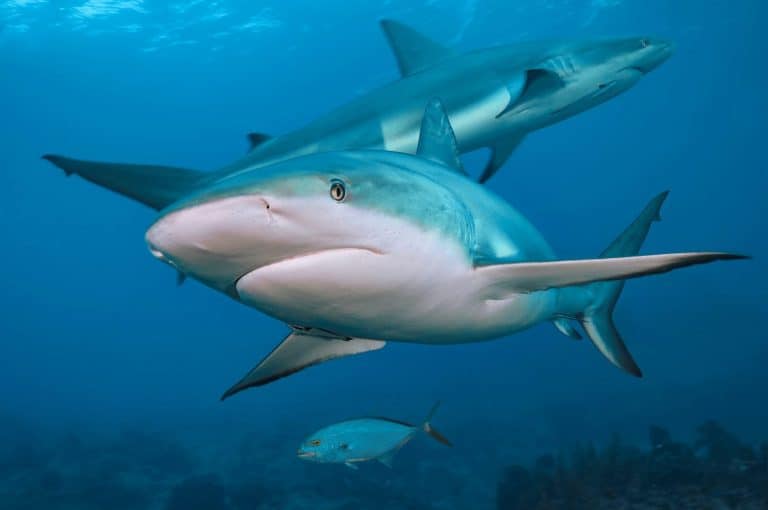
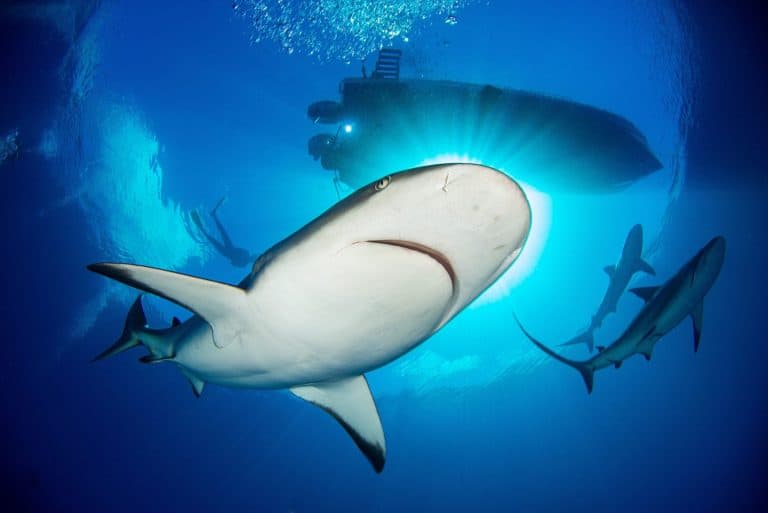
If you have ever seen footage of Zenato at work off the coast of Grand Bahama Island, you have likely seen full-grown Caribbean reef sharks resting placidly in her lap like oversized lap dogs. While observers often assume this implies a mystical control over marine life, Zenato insists it boils down to simply building a relationship over time.

Here, Cristina — pictured in her chainmail suit — visits with her shiver of sharks.
©Cristina Zenato
“A relationship we know it’s built over time and in a certain way, knowledge of each other,” Zenato explains. “You can build a relationship with any living, breathing creature, provided you give them the time and open yourself up to trying to understand each other.”
Within the local population, known as a shiver, Zenato recognizes distinct individual traits. Some sharks she has known for a decade prefer to keep their distance, while others actively seek out her touch.
“I try to remind people: you may live with a cat for 20 years, and every time you pick it up, it slithers out of your hands,” Zenato says. “Then you have the cat that willingly comes into your lap. Sharks do a little bit of that. It’s very individual-specific.”
Among the hundreds of sharks she has encountered, a few leave lasting impressions. There was “Grandma,” a calm, silver-toned matriarch measuring nearly 9 feet long, who carried herself with quiet authority. And then there was “Foggy Eye,” a shark whose bond with Zenato deepened dramatically after a chance encounter involving a discarded fishing line.
Zenato recalled the turning point clearly. “On a Monday, she showed up with a hook on the side, and I removed that one. Then the same week on a Thursday, she showed up and I could see a wire coming out of her mouth. I put my hand in and removed the hook. From that day on, Foggy Eye completely changed.”
For the next 12 years, Foggy Eye would routinely swim up during dives, pressing her nose gently against Zenato’s hip while resting her tail in the sand.
Over 400 Hooks and Bare-Handed Surgery
Removing hooks from wild apex predators sounds like a high-stakes gamble, but Zenato has performed the task more than 400 times. Over the years, she has collected the extracted metal in a decorated red box gifted to her by ocean advocates in China.
Despite the obvious dangers, Zenato shuns mechanical tools, preferring to remove the hooks with her bare hands.
“The hands are the best,” Zenato says. “The movement is fast, and these are free-swimming animals. By the time you open a tool and clamp down, it’s not like the animal sits there like you’re at the dentist’s chair.”
When people ask if she fears a defensive bite during extraction, Zenato points out a stark difference between marine life and land animals. Where a trapped land animal might reflexively snap out of fear, sharks demonstrate a surprising degree of patience.
“They pause, let me try, and then they swim away,” she notes. “Some sharks I try five or six times, and if it doesn’t happen, I let them rest. The shark never once in my 30 years has done anything of a defensive nature.”
The real danger, Zenato emphasizes, isn’t the shark itself, it is the hardware. A dangling hook can snag her chainmail suit or hand, tangling her with a powerful animal that simply wants to swim away.
To protect against accidental scrapes from sharp teeth and rough dermal denticles, Zenato wears a custom-welded chainmail suit composed of 400,000 stainless steel links. Weighing roughly 20 pounds, the suit functions much like a falconer’s heavy glove, ensuring both diver and shark remain safe during close interactions.
Dismantling the “Apex Monster” Stereotype
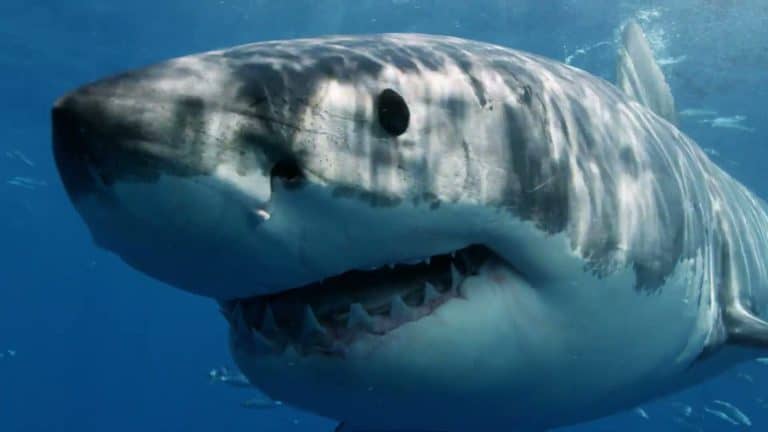
One of the largest hurdles in ocean conservation is the blanket term “shark” itself. In popular culture, the word evokes the image of a massive, sharp-toothed solitary hunter intent on attacking anything in sight.
In reality, there are over 530 distinct species of sharks spanning eight distinct biological orders. They range from the tiny dwarf lanternshark, which is no larger than a ballpoint pen, to the filter-feeding whale shark, which is the largest fish in the sea.
“Saying ‘sharks do this’ is like saying ‘birds do that,'” Zenato points out. “A hummingbird behaves very differently than an ostrich or an eagle. I wouldn’t say all birds fly, all birds nest in trees, or all birds sing beautifully.”
This lack of nuance hurts conservation efforts. Around 37 percent of shark species currently face elevated risks of extinction, driven primarily by human activities such as industrial overfishing, accidental bycatch, habitat destruction, and the shark fin trade. Because sharks mature slowly and produce few offspring, population declines happen quickly and recovery takes decades.
Losing sharks ripples across entire marine ecosystems because they actually act as regulators and health inspectors for the ocean. Their physical presence alone redistributes other marine life, keeping grazing species from destroying vital habitat like seagrass beds. Also, by targeting old or sick prey rather than the strongest breeding adults, sharks prevent the spread of disease and keep fish populations genetically resilient.
From Selfish Curiosity to Global Advocacy
Looking back on her journey, Zenato admits her initial dive into the underwater world was driven by pure personal fascination.
“When I came here and made the decision to stay and dive with sharks and in caves, it was absolutely the most selfish act I could ever do,” Zenato reflects. “All I wanted was time in the water, time with the sharks, time in the caves. But it didn’t take long to realize that people were not as enamored and passionate about what they perceived as large carnivorous animals and dark wet rocks.”
That realization sparked a lifelong mission. Through her non-profit organization, People of the Water, Zenato now channels her experience into actionable conservation, securing marine protected areas, mapping underwater cave systems, and supporting environmental education.
For Zenato, changing how we treat the ocean begins with changing how we perceive its inhabitants. Sharks aren’t unfeeling predators intent on eating anything in their path. In fact, they are complex, adaptable, and essential stewards of a healthy planet, and Zenato is tireless in her effort to ensure humans understand that.
To hear more stories from Cristina Zenato’s 32 years underwater, including her work protecting mangrove nurseries and advocating against acoustic ocean barriers, follow her online at cristinazenato.com or on Instagram.