
B
Species Profile

Booby

Sulidae

Born to dive, built to soar
Mariusz Bugno/Shutterstock.com

Booby Distribution

Click a location to explore more animals from that region

This map shows coastal regions where Booby are found.

Loading map...

Found in 97 countries

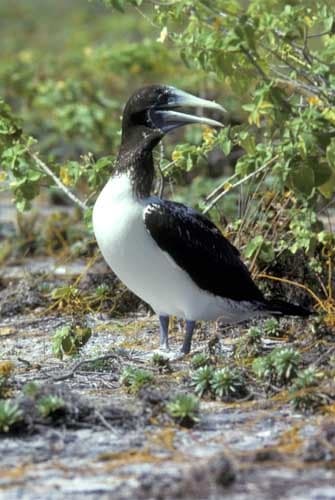
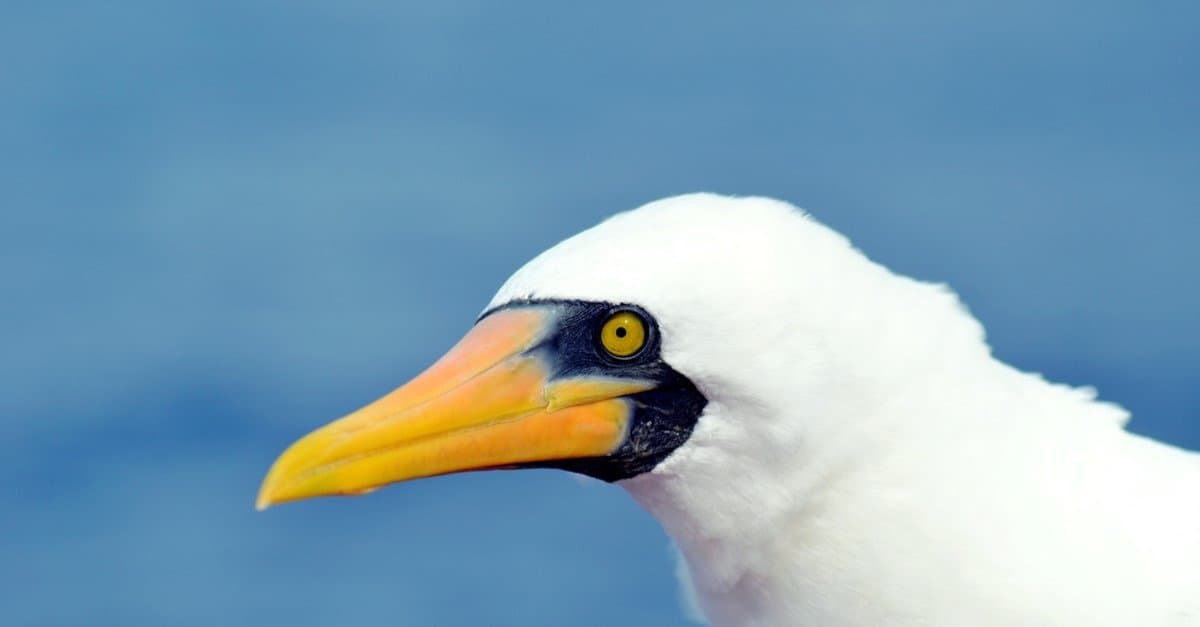
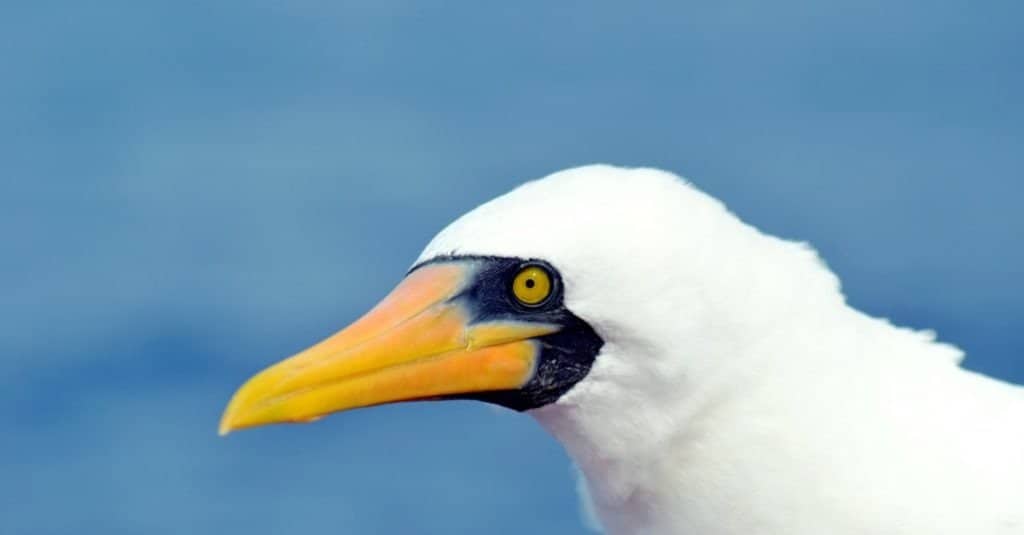
Closeup view of the seabird Masked Booby (Sula dactylatra)

At a Glance

Family Overview This page covers the Booby family as a group. Stats below are general traits shared across the family.
Also Known As Solan goose, Solan, Piquero, Fou de Bassan, Sulid
Diet Piscivore
Activity Diurnal+
Lifespan 20 years
Weight 3.6 lbs
Status Not Evaluated
Did You Know?

Family size spans from smaller tropical boobies to the largest gannets: ~64-105 cm long, ~132-200 cm wingspan, ~0.9-3.6 kg.

Scientific Classification

Family Overview "Booby" is not a single species but represents an entire family containing multiple species.

Sulidae are large marine seabirds (boobies and gannets) specialized for plunge-diving to catch fish and squid. They are colonial breeders, typically nesting on remote islands or coastal cliffs, and spend much of their lives at sea.

Kingdom
Animalia
Phylum
Chordata
Class
Aves
Order
Suliformes
Family
Sulidae

Distinguishing Features

  • Streamlined seabird body with long, pointed wings for soaring and fast flight
  • Strong, spear-like bill; face often bare-skinned
  • Highly specialized plunge-diving from height; air sacs help cushion impacts
  • Colonial nesting; many species show striking foot or facial coloration used in courtship

Physical Measurements

Males and females differ in size

Length
♂ 2 ft 9 in (2 ft 2 in – 3 ft 4 in)
Weight
♂ 5 lbs (2 lbs – 8 lbs)
♀ 5 lbs (2 lbs – 8 lbs)
Tail Length
♂ 7 in (6 in – 9 in)
♀ 6 in (4 in – 9 in)
Top Speed
62 mph
Plunge-dives ~60–100+ km/h

Appearance

Primary Colors
Secondary Colors
Skin Type Sleek waterproof feathers with bare skin on the face around the bill and webbed feet. Bare parts colors help identify, often brighter in boobies than gannets. Head and neck tissues and air sacs cushion dives.
Distinctive Features
  • Measurements (range across family, smallest to largest members): total length ~65-110 cm; wingspan ~130-180 cm; body mass ~0.9-3.6 kg (varies by species, sex, season, and condition).
  • Lifespan (range across family): commonly ~10-30+ years; many species regularly reach the teens to 20s, and some individuals (notably among gannets) can exceed 30 years under favorable conditions.
  • Long, pointed wings and a torpedo-shaped body optimized for high-speed flight and plunge-diving; strong, direct flight often with powerful wingbeats and efficient gliding in winds.
  • Long, stout, conical to dagger-like bill suited for grasping slippery fish and squid; bill color varies widely (yellowish, bluish, pinkish/grayish) among species and ages.
  • Fully webbed feet; foot color is a major field mark in several booby species (e.g., blue, red, or darker tones), whereas gannets tend to show less dramatically colored feet overall.
  • Face often shows a bare-skin "mask" around the bill/eye region; mask color and extent vary among species and can shift with breeding condition.
  • All Sulidae are built for high-speed plunge dives into the sea to catch fish and squid. Gannets dive higher and harder; many boobies use lower dives or take prey from the surface.
  • Colonial breeding is typical: nests on remote islands, offshore stacks, or coastal cliffs; nest substrate varies from cliff ledges (common in gannets) to ground scrapes, sand, or low vegetation (common in many boobies).
  • Spend much of the year over open water, traveling from colonies to feeding areas; they feed alone or in groups, often near predatory fish or marine mammals that drive prey to the surface.
  • Age-related variation is pronounced: juveniles often browner/duller with less crisp contrast; adult plumage usually becomes cleaner white-and-dark or more uniformly brown depending on species/morph.
  • Gannets (Morus) are usually larger, more white with black wing tips, nest on cliffs and make high plunge-dives. Boobies (Sula) are smaller, have varied feet and plumage colors, often nest on flat islands or ground.

Sexual Dimorphism

Sex differences in Sulidae (boobies and gannets) are usually small and vary by species. Females are often a bit larger. Feather colors are mostly alike. Bare parts (feet, face skin, bill) may show small color changes, especially in breeding; gannets often look the same.

♂
  • Often slightly smaller/slimmer on average in many species; differences are modest and overlap widely.
  • In some booby species, bare-part coloration used in display (notably foot color intensity) may skew brighter/more saturated in males during courtship, but this is variable and not universal.
♀
  • Often slightly larger/heavier on average in many species; overlap with males is substantial.
  • In some species, bill/facial skin tones can differ subtly (hue/intensity), but consistent field separation by color alone is frequently unreliable without close views or measurements.

Did You Know?

Family size spans from smaller tropical boobies to the largest gannets: ~64-105 cm long, ~132-200 cm wingspan, ~0.9-3.6 kg.

They can hit the water at very high speed during plunge-dives (often tens of meters from the air), then "fly" underwater with partly folded wings.

Boobies often advertise identity/condition with vivid bare-part colors (notably foot color in several species); gannets are typically larger, paler-headed, with black-tipped wings.

Most breed in dense colonies and show strong nest-site fidelity-many individuals return to the same colony year after year.

Foraging can range from nearshore feeding to multi-day trips far offshore; some gannets roam widely outside the breeding season.

Sibling rivalry varies across the family: some species commonly raise one chick when food is scarce, while others can successfully fledge two in good years.

They're classic "seabird signposts": mariners and navigators have long watched their commuting flights to locate productive fishing grounds and nearby land.

Unique Adaptations

  • Impact-resistant plunge-diving design: reinforced skull and neck musculature, plus streamlined body shape to enter water cleanly.
  • Breath protection: external nostrils are reduced/closed and breathing occurs via internal openings-helpful when hitting the sea at speed.
  • Subcutaneous and internal air sacs help cushion impact and aid buoyancy control at the surface after dives.
  • Long, narrow wings for efficient soaring and commuting over open water; flight style ranges from dynamic soaring to strong flapping depending on winds and species.
  • High-contrast plumage patterns and bare-part coloration (especially in boobies) support species recognition and mate choice in crowded colonies.
  • Strong webbed feet for surface maneuvering and launching from water; some boobies also use their feet prominently in displays.

Interesting Behaviors

  • Plunge-diving hunts: individuals circle, aim, then spear into the sea-often switching to underwater pursuit for seconds to tens of seconds (depth and technique vary by species and conditions).
  • Mixed-species feeding frenzies: Sulidae frequently associate with tuna, dolphins, or other predators that drive fish toward the surface; they also join other seabirds at bait balls.
  • Colonial breeding on islands and cliffs: nesting substrates range from bare ground and rocky ledges to shrubs/trees in some tropical boobies; gannets often pack tightly on cliffs or flat islands.
  • Courtship displays: includes sky-pointing, bill fencing, bowing, and (in several booby species) conspicuous foot-raising/"dancing" using brightly colored feet.
  • Strong pair bonds with variation: many pairs show seasonal monogamy and may reunite; mate and site fidelity are common but not universal.
  • Chick-rearing strategies vary: asynchronous hatching is common, and outcomes range from frequent two-chick fledging to regular brood reduction in harsher environments.

Cultural Significance

Sulidae (boobies and gannets) are tied to island and sea life. "Booby" comes from Spanish/Portuguese for "fool" because sailors found them tame. "Gannet" is Old English. Northern Gannets live on North Atlantic cliffs; Galapagos boobies are tourism and conservation icons.

Myths & Legends

For centuries, St Kilda (Scotland) islanders made an annual summer trip to collect and salt young Northern Gannets. This practice followed rules, timing, and community ritual and became a key island story.

Polynesian wayfinding lore: traditional navigators watched the purposeful evening flight of seabirds-including boobies-returning toward land, and stories of successful voyages often describe following these birds to find islands beyond the horizon.

Sailors' stories called boobies tame birds that would land on ships or be caught, making them symbols in sea tales of being simple, easy to trick, and of the far, strange parts of the ocean.

Island natural-history tradition: great gannet cliffs and booby colonies became local emblems and recurring subjects in coastal storytelling-seasonal arrivals and mass nesting were treated as a reliable "calendar" event marking turning points in the year.

Conservation Status

NE Not Evaluated (family-level hub; IUCN assesses Sulidae mainly at species level-statuses across the family range from LC to EN, with several species showing regional or ongoing declines)

Has not yet been evaluated against the criteria.

Population Unknown

Protected Under

  • Many Sulidae colonies occur within nationally designated protected areas (seabird sanctuaries, nature reserves, national parks) and are managed via access controls and seasonal closures.
  • Marine protection measures (MPAs, fishery regulations, bycatch mitigation, and forage-fish management) are central but uneven across the family's range; effectiveness varies by jurisdiction and enforcement.
  • Invasive predator prevention/eradication programs on breeding islands are a key protection tool for several species/colonies, especially for range-restricted taxa.
  • Multiple populations benefit from national wildlife protection laws and, in some regions, international migratory-bird frameworks (e.g., regional agreements for seabirds/waterbirds), though coverage is not uniform across all species and oceans.
  • Family-level note on conservation landscape: most boobies and gannets are currently classified as Least Concern, but there are notable higher-risk exceptions and problem areas-Abbott's booby is Endangered, and some gannet/booby populations show sustained declines tied to prey limitation and ecosystem change (even where the global species status remains LC).

You might be looking for:

Blue-footed Booby

22%

Sula nebouxii

Tropical eastern Pacific booby famous for bright blue feet and courtship displays.

Brown Booby

20%

Sula leucogaster

Widespread tropical booby with brown upperparts and white belly; often near coasts/islands.

Red-footed Booby

18%

Sula sula

Pelagic tropical booby; variable plumages; red feet; often nests in trees/shrubs.

Nazca Booby

12%

Sula granti

Eastern Pacific booby (Galápagos region); white body with black flight feathers; orange bill.

Masked Booby

11%

Sula dactylatra

Large tropical booby with black facial mask; widespread on oceanic islands.

Northern Gannet

9%

Morus bassanus

Temperate North Atlantic sulid; famous for high-speed plunge-diving.

Cape Gannet

8%

Morus capensis

Southern African gannet; colonial breeder and dramatic plunge-diver.

Life Cycle

Birth 2 chicks
Lifespan 20 years

Lifespan

In the Wild
10–40 years
In Captivity
12–45 years

Reproduction

Mating System Monogamy
Social Structure Socially Monogamous
Breeding Pattern Long Term
Fertilization Internal Fertilization
Birth Type Internal_fertilization

Boobies and gannets (Sulidae) are mostly monogamous, colonial seabirds. Pairs usually take turns warming eggs and feeding chicks and often pair again across years. Extra-pair matings sometimes happen; no helpers assist breeding.

Behavior & Ecology

Social Colony Group: 5000
Activity Diurnal, Crepuscular
Diet Piscivore Small schooling pelagic fish (especially sardine/anchovy-type prey when locally abundant)
Seasonal Migratory 2,485 mi

Temperament

Gregarious and tolerant at high-density breeding colonies, but strongly territorial at the nest site (defending a small radius rather than large areas)
Generally wary to bold depending on species and human exposure; some populations are notably approachable at colonies while others are easily disturbed
Aggressive ritualized displays are common in breeding contexts (posturing, bill fencing, pecking), with most conflict resolved through signaling rather than prolonged fights
Highly site-faithful in many populations (colony and nest-site fidelity), with flexibility when breeding conditions or food supply change
Foraging behavior is opportunistic and prey-driven; individuals may aggressively compete at concentrated prey patches yet disperse quickly once prey schools break up

Communication

low-frequency grunts, groans, and honks used in mate/nest recognition and at close range in colonies
hisses and harsh calls during aggression and nest defense
whistles/braying-like calls in some species, especially during courtship and pair interactions
begging calls by chicks that intensify with hunger and stimulate provisioning
highly visual courtship and territorial displays Sky-pointing, head shaking, wing spreading, bill fencing, and presentation of nest material
postural signaling to regulate spacing in dense colonies Upright threat postures, bill pointing, and body orientation
tactile behaviors including mutual preening/allopreening and contact at the nest, reinforcing pair bonds
flight and plunge-diving behavior can act as social cues at sea Birds keying on the diving activity of others to locate prey patches

Habitat

Open Ocean Coastal Rocky Shore Cliff/Rocky Outcrop Beach Coral Reef Kelp Forest +1
Biomes:
Terrain:
Coastal Island Rocky Sandy Volcanic
Elevation: Up to 1312 ft 4 in

Ecological Role

Upper-trophic marine predator and mobile link between pelagic prey resources and island/coastal ecosystems

Regulates populations of small pelagic fish and cephalopods and tracks forage-fish availability (indicator of marine productivity) Transfers marine-derived nutrients to terrestrial/coastal habitats via guano, enriching soils and nearshore productivity around colonies Supports food webs as prey/hosts for higher predators and parasites (eggs/chicks vulnerable to raptors and mammalian predators where present) Contributes to nutrient cycling and biodiversity in colony ecosystems through carcasses, guano, and colony-associated communities

Diet Details

Main Prey:
Small schooling pelagic fish Cephalopods Crustaceans

Human Interaction

Domestication Status

Wild

Domestication history: - None. Boobies and gannets (family Sulidae) have not been domesticated; there are no recognized domestic breeds or domesticated populations. They are wild seabirds and may only be temporarily kept by humans in contexts such as wildlife rehabilitation, research, or zoological display.

Danger Level

Low
  • Bites/pecks and wing strikes when handled or approached at nests (mainly a handler/disturbance risk)
  • Slip/fall hazards for people accessing steep cliffs or guano-slick colony areas
  • Zoonotic/occupational exposure risk when handling birds (e.g., ectoparasites, enteric bacteria; avian influenza risk is generally low but a consideration for rehab/field staff)
  • Aggressive defense of nest sites in dense colonies can cause minor injuries

As a Pet

Not Suitable as Pet

Legality: Generally illegal or highly restricted to possess as a pet in most countries; typically protected under wildlife laws and/or migratory bird protections. Possession usually requires specific rehabilitation, scientific, zoological, or educational permits.

Care Level: Expert Only

Purchase Cost:
Lifetime Cost: $10,000 - $80,000

Economic Value

Uses:
Ecotourism and wildlife watching Scientific research and monitoring (marine ecosystem indicators) Cultural significance in coastal/island communities Historical guano extraction/collection (localized) Subsistence/illegal harvest impacts (context-dependent)
Products:
  • Tourism services (boat trips, guided colony viewing)
  • Research data and monitoring value (non-consumptive)
  • Guano used as fertilizer (historical/localized)
  • Eggs/meat (historical or illicit/localized; generally regulated/illegal)

Relationships

Predators 8

Skua
Skua Stercorariidae
Large gulls
Large gulls Laridae
Ravens and crows Corvus spp.
Rats Rattus spp.
Feral cat
Feral cat Felis catus
Monitor lizards
Monitor lizards Varanus spp.
Reef and pelagic sharks Carcharhinus spp.
Orca
Orca Orcinus orca

Ecological Equivalents 5

Animals that fill a similar ecological role in their ecosystem

Terns Sternidae Often exploit similar small schooling fish near the surface and may forage over the same bait balls. Both groups can plunge-dive, but terns are generally smaller, more maneuverable, and typically dive from lower heights.
Pelican
Pelican Pelecanidae They share coastal and marine fish-eating niches and can use plunge-diving or surface-seizing strategies. Pelicans usually rely more on scooping with a gular pouch and on cooperative foraging than on the high-speed, streamlined plunge-dives typical of Sulidae.
Shearwaters and petrels Procellariiformes Overlapping pelagic lifestyle (long periods at sea and wide-ranging foraging), frequently targeting similar prey fields such as squid and schooling fish; they more often use surface-seizing and pursuit rather than repeated high-speed plunge-dives.
Auks Alcidae Comparable reliance on dense fish schools and colonial breeding on cliffs and islands. Auks mainly chase prey underwater with wing-propelled pursuit diving, whereas Sulidae usually capture prey by plunge-diving from the air.
Brown pelagic sharks Carcharhinidae Not ecological equivalents, but they frequently co-occur in productive waters: both concentrate around upwellings, fronts, and bait aggregations where Sulidae feed. Sharks may also act as predators or scavengers around colonies and feeding events.

Types of Booby

10

Explore 10 recognized types of booby

Abbott's booby Papasula abbotti
Masked booby Sula dactylatra
Nazca booby Sula granti
Blue-footed booby Sula nebouxii
Peruvian booby Sula variegata
Brown booby Sula leucogaster
Red-footed booby Sula sula
Northern gannet Morus bassanus
Cape gannet Morus capensis
Australasian gannet Morus serrator

“Booby birds have a wingspan of around 5 feet”
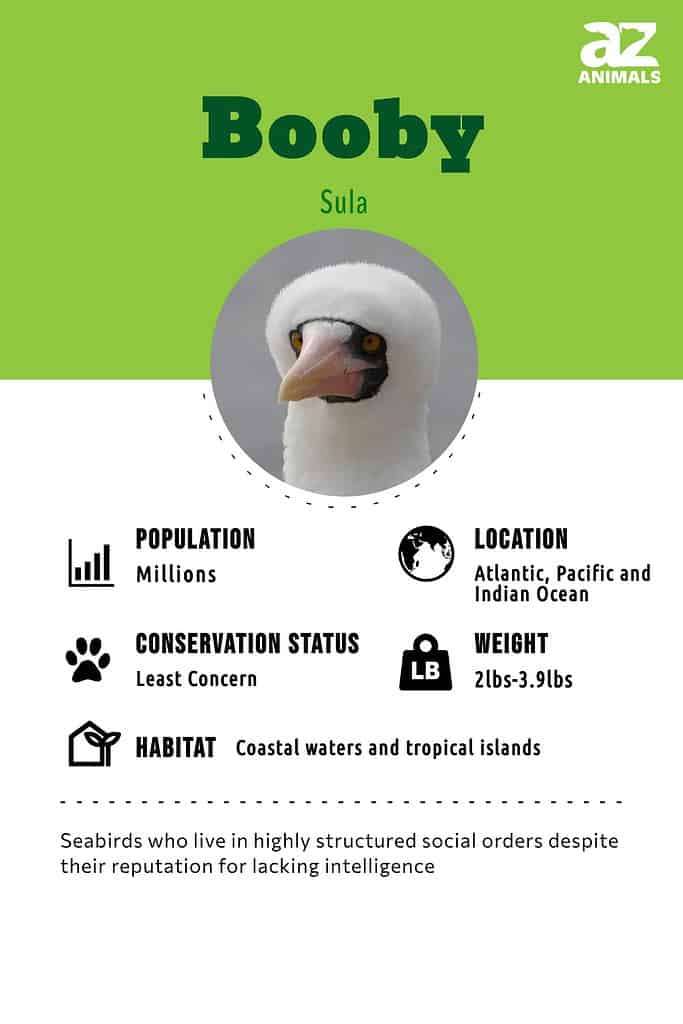
The booby is a seabird that lives in the coastal regions of Central and South America. Boobies are carnivorous birds that eat anchovies, mackerel, sardines, and squid. These feathered creatures appear awkward while walking on land but are excellent fliers and divers. They can live up to 17 years in the wild.

An Incredible Bird: 5 Booby Facts!
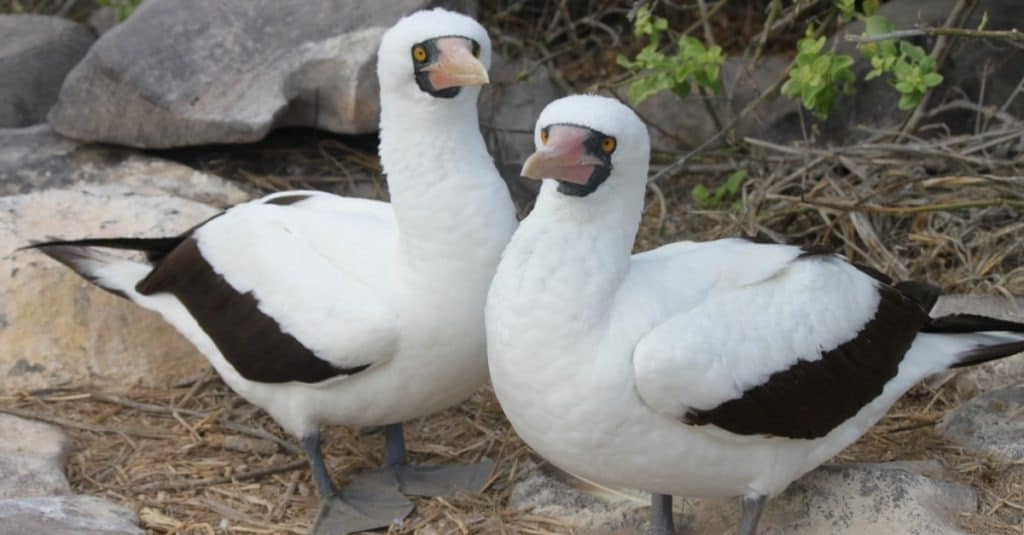
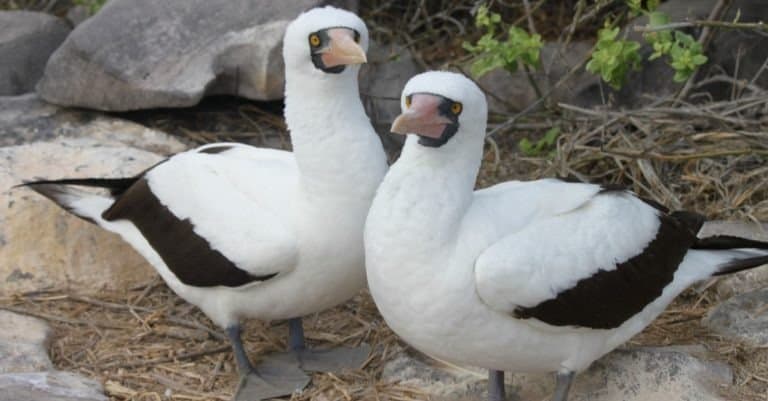
Masked Boobies in the Galapagos

Booby birds mate for life.

  • The booby bird stays with the same partner for life
  • A group, or colony, can include as many as 200 booby birds
  • A booby bird that spots a fish in the ocean can dive from a height of 80 feet or more in the air
  • The booby is similar in appearance to the gannet
  • When this bird is getting enough vitamins and other nutrients, its feet remain deep blue or even purple in color.

Scientific Name
Funny Animal Names

Boobies get their name from their clumsy, awkward behavior.

The scientific name of the blue-footed booby bird is Sula nebouxii. Its name comes from the Spanish slang term bobo. Bobo means foolish or clownish. When Spanish sailors observed the awkward way these feathered creatures walked and moved around on land, they called them bobos. Adding to their reputation for foolishness, these animals would land on Spanish ships making it easy for sailors to catch and eat them.

They belong to the Sulidae family and the class Aves.

There are six species of this seabird. They all belong to the Sula genus. These include:

  • Blue-footed booby
  • Masked booby
  • Brown booby
  • Red-footed booby
  • Peruvian booby
  • Nazca booby

Appearance & Behavior

The Masked Booby is easily mistaken for a gannet.

A booby bird is 32 to 34 inches long with a wingspan of approximately 5 feet. Picture two and a half bowling pins stacked on top of one another and you have the same length as a 34-inch-long booby bird. When thinking about a wingspan of 5 feet, picture a length equaling one-fourth of a giraffe! These animals weigh a little over 3 pounds. A 3-pound booby bird is equal in weight to half a brick.

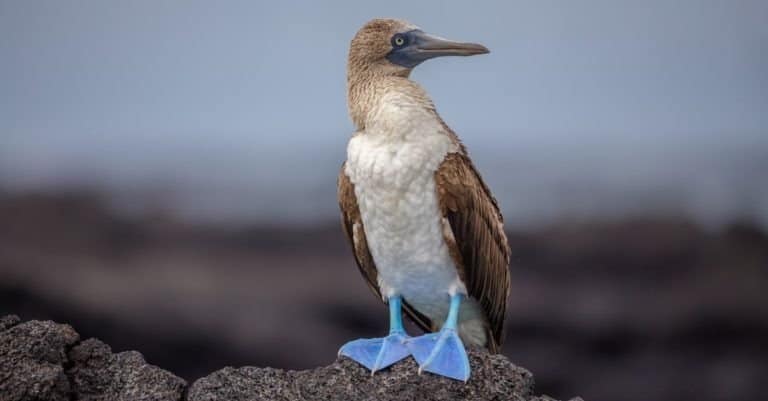
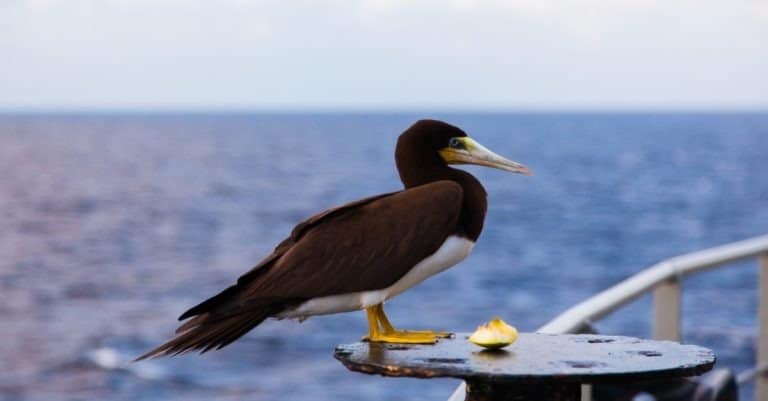
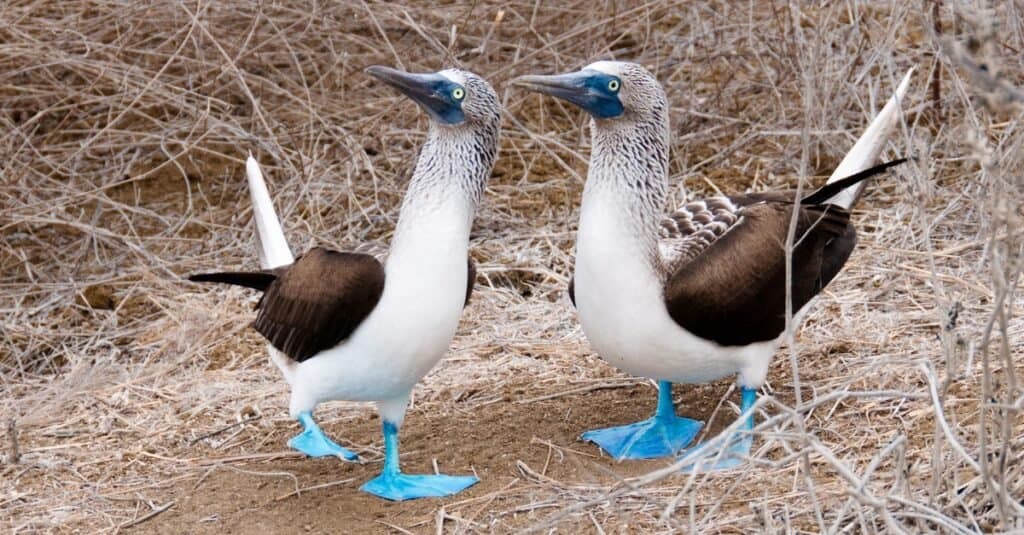
The appearance of this feathered creature differs according to its species. Of course, the blue-footed booby is known for its brightly colored feet. This species doesn’t start out with blue or purple feet from birth. The babies, or chicks, are born with white feet. Their feet don’t turn blue until they’re six months old. A brown booby doesn’t have blue feet. Instead, it’s known for the dark brown feathers on its back and head.

The masked booby is also called the masked gannet because it looks a lot like a gannet. Both have mostly white feathers with brown on their wings and tail. The masked booby gets its name because its feathers form a blue mask on its face.

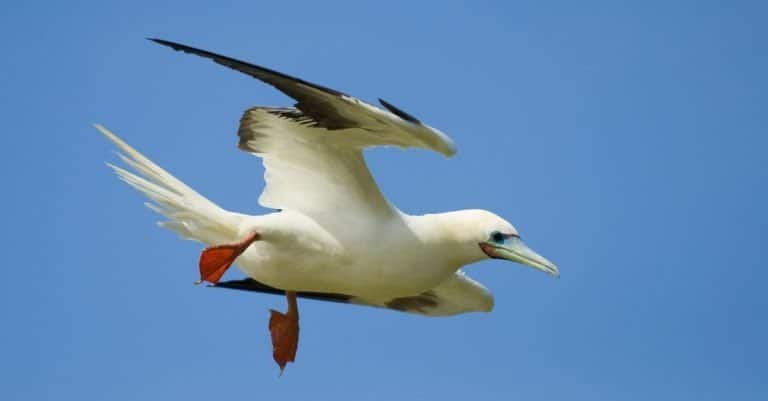
The red-footed booby? You guessed it! It’s known for its bright red feet. It also has a pink and blue bill that sets it apart from other species of booby birds.

The Peruvian booby has brown feathers on its back and wings and a white underside. Alternatively, the Nazca booby has white feathers on its back and some brown on its feathers. Its beak is a combination of orange and pink.

This animal has two yellow, intense-looking eyes along with a serrated beak. The rough, sharp edges of its beak help this animal to grab onto the slippery fish that make up its diet.

The feet of a booby bird whether it’s the blue-footed, red-footed booby, or another species, serve a purpose (other than walking). Male blue-footed boobies show off their feet to attract a mate. Also, both male and females use their feet to cover their chicks in the nest.

The largest species is the masked booby. Its wingspan can be as much as 5 feet, 7 inches and it can weigh up to 5 pounds.

This animal is social and lives in a colony. There can be a dozen to hundreds of birds in a colony. A large number of birds in a colony can discourage predators from entering the area to try to steal from nests.

These creatures can make a lot of noise in the form of grunting, honking, and whistling. So, as you might guess, a colony of these animals is a very loud place to visit!

One of the most notable qualities of a blue-footed, red-footed, masked, or another type of booby bird is curiosity. If a human approaches this seabird, it’s not likely to be frightened. In fact, they have a reputation for landing on boats or other types of watercraft to check out the activity of the humans aboard!

These animals can be aggressive during mating season. For instance, if two males are competing for the attention of a female, then there may be some aggressive behavior between them. Otherwise, they are mostly non-aggressive animals with a curious nature.

Evolution
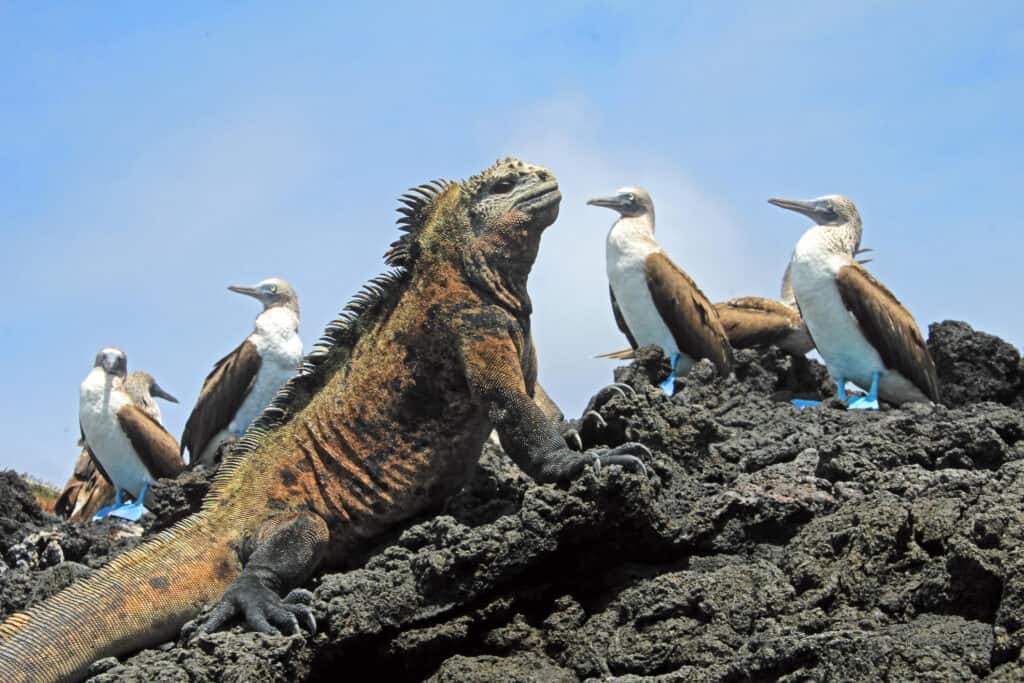
Galapagos islands

The blue-footed booby is found in large numbers on the Galapagos Islands.

Blue-footed boobies were one of the animals that helped spark Charles Darwin’s initial investigations into the theory of evolution during his trip to the Galapagos Islands in 1835. Their vibrant periwinkle paddles and exquisite diving techniques would be sure to dazzle anyone with a passion for animals. These birds which once were synonymous with the island have seen declining numbers at the birthplace of evolution in recent years. SInce boobies are what is known as bioindicator species, they will change their diet and habitat based on changing factors in their environment. While the blue-footed booby once had little interference from humans on the Galapagos, populations of people have been steadily increasing on the island since the 1970’s driving the birds away simultaneously. Even though these birds were instrumental in kickstarting the theory of evolution, little is known about their ancient history besides the fact that they diverged from a common ancestor sometime 200,000 years ago in Peru.

Habitat
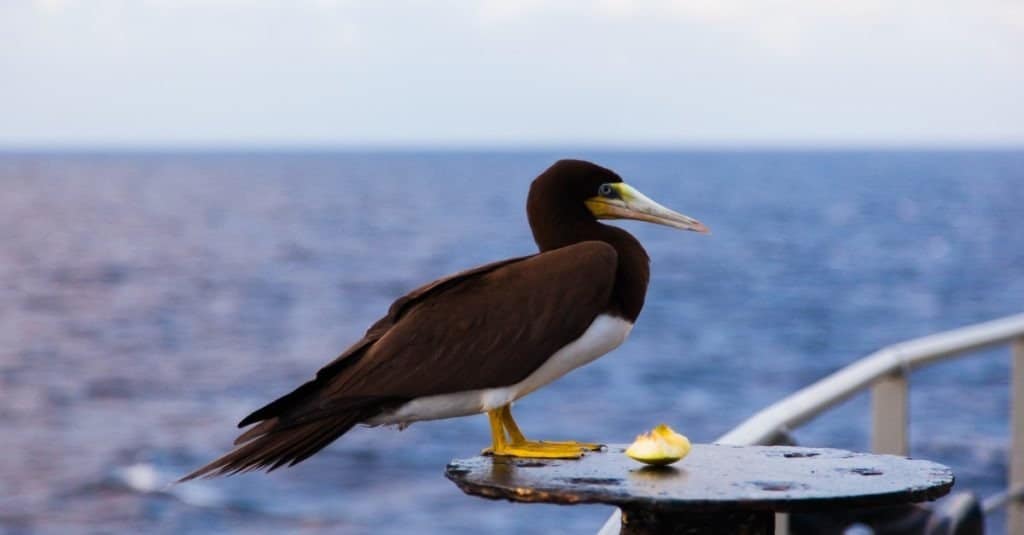
Portrait of a brown booby bird (Sula leucogaster) sitting on a ship in the ocean, close-up

Boobies are known to be incredibly curious.

These are tropical creatures. The blue-footed booby lives in Central and South America, specifically on the western coasts. This species is abundant on the Galapagos Islands. The habitat of the brown booby includes the Gulf of Mexico, the Caribbean, Indian, and Pacific Oceans. The masked booby bird’s habitat includes large stretches of the Pacific Ocean.

This seabird stays in its colony on land throughout the night. During the day, it takes flight to hunt for fish in the ocean. Though these seabirds move in an awkward, unsteady way on land, they are expert fliers. When they spot a fish, they pull their wings flat, against their body as they begin a dive from 80 feet or higher in the air. Furthermore, they can travel 50 feet beneath the surface of the water.

This animal’s nostrils are covered with a flap of skin which allows them to dive without water flowing up their nose. These seabirds also have what’s called a third eyelid that closes before the animal hits the surface of the water. So, think of a booby bird as a champion diver that has a natural nose plug and goggles! When you learn that the booby bird can be traveling at 60 mph when it hits the water, it makes sense that it has these adaptations to make the dive safely.

These animals don’t migrate. But they do move within the range of their habitat to a nesting area. The breeding season of this animal goes from June to August.

Diet
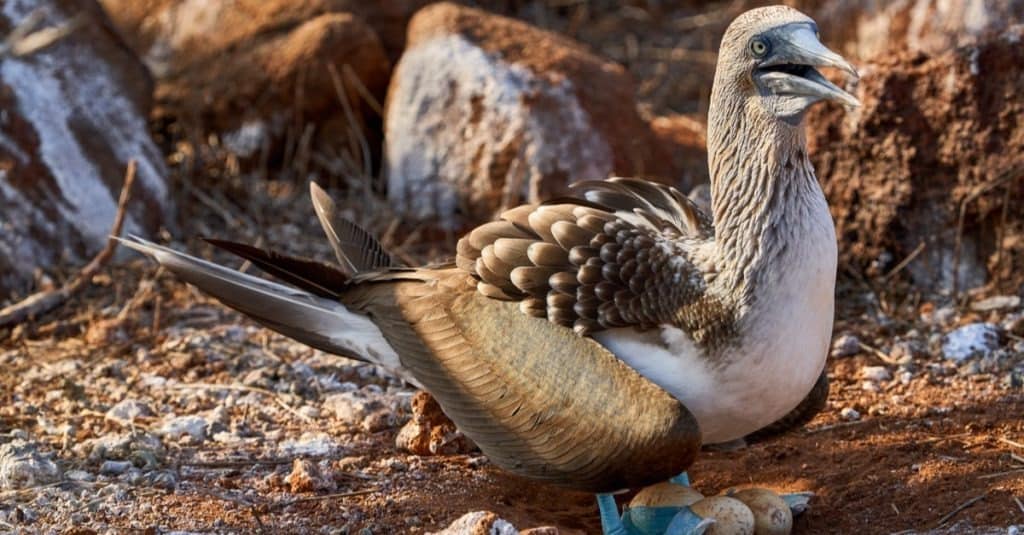
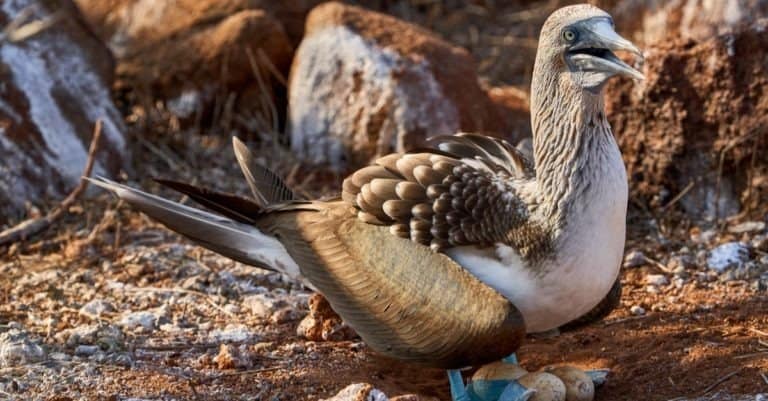
Female Blue Footed Booby Sula nebouxii setting eggs, North Seymour island, Galapagos in Ecuador

Boobies must protect their eggs diligently from potential threats.

This feathered creature is a carnivore. They are known to hunt in groups so when one spots a school of fish, they all get something to eat!

What eats booby birds?

Adult booby birds don’t have any natural predators. However, the chicks and eggs of this bird may be eaten by snakes, owls, and other larger birds.

What does the booby bird eat?

This bird eats fish including anchovies, sardines, and mackerel as well as squid. Female booby birds are able to dive deeper into the ocean than males. So, they may eat fish that are larger than the ones that males capture.

Predators and Threats
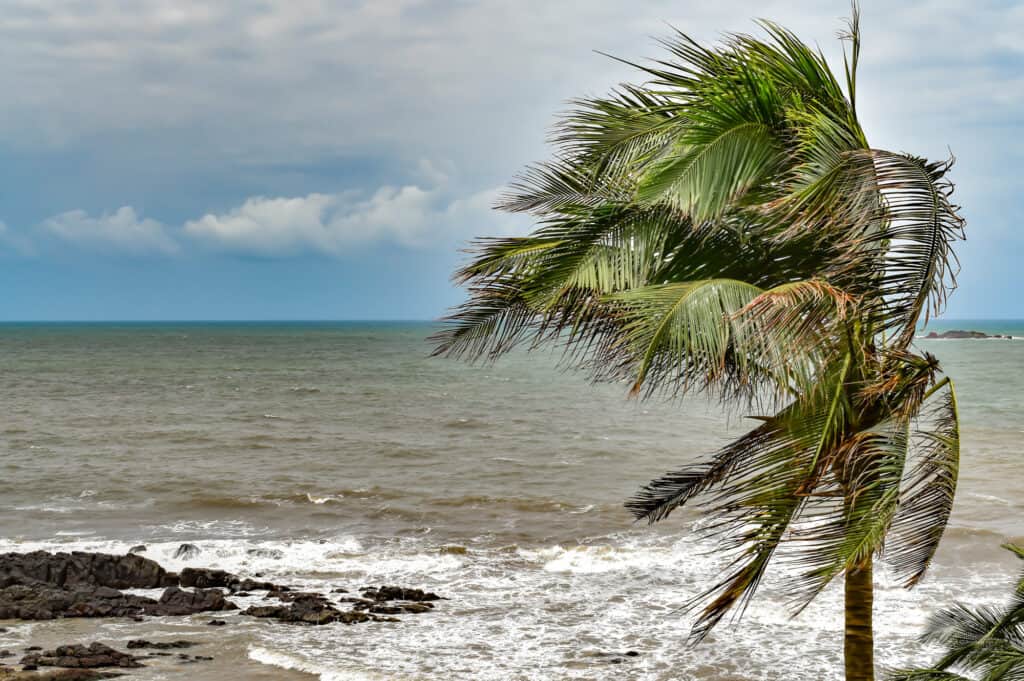
Cyclone, Monsoon, El Nino, Beach, Rough

Tropical storms can adversely affect the booby bird.

While adult booby birds are mostly safe from predators, their young chicks and eggs are vulnerable. Snakes, owls, and other large birds sometimes steal young from a nest and eat them.

Water pollution created by humans is a threat to these creatures. Also, weather events such as El Nino have reduced the population of the clupeid fish. This fish is the main part of the diet of booby birds living on the Galapagos Islands.

The conservation status of the blue-footed booby is Least Concern with a stable population.

Reproduction, Babies, and Lifespan
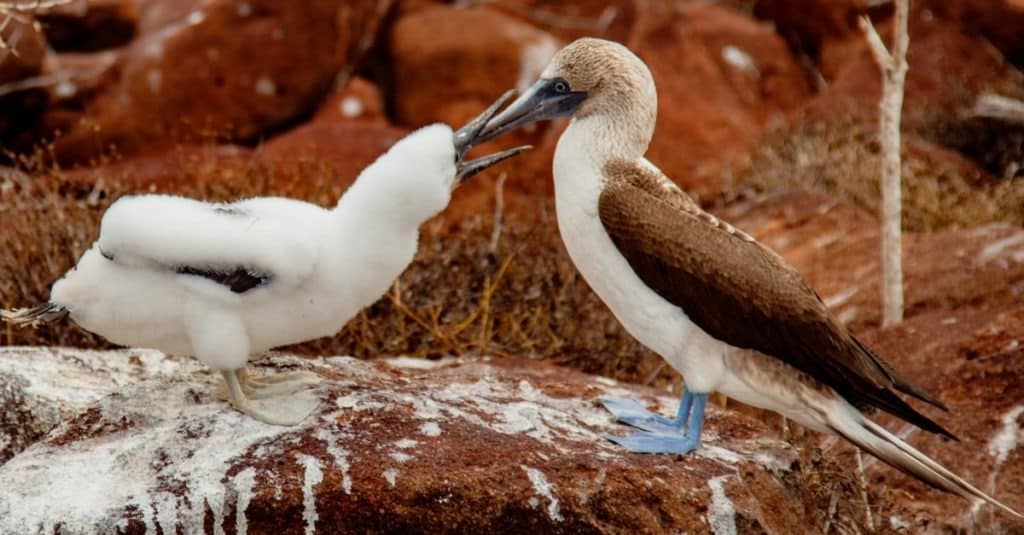
Mother and Baby Blue-Footed Booby on Grand Seymore Island, Galapagos Islands, Ecuador

Baby blue-footed boobies do not yet display their namesake trait.

The mating season of the blue-footed booby runs from June to August. Male blue booby struts around to get the attention of a potential mate. He is sure to show off his bright blue feet! Bright blue feet or even feet that border on purple in color are a sign the bird is healthy and, therefore, a good partner. Males may also make a whistling sound for more attention. Once a female and male pair up, they stay with one another for life.

These feathered creatures make a nest on rocky ground or on a sandy spot along the coast. The nest is made in the shape of a bowl. By the time the eggs hatch, the nest has a border of feces all around it. This is because the females and males relieve themselves there at the nest in order to watch over their young.

The gestation period of these birds is 40 to 45 days. This is similar to the gestation period of the gannet which is 42 to 46 days. They usually have 2 or 3 eggs in a clutch. The eggs are pale blue in color and are usually not the same size. The mother and father take turns sitting on the nest and protecting their eggs with their colorful feet. One member of the pair finds food for the other that is guarding the nest.

Once the eggs hatch, the featherless chicks are fed by both their mother and father. They are completely dependent on their parents. Since they don’t have feathers, the chicks are vulnerable to burns from the powerful sun of the tropical environment. The parent birds use their feet to cool and protect their young. The chicks stay in the nest for 2 months. After leaving their parents, the young birds are likely to live in the same general area as their parents.

These animals can live to be around 17 years old in the wild. The record for the oldest species goes to a masked booby that lived to be 25 years old. It lived in the Pacific Ocean region.

Population
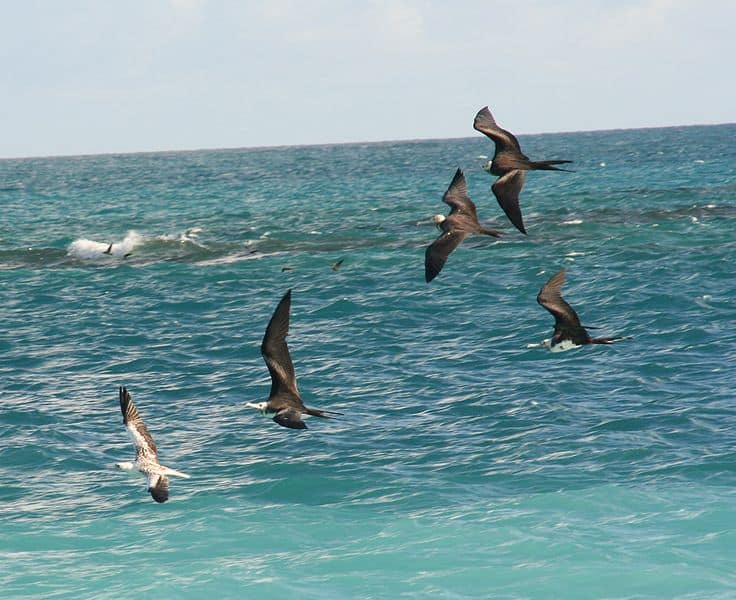
Frigatebirds stealing food from other seabirds

Most booby populations worldwide are in stable condition.

Scientists have estimated there are from 6,000-10,000 blue-footed boobies living on the Galapagos Islands. There are believed to be approximately 2,000 masked booby birds.

Though in some areas the population of this seabird has decreased, its population is stable overall. The official conservation status of the blue-footed booby is the Least Concern.

Species

Earlier we discussed some of the different types of booby birds and their most notable characteristics, you can find a comprehensive list of all 6 species of this silly seabird below:

Common NameScientific Name
Blue-footed boobySula nebouxii
Brown boobySula leucogaster
Masked boobySula dactylatra
Nazca boobySula granti
Peruvian boobySula variegata
Red-footed boobySula sula
View all 453 animals that start with B
How to say Booby in ...
Catalan
Mascarell camablau
German
Blaufußtölpel
English
Blue-footed Booby
Esperanto
Blukrura naivulo
Spanish
Sula nebouxii
Finnish
Sinijalkasuula
French
Fou à pieds bleus
Hebrew
סולה כחולת רגל
Hungarian
Kéklábú szula
Italian
Sula nebouxii
Japanese
アオアシカツオドリ
Dutch
Blauwvoetgent
Polish
Głuptak niebieskonogi
Portuguese
Patola-de-pés-azuis

Sources

  1. Oceana / Accessed January 15, 2021
  2. Wikipedia / Accessed January 15, 2021
  3. Aurora Expeditions / Accessed January 15, 2021
Corinna Cybele

About the Author

Corinna Cybele

My name is Corinna! In my profile photo you can see me with one of my two cats, Bisky! The other's name is Yma and she's a beautiful black Bombay kitty. I'm 24 years old and I live in Birmingham, AL with my partner Anastasia and like to spend my free time making music, collecting records and reading. Some other animals I've owned were a hamster, 2 chihuahuas and many different kinds of fish.

Thank you for reading! Have some feedback for us?


Booby FAQs (Frequently Asked Questions)

Boobies are Carnivores, meaning they eat other animals.