
G
Species Profile

Galapagos Tortoise

Chelonoidis niger

Big shell, bigger story of evolution
Don Mammoser/Shutterstock.com

Galapagos Tortoise Distribution

Click a location to explore more animals from that region

Endemic Species
Loading map...

Found in 1 country

Size Comparison

Human 5'8"
Galapagos Tortoise 2 ft 4 in

Galapagos Tortoise stands at 41% of average human height.

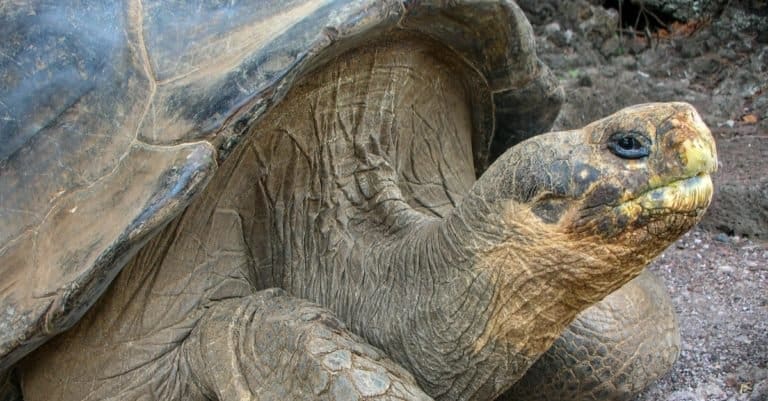
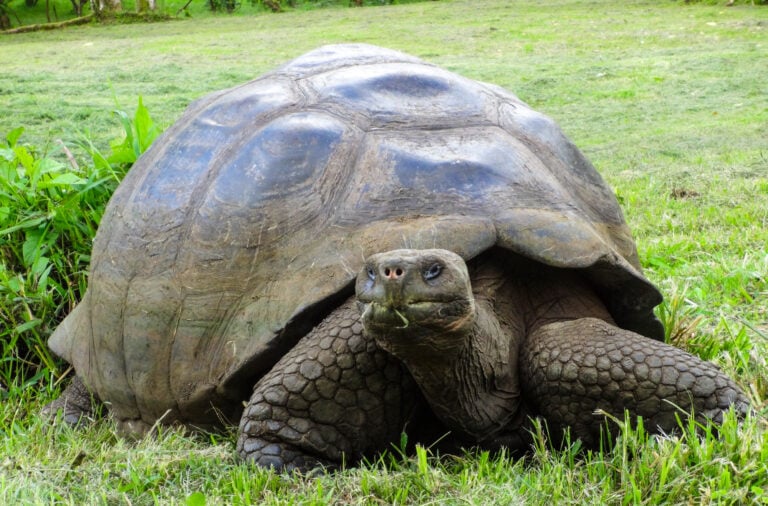
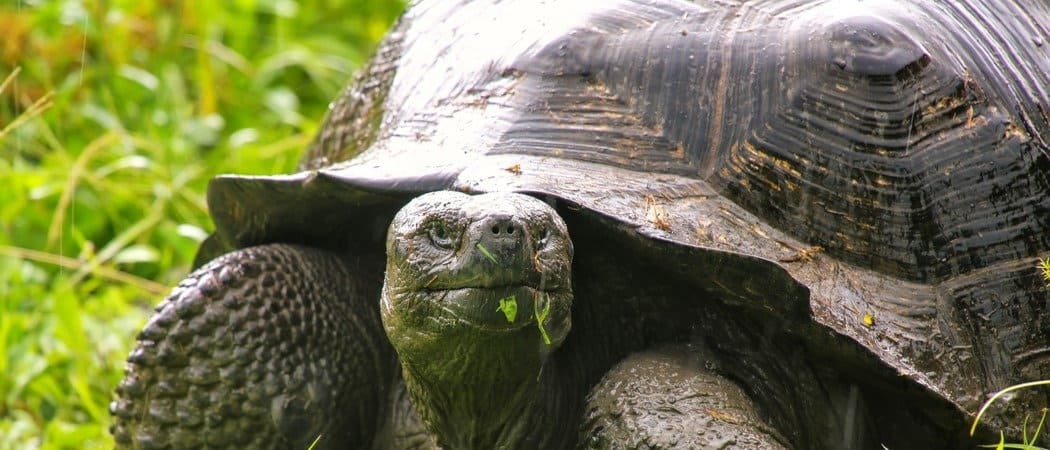
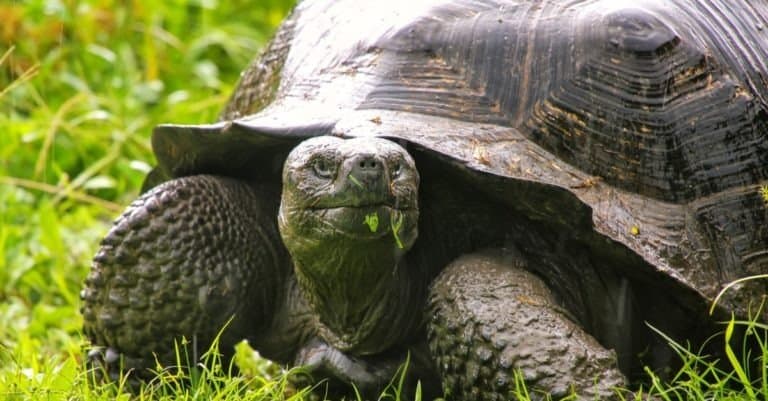
Galapagos giant tortoise (Geochelone elephantopus) on Santa Cruz Island in Galapagos National Park, Ecuador.

At a Glance

Wild Species
Also Known As Galápagos tortoise, Galapagos tortoise, Galápagos land tortoise, Giant tortoise, Tortuga gigante de las Galápagos, Tortuga de Galápagos
Diet Herbivore
Activity Diurnal+
Lifespan 100 years
Weight 417 lbs
Status Vulnerable
Did You Know?

Adults can reach ~1.5 m carapace length and commonly 200-250 kg; exceptionally large males have been reported >300 kg in some island populations (historic accounts).

Scientific Classification

Large, long-lived herbivorous tortoises endemic to the Galápagos Islands, famous for island-to-island variation (e.g., domed vs saddle-backed shells) and as a classic example in evolutionary biology.

Kingdom
Animalia
Phylum
Chordata
Class
Reptilia
Order
Testudines
Family
Testudinidae
Genus
Chelonoidis
Species
Chelonoidis niger

Distinguishing Features

  • Very large body size among tortoises; extreme longevity
  • Shell shape varies by island (domed vs saddle-backed)
  • Thick, columnar limbs adapted for terrestrial life
  • Endemic to the Galápagos; strong geographic (island) differentiation

Physical Measurements

Males and females differ in size

Height
1 ft 5 in (1 ft 2 in – 1 ft 8 in)
Length
3 ft 11 in (3 ft 3 in – 4 ft 3 in)
2 ft 7 in (2 ft 4 in – 3 ft 1 in)
Weight
441 lbs (331 lbs – 551 lbs)
198 lbs (154 lbs – 265 lbs)
Tail Length
4 in (2 in – 6 in)
Top Speed
0 mph
About 0.3 km/h

Appearance

Primary Colors
Secondary Colors
Skin Type Thick, leathery, heavily keratinized skin with large pebbly scales and deep wrinkles on neck and limb bases; robust keratin beak and claws. Shell is bony carapace/plastron covered by keratin scutes (often with pronounced annuli).
Distinctive Features
  • Galápagos giant tortoise (Chelonoidis niger) lives very long: often over 50 years and many over 100 years in captivity or long-term care. Exact maximum is unclear due to past taxonomic lumping and some lineages' extinction.
  • Galápagos giant tortoises have two shell types: domed shells (rounded, higher carapace, shorter necks) on wet highlands with low plants, and saddle-backed shells (raised front) in dry lowlands to reach tall plants like cacti.
  • Forelimbs stout and columnar with large overlapping scales; hind limbs elephantine; feet are not webbed (terrestrial).
  • Head relatively small for body; strong keratin beak adapted for cropping grasses, forbs, leaves, and pads/fruits where available; diet and foraging height shift seasonally and by island habitat.
  • Galápagos giant tortoise (Chelonoidis niger) populations move by season between dry lowlands and wet highlands. Body and shell shapes match local vegetation, a classic island-specific adaptation.
  • In managed settings, Galápagos giant tortoise (Chelonoidis niger) may show scute wear, smoother shells, or faint growth rings from changes in diet, water, or ground; head-starting and breeding programs also alter appearance.

Sexual Dimorphism

Sexual dimorphism is pronounced in adults: males are typically larger and more robust, with a longer tail and a more concave plastron; females are smaller with a flatter plastron. Degree of dimorphism varies among island lineages and environmental conditions.

  • Larger overall body size and mass on average; heavier head/neck appearance.
  • Plastron usually concave (facilitates mounting during mating).
  • Longer, thicker tail with vent positioned farther from the body.
  • More prominent gular projection (front plastron) in many individuals, used in male-male interactions.
  • Smaller average size and mass; body often appears broader relative to height.
  • Plastron typically flat to slightly convex.
  • Shorter tail with vent closer to the body.
  • Gular projection generally less pronounced than in males.

Did You Know?

Adults can reach ~1.5 m carapace length and commonly 200-250 kg; exceptionally large males have been reported >300 kg in some island populations (historic accounts).

They're among the longest-lived vertebrates: lifespans of 100+ years are typical in well-managed conditions; individuals documented well over 150 years exist in records from historic captives (longevity varies by record certainty and taxonomic ID).

Shell shape tracks habitat: domed shells dominate cooler, wetter highlands, while saddle-backed shells are common on drier islands where reaching higher cactus pads is advantageous.

They show temperature-dependent sex determination: incubation temperature influences hatchling sex, so nest microclimate matters for population recovery.

Sexual maturity is slow-often ~20-25 years-so populations rebound only over decades, even with protection.

They can endure long dry periods by storing water in the body (including the bladder) and by lowering activity-one reason sailors historically kept them alive aboard ships as a "walking larder."

Unique Adaptations

  • Island-specific shell morphology (domed vs saddle-backed) tied to local vegetation structure and climate-an iconic example of local adaptation within an island radiation.
  • Very slow metabolism and the ability to tolerate dehydration and fasting for extended periods-useful in strongly seasonal, drought-prone lowlands.
  • Massive, columnar limbs and a low center of gravity for supporting extreme body mass while moving over lava, loose soils, and steep volcanic terrain.
  • Long neck and sturdy keratinized beak adapted for cropping grasses, stripping leaves, and feeding on cactus (including spines avoidance via careful biting angles).
  • High longevity with continued, slow growth over many years-spreading reproduction across decades to buffer against bad years in unpredictable island climates.

Interesting Behaviors

  • Seasonal/altitudinal movements: in several island populations, adults travel between arid lowlands (dry-season foraging) and wetter highlands (cool-season grazing), using established pathways and returning to familiar areas.
  • Thermoregulation by behavior: basking to warm up in cool mornings, then seeking shade or wallowing in mud/wet soil to avoid overheating and reduce parasites.
  • 'Neck-up' browsing: saddle-backed individuals extend the neck and raise the front of the body to feed on higher vegetation (notably Opuntia cactus pads/fruits on arid islands).
  • Courtship and dominance: males engage in ritualized head-raising, ramming, and neck-extension displays; louder, forceful vocalizations can occur during mating in some populations.
  • Nest-site selection and digging: females walk long distances to find suitable warm, well-drained soils; they excavate deep nests and can lay multiple clutches across a season depending on conditions.
  • Seed dispersal through gut passage: they consume fruits and pass viable seeds, linking lowland and upland plant communities via their movements.

Cultural Significance

Galápagos giant tortoise (Chelonoidis niger) is a global symbol of evolution and of Ecuador's Galápagos. Once hunted by whalers and pirates, and harmed by introduced mammals and habitat loss, they are recovering through head-starting, habitat restoration, and reintroductions.

Myths & Legends

In the 18th–19th centuries sailors' stories said Galápagos giant tortoises (Chelonoidis niger) were "living casks" of meat and water, kept on deck for months—tales spread through whaling ports and pirate routes.

A modern legend about the Galápagos giant tortoise (Chelonoidis niger) says 'extinct' island tortoises still live in remote lava fields or as hidden hybrids. Genetic tests found living tortoises from lost lineages, sparking wide interest.

Naming story: Early Spanish sailors compared some Galápagos giant tortoises (Chelonoidis niger) with saddle-shaped shells to riding saddles, and the islands were later named Galápagos after these tortoises.

Conservation Status

VU Vulnerable

Facing a high risk of extinction in the wild.

Population Increasing

Protected Under

  • Ecuador: Galápagos National Park (created 1959; terrestrial protection for most tortoise habitat)
  • Ecuador: Galápagos Marine Reserve (1998) - indirectly supports island biosecurity and ecosystem protection
  • UNESCO World Heritage Site: Galápagos Islands (inscribed 1978)
  • CITES Appendix I (Galápagos giant tortoises; international commercial trade prohibited)
  • Ecuador: Special Law for the Conservation and Sustainable Development of Galápagos Province ("Ley Orgánica de Régimen Especial de la Provincia de Galápagos"; 1998, with subsequent reforms) - biosecurity/settlement controls supporting tortoise conservation

Life Cycle

Birth 8 hatchlings
Lifespan 100 years

Lifespan

In the Wild
50–150 years
In Captivity
50–170 years

Reproduction

Mating System Promiscuity
Social Structure Aggregation Group
Breeding Pattern Transient
Fertilization Internal Fertilization
Birth Type Internal_fertilization

Chelonoidis niger (Galápagos giant tortoise) mates with many partners: adults are mostly solitary but meet briefly to mate. Males fight for mates; females can mate many times and store sperm up to about 4 years. No pair bonds or parental care.

Behavior & Ecology

Social Congregation Group: 1
Activity Diurnal, Crepuscular, Matutinal, Vespertine
Diet Herbivore Opuntia cactus (pads and fruits)
Seasonal Migratory, Hibernates 6 mi

Temperament

Generally calm and slow-moving; low reactivity outside of breeding contexts.
Docile toward conspecifics at shared resources; tolerant of close proximity in congregations with minimal overt aggression.
Breeding-season males of the Galápagos giant tortoise (Chelonoidis niger) are pushy: they mount, block, show dominance (neck extension, raised posture, shell contact/ramming) near females ready to mate; fights are mostly ritual and rarely cause injury.
Strong site fidelity and routine use of resource 'hubs' (water/wallows/shade), producing predictable daily/seasonal movement between resting and feeding areas; intensity varies by island, season, and rainfall (e.g., Blake et al. 2013).

Communication

Breathy hisses/exhalations during handling or close interactions Typical of large tortoises
Males produce loud rhythmic grunts or groans (sometimes described as bellow-like) during copulation; females may vocalize less frequently.
Visual displays: neck extension, head elevation, body 'stilted' posture to appear larger; head bobbing and orientation toward rivals/partners during courtship and male-male assessment.
Tactile interaction: shell bumping/ramming and pushing during male-male contests; mounting during copulation.
Chemical cues: scent-based assessment via skin/cloacal odors is inferred to mediate sex/reproductive status recognition Common in tortoises; specific experimental quantification for C. niger is limited
Spatial signaling via repeated use of paths and hubs Movement corridors and congregation sites), facilitating encounter rates without cohesive group living (e.g., Blake et al. 2013

Habitat

Biomes:
Tropical Dry Forest Savanna Tropical Rainforest Wetland
Terrain:
Island Volcanic Hilly Plains Coastal Rocky
Elevation: Up to 5577 ft 5 in

Ecological Role

Megaherbivore and ecosystem engineer in Galápagos terrestrial ecosystems

Seed dispersal (endozoochory) of many native and some introduced plants via long gut passage and wide movements, including dispersal between habitat zones Vegetation structuring through grazing/browsing that can maintain open areas, influence plant community composition, and reduce woody encroachment in some contexts Nutrient cycling and fertilization via dung deposition, creating nutrient hotspots and supporting detrital food webs Soil disturbance and microhabitat creation via trampling and use of trails/movement corridors, influencing water infiltration and plant establishment

Diet Details

Other Foods:
Opuntia cactus pads and fruits Grasses and sedges Herbaceous forbs and ground vegetation Leaves and shoots of shrubs and woody plants Fallen fruit

Human Interaction

Domestication Status

Wild

Not domesticated. The Galápagos giant tortoise (Chelonoidis niger) was taken by sailors in the 17th–19th centuries for meat, with thousands removed. Now they are kept only as protected wildlife in zoos and breeding/head-start programs. Ecuador's Galápagos National Park and partners rear and return tortoises to restore islands. Scientists now often split the group into island species.

Danger Level

Low
  • Bites and crushing injuries are possible if handled improperly (large body mass; strong jaws), though attacks are uncommon and typically defensive or during handling
  • Zoonotic risk typical of reptiles: Salmonella transmission through contact with animals, feces, or contaminated surfaces
  • Minor injuries from scratches during handling/transport

As a Pet

Not Suitable as Pet

Legality: Galápagos giant tortoise (Chelonoidis niger) cannot be kept as a private pet. Ecuador law and CITES Appendix I ban export and commercial trade; only permits for conservation, zoos, or special government approval.

Care Level: Expert Only

Purchase Cost:
Lifetime Cost: $50,000 - $250,000

Economic Value

Uses:
Ecotourism flagship species (Galápagos tourism value driver) Conservation employment and funding (breeding centers, ranger operations) Scientific research value (evolutionary biology, island biogeography, genomics, demography) Ecosystem services (grazing/browsing shaping vegetation; seed dispersal) Historical extractive use (meat/fat/oil for ships; now illegal)
Products:
  • Non-consumptive: wildlife viewing/tourism experiences, educational programming, research outputs
  • Historical (now illegal): live tortoises taken as ship provisions; meat and fat/oil; shell curios

Relationships

Related Species 10

Chaco tortoise Chelonoidis chilensis Shared Genus
Yellow-footed tortoise Chelonoidis denticulatus Shared Genus
Red-footed tortoise
Red-footed tortoise Chelonoidis carbonarius Shared Genus
Santa Cruz giant tortoise Chelonoidis porteri Shared Genus
Espanola giant tortoise Chelonoidis hoodensis Shared Genus
Pinzon giant tortoise Chelonoidis duncanensis Shared Genus
Santiago giant tortoise Chelonoidis darwini Shared Genus
Volcano Wolf giant tortoise Chelonoidis becki Shared Genus
Fernandina giant tortoise Chelonoidis phantasticus Shared Genus
Aldabra giant tortoise
Aldabra giant tortoise Aldabrachelys gigantea Shared Family

Ecological Equivalents 5

Animals that fill a similar ecological role in their ecosystem

Aldabra giant tortoise
Aldabra giant tortoise Aldabrachelys gigantea Like the Galápagos giant tortoise (Chelonoidis niger), it is a very large, long-lived terrestrial tortoise that feeds on plants, grazes and disperses seeds on oceanic islands, can survive long periods without fresh water, and commonly lives over 100 years and exceeds 100 kg.
African spurred tortoise
African spurred tortoise Centrochelys sulcata Convergent herbivore physiology and water-stress tolerance (hindgut fermentation, high-fiber diet, prolonged fasting). It occurs on continental arid savanna/desert margins rather than on humid-to-arid island gradients, but like Galapagos tortoises it can strongly modify vegetation structure via grazing, browsing, and trampling.
Desert tortoise Gopherus agassizii Shares drought-avoidance behaviors (seasonal activity, use of thermal refuges) and herbivory. Both are slow-growing, reach maturity late, and have low annual reproductive output, making populations sensitive to adult mortality even when juvenile predation is high.
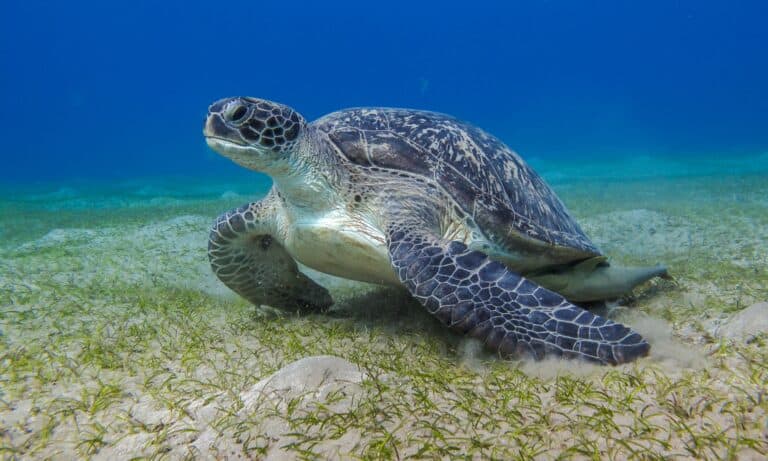
Green sea turtle Chelonia mydas Not a terrestrial analogue, but an ecological parallel as a large-bodied, long-lived reptile herbivore that shapes primary producer communities through grazing and has similar life-history constraints: late maturity, high egg and hatchling mortality, and very long adult lifespan.
Marine iguana
Marine iguana Amblyrhynchus cristatus An endemic Galápagos reptile that feeds on marine algae; populations vary from island to island, with different body shapes tied to diet and island environments, a pattern similar to giant tortoises.

The Galapagos tortoise is among the giants of the reptile class.

Evolving over millions of years on its remote island habitat, this tortoise had almost no contact with the outside world until the permanent discovery of the island in 1535 by humans led to rapid changes with which the tortoise could not cope. Only an immense conservation effort saved them from extinction.
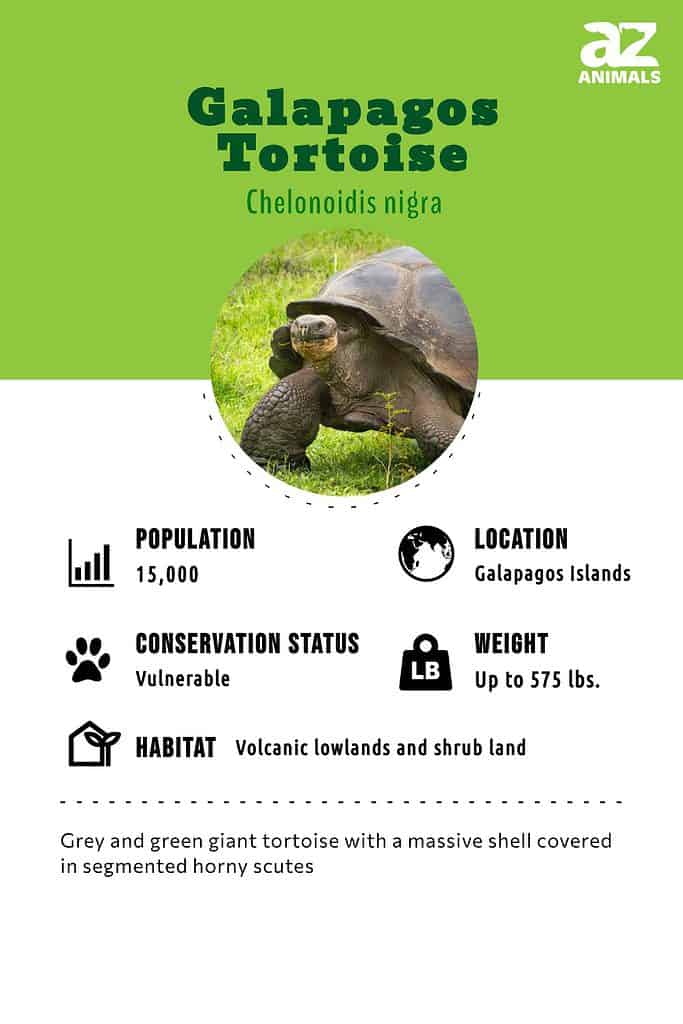
5 Incredible Galapagos Tortoise Facts!

  • Galapagos actually means turtle or tortoise in Spanish.
  • The shell of the tortoise may look solid, but it is actually composed of a honeycomb-like structure that weighs less than it appears.
  • The tortoise first came to the Galapagos about three million years ago from South America. Although they aren’t great swimmers, the evidence suggests that tortoises have the ability to remain buoyant on the water and keep from drowning.
  • Because of their poor hearing, the Galapagos tortoises rely on their vision and smell to sense their surroundings.
  • One of the more interesting facts is that the Galapagos appears to have a beneficial relationship with some species of finches and mockingbirds. These birds feed on the parasites clinging to the turtle’s skin and receive a free meal in turn. The tortoises anticipate this and even stretch out parts of their body for the birds to access. However, the tortoise has been known to betray the bird and eat it instead.
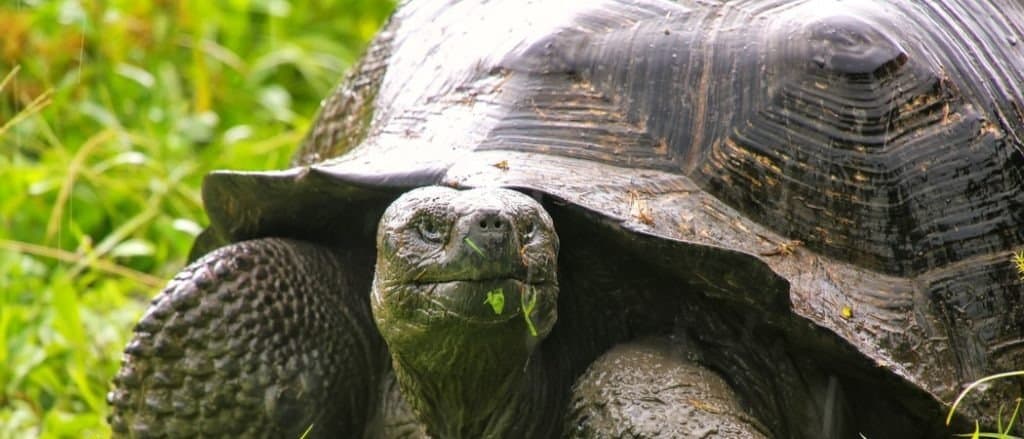
Galapagos giant tortoise (Geochelone elephantopus) on Santa Cruz Island in Galapagos National Park, Ecuador.

Because of their poor hearing, the Galapagos tortoises rely on their vision and smell to sense their surroundings.

Scientific Name

The scientific name of the Galapagos tortoise is Chelonoidis nigra, which simply means black, although this species has more of a gray-green color. The Galapagos tortoise is not really a single species at all, but rather a collection of several distinct species all existing under a single taxonomy. Each species occupies a different part of an island or a different island altogether.

Charles Darwin, when he made his famous voyage aboard the Beagle in the 1830s, remarked at the amazing diversity of tortoise species on the various islands of the Galapagos by saying that these tortoises were like “inhabitants of some other planet.” There was about 15 distinct taxonomy of tortoise populations at Darwin’s time, but only about 10 currently exist today. There is also some debate about whether certain populations arose as a result of several colonization events to the island or whether all of them descended from a single colonizer.

The Galapagos turtle belongs to the family of land-dwelling tortoises known by the scientific name of Testudinidae. This taxonomy classification is based on its anatomy, genetics, and evolutionary history.
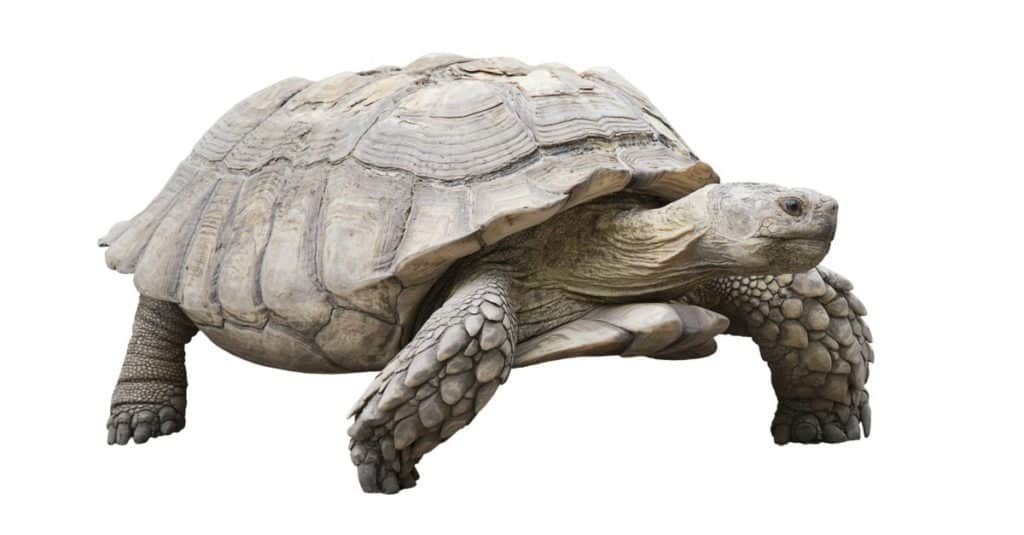
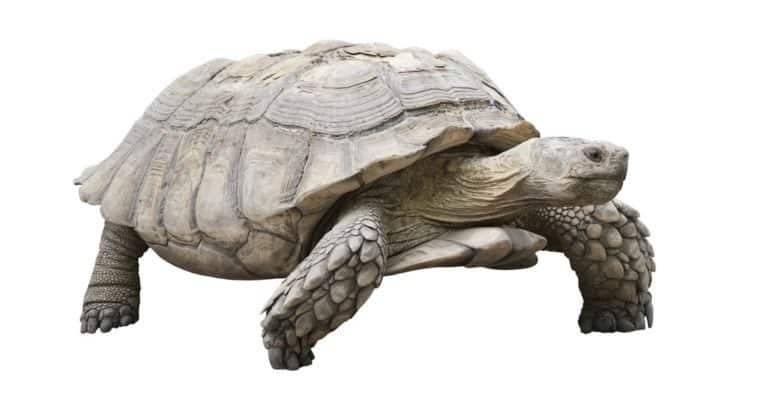
giant Galapagos tortoise isolated on white background

The scientific name of the Galapagos tortoise is Chelonoidis nigra, which simply means black, although this species has more of a gray-green color.

Evolution and History

It is believed that these tortoises arrived on the island chain between 2 and 3 million years ago, and they probably drifted on piles of vegetation functioning like rafts across the 600 miles of ocean. Or they drifted on their own. Once there, they developed into two general carapace styles with either a domed shell and a saddle-backed shell (or a shell somewhere in between).

There is a huge connection between many of the Galapagos Island Chain living creatures and the concept of evolution itself. Charles Darwin’s visit to the island inspired his groundbreaking theory concerning natural selection. Because of their similarities but differences, the tortoises were an acute example of how species evolve from their common ancestors.

Appearance

The Galapagos tortoise is one of the largest species of tortoise in the world. Males can weigh more than 500 pounds and reach 6 feet in length, while females weigh a comparatively smaller 250 pounds. The giant shell is obviously the most important characteristic of the tortoise’s anatomy. This massive structure is fused to the ribs and covered in segmented horny scutes. The bands on the shell cannot be used to determine the animal’s lifespan, since they wear off over time.

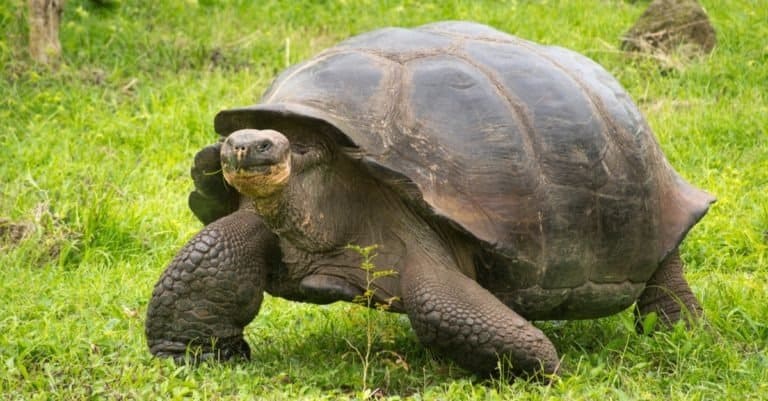
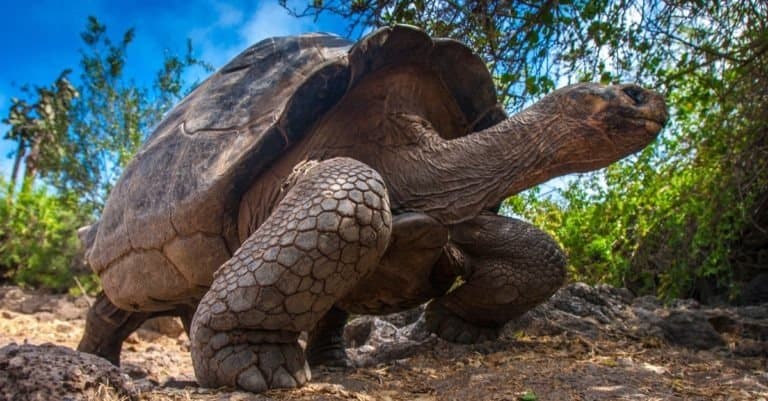
The tortoise’s shell has two types of adaptations. The domed shells, which is completely round, restrict the movement of the head. These tortoises live in humid areas with diverse vegetation in reach. The saddleback shells curl up near the neck, which allows them to stretch out their necks and feed on higher vegetation. These tortoises live in arid regions where the vegetation is sparser and the tortoises must work harder to reach it.
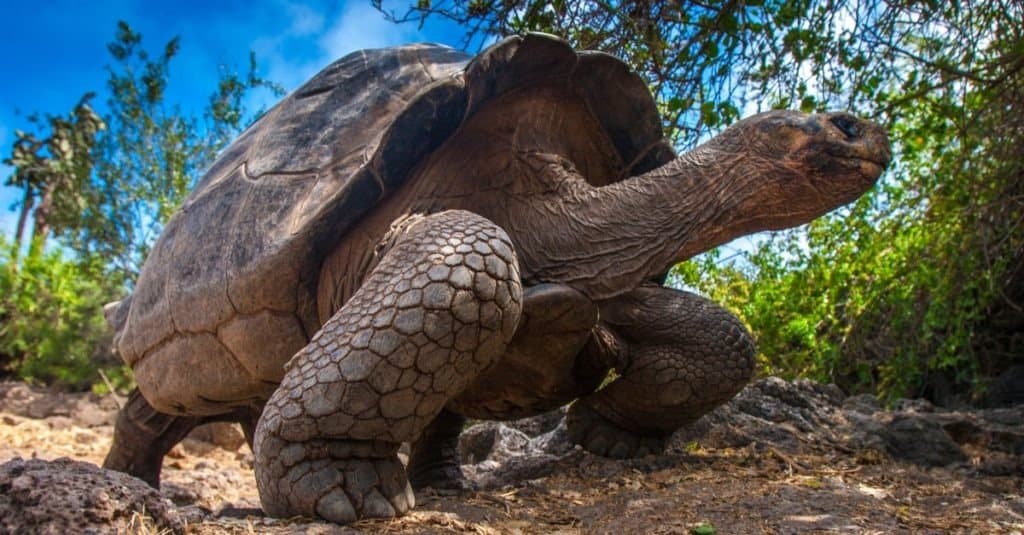
Galapagos tortoise stands on legs.

The saddleback shells curl up near the neck, which allows them to stretch out their necks and feed on higher vegetation.

Behavior

Restricted in what it can do by a slow metabolism, the Galapagos tortoise leads a rather sluggish and languid life. It sleeps up to 16 hours a day and then spends the rest of the time either feeding or resting. As a cold-blooded reptile, the tortoise lacks the adaptations to properly regulate its internal body temperature, so it must spend a lot of time wallowing in mud, soaking in water, or exposing its body to the rays of the sun.

One of the more interesting facts is that the Galapagos tortoise can migrate between different elevations of the island throughout the day in response to temperature. These tortoises maintain a very specific, regimented schedule from which they hardly deviate. By following the same routine every day, their heavy bodies carve out distinctive paths in the landscape which become semi-permanent features.

The Galapagos tortoise is slow and cumbersome, but the size of an adult obviously confers an enormous advantage against most predators. When it’s seriously threatened, the tortoise will pull back into the shell for protection, but contrary to some beliefs, the tortoise cannot leave the shell, since it’s fused to the body.

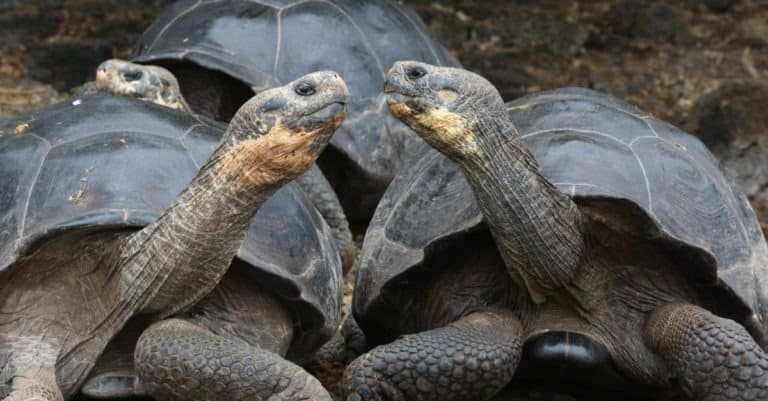
The Galapagos tortoise does not appear to cooperate in any substantive way with other members of the same species, but it does tolerate their presence since they feed and rest in close proximity. However, when mating season arrives, male tortoises engage in a competition by stretching out their heads. The tortoise with the higher head is considered to be the winner of this contest, and that is usually the end of it. But if the loser does not concede right away, then hostilities might break out into a bitter brawl, which consists of biting and nipping. The Galapagos tortoise makes very few sounds except for hoarse grunts during copulation, harsh sounds during aggressive encounters and a hissing noise made by the expulsion of air as the tortoise withdraws into its shell.
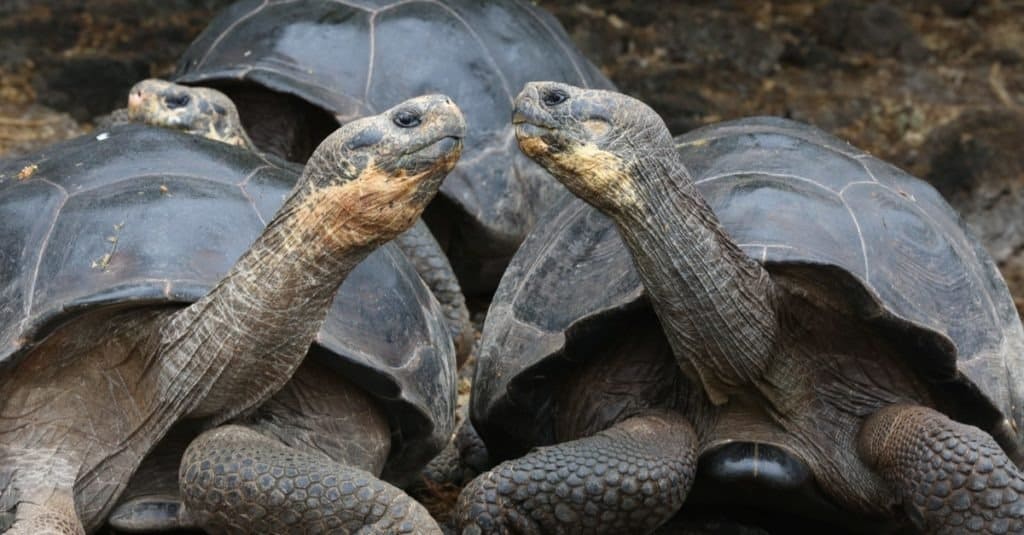
Galapagos Tortoise, Galapagos Islands, Ecuador

Male tortoises engage in a competition over females by stretching out their heads.

Habitat & 12 Types of Galapagos Tortoises

The Galapagos is a hotspot of volcanic activity; it contains Volcan Wolf, Volcan Alcedo, and many others. The climate is generally hot and dry, but frequent spells of rainfall throughout the year do keep life flourishing. The El Nino weather event also buffets the island chain every three to seven years.

The Galapagos tortoise is endemic to the island chain of the Galapagos, about 563 miles west off the coast of Ecuador and an official part of that country. There are several subspecies spread throughout the island chain.

  • Volcan Wolf – The Volcan Wolf tortoise has adapted two different body carapace types, the domed and the saddle-backed, that are both found throughout the islands on different subspecies. This is probably due to a lava barrier that separated populations and then a blending of them later on. Like all Galapagos Tortoises, there have been efforts to increase population numbers and conserve this great species. There are now almost 1,200 individuals in the wild.
  • Chatham Island – The Chatham Island tortoise had much of its territory damaged by dogs and donkeys brought to the island by humans. Efforts to bring back the numbers of this breed have worked well, and their numbers are close to 7,000 individuals. Their carapace is black, wide, and somewhere in between the domed shape and the saddle-backed shape of its cousins.
  • Santiago Island – The Santiago Island Tortoise had a population that was severely lowered much like the other tortoises on the islands due to hunting and the introduction of foreign animals, like goats. The numbers have grown due to conservation steps to nearly 1,200 individuals. Their dark gray shells are in between the domed and saddle-backed variations of their species, with flared sides that are somewhat serrated.
  • Eastern Santa Cruz Island – The Eastern Santa Cruz Island tortoise, make up one of the two distinct subspecies on the island, and like their cousins on the western part of the island, have a domed, black, oval carapace. There are only 400 or so left on the island.
  • Duncan Island – The Duncan Island tortoise were one of the lucky subspecies that were not as badly hunted as others; however, their numbers were greatly reduced later in the 1900s due to expeditions on the island and the introduction of rats into their environment. Because of a breeding program, this subspecies was able to recover and reproduce in the wild. They now have over 500 members on the island. Their shells have a brownish, gray tint which is long and somewhat shallow.
  • Sierra Negra – The Sierra Negra tortoise has been one of the more endangered of the islands’ tortoises. They have recovered after overhunting to have numbers close to 700 today. In fact a group was removed into a breeding, protected program due to the threat of a nearby volcano. They are known for their flat-topped shells that are a in the middle of domed and saddle-backed.
  • Hood Island – The Hood Island tortoise is one of the best turnaround stories for this giant reptile. Due to overhunting in the 1800s, the population of the Hood Island tortoise was reduced to just a few sole members. Amazingly, about a dozen remaining tortoises were collected to be held at the Charles Darwin Research Station and have been able to recover! Around 1,000 tortoises now inhabit Hood Island. These tortoises have a shell with a large cervical indentation, and they are saddle-backed and black in color.
  • Volcan Darwin – The Volcan Darwin tortoise, like many of its relatives, were almost crushed out of existence in the 1800s by whalers looking to sell their oil. Since then, numbers have regained to almost 1,000 in the wild. These members of the family have a more brown tint to their oval shells, which are somewhere between saddle-back and domed.
  • Fernandina Island – The Fernandina Island tortoises sadly only have one remaining member of the subspecies that we know about. However, there may be more members of this group still remaining that no one has discover as of yet. The lone member is in captivity with strict protection for testing and conservation.
  • Western Santa Cruz Island – The Western Santa Cruz Island tortoises are divided into through groups on the island, and they have a domed, black, oval carapace.
  • Volcan Alcedo – The Volcan Alcedo tortoise has a black, domed shell and has been successfull at reproduction in the wild despite the challenges all Galapagos Tortoises face. In fact, they hold the number for the biggest tortoise population of the whole group.
  • Iguana Cove – The Iguana Cove tortoise has been a subspecies that has been lowered over the last couple of centuries but has managed to grow back to around 2,500 tortoises through preservation efforts. They have one of the more thicker, sturdier shells with a shape that lands somewhere between the domed and saddle-backed types.
The Galapagos tortoise is endemic to the island chain of the Galapagos, about 563 miles west off the coast of Ecuador and an official part of that country.

Diet

The Galapagos tortoise is an herbivorous grazer that has many unique adaptations to cope with the difficult environment in which it lives. By storing excess resources in its body, the tortoise can go without food or water for an entire year.

What does the Galapagos tortoise eat?

The Galapagos tortoise eats many different types of fruits, flowers, leaves, and grass, some of which are so dangerous that they can burn the human skin. The prickly pear cactus appears to be a particular favorite. Lacking teeth, the tortoise grinds up food with the tough outer parts of the mouth.

Predators and Threats

For millions of years, the Galapagos tortoise evolved in a habitat that was almost completely free of large mammals. Its sheer size and giant protective shell usually provided adequate protection against everything else. But after the discovery of the island, people indiscriminately hunted the turtle for food and introduced non-native predators to the island. These new mammals either preyed upon the tortoise directly or out-competed it for precious food.

What eats them?

Before the arrival of people, the Galapagos hawk was the only creature to prey upon the juveniles and eggs. However, as people poured onto the island, they introduced pigs, cats, rats, and other species, which gorged on the eggs in enormous numbers, causing populations to plummet.
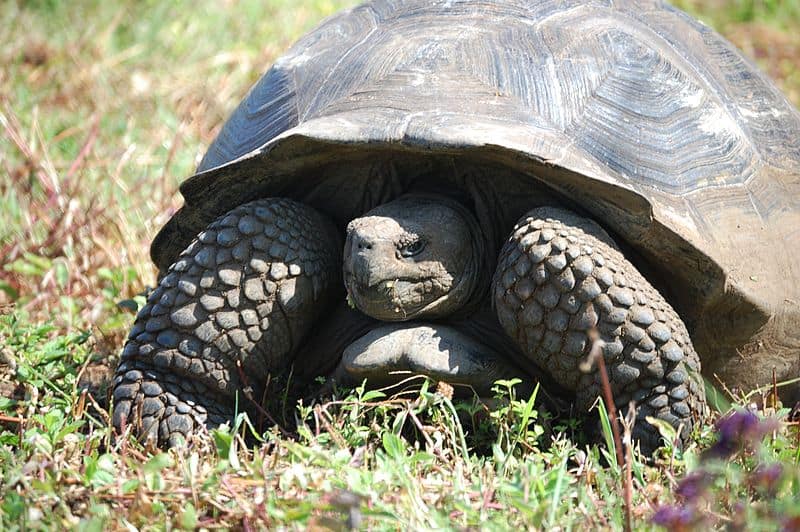
The Galapagos Tortoise’s sheer size and giant protective shell usually provided adequate protection against everything else.

Reproduction, Babies, and Lifespan

Upon the arrival of the mating season, which usually lasts between the months of January and August, the male will locate and track down a female from her scent. He will then initiate courtship in a rather violent manner by ramming her with the front of his shell and then nipping at her legs. Once copulation is complete, the female may travel several miles to the drier lowlands and then deposit 10 eggs, which are about the size of a tennis ball, into a 12-inch sandy hole in the ground. The temperature of the soil appears to play a role in determining the sex of the offspring, as hotter soil will lead to more females.

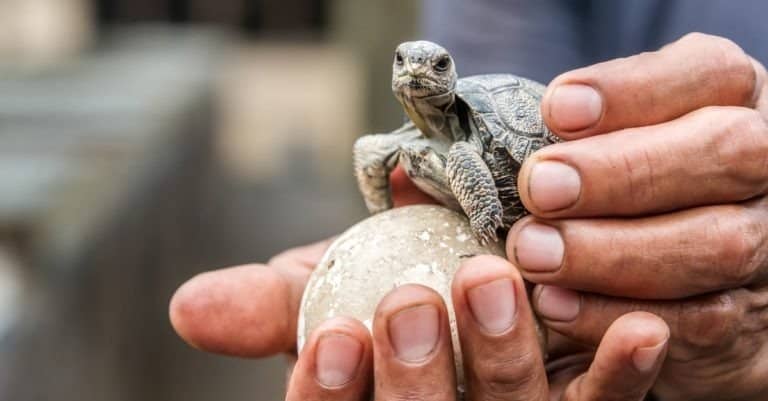
After an incubation period of about three to eight months, the young tortoises emerge from the eggs, measuring about 2.4 inches in size. Since they receive no other parental care, the first challenge in their life is to dig their way toward the surface, which takes about a month. The nutrient-rich yolk sac will sustain them for several more months, after which time they must learn to fend for themselves.

The Galapagos tortoise is exceptionally slow-growing animals that take about 20 to 25 years to fully mature, but they compensate for this with an incredible lifespan. The oldest recorded lifespan was more than 150 years. Unfortunately, most perish within the first 10 years of life.
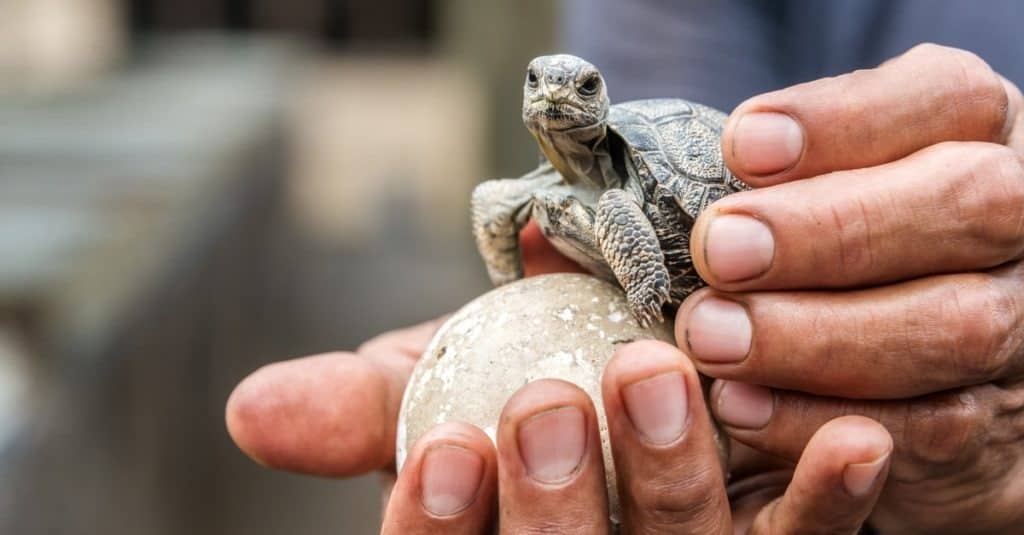
Baby Galapagos tortoise on Isabela Island in the Galapagos Islands in Ecuador

Young tortoises emerge from the eggs, measuring about 2.4 inches in size.

Population

The Galapagos tortoise has been in a constant state of peril for centuries. Once common across the entire island chain before the 16th century, more than 100,000 were killed by pirates, hunters, and merchantmen who stopped by the island and stocked up on food to sustain them for their journey.

Although hunting has largely ended, the tortoise still faces threats and competition from non-native animal species, which caused populations to dwindle to a low of only 3,000 by the 20th century. The Pinta Island tortoise was officially declared extinct in 2012 upon the death of the last known male, Lonesome George, who became something of an international cause célèbre for conservation issues. All attempts to find a suitable female for him, including those of different species, were unsuccessful.

Since falling to this low point, it is estimated that populations have now climbed as high as 20,000 individuals, thanks in part to the fact that the Ecuadorian government has extended protection to the tortoise and carved out national park refuges. The Charles Darwin Research Station has also mounted an effort on the island to breed this species in captivity. But the long maturation times and lifespan also make it difficult to revive numbers quickly. No species has managed to achieve better than a vulnerable status by the IUCN Red List, while a few of them are critically endangered.
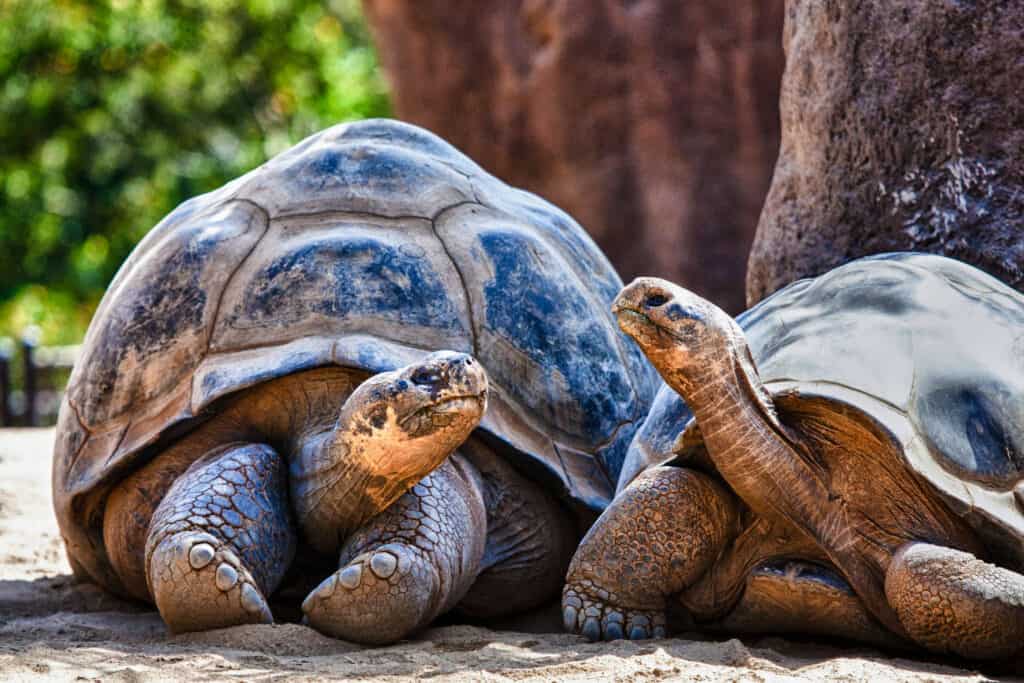
Galapagos Islands, Turtle, Tortoise, Animal, Discussion

Many efforts have been made to protect the island’s species of tortoises.

In the Zoo

The San Diego Zoo is one of the top worldwide refuges for captive Galapagos tortoises. They received the first batch of tortoises in 1928 to establish a North American population and save it from extinction. Four decades later, this morphed into a partnership with the Charles Darwin Research Station to help rear tortoises in captivity. The tortoise is also found at the Saint Louis Zoo, the Cincinnati Zoo and Botanical Gardens, the Houston Zoo, the Honolulu Zoo, the Philadelphia Zoo, and many others.

View all 261 animals that start with G

Sources

  1. San Diego Zoo / Accessed February 3, 2021
  2. National Geographic / Accessed February 3, 2021
  3. Animal Diversity Web / Accessed February 3, 2021
Heather Ross

About the Author

Heather Ross

Heather Ross is a secondary English teacher and mother of 2 humans, 2 tuxedo cats, and a golden doodle. In between taking the kids to soccer practice and grading papers, she enjoys reading and writing about all the animals!

Thank you for reading! Have some feedback for us?


Galapagos Tortoise FAQs (Frequently Asked Questions)

Galapagos Tortoises are Herbivores, meaning they eat plants.