


M
Species Profile

Mountain Lion

Puma concolor

One cat, many names, endless range
Scott E Read/Shutterstock.com

Mountain Lion Distribution

Click a location to explore more animals from that region

Loading map...

Found in 72 locations

Size Comparison

Human 5'8"
Mountain Lion 2 ft 6 in

Mountain Lion stands at 43% of average human height.

puma vs Mountain lion

At a Glance

Wild Species
Also Known As Panther, Catamount, Mountain cat, Painter
Diet Carnivore
Activity Crepuscular+
Lifespan 10 years
Weight 120 lbs
Status Least Concern
Did You Know?

One species, many names: "puma" (Quechua origin), "cougar" (from older European forms), plus mountain lion and catamount in North America.

Scientific Classification

The mountain lion (cougar/puma) is a large, solitary felid native to the Americas, notable for its wide range and adaptability across many habitats.

Kingdom
Animalia
Phylum
Chordata
Class
Mammalia
Order
Carnivora
Family
Felidae
Genus
Puma
Species
concolor

Distinguishing Features

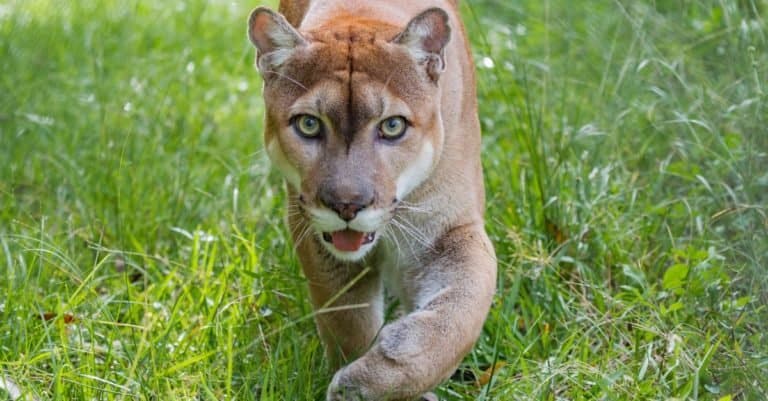
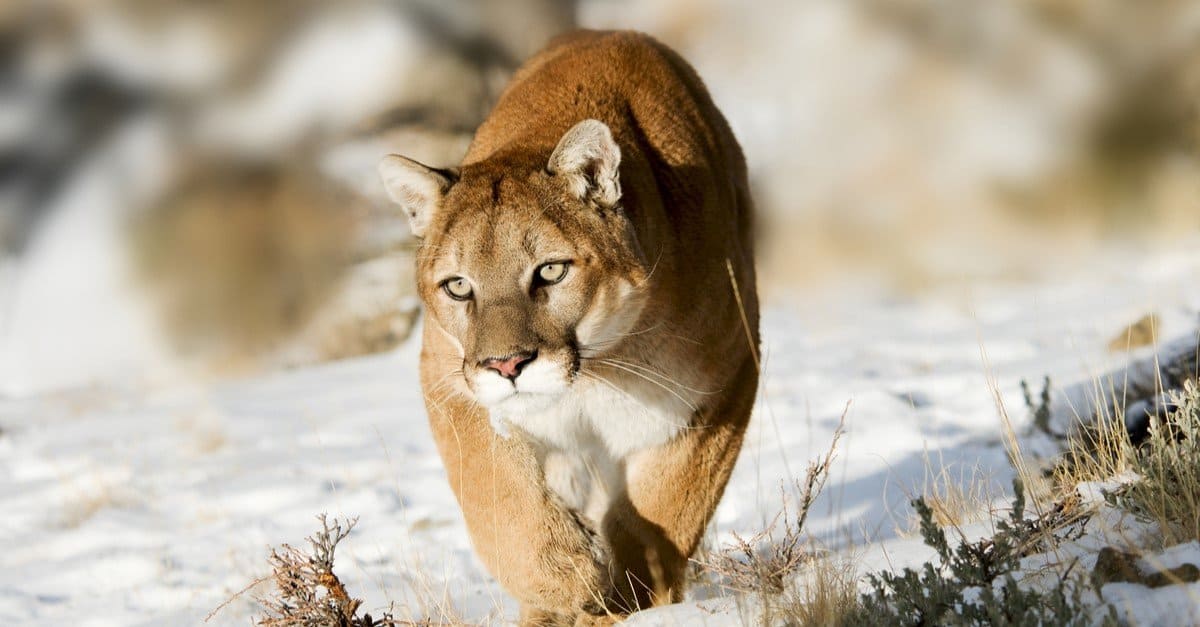
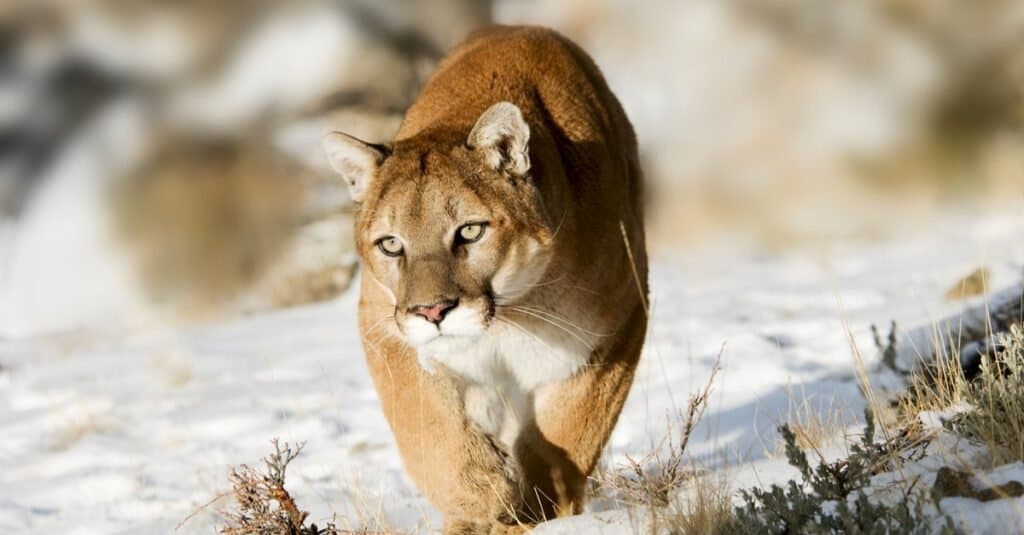
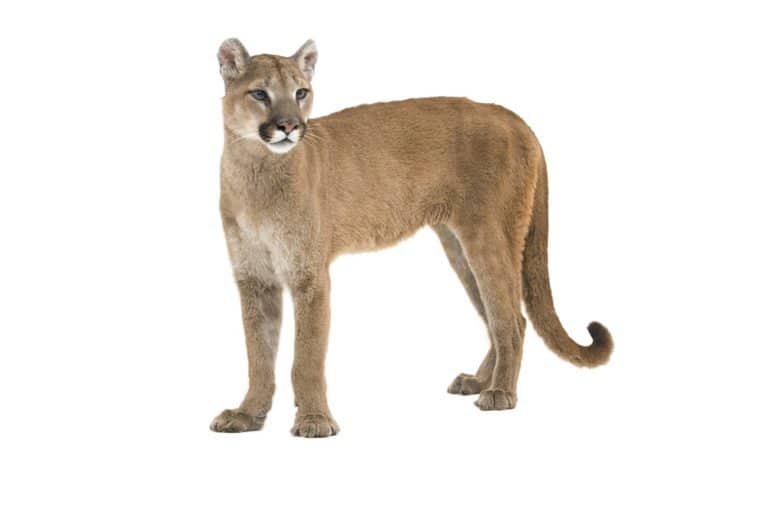
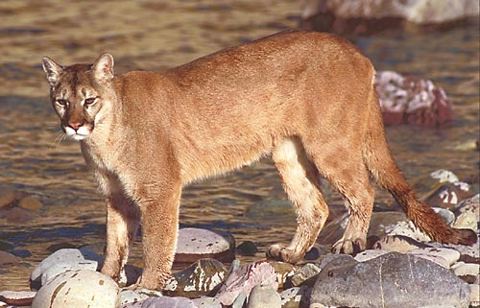
  • Uniform tawny/tan coat with lighter underside
  • Long, thick tail (often with a darker tip)
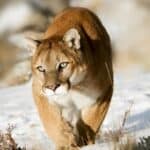
  • No rosettes/stripes (unlike jaguars/leopards/tigers)
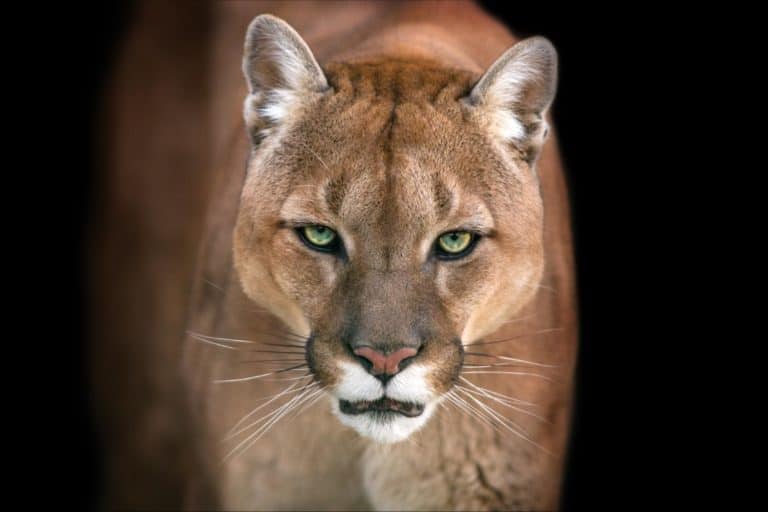
  • Broad face with black-backed ears and pale muzzle

Physical Measurements

Males and females differ in size

Height
2 ft 3 in (1 ft 12 in – 2 ft 6 in)
2 ft 2 in (1 ft 12 in – 2 ft 6 in)
Length
1 in (1 in – 1 in)
6 ft 9 in (5 ft 5 in – 8 ft 1 in)
Weight
154 lbs (117 lbs – 220 lbs)
90 lbs (64 lbs – 141 lbs)
Tail Length
2 ft 4 in (1 ft 12 in – 2 ft 7 in)
2 ft 7 in (2 ft 1 in – 3 ft 2 in)
Top Speed
40 mph
running

Appearance

Primary Colors
Secondary Colors
Skin Type Short, dense fur over tough, flexible mammalian skin; seasonally variable thickness by latitude/elevation.
Distinctive Features
  • Multiple common names: mountain lion, cougar, puma, catamount; not a Panthera 'big cat'.
  • Head-body length typically 1.02-1.54 m; tail length 0.53-0.95 m.
  • Shoulder height commonly ~60-76 cm; long-limbed, built for bursts of speed and jumping.
  • Adult mass: males ~53-100 kg; females ~29-64 kg (values reported across North American studies).
  • Long, heavy tail used for balance; tail tip distinctly black in most individuals.
  • Rounded ears with black backs; pale muzzle with darker facial edging and prominent whisker pads.
  • Solitary, territorial ambush predator; primarily crepuscular/nocturnal where humans are present.
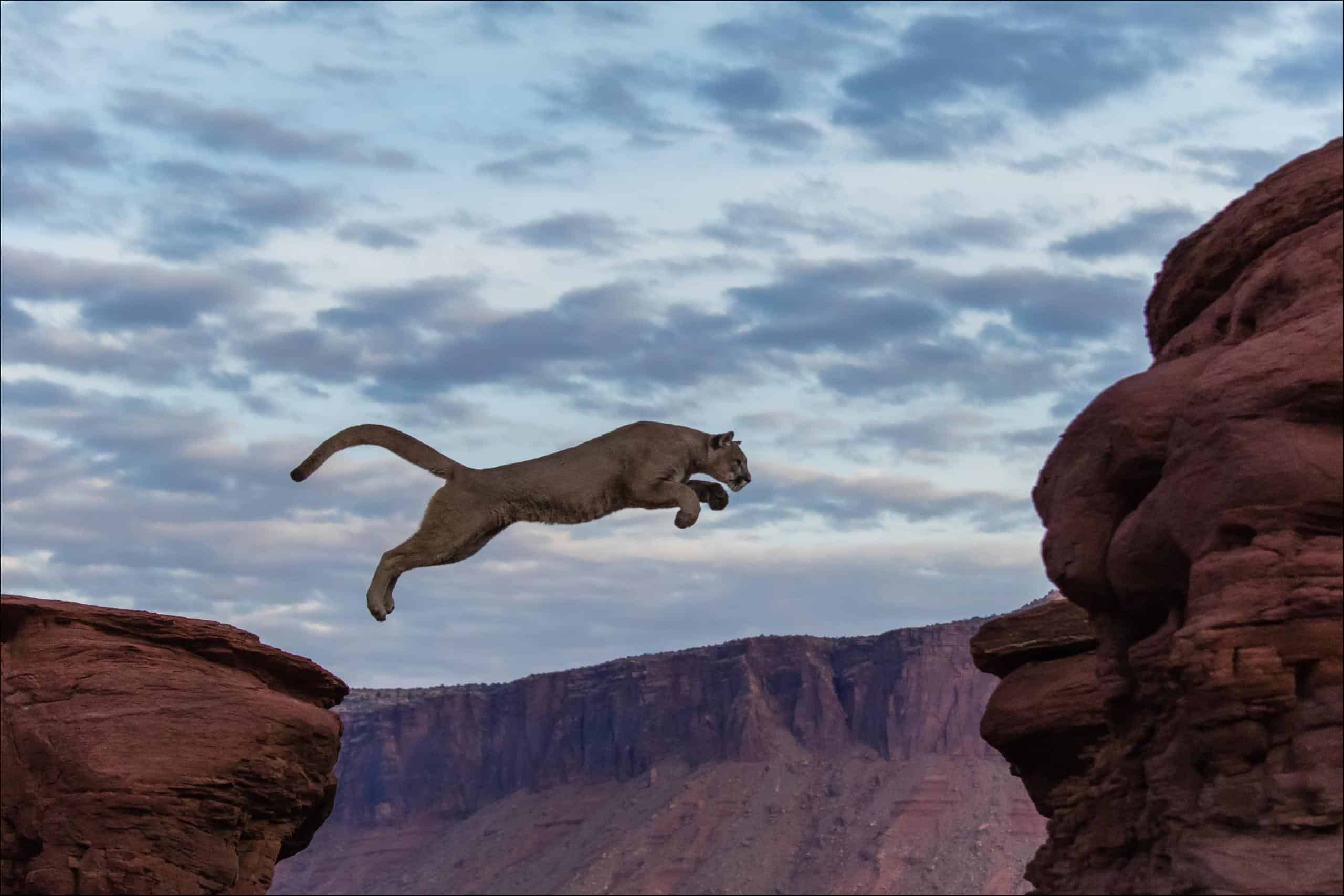
  • Powerful leaper: reported vertical jumps up to ~5.4 m and horizontal jumps up to ~12 m.
  • Wide range and adaptability: from Canada through the Andes, occupying deserts, forests, mountains, and scrub.
  • Ecological role varies by region: apex predator where larger carnivores absent; mesopredator alongside wolves/bears/jaguars.
  • Typical wild lifespan about 8-13 years; can reach ~20 years in captivity (zoo/managed care reports).

Sexual Dimorphism

Sexual dimorphism is mainly size-based: adult males average substantially heavier and more robust than females. Males often show a broader head/neck and heavier forequarters, while coat coloration and pattern are similar between sexes.

  • Larger average body mass (~53-100 kg) and more muscular build.
  • Broader skull and thicker neck; heavier forequarters.
  • Often larger overall linear dimensions within the species' range.
  • Smaller average body mass (~29-64 kg) and more slender build.
  • Narrower head/neck; lighter forequarters.
  • Same tawny coat and markings; differences are primarily size and robustness.

Did You Know?

One species, many names: "puma" (Quechua origin), "cougar" (from older European forms), plus mountain lion and catamount in North America.

Adults are long and lanky: total length ~1.5-2.75 m including a 63-95 cm tail; shoulder height ~60-76 cm.

Typical mass is strongly sex-biased: females ~29-64 kg; males ~53-100+ kg (regional variation is large).

They can't roar (no specialized larynx like Panthera cats); instead they purr, chirp, growl, and can give a piercing scream.

Explosive athleticism: recorded leaps are up to ~5.5 m vertically and ~12 m horizontally, helping them ambush prey from cover.

Reproduction is relatively slow for a large carnivore: gestation ~91-96 days; litters usually 1-6 (commonly 2-3) kittens.

Dispersing young males can travel astonishing distances; documented individuals have moved thousands of kilometers while searching for territory.

Unique Adaptations

  • Powerful hindquarters + flexible spine: optimized for sudden acceleration and jumping-key to a short-range ambush lifestyle.
  • Long tail (63-95 cm): acts as a counterbalance and steering aid during rapid turns and leaps on uneven terrain.
  • Large, well-padded paws and retractile claws: improve silent stalking, traction, and grappling on steep or rocky substrates.
  • Exceptional ecological plasticity: occupies habitats from near sea level to high mountain environments, including deserts, chaparral, temperate rainforest, and boreal edges.
  • Low-profile morphology: relatively small head and streamlined body help it move through dense cover and approach prey undetected.

Interesting Behaviors

  • Solitary territoriality: adults typically live alone, with overlapping ranges mainly between males and females; males exclude rival males via scent marks and avoidance.
  • Ambush predation: relies on stalking and short bursts rather than long chases; commonly targets deer-sized ungulates where available, but switches to smaller prey in other habitats.
  • Caching kills: often drags prey to cover and partially buries it with leaves/soil; returns to feed over multiple days, reducing detection by scavengers.
  • Scrape-marking: makes small ground scrapes (often with urine/feces nearby) as communication signposts along travel routes and territory edges.
  • Crepuscular/nocturnal flexibility: activity peaks often occur at dawn/dusk, but timing shifts with human presence, prey behavior, and temperature.
  • Quiet kitten rearing: females den in rocky crevices/thickets; kittens are born spotted and remain with the mother for ~12-24 months before dispersing.
  • Intraguild interactions: may avoid or be displaced by wolves/bears/jaguars depending on region; where it dominates, it functions as an apex predator, but elsewhere as a mesopredator.

Cultural Significance

Puma concolor (mountain lion, cougar) is feared and respected across the Americas. It is a symbol of power, stealth, and protection. In the Andes it links to strength and the earth; in North America it shapes place names and conservation for connected habitats.

Myths & Legends

Andean/Quechua-Inca tradition: the puma is one of the three sacred animals in a common Andean triad (often condor-puma-serpent), representing the middle/earthly world and strength in life and warfare.

Cusco origin symbolism (Inca): the imperial city is widely said in tradition to have been laid out in the shape of a puma, tying the animal to authority, protection, and the ordered human world.

Zuni/Pueblo traditions (U.S. Southwest): mountain lion is a powerful guardian figure associated with directionality and protection in ceremonial cosmology (often described as a directional guardian/warrior spirit).

Appalachian/New England folklore (U.S.): "catamount" stories describe a ghostly big cat whose scream foretells danger; the animal became a figure in frontier tales and local superstition about wild places and omens.

Conservation Status

LC Least Concern

Widespread and abundant in the wild.

Population Decreasing

Protected Under

  • CITES Appendix II (Puma concolor)
  • Legal protection/regulated harvest varies by jurisdiction across the Americas; many areas manage the species under wildlife laws, with stricter protections in select regions and protected areas (national parks/reserves).

Life Cycle

Birth 3 cubs
Lifespan 10 years

Lifespan

In the Wild
3–18 years
In Captivity
12–20 years

Reproduction

Mating System Polygynandry
Social Structure Solitary
Breeding Pattern Transient
Fertilization Internal Fertilization
Birth Type Internal_fertilization

Solitary adults; males' home ranges overlap several females and both sexes can have multiple mates. During estrus (~8 days) pairs associate 2-5 days with repeated copulations; internal fertilization. Gestation 82-96 days; females rear 1-6 (usually 2-3) cubs alone.

Behavior & Ecology

Social None (solitary); mother-and-kittens family unit Group: 1
Activity Crepuscular, Nocturnal, Cathemeral
Diet Carnivore Deer (especially mule deer and white-tailed deer; Odocoileus spp.)

Temperament

Strongly solitary and territorial; social contact mainly during mating and maternal care (Hornocker & Negri 2010).
Ambush predator; stalk-and-pounce hunting with short chases, prioritizing cover and surprise (Currier 1983).
Generally avoidant of humans; becomes more nocturnal/secretive near human activity (e.g., Beier et al. 1995).
Intraspecific tolerance low; same-sex overlap limited, with male ranges often encompassing multiple females (Logan & Sweanor 2001).
Reproductive behavior: polygynous tendencies; litters 1-6 kittens (mean commonly ~2-3) (Logan & Sweanor 2001).
Longevity: commonly ~8-13 years in wild; documented to ~18; captivity often ~20 years (Currier 1983; AZA husbandry summaries).

Communication

hiss and spit during defensive encounters
growls, snarls, and yowls during aggression
purr/chirp-like calls between mother and kittens
loud caterwaul/scream associated with estrus and mating interactions
scent marking via urine spray and feces placement along travel routes
scrapes (hind-foot raking) often paired with urine to advertise territory
claw marking on trees and ground to leave visual and scent cues
body posture and facial expressions (ears flattened, tail position) during conflict

Habitat

Biomes:
Tropical Rainforest Tropical Dry Forest Savanna Desert Hot Desert Cold Mediterranean Temperate Grassland Temperate Forest Temperate Rainforest Boreal Forest (Taiga) Tundra Alpine Freshwater Wetland +8
Terrain:
Mountainous Hilly Plateau Plains Valley Coastal Island Riverine Rocky +3
Elevation: Up to 19028 ft 11 in

Ecological Role

Apex predator (or dominant large carnivore in many systems) that structures ungulate populations and behavior and subsidizes scavenger communities via cached kills and carrion.

Top-down regulation of ungulate prey (especially deer), helping limit overbrowsing pressure on vegetation Behavioral effects on prey (risk-driven habitat use), contributing to trophic cascades in some ecosystems Carrion provisioning: cached/partially consumed kills feed scavengers (e.g., vultures, corvids, canids, bears, small carnivores), increasing food-web connectivity Selective predation that can remove vulnerable individuals (young, old, injured), potentially influencing prey population health Potential mesopredator suppression/competitive effects in some regions (e.g., interference with coyotes), altering community dynamics

Diet Details

Main Prey:
Mule deer White-tailed deer Wapiti Bighorn sheep Pronghorn Moose Collared peccary Beaver Porcupine Snowshoe hare and other rabbits/hares Raccoon Skunks Armadillo Small rodents Ground-nesting birds Reptiles +10

Human Interaction

Domestication Status

Wild

Puma concolor (mountain lion, cougar, puma) is not domesticated and has no domestication history. Some are kept in zoos or private collections but keep wild behavior (solitary, territorial ambush predator). Human interactions include suburb coexistence, livestock and pet losses, roadkill, ecotourism, research, and conservation. Listed CITES II.

Danger Level

Moderate
  • Rare but potentially fatal attacks: cougars can target humans as prey under specific circumstances (e.g., small children, lone runners/cyclists, dawn/dusk encounters, habituation/food-conditioning, or defensive encounters near kittens). Documented attacks in North America are uncommon relative to human exposure but include fatalities (Cougar Management Guidelines Working Group 2005; state/provincial incident summaries).
  • Defensive aggression at close range: cornered animals, wounded individuals, or females with kittens may charge or bite/claw.
  • Human-cougar interface drivers: expanding development into habitat, prey concentration (deer) near suburbs, attractants (pet food, unsecured carcass disposal), and habitat corridors that channel movement.
  • Secondary hazards: vehicle collisions (risk to drivers), and handling risks to professionals (wildlife officers, researchers, rehab staff) during capture/transport.
  • Disease/parasite considerations are generally low for casual contact but include typical felid zoonoses/parasites if handling tissues (e.g., ectoparasites; pathogens associated with carnivore carcass handling); primary risk to the public remains physical attack rather than disease.

As a Pet

Not Suitable as Pet

Care Level: Expert Only

Purchase Cost: $2,000 - $8,000
Lifetime Cost: $120,000 - $300,000

Economic Value

Uses:
Ecosystem value (apex/mesopredator regulation; trophic effects) Wildlife management and research funding Ecotourism / wildlife viewing Regulated hunting revenue (where legal) and depredation-control programs Negative economic impacts (livestock losses; pet losses; fencing/guarding costs) Public safety and infrastructure costs (conflict response; roadkill mitigation; corridor projects) Cultural/educational value (symbolism, outreach programs, zoos)
Products:
  • Hunting licenses/tags and associated fees (jurisdiction-dependent)
  • Trophies (where legal) and historically pelts (now regulated/limited depending on location)
  • Zoo/exhibit attendance and educational programming
  • Research outputs and monitoring contracts (GPS collaring, genetic sampling, conflict assessment)
  • Mitigation services and equipment (predator-proof fencing, fladry/alarms, guard animals, compensation programs)

Relationships

“Can jump to the height of a two-story building!”

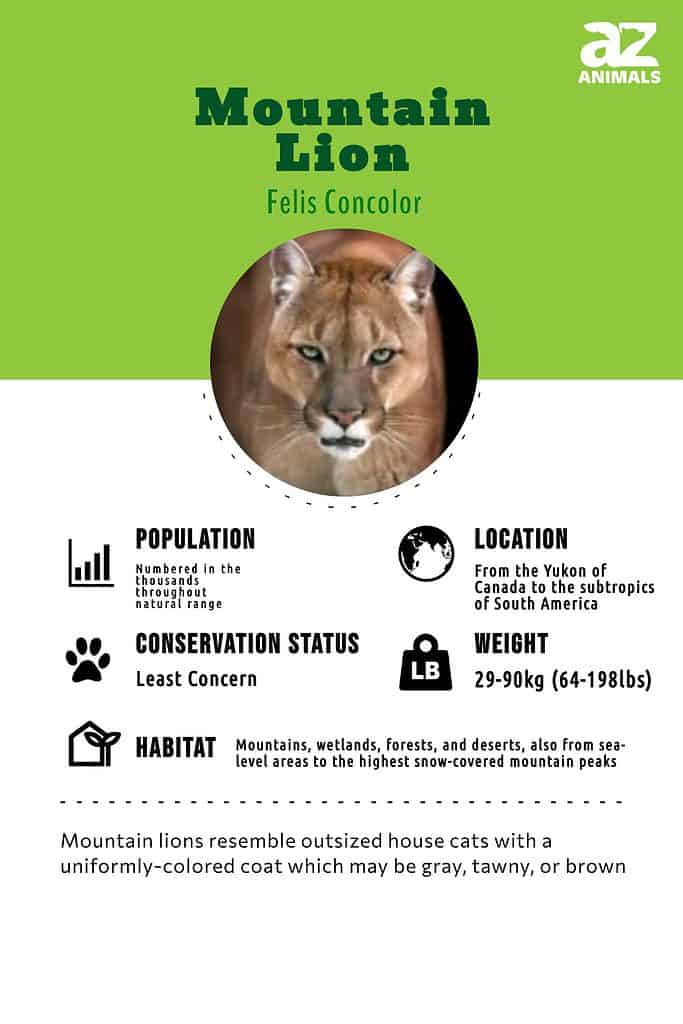
The mountain lion is a large, tan colored cat species native to North America, Central America and South America. In the United States, these cats live primarily in western states and Florida. Also called by the name cougar, puma, catamount and panther, mountain lions are animals that thrive in many habitats. They live in more geographies than any other Western Hemisphere mammal, besides humans.
Top Facts

  • Cry like house cats: Mountain lions do not roar, instead using a distinct mountain lion scream, growl, hiss, meow and purr
  • Changing eye color: Cubs are born with blue eyes that change to yellow by age 16 months
  • Solitary life: These lions prefer to live alone on about 30 square miles of territory
  • Fast runners: They can run at speeds up to 50 miles per hour

Want more mountain lion facts? Give ‘11 Incredible Mountain Lion Facts‘ a read for a deep dive into the most incredible facts about these majestic animals!

Scientific Name

The mountain lion’s scientific name is Puma concolor, from the Spanish word puma of Latin origin. The name translates to mean “mountain lion” in Spanish, French, German and other Latin-based languages. The big cat’s phylum is Chordata, in the class Mammalia, order Carnivora, family Felidae and genus Puma. Early Spanish explorers of the Americas called the cat “leon,” meaning lion and “gato monte, meaning mountain cat. Incas called it “puma,” while early South American Indians called it “cuguacuarana,” from which the word “cougar” comes. Most scientists prefer to call these cats “pumas.” These cats have about 40 names in the English language, including panther, puma, cougar, catamount, painter, mountain screamer, red tiger, Mexican lion and American lion. Six subspecies live in North America, Central American, eastern South America, northern South America, central South America and southern South America.

Types

There are two main mountain lion subspecies:

  • South American cougar (Puma concolor concolor): This subspecies is found in countries which include Argentina, Bolivia, Chile, Colombia, Peru, and Venezuela.
  • North American cougar (Puma concolor couguar):  This subspecies lives in Canada, Central America, Florida, Mexico, and the western United States.

Appearance & Behavior

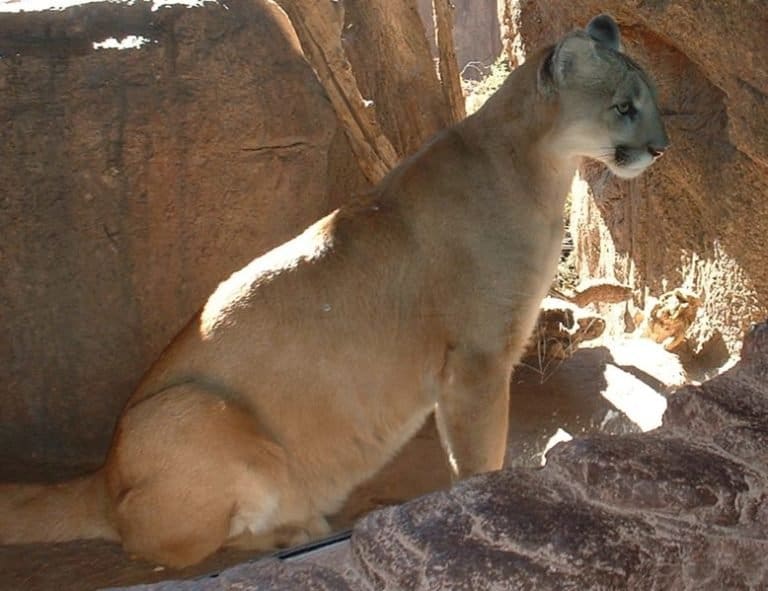
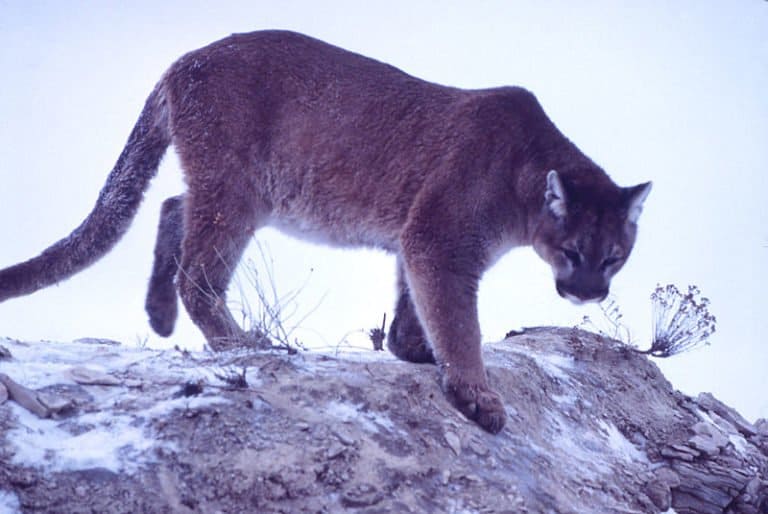
These predators look very much like over-sized short-hair house cats. They have small heads with short faces. Ears are rounded and small. Their bodies are long and sleek, with long necks and tails. Puma legs are powerful, suited to rapid increase of speed and made for pouncing. The cats’ teeth seize their prey, tearing and slashing the meat.

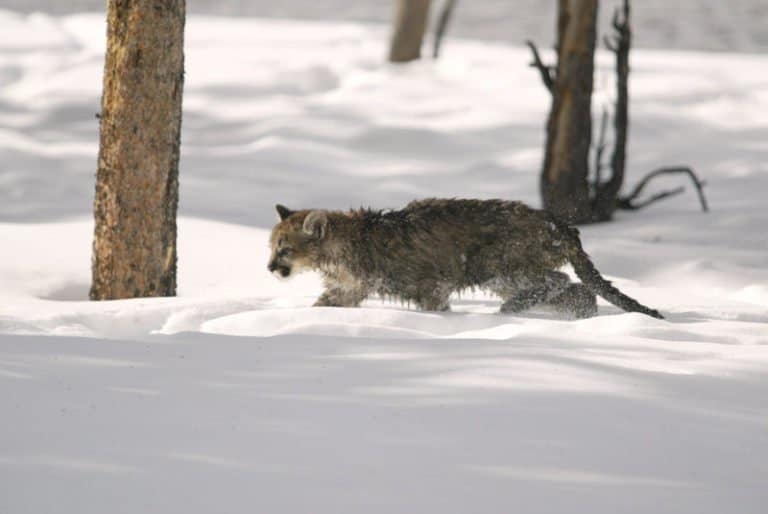
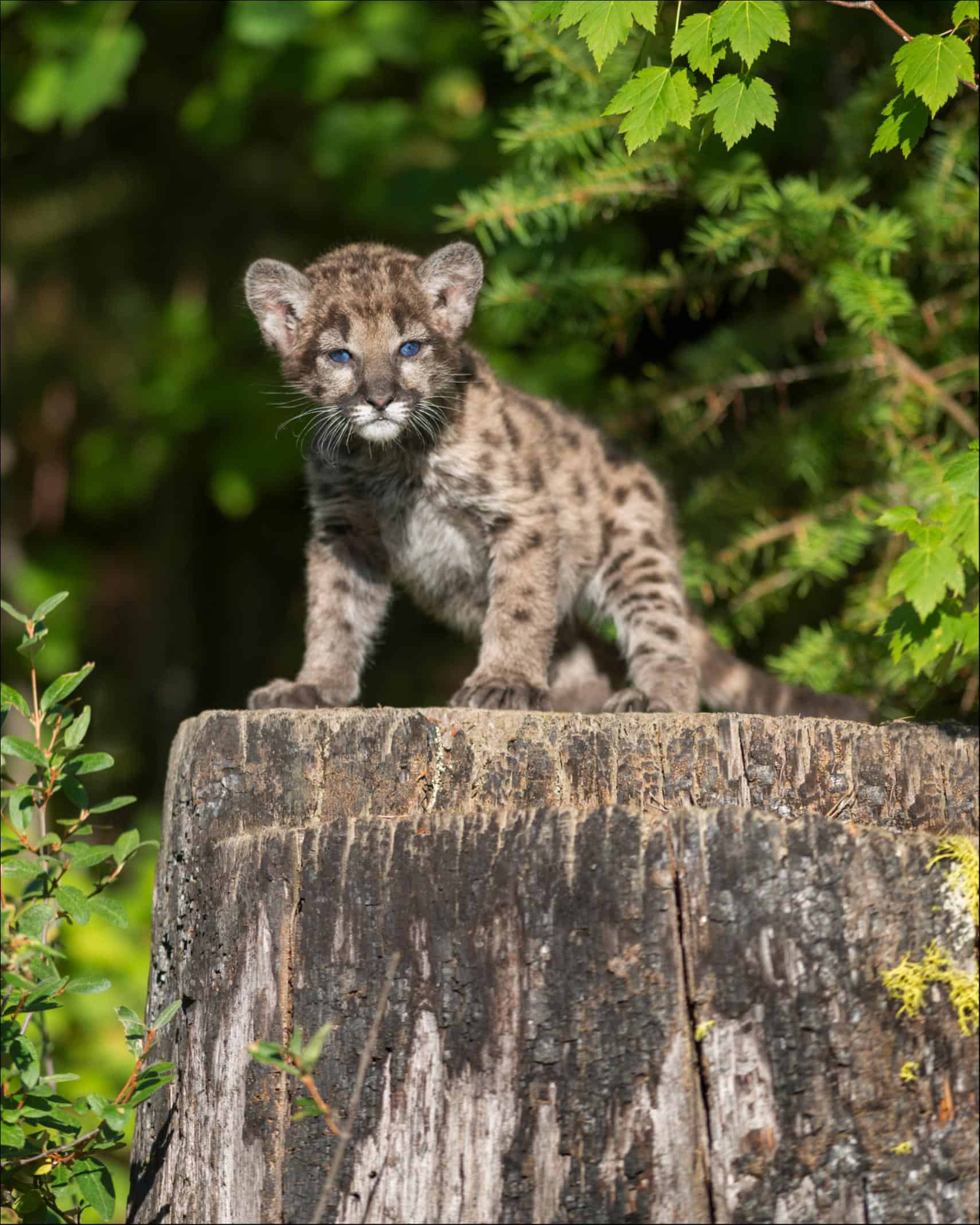
The average mountain lion is an animal that ranges from about 3’3″ in length to about 5’5″. But with their tails, some males measure as long as nine feet and females up to seven feet. The cats stand between two feet and 2’6″ from the ground to their shoulders. In adulthood, females weigh from 80 to 100 pounds and males from 125 to 160 pounds. Mountain lion color in the United States is most commonly tan. Throughout the Americas, their color ranges from a tawny color to a bluish gray. Their bellies, inner legs and throats are always lighter in color, with their noses and tails having black or dark edges. Babies are born with spots to camouflage them in the wild. These spots fade at about six months. Their blue eyes also change to yellow by the age of 16 months.
Mountain lions are solitary by nature. They sometimes share territory with one other puma, but prefer a 30 square mile range to call their own. Some mountain lions maintain a territory of up to 125 square miles. They live in habitats of all kinds in the Western Hemisphere, from mountainous regions to the swamps of Florida. Humans rarely see mountain lions, as they are nocturnal and prefer to remain hidden. But they are stealthy creatures that stalk their prey. Pumas are very intelligent. They avoid humans whenever possible.

Mountain lions are at the top of the food chain. They keep deer populations in balance and even help reduce the number of vehicle accidents involving deer. Although brown bears will kill and eat mountain lions, sometimes the lions win in fights against these giant bears. Humans and domestic animals must watch out for mountain lions, when we cross into their habitats. Puma avoid humans whenever possible. But people sometimes cross their paths on hiking trails or out in the wilderness.

To know how dangerous mountain lions are, read here.

Evolution

Experts assert that the mountain lion’s ancestor first appeared in Asia about 11 million years ago. Three million years later, it would cross the Bering land bridge to North America. In its new home, it would differentiate into different genetic strains, including those responsible for wild and domestic felines, ocelots, oncillas, lynxes, and mountain lions.

About 2 – 4 million years ago, these cats entered South America, crossing the Isthmus of Panama. However, the population of mountain lions in North America diminished, and those which are found there today are actually their relatives which returned to their original home from the southern part of the Americas.

 Between 6 to 4 million years later, these felines would make their way to South America by way of the Isthmus of Panama. 

It is worth noting that certain experts believe that the North American population of pumas eventually dwindled and that present-day cougars are actually arrivals which retraced their steps from South America to North America at a later date.

Habitat

Mountain lions live throughout the Americas, from the Yukon of Canada to the subtropics of South America. No other American mammal, except humans, spans such a wide land range. They can live in almost any type of habitat, such as mountains, wetlands, forests and deserts, also from sea-level areas to the highest snow-covered mountain peaks. Although they prefer 14 western states of the United States, puma in the U.S. are also found in low numbers in Florida. These cats also roam as far as the northeastern states from time-to-time. Mountain lions live in areas with dense shrubbery, undergrowth and other plant life for cover. If they feel threatened, they leave the area. The average lifespan for a wild mountain lion is about ten years. But in zoos, many live for 20 or more years. Because of sport hunting in some regions, the cats in those areas only live to about five years of age.

Throughout their lifetime, mountain lions prefer to live alone. Only for mating and parenting do they break this rule. They mark their territory by urinating on piles of leaves, pine needles or grass and clawing trees. This tells other lions to stay away. If another lion crosses into the territory, the two will fight to their death if necessary. The cats’ coat color varies from region to region. Where they live determines this color. With the ability to blend into their surroundings, mountain lions easily prey on deer and small mammals.

They eat coyotes, raccoons, rabbits and porcupine. To preserve their killed prey and protect it from scavengers, they bury it and return to feed off of it for several days. Mountain lions’ large hind legs have greater muscle mass than their front legs. This enables them to jump up to 18 feet into a tree and 20 feet up or down a hill. They run very fast, with their flexible spine allowing them to change direction and move around obstacles quickly. Their large paws keep them steady, with sharp claws for defense and attacking prey. Keen eyesight helps them find their prey.

Predators & Threats and Diet

The biggest threats to mountain lions are humans. These cats are apex predators, near the top of the food chain. They are sometimes killed by brown bear or as part of territory fights with other mountain lions. Mountain lions once lived from the east coast of America to the west coast. But people feared the big cats and believed them to be predators of livestock. So by the 1940s, many states paid bounties for killing of the lions. Each pelt once brought a reward of $25 to $35. This reduced their numbers by far, restricting the cat population mostly to the western coast and a small number in Florida. Despite laws in place to protect them in many parts of the U.S., some people still illegally trap, poison and shoot the lions on sight. Hunting is still legal in some form in many states, such as Utah, Idaho, Wyoming, Montana, Colorado, New Mexico, Nebraska, North Dakota, South Dakota, Nevada, Arizona, Texas, Washington and Oregon.

Mountain lions are carnivores that are apex predators across much of their environment. Their favorite meals include mule deer, badgers, raccoons, and other mammals. For a complete analysis of their diet, give our ‘What Do Mountain Lions Eat? 20 Animals in Their Diet’ page a read!

Reproduction, Babies and Lifespan

Mountain lion females can mate with several males in one reproductive season, called estrus. Typically, the female prefers to mate with a male from an overlapping territory. The three to 10 days of a mating period is the only time humans see males and females together. Otherwise, they remain solitary animals and avoid contact. For both females and males, sexual maturity occurs at about one to 2.5 years old.

Females do not try to reproduce until they have established their own territory. Females with cubs move from one place on their territory to another every few weeks. This helps her protect the cubs from roaming males and other predators. Mating occurs throughout the year, when the female is in estrus. But most litters are born during the warm months of summer, particularly July to September. Females produce a litter every 1.5 to two years, on average. But if she loses a litter, she quickly enters estrus again. Gestation, also called pregnancy, for a mountain lion is about 90 days. Gestation for a mountain lion is short compared to other large land animals. But it compares closely to other lions and their tiny cousins, domestic house cats.

  • Human: 270 days
  • Brown bear: 215 days
  • African lion: 110 days
  • House cat: 58 to 67 days
  • Mountain lion: 90 days

Most litters include two to three spotted, blue-eyed cubs, sometimes called kittens. Sometimes only one or as many as four are born. By six months of age, the fur has changed to a tawny, unspotted coat like adults. Their blue eyes change to yellow by the age of 16 months. Kittens nurse for three months. They start eating a meat at one and a half months, then eating meat exclusively after weaning. As they grow in their adult coats at six months, they start hunting with their mother. Babies are cared for by their mother until one to two years of age, when the cubs must strike out on their own. Where hunted, such as in U.S. states that permit some hunting of mountain lions, the average lifespan for one of these cats is about five years. Left to live a natural lifespan in the wild, most live about 13 years. The average lifetime for these big cats in zoos is about 19 years, although some live beyond 20.
Population

As of 2015, the existing mountain lion population is listed as decreasing due to diminishing habitat, but stable. Overall, the species is not endangered. This is with a few exceptions, including the subspecies of Florida panthers and the now extinct eastern cougar. The eastern cougar was declared officially extinct in 2011 by the U.S. Fish & Wildlife Service. In Florida, only 160 panthers remain. One of the biggest problems in mountain lion conservation is the lack of clear lion counts over the past decades. States and other countries are working now to establish clear counts, such as in California. But thousands of these cats are known to exist in the U.S., as well as throughout Central America, Canada and South America. In California, the Fish and Wildlife’s Wildlife Investigations Laboratory has set a goal to know a precise statewide mountain lion count by 2022.

Additionally, there are 15 US states that have a stable breeding population of mountain lions.

View all 330 animals that start with M

Sources

  1. David Burnie, Dorling Kindersley (2011) Animal, The Definitive Visual Guide To The World's Wildlife / Accessed November 10, 2008
  2. Tom Jackson, Lorenz Books (2007) The World Encyclopedia Of Animals / Accessed November 10, 2008
  3. David Burnie, Kingfisher (2011) The Kingfisher Animal Encyclopedia / Accessed November 10, 2008
  4. Richard Mackay, University of California Press (2009) The Atlas Of Endangered Species / Accessed November 10, 2008
  5. David Burnie, Dorling Kindersley (2008) Illustrated Encyclopedia Of Animals / Accessed November 10, 2008
  6. Dorling Kindersley (2006) Dorling Kindersley Encyclopedia Of Animals / Accessed November 10, 2008
  7. David W. Macdonald, Oxford University Press (2010) The Encyclopedia Of Mammals / Accessed November 10, 2008
Dana Mayor

About the Author

Dana Mayor

I love good books and the occasional cartoon. I am also endlessly intrigued with the beauty of nature and find hummingbirds, puppies, and marine wildlife to be the most magical creatures of all.
Connect:

Thank you for reading! Have some feedback for us?


Mountain Lion FAQs (Frequently Asked Questions)

Mountain lions go by a number of names and are sometimes even called panthers. However, the name “panther” can be applied across a number of big cats and is often used when referring to the melanistic jaguar that’s doesn’t have visible spots.