
5 Facts
• This bear is also called the Andean bear because it lives near the Andes mountains in South America
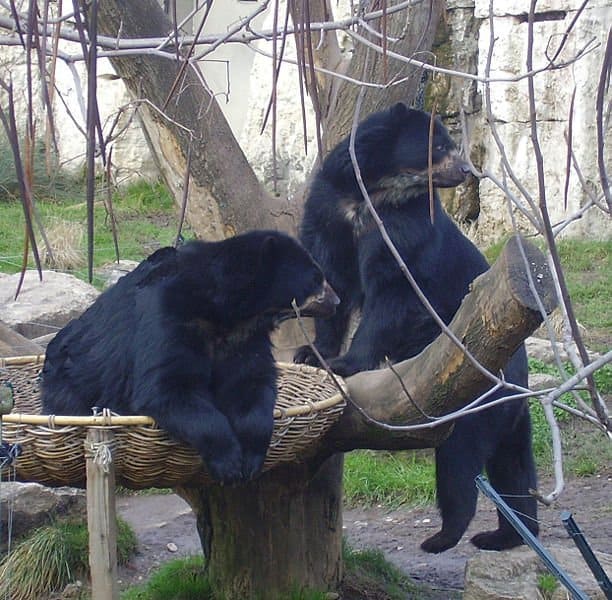
• Spectacled bears make a platform or nest of sturdy branches in a tree where they can eat and sleep
• These bears are active throughout the year because food is available to them year-round
• Spectacled bears like to live alone
• These bears eat fruit and plants with spiny leaves as well as insects and rodents
Evolution and Scientific Name
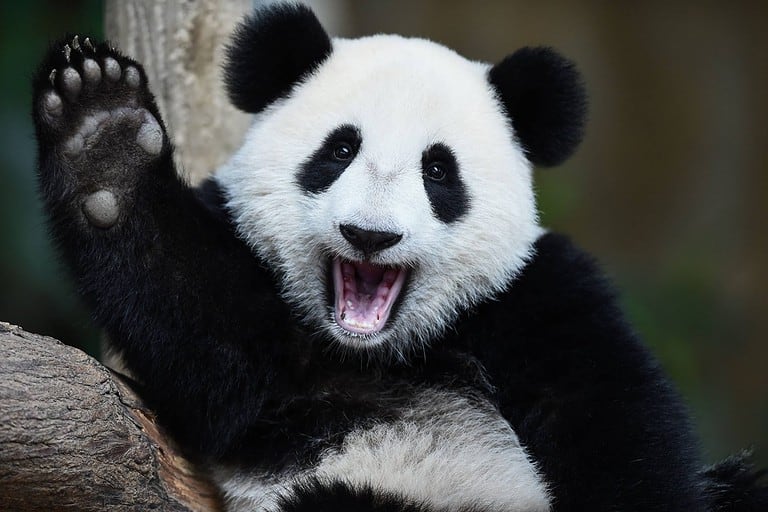
The original bears from 30 million years ago looked like badgers. About 20 million years ago, a new branch on the evolutionary tree resulted in the Panda Bear. Then 10-13 million years ago, the Tremarctinae appeared in North America. The Tremarctinae was the ancestor of the huge, carnivorous Short-Faced Bear (4-5 million years ago) and the Spectacled Bear. The Short-Faced Bear became extinct 2-3 million years ago, as did the North American or Florida Spectacled Bear (tremarctos floridanus).
Fortunately, the South American Spectacled Bear survived, and it is the only bear in South America. Tremarctos ornatus is its scientific name. It’s sometimes called the Andean bear, the Andean short-faced bear, or the Mountain bear. It belongs to the Ursidae family in the class Mammalia.
Tremarctos ornatus is a Greek word. Trem means hole while arctos means bear. The word hole is a reference to a hole in the humerus bone of this particular bear. The word ornatus means decorated. Decorated refers to the unusual coloration of this bear’s fur.
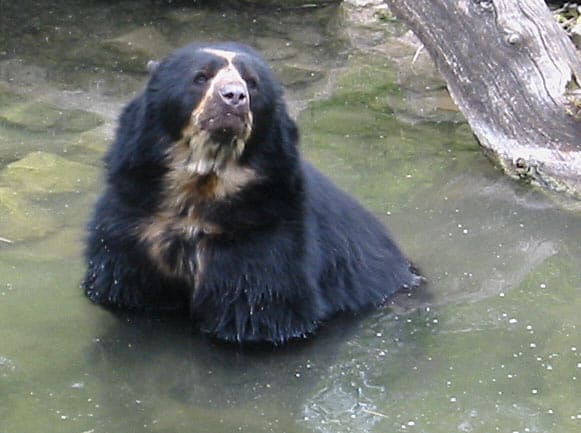
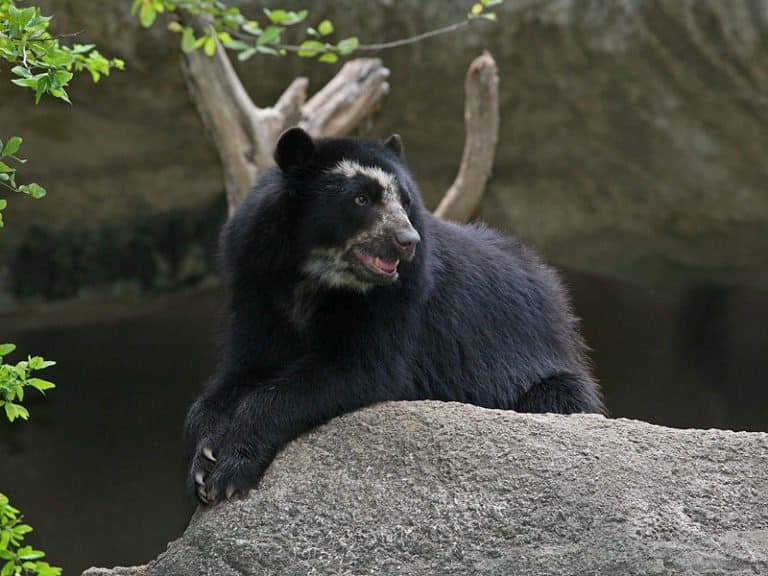
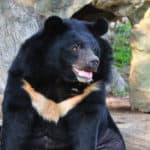
The distinctive tan fur markings on this Spectacled Bear make it easily identifiable.
©Lars Haefner / Creative Commons – Original
Appearance and Behavior
The fur on the body of a spectacled bear is black and brown. These bears have white or light-colored fur creating a half-circle pattern around both their eyes. Every spectacled bear has a unique pattern of white markings on the fur that covers its head, neck, and chest. No two spectacled bears look the same! Scientists think of these markings as the bear’s ‘fingerprint.’
Male bears are about twice as large as females. Males can grow to 6 and a half feet long weighing from 220 to 380 pounds. To put it into perspective, a 6-foot bear is equal in length to the average grown adult man. A 380-pound bear is equal in weight to two adult kangaroos!
A female bear weighs between 130 to 170 pounds and is about 3 and a half to 4 feet long. A female bear weighing 170 pounds is about as heavy as just one adult kangaroo.
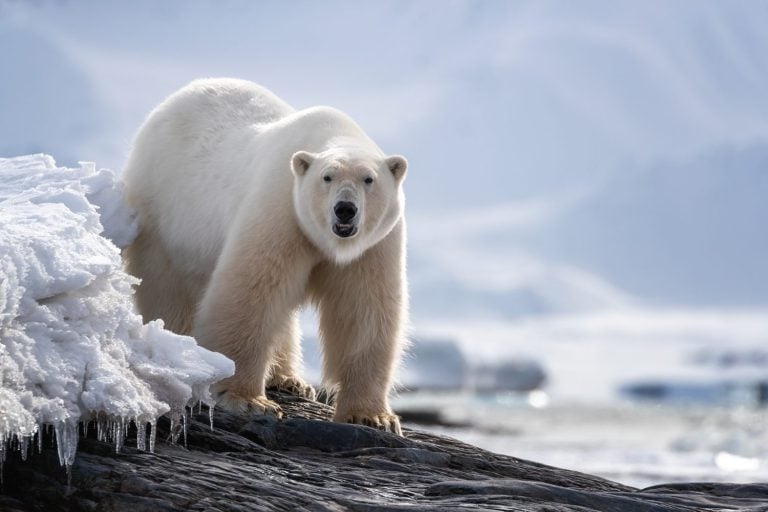
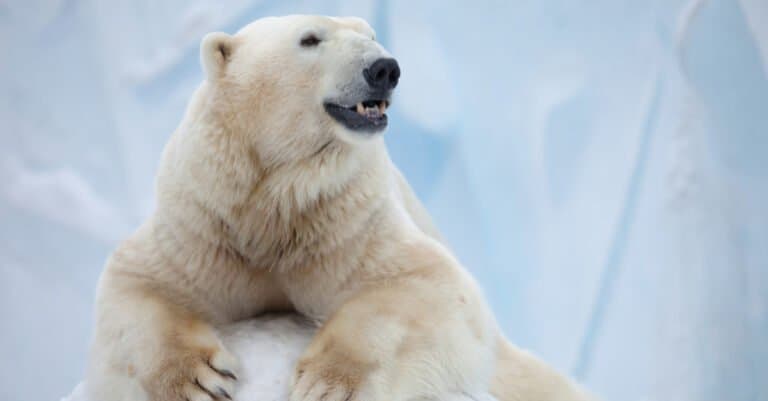
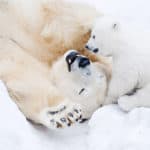
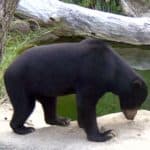
These bears are one of the smallest species of bears in the world. The polar bear is the largest bear in the world while the sun bear is the smallest. As a comparison, a male polar bear ranges from 8 to over 9 feet in length while a male spectacled bear can be as long as 6 and a half feet.
These bears are solitary, shy animals. They stay hidden from sight most of the time. Of course, they are seen together during the breeding season. They are said to communicate with other bears with screeching, cooing, and purring sounds. Like the sun bear, the spectacled bear stays active year-round. They don’t go into hibernation like many bear types because they have a food source available to them throughout the seasons.
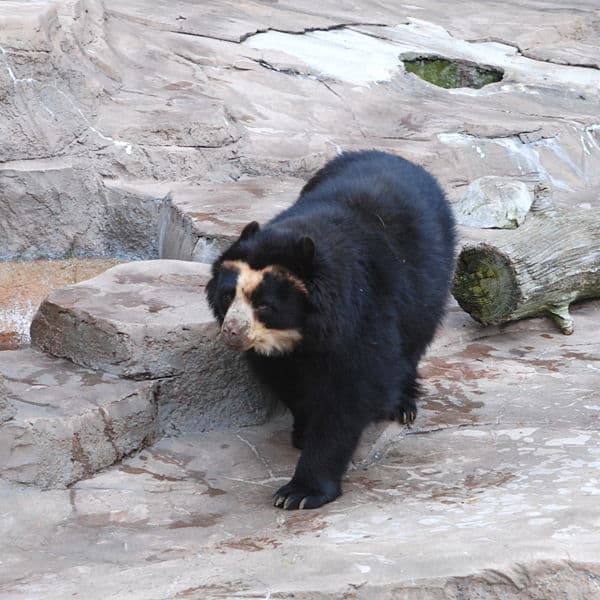
Spectacled Bear walking on rocks in the Andes Mountains.
©Kuribo / Creative Commons – Original
Habitat
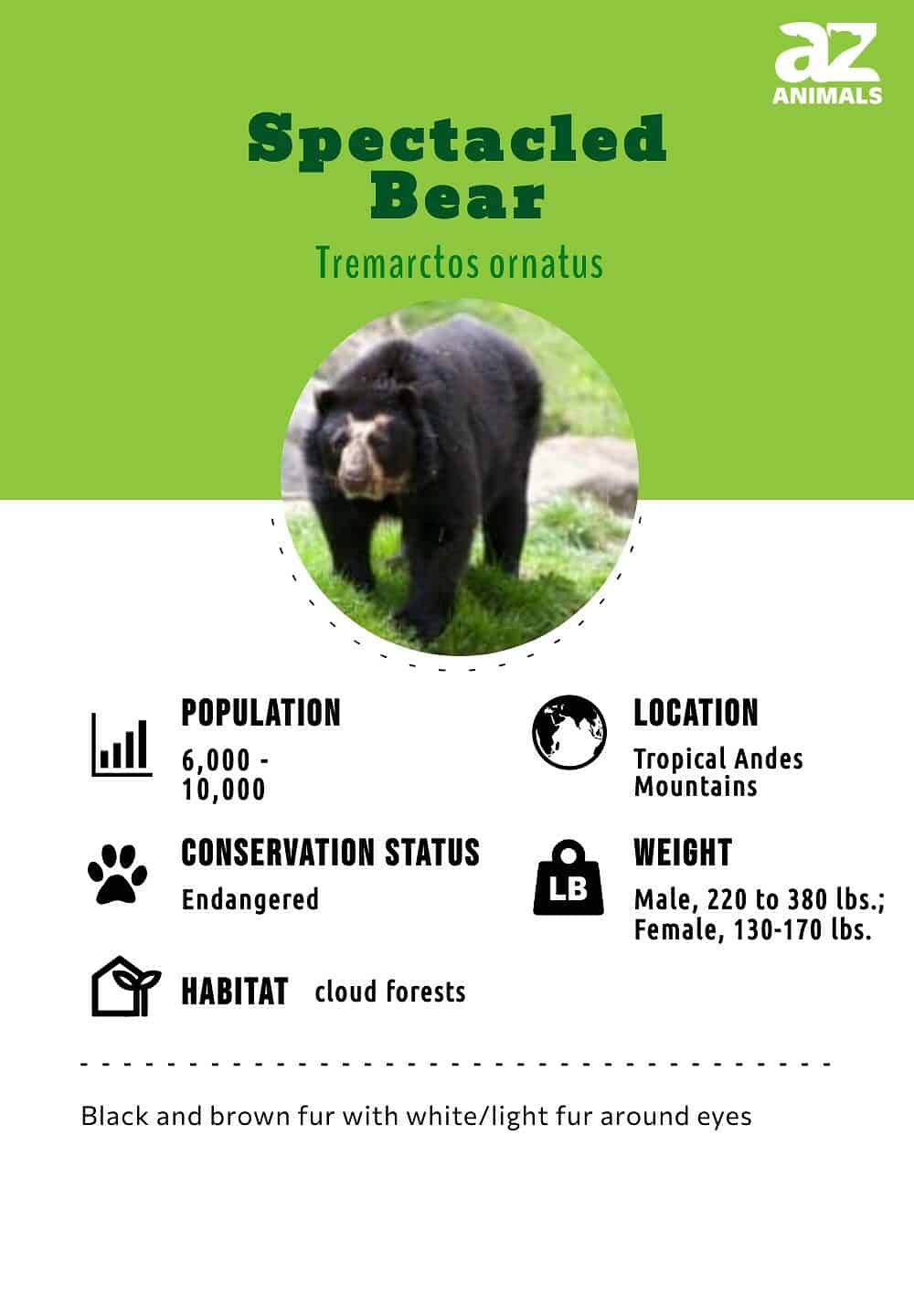
These bears live in South America in the tropical Andes Mountains. Their territory includes Peru, Bolivia, Columbia, Ecuador, and Venezuela. These bears live in cloud forests located 14,000 feet up in the Andes mountains. They’re called cloud forests due to the tropical climate and the low-level clouds or mist that constantly covers the treetops.
Spectacled bears spend a lot of time relaxing on the branches of trees and climb down when they want to find food. They have sharp, long claws and their front legs are longer than their back ones. These two features help these bears to climb high into the trees. In addition, they use their claws as well as their strength to bend and break branches to create a platform nest in a tree.
Most of these bears stay in the same area throughout the year. They’ll only migrate a short distance if they need to do so to find food.
Diet
What do spectacled bears eat? These bears are still classified as carnivores, but only 5% of their diet is meat, so they live like omnivores. They eat a lot of plant life including palm fronds, fruit, orchid bulbs, nuts, and berries. These bears also eat insects and small animals such as birds and viscachas (a type of rodent). Sometimes they’ll eat dead animals, or carrion, they find in the forest.
Compare this to polar bears that live in a freezing arctic environment. Polar bears are carnivores because they have easy access to walrus, seals, and other animals they can catch and eat.
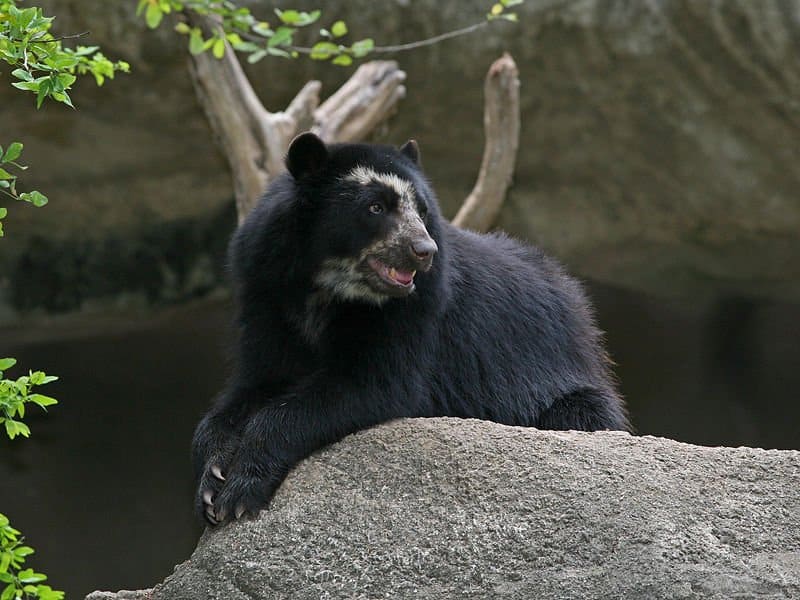
Because of its size, the only predator of the Spectacled Bear is humans.
©birdphotos.com / Creative Commons – Original
Predators and Threats
Full-grown spectacled bears don’t have any predators except humans. Some people hunt these bears for their claws, skin, or fur. Others hunt them for bear meat. In addition, some spectacled bears find their way onto farmland. They may be seen as a threat by a farmer and killed.
Bear cubs do have predators because of their small size. In addition, they are blind and helpless when they are born. Unfortunately, this makes them appealing to predators that may be in the area. Their predators include pumas, jaguars, adult spectacled bears, and people. A cub may be attacked if it wanders too far from its mother.
These bears face losing their habitat due to forests being cut down and the land cleared. Forests may be cut down to make way for roads, highways, or gas lines, or the land could be turned into farmland.
The official conservation status of the spectacled bear is Endangered. To help increase the population of these bears, laws have been put into place against hunting them. Also, some zoos have conservation programs set up to protect these bears and increase the population.
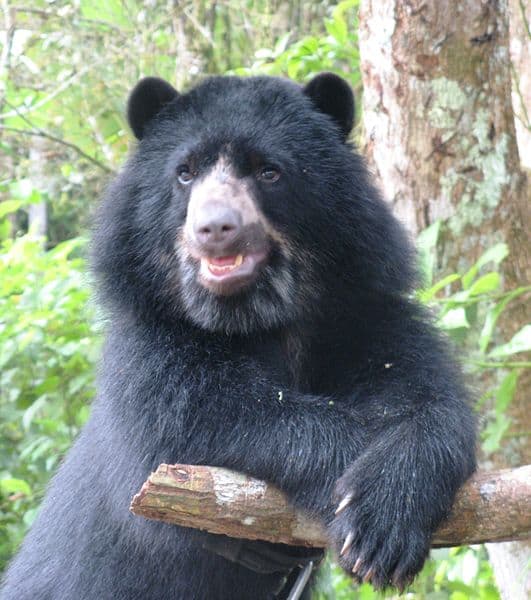
The lifespan of a Spectacled Bear in the wild is 20-25 years.
©Gelber21, CC BY 3.0, via Wikimedia Commons – Original / License
Reproduction, Babies and Lifespan
The mating season for spectacled bears falls between April and June. Females give off a certain scent attracting males during mating season. Two male bears may fight for the attention of one female. A female spectacled bear is pregnant for 6 to 7 months and gives live birth to 1 to 2 babies. Sometimes a female bear will give birth to 3 cubs, but that’s not as common. As a note, a female only gives birth about every 2 to 3 years.
A newborn weighs an average of just 11 ounces! That’s almost as much as a soup can. A baby bear’s eyes are closed at birth and don’t open until the bear is about one month old. It can move around, but relies on its mother for everything. The fur of a newborn is black with some white markings on it. The markings become more defined as the young bear grows.
The cubs stay with their mother for about two years, riding around on her back as she teaches them to find food and make shelter. They grow very fast, reaching a weight of 22 pounds at 6 months old. After reaching the age of 2, the young bears make their way out into the world on their own.
The lifespan of spectacled bears in the wild ranges from 20 to 25 years. Bears kept in a zoo can live into their 30s. It stands to reason that a bear that lives in a protected environment is most likely to live longer than one in the wild. The record for the oldest spectacled bear goes to one that lived for 36 years and 8 months in the National Zoo in Washington DC.
Spectacled bears that live in zoos are vulnerable to a condition called alopecia syndrome. This condition causes hair loss on the flanks and elsewhere on the bear’s body.
Population
The conservation status of the spectacled bear is Endangered. It’s difficult to get an accurate number regarding the total population of this bear because it hides most of the time. But, scientists have estimated the population to range between 6,000 and 10,000 bears in the northern part of the Andes mountains. With both the loss of habitat and poaching issues, the population of this bear seems to be decreasing.
Spectacled Bear Pictures
View all of our Spectacled Bear pictures in the gallery.

Sources
- David Burnie, Dorling Kindersley (2011) Animal, The Definitive Visual Guide To The World's Wildlife / Accessed November 24, 2008
- Tom Jackson, Lorenz Books (2007) The World Encyclopedia Of Animals / Accessed November 24, 2008
- David Burnie, Kingfisher (2011) The Kingfisher Animal Encyclopedia / Accessed November 24, 2008
- Richard Mackay, University of California Press (2009) The Atlas Of Endangered Species / Accessed November 24, 2008
- David Burnie, Dorling Kindersley (2008) Illustrated Encyclopedia Of Animals / Accessed November 24, 2008
- Dorling Kindersley (2006) Dorling Kindersley Encyclopedia Of Animals / Accessed November 24, 2008
- David W. Macdonald, Oxford University Press (2010) The Encyclopedia Of Mammals / Accessed November 24, 2008