
Quick Take
- One axolotl morph actually glows in the dark, and the reason why is far stranger than you would expect. See the glowing morph →
- Some of the rarest morphs aren't bred at all. They happen by accident, and most don't survive. Explore accidental fusions →
- Two morphs look nearly identical at first glance, but their biological difference could matter a lot if you're keeping one as a pet. Compare leucistic vs. albino →
- Some axolotl colors that start one way change dramatically over a lifetime, and not always in the direction you would predict. See the color shift →
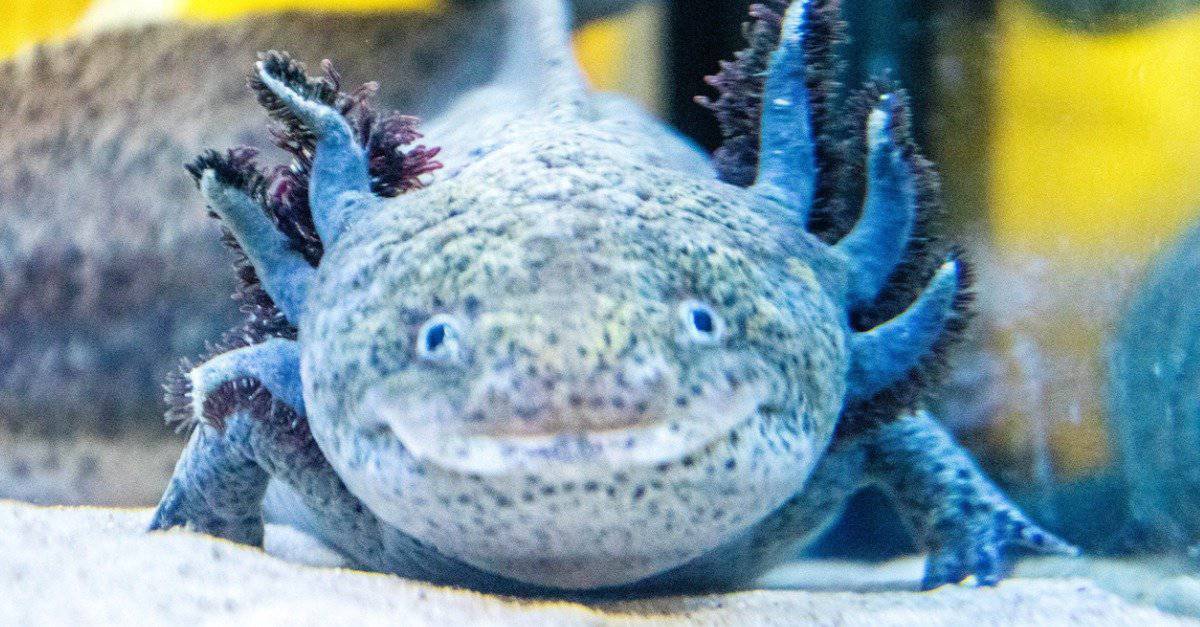
Considered the animal form of the Aztec god Xolotl, a deity associated with lightning, fire, and the underworld, the axolotl (Ambystoma mexicanum) is a rare aquatic salamander whose wild population is restricted entirely to Lake Xochimilco and its surrounding network of canals on the southern edge of Mexico City. While related to the tiger salamander, the axolotl is one of the most remarkable amphibians in the world. It grows to adulthood without ever undergoing metamorphosis.
Known as neoteny, adults retain many features of the larvae, including the gill stalks and the ability to live in water. Axolotls also have the amazing ability to regenerate limbs and other organs, which has become the subject of intense scientific study. In the wild, this aquatic animal is characterized by mottled olive-brown to dark green skin with gold speckles around the body.
While critically endangered in the wild, the axolotl is raised by humans in captivity for both commercial and scientific purposes. Artificial selection (human-driven evolution) has created many axolotl variations with different shapes, sizes, and colors. It is now possible to find an axolotl that suits your particular visual and physical preferences.
Rarer axolotl colors are obviously more difficult to find and generally more expensive than the common ones. Axolotls start at $40 or $50 and become quite pricey from there. Some of the least common axolotl morphs can cost more than $1,000.
Golden Albino Axolotl
The golden albino is characterized by bright gold skin (as well as white, pink, or yellow eyes, and reflective patches covering the body) that subtly changes color from white to yellow to orange-gold over the course of its lifetime.

©iStock.com/Trebor Eckscher
When it first hatches, the golden albino larva is almost indistinguishable from an albino, but toward the end of its life, the golden color looks quite lustrous. This color morph is the result of almost all pigments being suppressed except for one that causes yellow and gold.
Albino Axolotl
The albino axolotl is among the most common artificial color morphs. Characterized by a pure white body, red gill filaments, and pink or white eyes, the albino morph is the result of the axolotl producing much less of the pigment known as melanin, which not only determines skin color but also protects the skin from UV radiation. The albino also lacks important pigments in the eye. As a result, this morph is considered to be very sensitive to bright light.

The color of the albino axolotl is the result of a lack of melanin.
©iStock.com/slowmotiongli
An albino axolotl would struggle to survive in the wild, but humans have favored the albino morph for captive axolotls. The offspring must inherit two copies of the recessive albino gene to be albino. As they age, the albino undergoes a few different changes. The red color of the gill stalks tends to become even deeper, although the body stays completely white.
Leucistic Axolotl
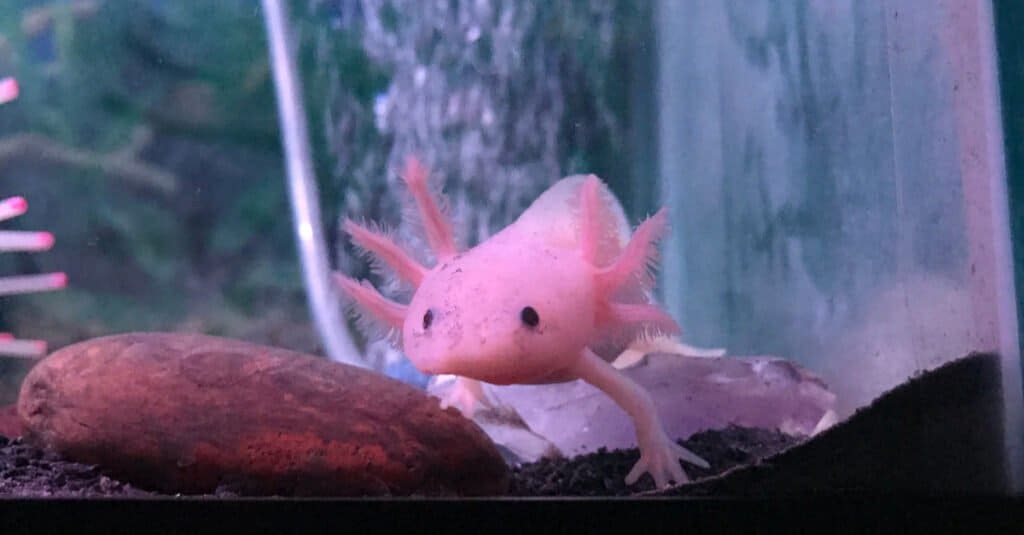
Although at first glance this is easy to mistake for the standard albino, the leucistic axolotl actually has more translucent, see-through skin with red gill filaments and dark brown or black eyes. The main difference, biologically, is that the albino version is produced from a reduction of just the pigment melanin, whereas the leucistic version is produced from the reduction of multiple pigments in the skin, though leucistic axolotls still retain some melanin, which is why their eyes are usually dark. An alternative version called the speckled leucistic morph has the same translucent skin color but also some dark green, brown, or black speckles on the head, back, and tail.
The speckled leucistic morph has the same skin color as the leucistic axolotl.
©Meggyn Pomerleau/Shutterstock.com
The larvae start out as a regular leucistic morph, and then the speckles appear as the pigment cells mature. Both the leucistic and the speckled are considered to be fairly common morphs of axolotl color in the pet trade.
Piebald Axolotl
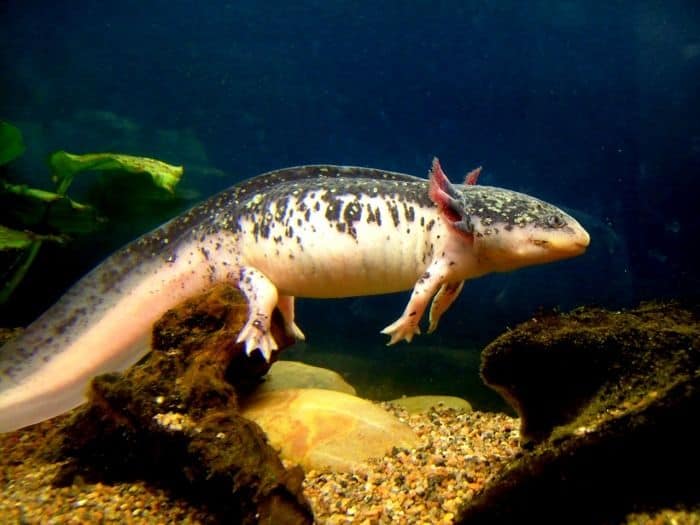
The piebald morph is among the rare axolotl colors. It is the result of a partial leucistic pattern in which dark green or black spots or patches cover parts of the white or translucent skin. Most of the patches cover the face and back and rarely the sides and legs. It is different from the speckled leucistic morph due to the extreme amount of spots on the body. The piebald spots can darken with time until the skin becomes completely covered in black-and-white markings. The specific gene that causes this pattern can be inherited, but it’s very rare.
Copper Axolotl
The copper axolotl is a fairly uncommon morph with a light gray-green body with copper-colored flecks spread fairly evenly across the surface of the skin. It also has gray-colored eyes and gray-red gills. The unusual combination is the result of lower levels of melanin and other pigments in the skin.

The copper axolotl is usually found in the United States and Australia.
©iStock.com/Lucia Martini
The copper morph is most likely to be found in the United States and Australia. When crossed with other morphs, they can produce some very interesting axolotl color combinations.
Black Melanoid Axolotl
First discovered in 1961, the black melanoid is now among the most common axolotl color morphs in the world. The particular mixture of pigments in its skin produces a range of dark green to completely black morphs with dark purple gills and a pale gray or purple belly.

The black melanoid is one of the most common axolotl morphs.
©Stan Shebs, CC BY-SA 3.0, via Wikimedia Commons – Original / License
Some individuals look similar to the wild-type axolotl except for the lack of the golden iris. The black morph is basically the exact opposite of the albino color morph.
Lavender Axolotl
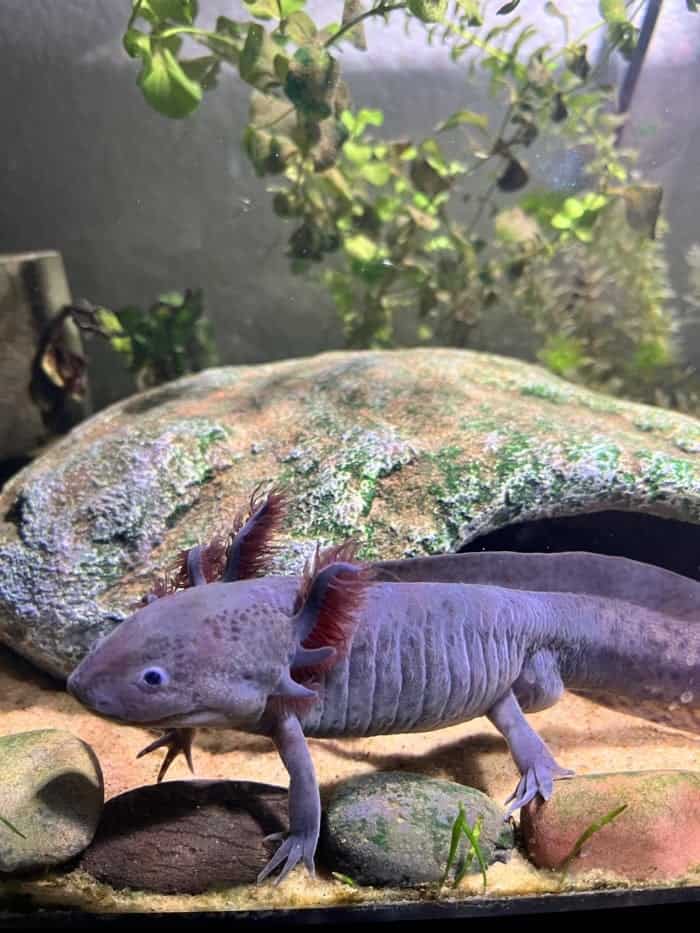
This axolotl color morph is defined by a light silvery-purple hue, as well as gray-red gills and black eyes that can become gray or green as it ages. The presence of spots all over the body has given it the alternative name of silver Dalmatian axolotl. These rare variations may be difficult to find and even more expensive than a typical color morph, but the color combination is truly unique.
Firefly Axolotl
This is perhaps the most controversial axolotl color morph on the list. The firefly morph is a dark-colored wild-type axolotl with an albino tail that will actually glow in the dark under the glare of a black light, thanks to the presence of a green fluorescent protein. The gene that produces this glowing protein was originally transplanted into the axolotl from a jellyfish for the purpose of studying cancer resistance.
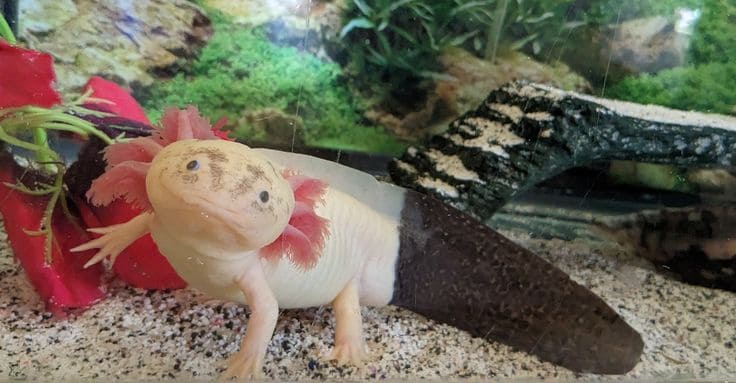
While the classic or most common firefly look features a dark body with a light/glowing tail, the opposite configuration, a light body paired with a dark tail, is also produced through this grafting process.
The firefly morph was thr first axolotl to undergo this procedure had glowing light-colored skin across the entire body. This trait was then introduced into a dark-colored wild-type axolotl when two embryos were fused together. The firefly is an entirely artificial creation, and the controversy is whether this method is suitable for creating pets.
Chimera Axolotl
Chimera axolotl morphs are very rare variations produced by an accident in development. Characterized by half-white and half-black skin color split right down the length of the body along the horizontal axis, the chimera is the result of two eggs (one wild type and one albino) fusing together before hatching. They are so rare and unusual that they are not consistently sold in stores. Many of the eggs do not hatch because they fail to fuse properly.
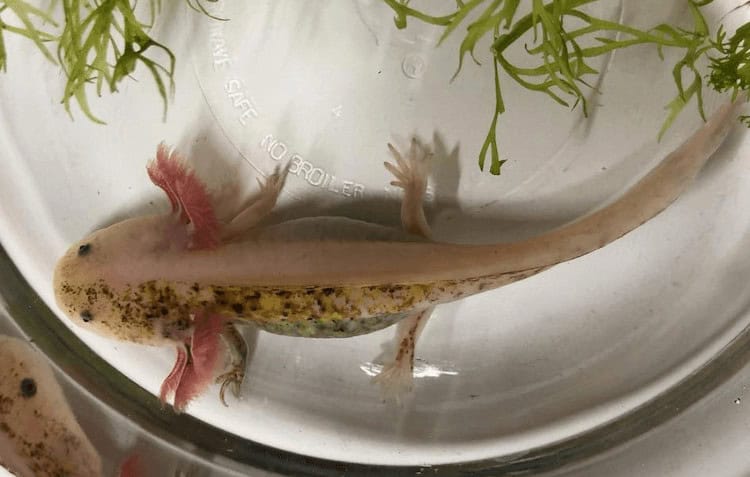
The name chimera comes from a creature found in Greek mythology that has a unique appearance due to the combination of multiple animal forms in one beast, such as a lion’s body, a goat’s head arising from its back, and a serpent’s tail. Because the chimera axolotl has horizontal color division rather than the random coloration found in other axolotls, it has the look of an imaginary animal or one fabricated from different parts.
Mosaic Axolotl
the mosaic axolotl morph is another rare axolotl color that cannot generally be found in stores, and even if you did happen to find one, it would probably be very expensive. It is created from a combination of two eggs fusing together: one egg is albino or leucistic and the other is dark or wild type.
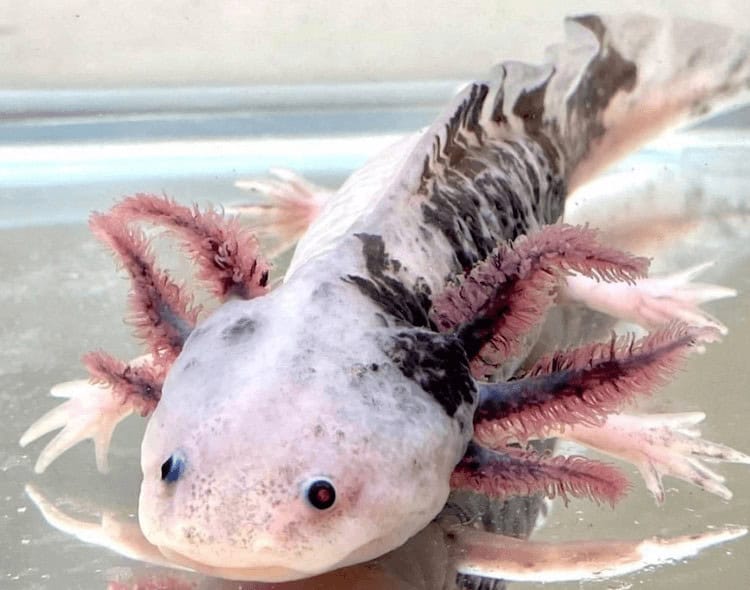
Instead of the colors being split down the middle like the chimera, the result is a randomly mottled salamander with black, white, and golden flecks. The mosaic may also have striped red or purple gills to further enhance its striking appearance.