
Quick Take
- Scout bees use a surprisingly democratic process to choose their new home, with the quality of a site determining how loudly they advocate for it. See how scouts decide →
- That cluster of bees hanging from a tree branch isn't a nest, and misidentifying it changes everything about how you respond. Swarm vs. true nest →
- Sealing bees inside your wall feels like a solution, but it sets off a chain of consequences most homeowners don't anticipate. Safe removal methods →
- Getting rid of a honey bee nest doesn't mean the bees won't come back, and the reason why has nothing to do with the bees you removed. Stop bees returning →
Honey bees (Apis mellifera) have specific needs for their nests. Generally, they build their hives in a hollow tree or small cave. Then, as the colony expands, the bees set out in search of a larger place to create a new home. But how do they find the perfect site? It involves a remarkable amount of complex communication and skillful teamwork. Continue reading to learn about honey bee nests, how to identify them, and what to do if their new nest is your home.
Location of Honey Bee Nests
Bees like to build their nests in very specific locations, which vary depending on the species. For example, bumble bees prefer ground-based nests, while honey bees choose sites like hollow trees, caves, and rock crevices. However, sometimes they choose to build their hives in people’s homes or gardens, like inside a wall of a building or house.
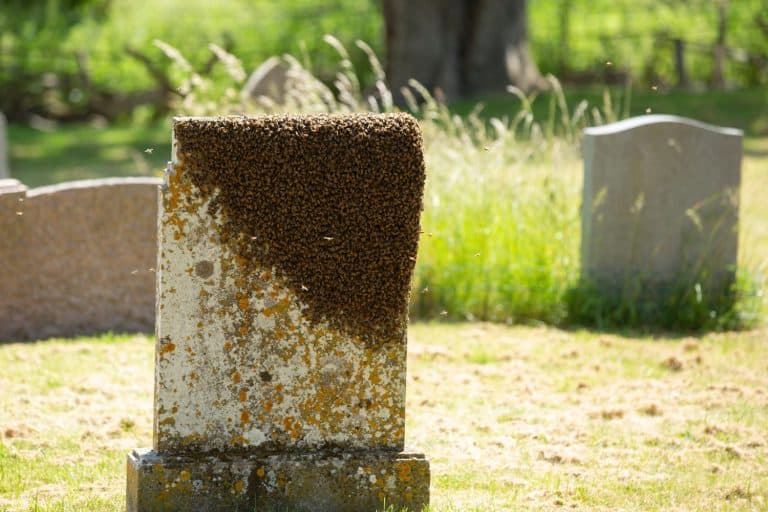
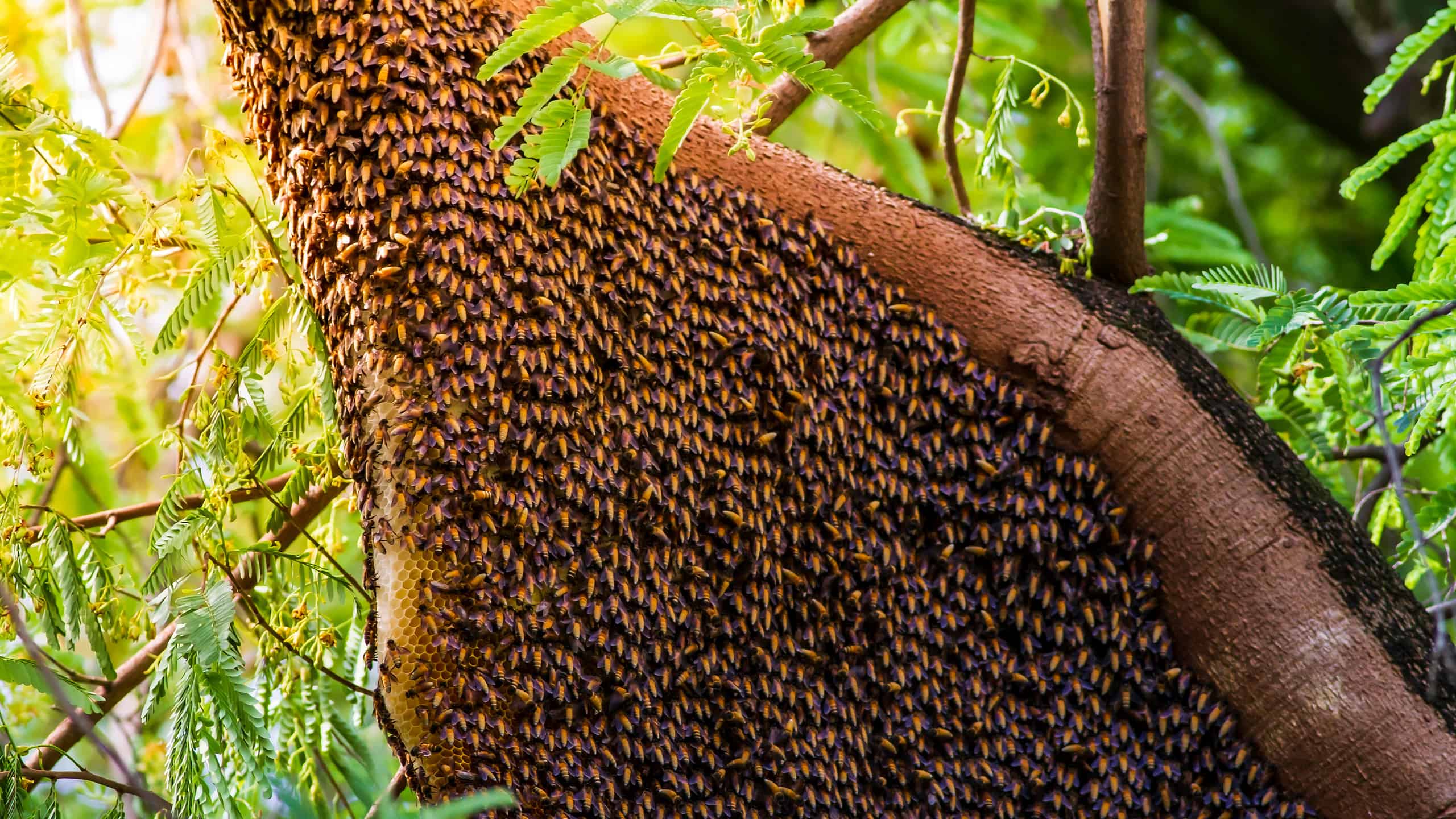
While most depictions of bee hives show them hanging off a branch of a tree, honey bees don’t like being so exposed. While it is possible to see a large group congregating on a tree branch, that is not a nest — it’s a swarm. Honey bees swarm when they have outgrown their current hive and are scouting a location for a bigger nest.

A large group of bees congregating on a tree may be a swarm preparing to locate a new nest.
©Infinity_Pok/Shutterstock.com
How Do Honey Bees Choose a New Nest Location?
Scout bees leave the swarm to search for a suitable new home. Bees typically favor cavities that are unoccupied, high off the ground, dry, well-insulated, clean, sheltered, south-facing, and have an easily defensible entrance. They generally choose a cavity that has a volume of around 40 liters (approximately 10 gallons).
Once a site has been selected, scouts do not show others the way to the site. Instead, they perform dances to indicate the direction and distance of the potential site. Researchers have found that dances for higher-quality sites last longer, which attracts more nest-mates. Then a quorum of at least 20–30 scouts decides if the site is suitable, which will initiate the move.
How Honey Bees Make Their Nests
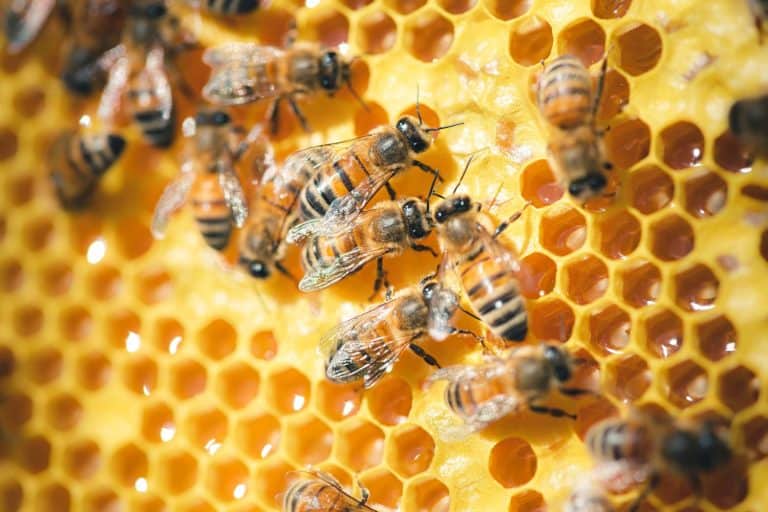
Honey bees secrete wax from glands on the undersides of their abdomens to make their nests. The hive contains thousands of hexagonal cells called honeycombs. To create a sturdy building substance, worker bees consume honey, converting its sugars inside specialized abdominal glands, which then secrete the wax through tiny pores on the underside of their abdomens. Finally, the worker bees chew the substance, mixing it with their saliva, making it pliable.
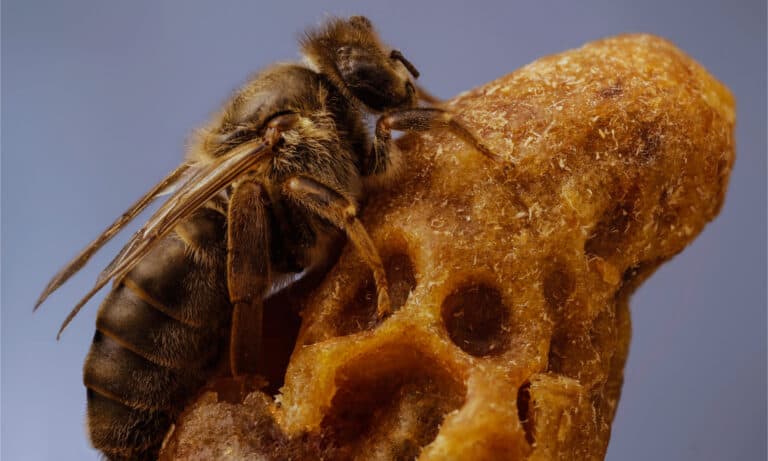
Each cell consists of tiny mouthfuls of wax, which they need to repeat hundreds of thousands of times as the colony expands. For example, a healthy bee hive can contain up to 60,000 bees at the height of summer. A typical bee hive in a cavity is made up of about 30,000 to 50,000 cells, depending on the size of the colony. Each layer serves a different purpose. Tree cavity hives are generally vertically-oriented. The top combs house the honey, the middle combs store pollen, and the lower combs are the brood cells. This is where offspring are hatched and raised.
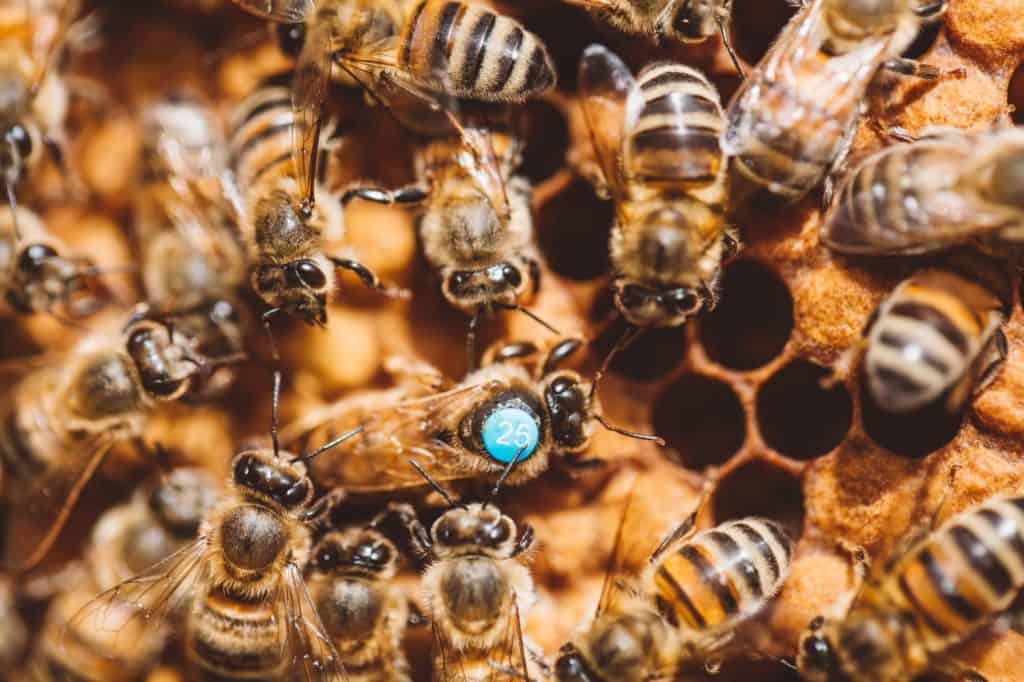
Tree hives are typically vertically oriented, with the brood located at the bottom and honey stored at the top.
©PHOTOCREO Michal Bednarek/Shutterstock.com
Preventing a Colony of Honey Bees in Your Home
It might be hard to determine if a colony of honey bees on the side of a building is scouting for a new site or entering the building one by one through a small hole. However, keep an eye on them, and if you don’t see any flying away, but the colony is getting smaller, they are moving in. After moving into the building, the bees won’t have much food and must begin producing wax to build combs. Therefore, they need access to the outside to look for nectar.
If you seal them in their new home by covering the hole with steel wool, screen, or any material they can’t chew through, they won’t be able to survive. However, killing bees is not the answer. They are essential to life on earth and need to be preserved. Therefore, calling a beekeeper is the best solution. They have methods of removing the bees without killing them and safely relocating them.
Humane Honey Bee Nest Removal
Removing a honey bee nest from your home is much more complicated than eliminating swarm clusters. While there are pesticides that will kill the whole colony, a better solution is hiring a beekeeper to remove the honey bee nest without killing the bees. The professional will be able to find the nest, often by tapping on the wall until they hear the hum of the bees. In fact, some beekeepers use a stethoscope to accurately find the edges of the hive. Some professionals drill small holes into the wall and insert a fine wire to find the outer limits of the nest.
Collecting these bees and their nest requires a relatively large hole in the wall. Next, the beekeeper will gently remove the bees and their combs. This is usually done with a vacuum that has a baffle or container that protects the bees. However, this process usually causes the bees to become defensive and release a scent that triggers an alarm response. Therefore, everyone in the home must wear a bee suit. You will also need to hire a contractor to ensure the hole is cut so it can be easily resealed.

Professional beekeepers can help safely remove bees from in and around your home.
©Jacques Hugo/Shutterstock.com
Another way to get rid of honey bees in your home is by trapping them outside with a one-way wire screen. While this technique requires a lot of patience, it doesn’t kill bees. Basically, this method works by luring the bees into a beehive placed near the original entrance, then relocating them to a safe spot. Never try to remove a honey bee nest on your own. It is extremely dangerous, especially if you are allergic.
Preventing Future Invasions
Removing the honey bees and their nest doesn’t always solve the problem. The smell of beeswax lingers, and because these bees have such an amazing sense of smell, other colonies might find the site incredibly tempting. Moreover, this odor persists long after the original colony is removed. Therefore, all gaps or holes larger than a pencil must be sealed. However, you don’t need to seal larger entrances. Instead, you can cover them with a screen with six or more meshes per inch.
In addition, you can fill large cavities with expandable foam, which will deter the bees from building a nest as there won’t be enough space. It’s essential to examine and repair the entire side of the building where the original entrance was located, or both sides if the entrance was on a corner. Be thorough, because they will move in immediately if they find an opening.
However, it’s not just new colonies that will want to move in; some original colony members might have escaped. In addition, foragers sometimes spend the night away from the nest during warmer months. Therefore, there is a strong possibility a cluster of honey bees will congregate at the sealed-off entrance. You can vacuum these bees up or use a pesticide spray specifically for wasps and bees. However, ensure to read the instructions first.