
Quick Take
- These bees are technically solitary, which makes the sheer scale of what's living under this cemetery even harder to explain. Meet the solitary bees →
- A cemetery might sound like an odd place for millions of bees, but it turns out to be close to perfect for reasons most people would never guess. See why cemeteries work →
- Counting 5 million underground bees sounds impossible, but scientists found a surprisingly clever way to do it. Discover the counting method →
Deep within one of the largest and most beautiful cemeteries in Ithaca lies a secret. Among East Lawn Cemetery’s historic headstones and peaceful grounds exists an entire underground world that no one has ever witnessed. It was discovered by accident when Rachel Fordyce, walking to work at Cornell University’s entomology lab, saw something extraordinary.
Her typically peaceful walk was interrupted by buzzing. As she cut through the cemetery, her usual shortcut, she spotted bees. These weren’t the average worker or scout bees—this was a swarm, buzzing as though an aggregation was nearby. As it turns out, one was. The twist? It’s now believed to be one of the largest underground nesting aggregations of wild bees ever recorded.
A Story Too Bizarre to Bee-lieve
Fordyce did what any entomology lab student would do: she caught one of the bees in a jar and brought it to her supervisor. Bryan Danforth, professor of entomology in Cornell’s College of Agriculture and Life Sciences, identified them as mining bees (Andrena regularis). The interesting thing about this bee species is that it’s solitary, yet an aggregation of nearly 5.5 million solitary bees nests just beneath its flight pattern.
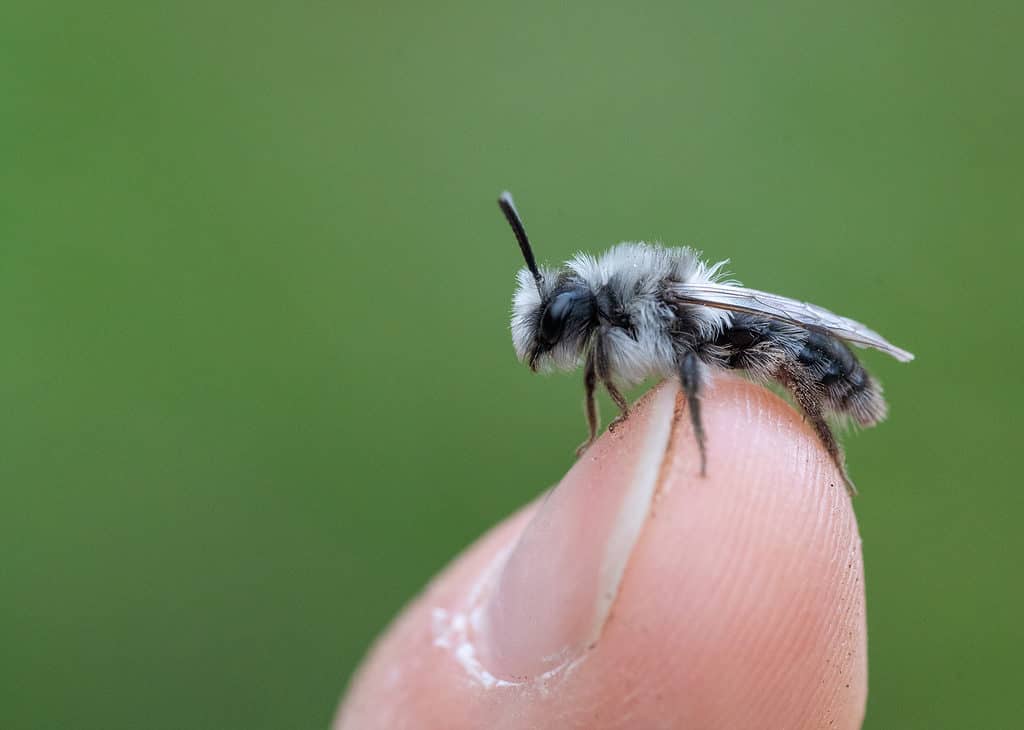
Mining bees are extremely docile and pose no stinging threat.
©Joshua Clarke/Shutterstock.com
Mining bees are extremely docile and are also one of the first pollinators seen during the spring. In Ithaca, they’re commonly seen flying from flower to flower before buzzing back to their underground nests. This species is an important pollinator for many of Ithaca’s plants, and it’s completely harmless. Males don’t have stingers, and females don’t have stingers strong enough to break human skin.
The Incredible Underground Labyrinth
When mining bees aren’t pollinating, they’re building. Rather than create the hives most associate with honeybees, mining bees prefer something a little more low-key. As a solitary species, they prefer to live separately, but close together. They achieve this by burrowing and constructing tunnels that are just big enough for one bee, but are located close to other tunnels.
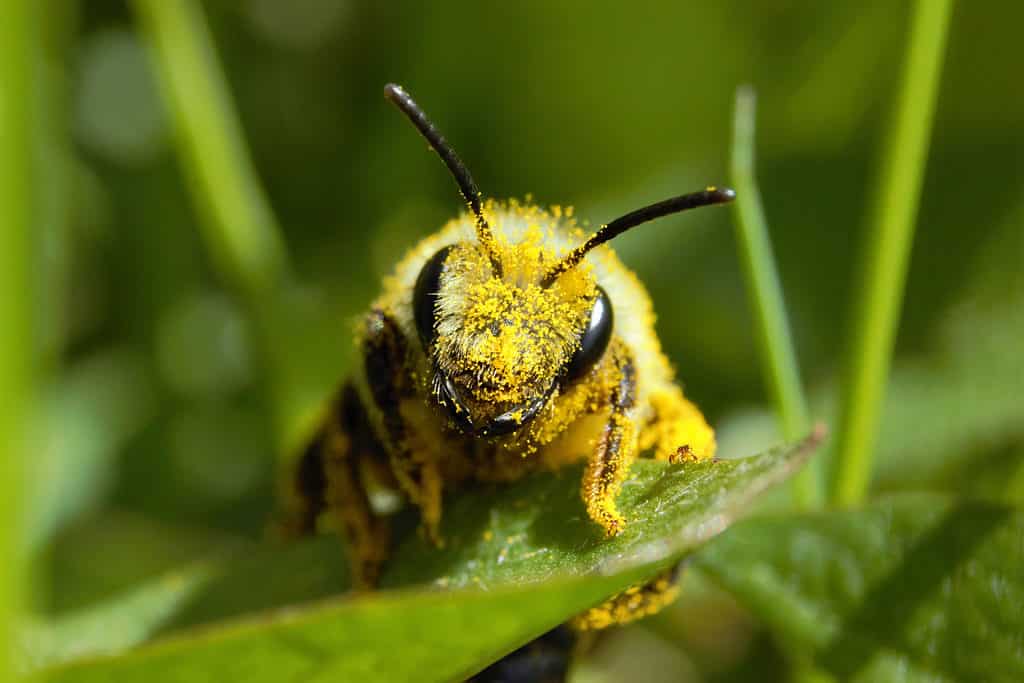
As crucial pollinators, mining bees do most of their flower-hopping in the early spring.
©David James Chatterton/Shutterstock.com
In the spring, right around the time this swarm was observed, females begin digging. They opt for well-draining soil, and cemeteries happen to be perfect for the job. East Lawn Cemetery is extremely well-kept, with a lawn that looks just like paradise to a solitary, burrowing bee. The tunnels they dig can be anywhere from 4 to 6 inches deep and feature elaborate side chambers.
At the very bottom of each tunnel, females leave a mixture of nectar and pollen, form it into a ball, and lay their eggs on it. When winter comes, the larvae are nicely tucked and warm enough to survive until their spring emergence. The buzzing activity witnessed at East Lawn Cemetery was likely the annual ritual of females collecting pollen for their chambers. Despite the unusual ground-dwelling nature of solitary bees, they are estimated to account for roughly 90% of all bee species.
They Counted How Many Bees?
Keven Morse, superintendent of East Lawn Cemetery, told Science Daily that in 46 years of caretaking, he’s seen countless bees. None of them ever seem deterred by human presence, nor do they sting, which led to the growing suspicion that there were more bees than initially thought. To determine just how many, Ithaca scientists had to get a little clever.
Emergence traps, made of mesh and harmless to bees, proved highly effective. They were placed over the tops of tunnel openings, funneling outgoing bees into glass jars. From March 30 to May 16, 2023, ten traps were laid in East Lawn Cemetery. During this time, the team learned that it was more than just mining bees passing through the area. A total of 3,251 insects representing 16 species of bees, beetles, and flies were recorded.
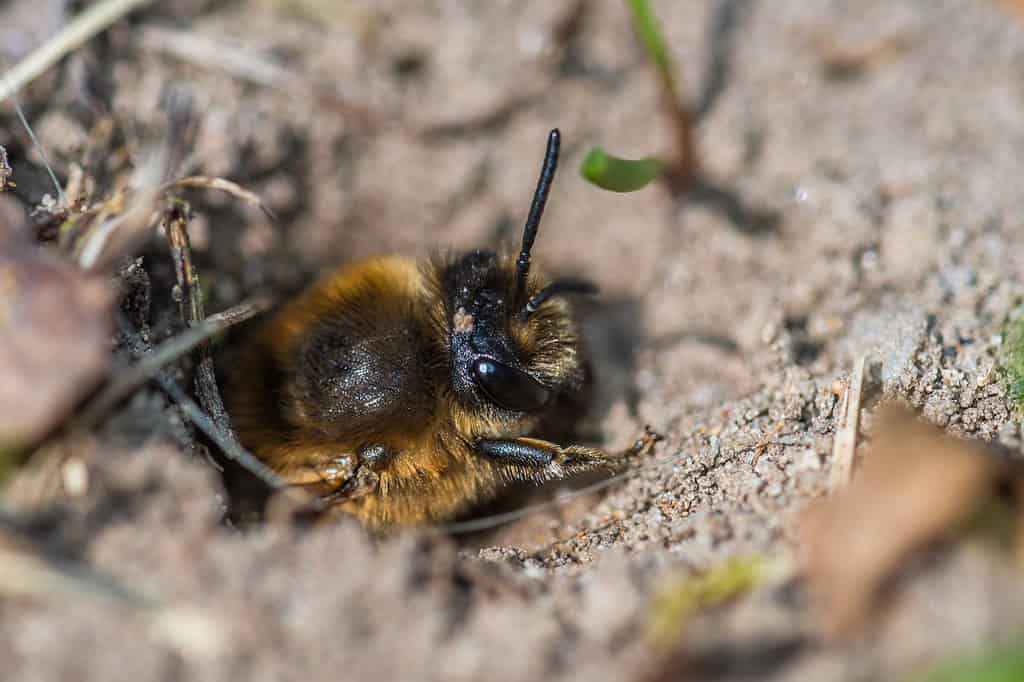
You may never even notice a mining bee, since they live in deep-ground burrows.
©StGrafix/Shutterstock.com
By using this method to calculate the density of bees in other parts of the cemetery, scientists were able to estimate the total population. This put the estimated total at a whopping 3 million to 8 million bees across 6,000 square meters.
This significant population of mining bees shows just how crucial it is to protect public spaces, as nature doesn’t discriminate based on land use. If the cemetery were to ever use toxic pesticides or undergo major construction, these aggregations would likely be destroyed. For now, these bees are safely under the protection of Ithaca’s caretakers, but their story serves as a cautionary tale about how Mother Nature—especially bees—doesn’t always follow human rules.