
Quick Take
- A 1,500 PSI bite force sounds unbeatable, yet raw power isn't the only thing that decides this fight. See the bite force breakdown →
- Speed and agility seem like the cheetah's ace cards, but researchers found one factor that outranks both. See what outranks speed →
- These two cats share the same hunting playbook, so what actually separates the winner from the loser? Compare their hunting tactics →
- The stronger animal doesn't always win, and this matchup is a perfect example of that principle in action. Find out who wins →
Jaguars (Panthera onca) and cheetahs (Acinonyx jubatus) are two of the fastest, deadliest cats. Both of these large felines have tan to gold coats with black spots. Although they are superficially similar in appearance, they have many significant differences. Their paths would rarely cross in the wild, as jaguars inhabit the Americas, while cheetahs are found primarily in Africa, with a small population of Asiatic cheetahs (Acinonyx jubatus venaticus) also surviving in Iran. However, what would happen in a matchup between these swift, powerful felines? Fortunately, we don’t have to cross oceans to come up with the answer. Using the information available to us, we can predict how this fight would end in real life.
Jaguar vs. Cheetah Quick Comparison
| Jaguar | Cheetah | |
|---|---|---|
| Size | Weight: 120-300 pounds Length: 3.5-5.5 feet Shoulder height: 2-2.5 feet | Weight: 80-140 pounds Length: 3.5-5 feet Shoulder height: 2.5-3 feet |
| Bite Power and Teeth | 1,500 PSI bite power; 30 teeth with 2-inch fangs | 450-500 PSI bite power; 30 teeth with 1-inch fangs |
| Speed and Movement Type | 50 mph in a galloping run; can easily climb trees; capable swimmer | 70 mph in a galloping run with long strides; can climb trees with low, sloping branches; can swim when necessary |
| Predatory Behavior | Stealthy and patient stalkers; ambush predator that can attack from above | Stealthy and slow stalkers; explosive ambush predator that runs down prey |
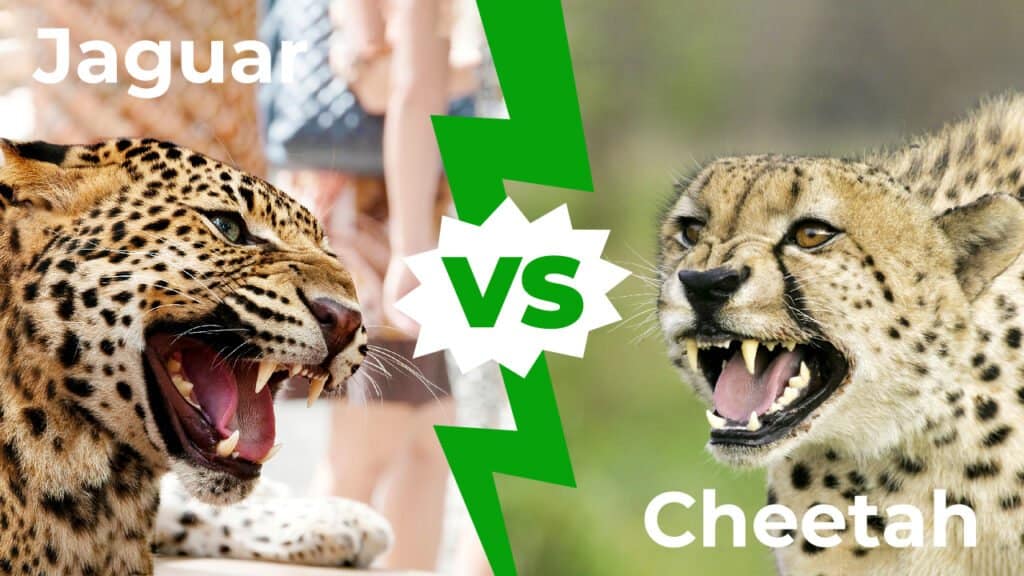
How Do a Jaguar and a Cheetah Compare?
In a battle between such powerful felines, what determines the winner? We have come up with a list of six of the most important elements that would impact the outcome of a fight. Examining physical characteristics and fighting instincts, we’ll identify which animal has the true advantage in a fight.
Size
Jaguars have stocky, muscular bodies. They are the third largest cats in the family Felidae, behind tigers and lions, and the largest cats in the Americas. A jaguar can weigh up to 300 pounds, measure 5.5 feet long (excluding the tail), and stand 2 to 2.5 feet tall at the shoulder. The largest jaguar on record weighed 348 pounds. However, jaguar weight can vary by region. Jaguars typically range from 150 to 200 pounds, with females being smaller.
Cheetahs are much lighter and leaner, but they are typically taller than jaguars. They typically weigh 75 to 140 pounds, measure up to 5 feet in length (excluding the tail), and stand approximately 2.5 to 3 feet tall. Females are usually significantly smaller. Size and weight vary throughout their range.
Bite Power, Teeth, and Claws
Both felines use their bite force to take down prey; however, jaguars have the most powerful bite force relative to their body size among all big cats, at around 1,500 PSI. Their longest teeth measure 2 inches in length. Jaguars have sharp, fully retractable claws that measure around 2 inches in length. Their claws aid in gripping trees and holding prey.
Although it may seem as if cheetahs have a much weaker bite force at only 450-500 PSI, they have a strong bite force relative to their weight and body size. Their longest teeth measure about 1 inch long. Cheetahs have blunt, semi-retractable claws that aid in traction and stability. Overall, cheetahs are adapted for speed instead of power.
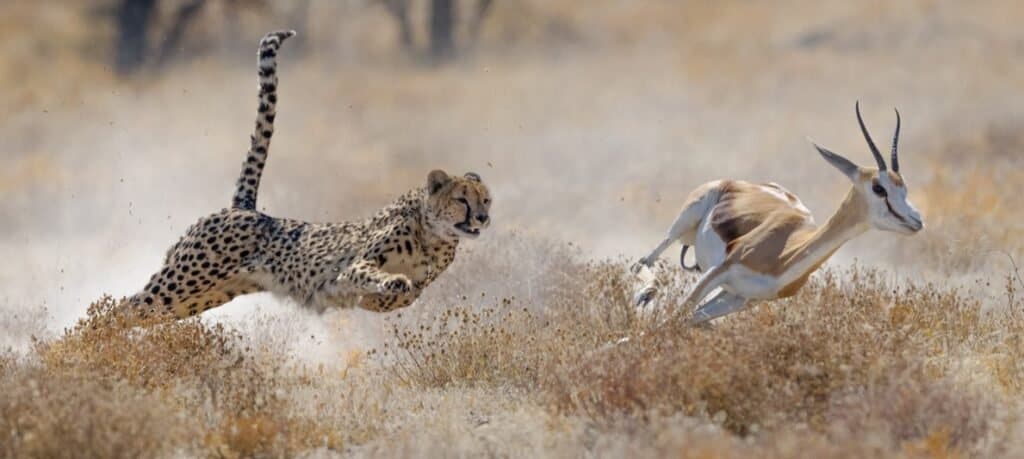
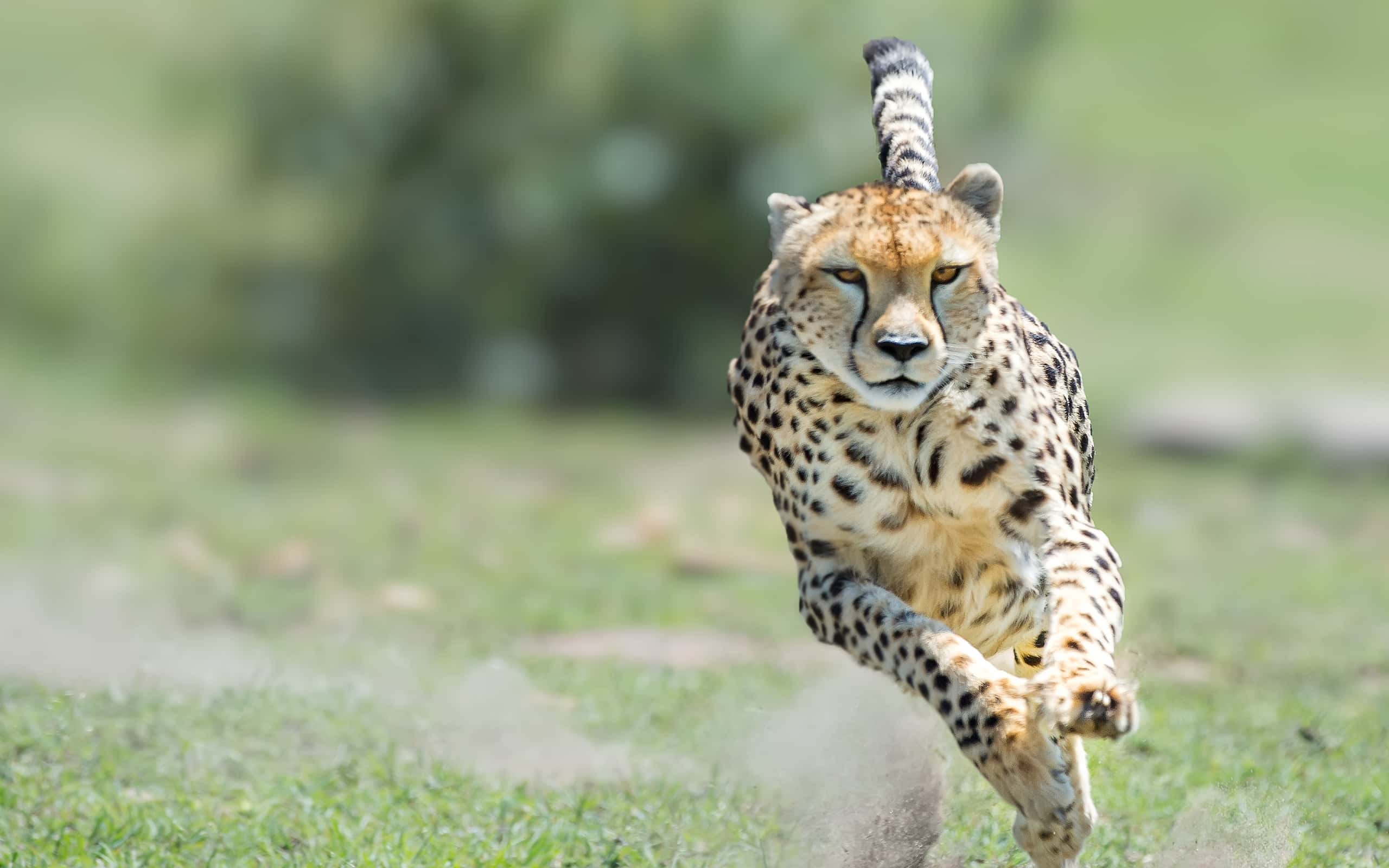
Cheetahs rely on speed and agility to capture prey.
©Elana Erasmus/Shutterstock.com
Speed and Movement
Cheetahs and jaguars are both renowned for their speed, and each is the fastest in its respective range. Jaguars can reach a top speed of 50 mph, but only in very short bursts. With their heavy, muscular frames, they are not as agile as cheetahs on land. However, jaguars can easily climb trees and are superior swimmers.
Cheetahs are the fastest land animals on Earth. These felines are built for speed. With their lighter, slimmer bodies, cheetahs can reach speeds of 70 mph in just over 3 seconds. They can maintain top speed for around 300 yards or 30 seconds. Their long legs, semi-retractable claws, and long tails also aid in agility. Researchers have found that their exceptional maneuverability may be even more important than their speed. While cheetahs can swim when necessary, they generally avoid water. They can climb trees, but only those with low, sloping branches.
Predatory Abilities
Both of these big cats have amazing vision, hearing, and smell, all of which are used to locate and stalk prey. Jaguars use stealth to stalk their prey and can ambush their victims on both land and in water. Unlike most big cats, they do not suffocate their prey. They use their incredible bite force, often piercing their prey’s skulls or shells.
Cheetahs camouflage in the tall grass and slowly stalk their prey, getting closer and closer before attacking with explosive speed. Cheetahs can sprint toward their prey and then chase them down with their superior speed. Once they clamp onto their prey’s throat, they drop to the ground, dragging their prey along with them. They rely on suffocation rather than a quick killing bite. Their sharp dewclaw can inflict extra damage, but overall their claws are not as sharp as a jaguar’s.
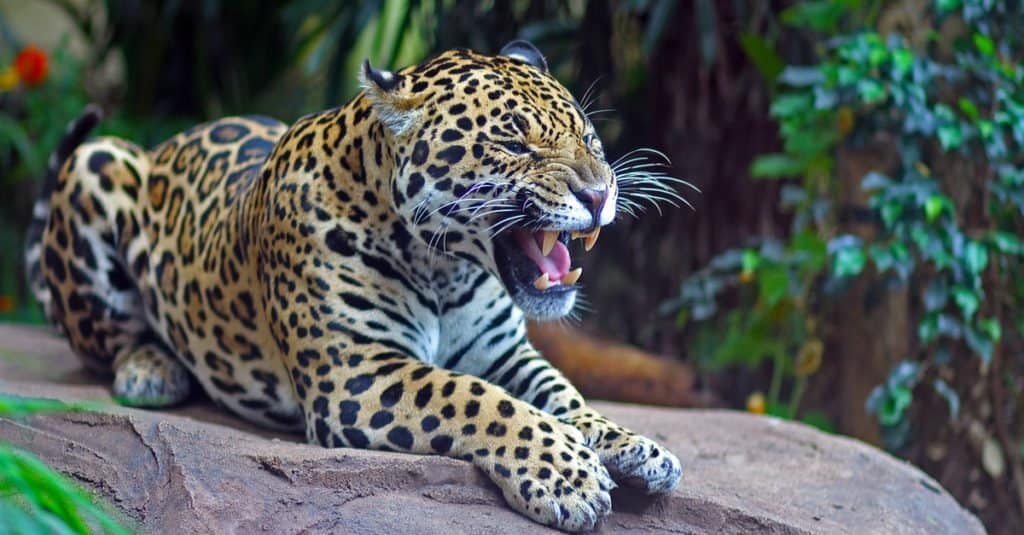
Jaguars do not suffocate their prey, instead they use their powerful bite force to deliver a killing bite.
©GoWildPhotography/Shutterstock.com
Which Animal Would Win in a Fight Between a Jaguar and a Cheetah?
Both animals use camouflage, stealth, and patience to stalk and ambush their prey. So neither of these animals has the edge when it comes to hunting ability. Jaguars clearly have an advantage when it comes to size and strength. If a cheetah was cornered, a jaguar would ultimately be able to overpower the smaller, slighter cheetah.
However, unless the jaguar somehow takes the cheetah by surprise, an actual fight is unlikely. A cheetah’s typical defense is to flee when confronted by predators. Although jaguars are certainly fast, powerful cats, their top speed is 20 mph less than a cheetah’s, and they can only maintain this speed in very short bursts. Cheetahs can quickly accelerate to top speed and maintain it for around 30 seconds, which is more than enough time to escape a jaguar.