Quick Take
- One heron species holds the title of most widespread bird on Earth, and it's probably not the one you'd guess. World's most widespread heron →
- Cattle egrets struck up an unusual deal with livestock that occasionally flips from a one-sided arrangement into something mutually beneficial. Cattle egret's unusual relationship →
- Juvenile little blue herons look nothing like their parents, which is a disguise that raises an obvious question about why it exists. Juvenile disguise explained →
- Not every bird in this heron lineup is actually called a heron, and the reason behind the naming confusion runs deeper than you'd think. Why the ibis is listed here →
Herons, egrets, and bitterns are all part of the bird family Ardeidae, which consists of approximately 60 to 72 species across numerous genera. However, heron is often used as a general, catch-all term for the entire family. Herons are exceptionally widespread birds, with species found living on every continent except Antarctica. As aquatic birds, herons tend to nest near wetlands, such as marshes, rivers, lakes, swamps, and estuaries. Although some herons are quite large, the majority are medium-sized. Continue reading to discover 12 herons that are found in the United States.
Great Blue Heron
The great blue heron (Ardea herodias) is a year-round resident throughout most of the United States. Populations that breed in northern areas migrate south in winter, typically to the southern United States and beyond. You can find these birds in marshes, swamps, and tide flats.
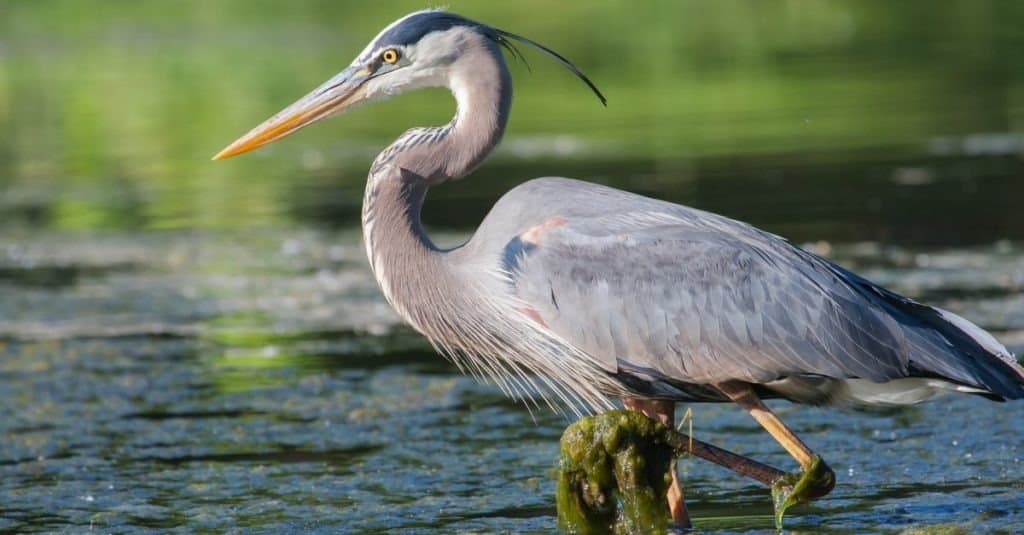
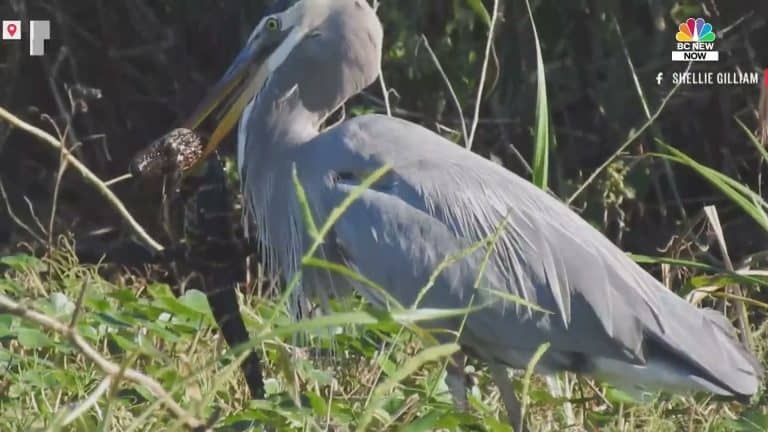
They are the largest North American heron, featuring long legs, curved necks, and dagger-like bills. The great blue heron lives in marshes, swamps, and tide flats.
©Joseph Scott Photography/Shutterstock.com
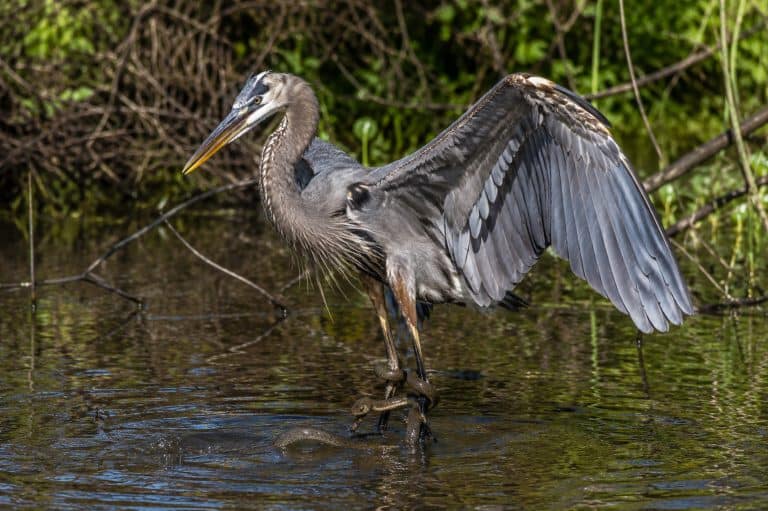
Great blue herons are the largest North American heron. An average great blue heron stands 3.2 to 4.5 feet tall and possesses an impressive wingspan of 5.5 to 6.6 feet. They have long legs, curved necks, and dagger-like bills. They are bluish-gray with yellow beaks and black eye stripes.
Great blue herons eat fish, frogs, turtles, snakes, insects, rodents, and birds.
Their calls are harsh squawks and croaks. They build their nests on a stick platform in trees above water.
Little Blue Heron
The little blue heron (Egretta caerulea) has scattered populations across the US, where it lives year-round in the southeast along the coast and breeds occasionally in inland freshwater habitats. They inhabit marshes, swamps, rice fields, ponds, and shores.
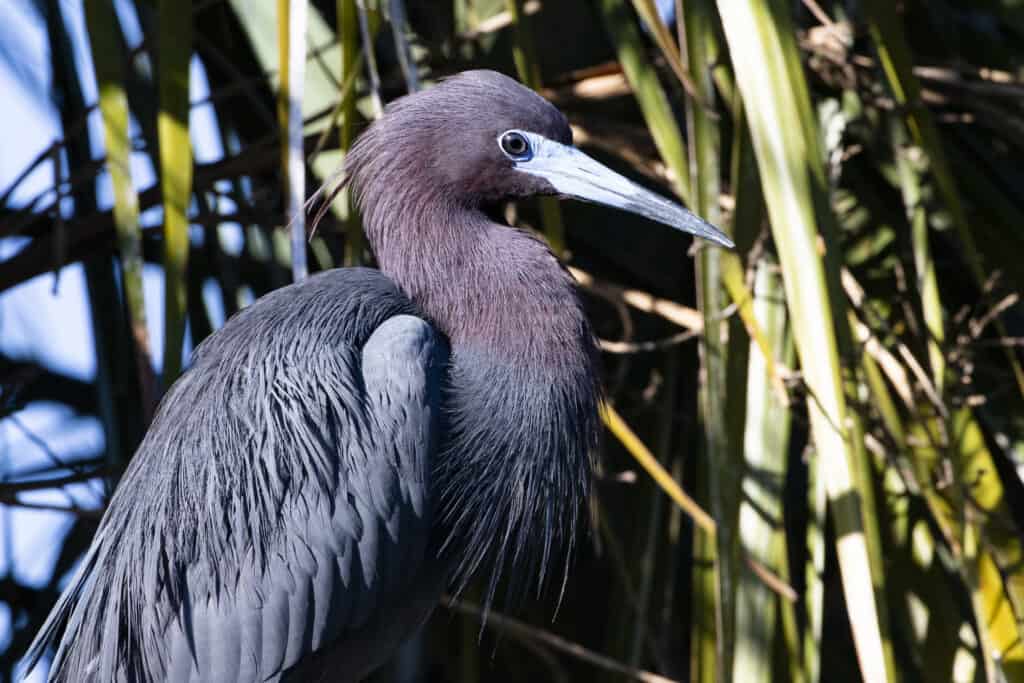
On average, a Little Blue Heron stands 2 feet tall and has a wingspan of 39 to 41 inches.
©iStock.com/Florence and Joseph McGinn
Little blue herons have slender necks, long legs, and straight bills. Adults are dark gray-blue with maroon heads, while juveniles are all white.
Little blue herons eat fish, crustaceans, lizards, frogs, snakes, turtles, and spiders.
Like the great blue heron, little blue herons emit coarse squawks, croaks, and screams.
Little blue herons build their nests on a stick platform placed in shrubs or trees.
American Bittern
Northern breeding populations of the American bittern (Botaurus lentiginosus) migrate to the southern U.S. and Mexico during winter. They live in freshwater marshes and reedy lakes with plenty of cattails and sedges.
On average, an American Bittern stands 23 to 34 inches tall and has a wingspan of 36 to 45 inches.
©iStock.com/Marianne Pfeil
American bitterns are medium-sized herons with thick necks, short legs, and a hunched posture. Their plumage is streaky brown, buff, and white. They eat fish, frogs, aquatic insects, crabs, and garter snakes.
The American bittern’s calls are described as loud pumping sounds.
American bitterns nest on a grass platform in dense marsh growth.
Black-crowned Night Heron
The black-crowned night heron (Nycticorax nycticorax) lives in many aquatic habitats, such as marshes, swamps, shores, rivers, and ponds. The black-crowned night heron is the most widespread heron globally, found on every continent except Antarctica and Australia. In the Americas, its distribution spans from Southern Canada through the United States, Mexico, the Caribbean, and Central America, extending down to Tierra del Fuego, the southernmost tip of South America.

The average black-crowned night heron has a height of 22.8 to 25.6 inches and a wingspan of 41.3 to 44.1 inches.
©Nycticorax nycticorax/Shutterstock.com
Black-crowned night herons are small, stout herons with flat heads and heavy bills. Adults have a glossy black cap and back with pale gray wings and underparts, and yellow legs. They eat fish, crustaceans, aquatic insects, snakes, frogs, rodents, and carrion. Their calls resemble loud barks and croaks.
Black-crowned night herons build their nests on a stick platform in marsh vegetation.
Green Heron
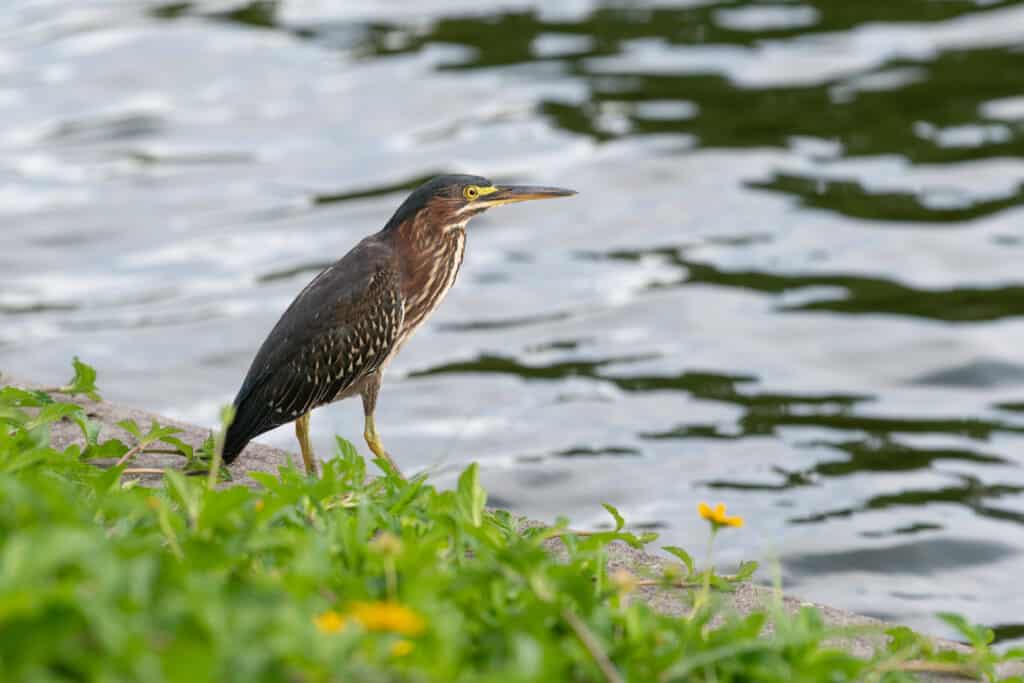
The green heron (Butorides virescens) is distributed widely across the United States. Look for them in marshes, swamps, lakes, ponds, and streamsides.
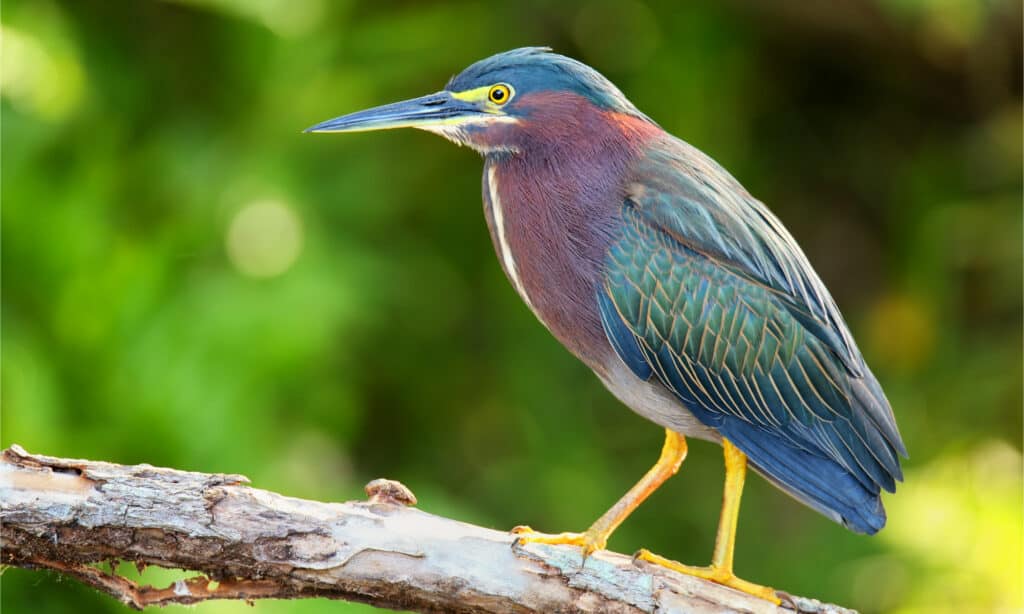
The average green heron is 16.1 to 18.1 inches long and has a wingspan of 25.2 to 26.8 inches.
©Don Mammoser/Shutterstock.com
Green herons are short, stocky herons with thick necks and broad wings. These birds are difficult to spot, as their plumage appears dark at a distance. However, they have deep green backs and caps with chestnut breasts and necks.
Green herons eat small fish, aquatic insects, crustaceans, frogs, snakes, and small rodents.
The green heron’s call is a sharp sky-ow. They build their nests on a stick platform in shrubs or trees.
Cattle Egret
Cattle egrets (Bubulcus ibis) are a migratory species of heron, found throughout most of the United States and breeding in the Southeast. They inhabit marshes, flooded fields, farms, and roadsides.

The average cattle egret has a height of 18 to 22 inches and a wingspan of 35 to 38 inches.
©Richard A McMillin/Shutterstock.com
Cattle egrets are small, compact herons with short legs and thick necks. They are all white except for the golden plumes on their heads, yellow legs, and yellow bills.
Cattle egrets have a symbiotic relationship with cattle, primarily classified as commensalism. As cattle graze, their hooves stir up hidden insects, allowing the egrets to catch more food with less energy. The relationship occasionally becomes mutualistic when egrets perch directly on the animals to eat ticks and biting flies, providing pest relief to the host.
The cattle egret’s call is a hoarse croak, and they nest in a shallow stick bowl in trees or shrubs.
Great Egret
Great egrets (Ardea alba) are scattered across the United States with the most abundant populations in the southeast. They inhabit marshes, ponds, shores, and mudflats.

The average great egret stands about 3 feet tall and has an average wingspan of 51 to 67 inches.
©WildMedia/Shutterstock.com
Great egrets are tall with exceptionally long necks and legs. They are all white with yellow bills and black legs. They eat fish, crustaceans, frogs, snakes, and aquatic insects.
The great egret’s calls are guttural croaks and loud squawks. They build their nests on a stick platform in trees or shrubs near water.
Glossy Ibis
The glossy ibis (Plegadis falcinellus) lives along the United States’ East Coast, where it inhabits marshes, rice fields, and swamps. The glossy ibis is a euryhaline species that can tolerate both freshwater and saltwater habitats.

The glossy ibis has an average body length of 23.4 inches and an average wingspan of between 31 and 41 inches.
©iStock.com/Dmitry Potashkin
The glossy ibis is a medium-sized bird with a long neck and long legs. Most of its body is rich maroon, and its wings are metallic green, bronze, and purple. It eats insects, snakes, snails, crabs, frogs, and fish.
The glossy ibis’s calls are a series of low grunts and bleats. They build their nests on a stick platform in low trees over water.
Snowy Egret
The snowy egret (Egretta thula) is widely distributed throughout the United States, where it inhabits marshes, ponds, swamps, and shores.
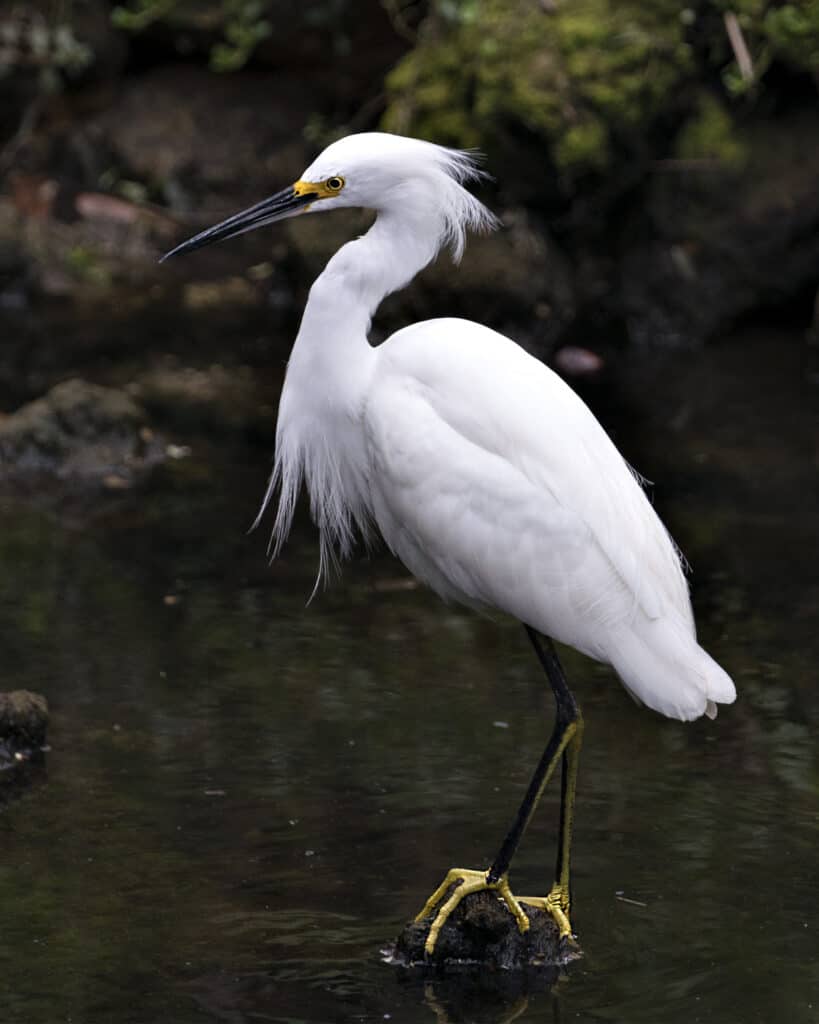
The average snowy egret stands about 22 to 26 inches tall and has a wingspan of about 39 to 41 inches.
©iStock.com/Rejean Bedard
Snowy egrets have thin legs, slender bills, and small heads. They have all-white plumage, black legs, black bills, and yellow feet. They eat fish, insects, and crustaceans.
The snowy egret’s call consists of harsh squawks and gagging croaks. They build their nests on a stick platform in trees or shrubs.
Least Bittern
The least bittern (Ixobrychus exilis) breeds in the Eastern United States, with some populations living year-round in southern Florida. Least bitterns live in freshwater marshes and reedy ponds, although they can occasionally be found in brackish water.

The least bittern has an average height of 11 to 14.2 inches and an average wingspan of 16.1 to 18.1 inches.
©iStock.com/Carol Hamilton
Least bitterns are very small herons with long toes and dagger-like bills. Adults are grayish-brown above and buff or brown below, with white streaks along the sides and yellow legs. They eat fish, insects, leeches, frogs, and snakes.
The least bittern’s call consists of soft coos and chuckles. They nest on a well-concealed platform made from marsh grasses.
Yellow-crowned Night Heron
The yellow-crowned night heron (Nyctanassa violacea) breeds across the eastern and southern United States. They are found in cypress swamps, mangroves, bayous, and streams. These small herons are stocky with thick necks and short legs. They have streaky gray plumage with black and white faces and yellow-orange legs.
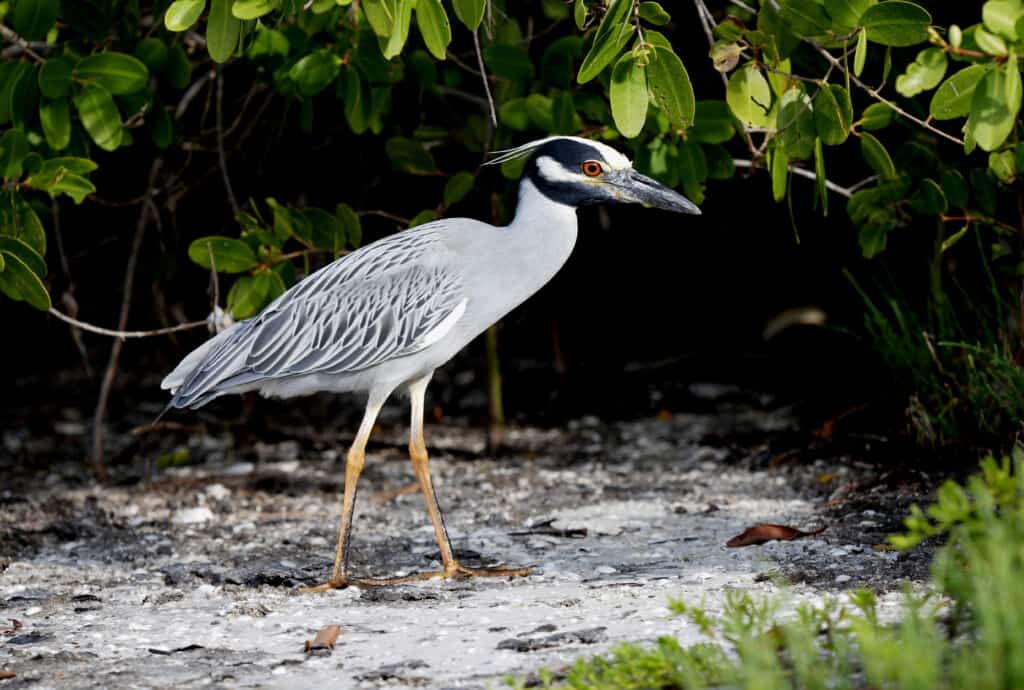
The average yellow-crowned night heron is 22 to 28 inches tall with a wingspan of 3.3 to 3.7 feet.
©iStock.com/neil bowman
Yellow-crowned night herons consume crustaceans, frogs, insects, and fish.
Their call resembles a loud, high-pitched quack. Yellow-crowned night herons nest on a stick platform in trees above the ground.
Tricolored Heron
Tricolored herons (Egretta tricolor) live in saltwater marshes, coastal estuaries, mangroves, and lagoons. They live year-round along the East Coast of the United States and the Gulf of Mexico.
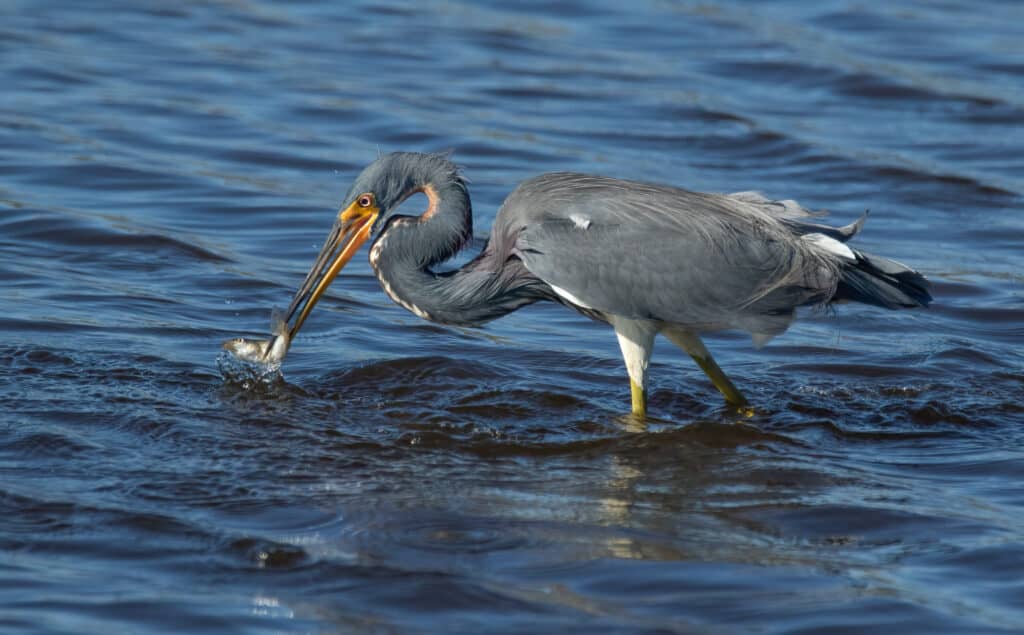
The average tricolored heron is 22 to 30 inches tall with a wingspan of 36 to 42 inches.
©iStock.com/MattCuda
Tricolored herons are slim, medium-sized herons with long bills and thin, curved necks. They are a mix of bluish-gray and lavender above and white below. Breeding birds have pink legs, while nonbreeding birds have yellow legs. They consume small fish.
Their calls are scratchy, nasal snaps. Tricolored herons nest on a platform of loose twigs on islands with dense vegetation.