Quick Take
- A wildlife expert compared the heron's hunting strike to a rattlesnake, and the anatomy behind it turns out to be stranger than you'd expect.
- Scientists have argued for over a century whether the great white heron is even its own species, and the debate still isn't settled.
- The great white heron will eat almost anything it can swallow, and that includes creatures most people wouldn't expect a bird to tackle.
- Why do Florida's white herons skip migration while their blue relatives travel thousands of miles? The reason is more telling than it seems.
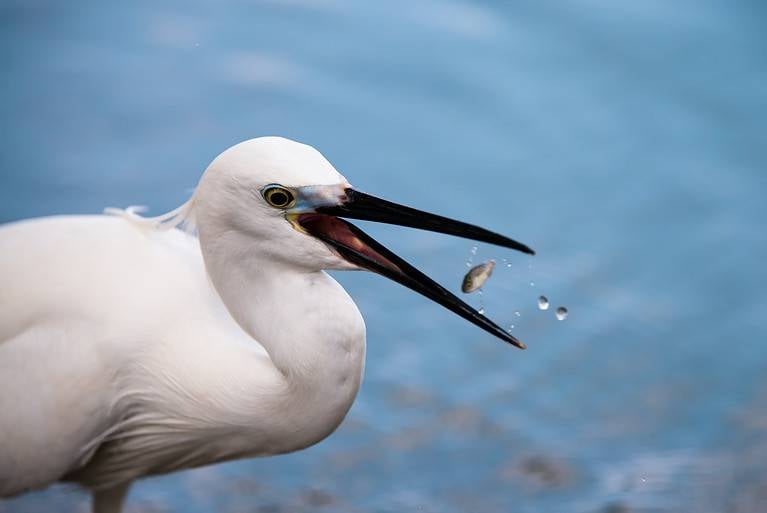
Like a slingshot, the neck of a great white heron extends, capturing its prey within the blink of an eye. While most birds typically have around 14 or 15 neck vertebrae, the 20 or more cervical vertebrae of a great white heron give the bird a lightning-fast strike.
“It’s like a rattlesnake with feathers,” said Ron Magill, wildlife photographer and former communications director at the Zoo Miami, the Miami-Dade Zoological Park and Gardens.
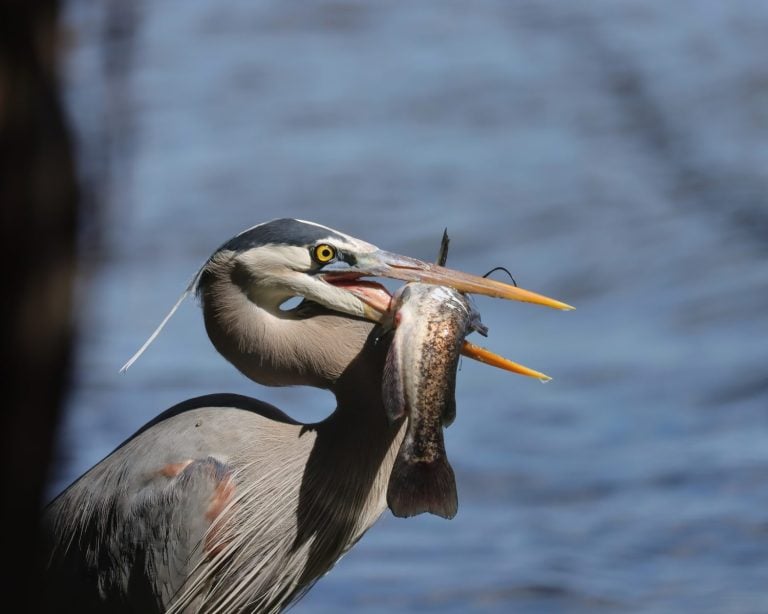
The heron‘s strike makes it an exceptionally versatile, highly opportunistic hunter. Forming an S-shaped coil that acts like a slingshot or spring, once uncoiled, the mechanism of the heron’s neck allows the bird to strike in as little as .05 to .08 seconds as it snaps up frogs, fish, and other small animals.
Eyes of a Hunter
“They’re visual hunters and hunt with their eyes,” says Jim Dunster, bird curator at Zoo Miami, adding that the birds have a wide-ranging diet, feasting mostly on fish, amphibians, snakes, and other birds. Dunster has witnessed white herons attacking other wading birds, including bitterns.
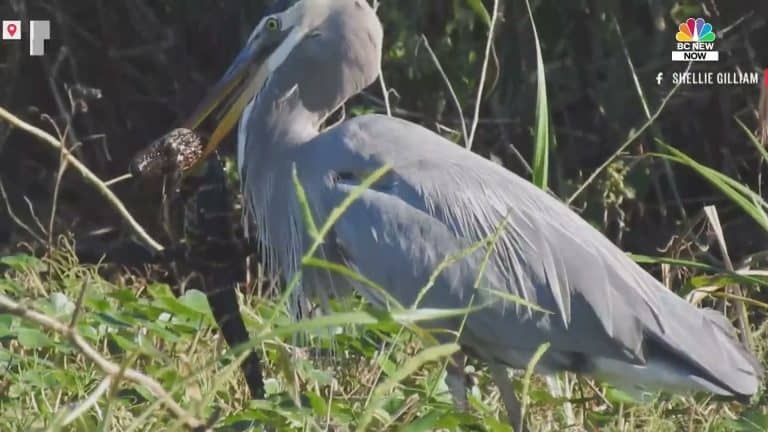
“They’re pretty opportunistic,” says Dunster. “They’ll eat baby alligators. Basically, if they can grab it and they can swallow it, they’ll pretty much eat it, but they primarily feed on fish.”
Dunster currently oversees the two unreleasable great blue herons at Zoo Miami, a male and a female. Working with several bird rehabilitation facilities in Florida, the zoo often supports rehab and conservation efforts by taking in new birds, including pelicans, cormorants, and herons, that cannot be released into the wild due to injury or other needs.
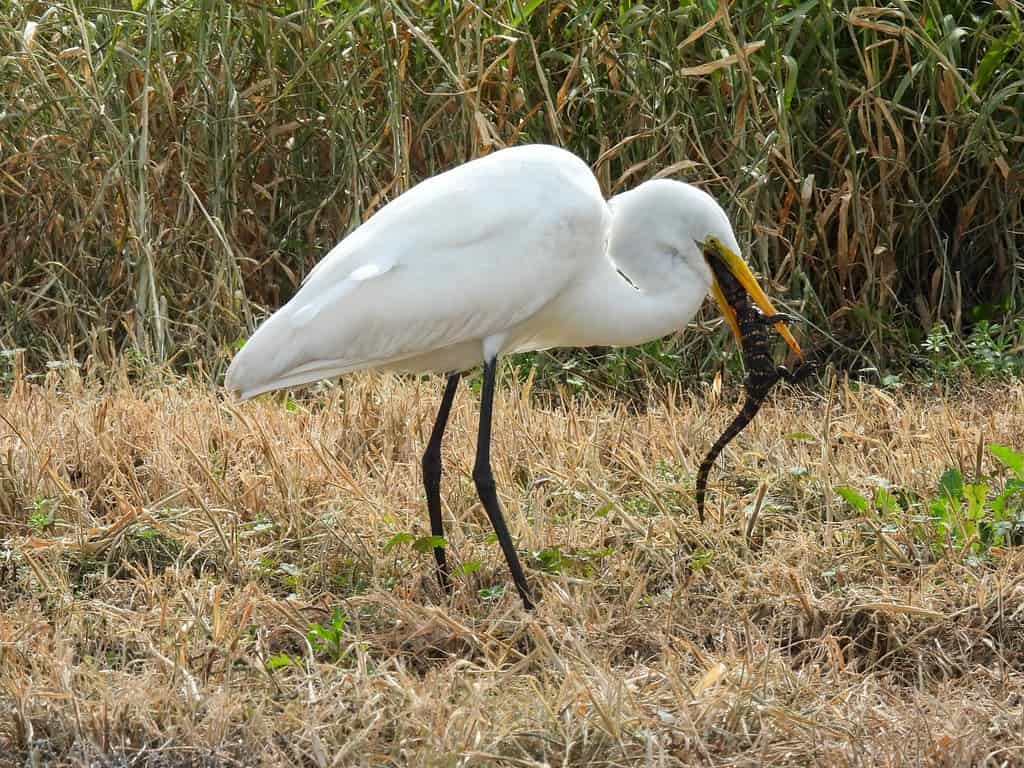
The slingshot-like mechanism of the heron’s neck allows the bird to strike in as little as .05 to .08 seconds as it snaps up fish, frogs, baby alligators, birds, and other small animals.
©Lisa Crawford/Shutterstock.com
The herons at the Zoo Miami haven’t bred, Dunster believes, because of their inability to fly. “They’d have to nest on the ground basically, and they may not feel comfortable doing that,” says Dunster. “I’ve worked with birds that typically nest off the ground that aren’t able to fly, and they will nest on the ground because the drive to reproduce is so strong, but these guys haven’t.”
Courting Rituals
In the wild, herons also have an elaborate courtship display that involves growing longer nuptial plumage on their heads, necks, and backs. Males will often fly in wide loops around a colony, with their necks fully extended while making an exaggerated “whomp” sound to attract a mate. After a few more stages of courtship, once linked, a male and female will fluff their feathers and quickly snap their bills together, a step called bill clappering.
While nesting, white herons often build their nest from large sticks, branches, and twigs, lining the interior with leaves, grass, and other plant material. Herons nest in dense shrubs, trees, or mangroves near water, often sharing their rookery with a variety of birds, including egrets, ibises, spoonbills, cormorants, waterfowl, gulls, storks, anhingas, and other species.
The nesting commune often becomes a “smelly affair,” jokes Dunster, since the birds eat fish and carcasses, and droppings are often part of their nesting material.
“Florida is an ideal habitat for the heron. They’re more a resident of Florida than a seasonal species.”
Josh Randle, Animal Care Manager, Zoo Miami
Aviary, Avian Propagation Center
For more than a century, scientists and researchers have debated whether the great white heron is a separate species or merely a color morph subspecies of the great blue heron.
First considered a separate species (Ardea occidentalis) by John James Audubon in 1835, the taxonomy of the white heron was debunked in 1973 when the American Ornithologists’ Union Committee on Classification and Nomenclature synonymized both herons.
“I think it’s a color morph, but there are people that think it’s an entirely different species,” says Dunster. “So it’s still up for debate.”
Whether they are a single species or a variant of the blue heron, white herons stand apart from other wading birds with distinct features, including their crisp white plumage, pale yellowish/pink legs, and a thicker, dagger-like bill.
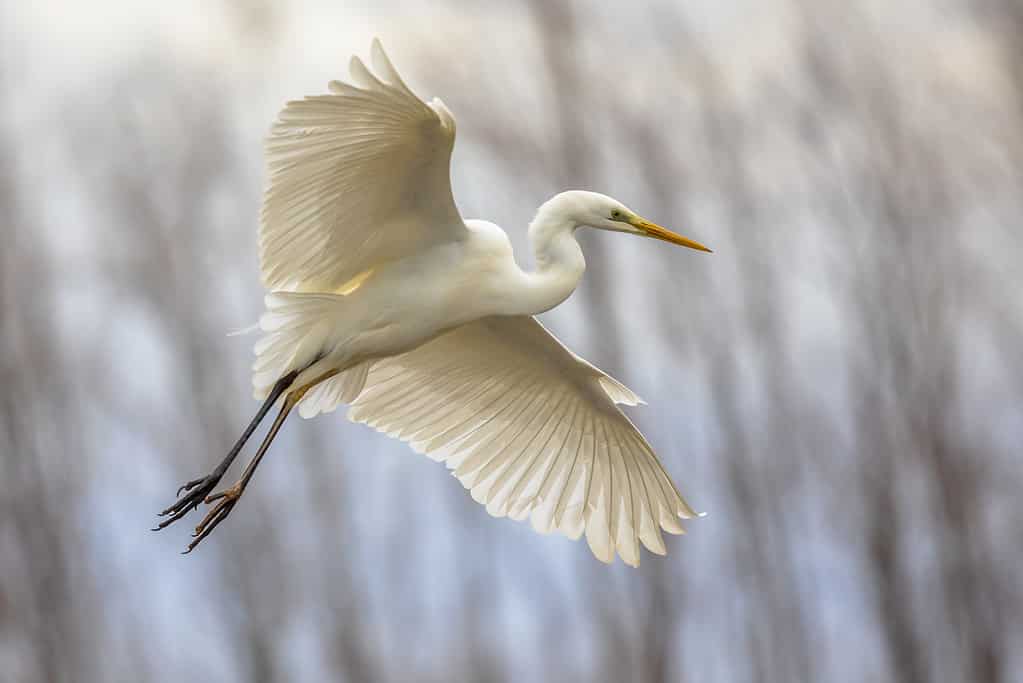
Great white herons stand apart from other wading birds with distinct features, including their crisp white plumage, pale yellowish/pink legs, and a thicker, dagger-like bill.
©iStock.com/CreativeNature_nl
Rehab and Threats
Among the largest wading birds in the world, herons face the same threats as most birds and marine animals. Boat traffic, damage to marine shallows, and environmental factors such as climate change and water pollution have all contributed to habitat loss.
Increased boat activity in the shallower waters along Southern Florida and the Keys can damage vital seagrass beds, disturbing foraging and nesting areas. As larger, sedentary stand-and-wait predators with long nesting periods, herons have limited mobility and a higher risk of nesting failure when their shallow-water habitats are disrupted.
At the Zoo Miami, herons are generally brought in for rehabilitation. Two of the most common threats to the birds are car strikes — the herons often hunt for insects near busy roads and highways — and getting caught in discarded fishing lines. Herons can also become victims of power lines, often colliding with them mid-flight and being electrocuted, a result of the birds’ reduced visibility during twilight hours, compounded by their large wingspan and flight speed.
While the great blue heron generally migrates farther than its white-plumed “relative,” traveling thousands of miles during winter to feed and breed, the great white operates within a more restricted, localized geographic range. Though white herons migrate to parts of the Caribbean, Cuba, and the Yucatan Peninsula, they predominantly reside in Southern Florida and the Florida Keys.
The birds’ shorter migratory path is more a result of access to year-round food sources, says Josh Randle, Animal Care Manager at the Zoo Miami Aviary, Avian Propagation Center, than any physical or other restrictions. Since food sources are plentiful for the birds in Florida, they generally remain in the region throughout the year.
“White herons are pretty much here year-round,” says Randle. “They may move around South Florida to feeding areas, but they’re not going to typically migrate; some further north would. Even birds up north will sometimes spend the winter up there if they can find the food to survive on.”
He adds, “Florida is an ideal habitat for the heron. They’re more a resident of Florida than a seasonal species.”