
Cranes are large omnivorous birds of the family Gruidae, of which there are 15 species. They are known for their vocalizations and for performing elaborate mating dances. With long legs and a large torso, these birds stand over four feet tall and have incredible wingspans. Continue reading to learn about the 10 largest cranes in the world.
10. White-naped Crane
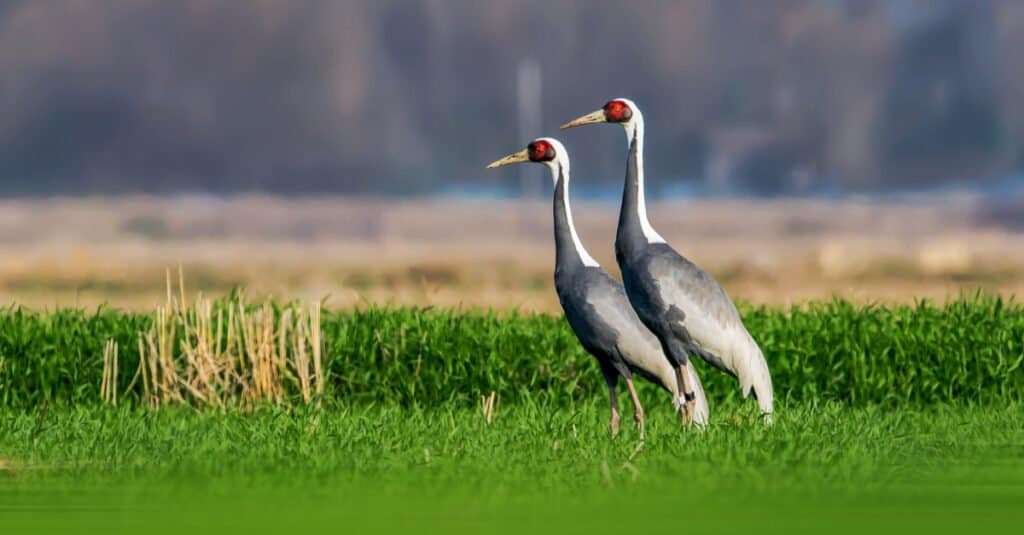
The white-naped crane is found across Asia.
©Wang LiQiang/Shutterstock.com
- Height: 4.3 feet
- Wingspan: 6.9 feet
- Weight: up to 12 pounds
The white-naped crane (Antigone vipio) is a large crane found in Mongolia, China, South Korea, Siberia, Russia, and Kazakhstan. It is omnivorous, feeding on a variety of insects, seeds, roots, plants, and small animals. Because of overhunting and habitat loss, only about 5,000 white-naped cranes remain in the wild. The IUCN lists the species as Vulnerable.
The white-naped crane is easily recognized by its distinctive white nape and the white stripe running down the side of its dark gray neck. There is not much difference in size and appearance between males and females. However, in some breeding pairs, the male is larger than the female. Like many cranes, the white-naped crane participates in a complicated and unique courtship display, with elaborate vocalizations and movements.
9. Sandhill Crane
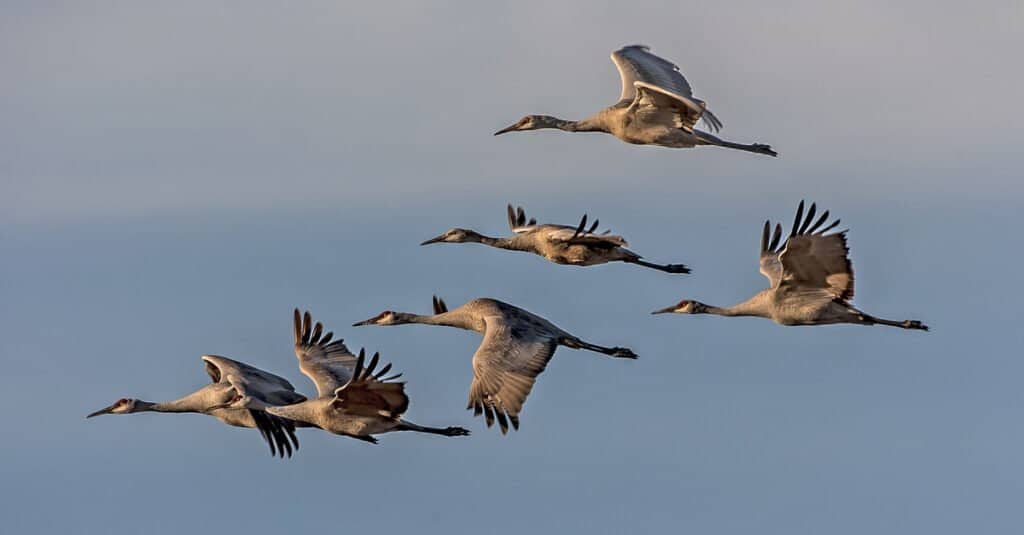
Sandhill cranes are commonly found in Nebraska.
©Tom Zeman/Shutterstock.com
- Height: 4.6 feet
- Wingspan: 7.5 feet
- Weight: 9 to 14.8 pounds
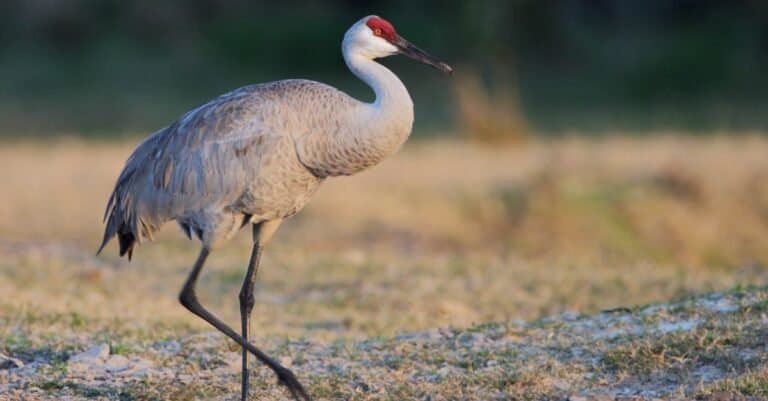
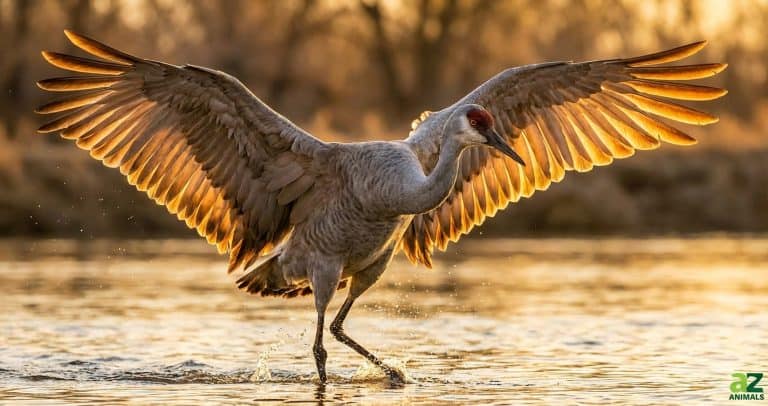
The sandhill crane (Antigone canadensis) is one of the largest crane species in North America, with a habitat range extending into Northeastern Siberia. The common name is derived from Nebraska’s Sandhill region, where they are frequently found. Currently, the sandhill crane is listed as Least Concern by the IUCN, with an estimated population of over 500,000 members.
Although stable overall, there are differences in conservation status between the 5 subspecies. The Cuban sandhill crane (Antigone canadensis nesiotes) and the Mississippi sandhill crane (Antigone canadensis pulla) are Endangered, while the lesser sandhill crane (Antigone canadensis canadensis) has more than 400,000 members. In Wisconsin, there is currently a push to establish a sandhill crane hunting season because of the seasonal damage they cause to local agriculture.
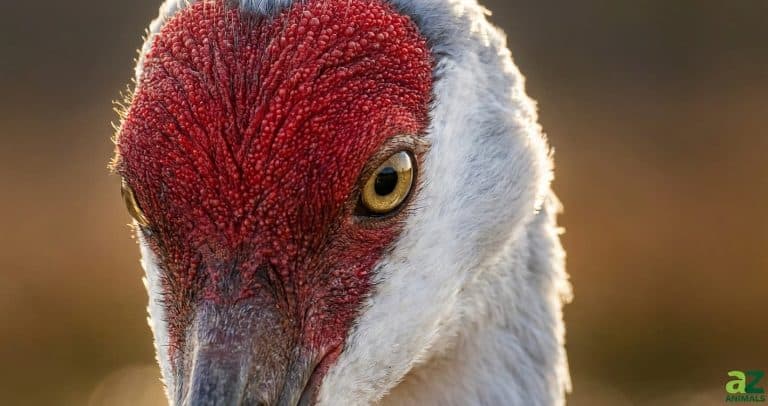
Like other crane species, the sandhill has a red bald patch above its eye and a long, tapered beak. The feathers on mature adults are gray with white patches underneath the red crown. Sandhill cranes are herbivorous and social creatures, often forming groups that roost and feed together. When breeding, the sandhill crane typically lays a clutch of one to three eggs.
8. Whooping Crane
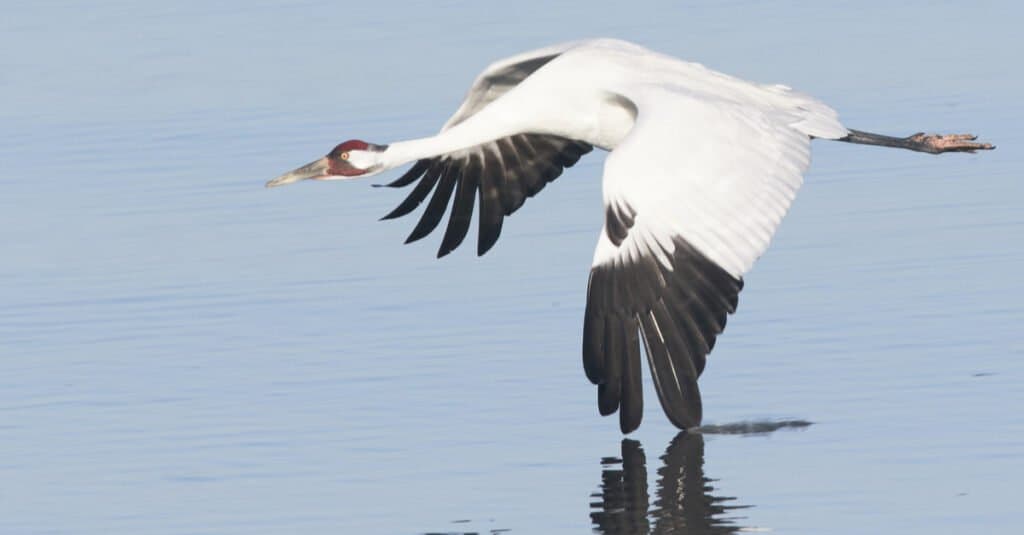
©Kent Ellington/Shutterstock.com
- Height: 5.25 feet
- Wingspan: 7.5 feet
- Weight: 10 to 19 pounds
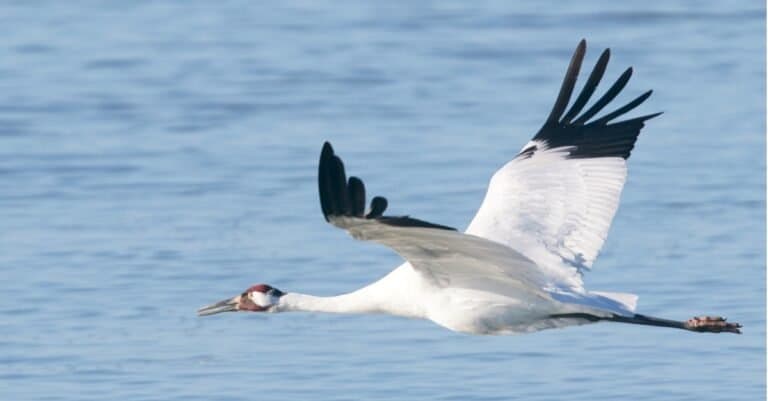
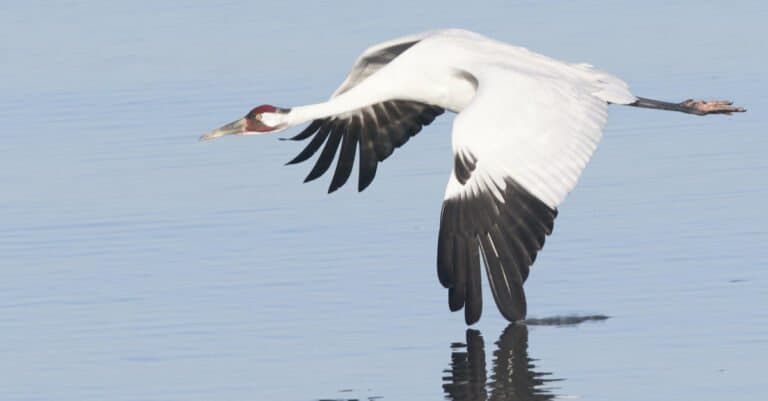
The whooping crane (Grus americana) is recognized by its whooping vocalizations and, like many other crane species, is a migratory bird. By 1941, only 21 wild and 2 captive cranes remained because of overhunting and habitat loss. This crane has been the beneficiary of numerous conservation efforts, which have led to a limited recovery, with over 800 whooping cranes alive today, as the population continues to increase. The IUCN lists the entire whooping crane population as Endangered.
The adult whooping crane has a striking white body plumage, a featherless red crown, a long-tapered beak, and black-tipped wings, which are visible during flight. The list of animals that prey on whooping cranes and their eggs includes the American black bear, wolverines, gray wolves, cougars, red foxes, bald eagles, common ravens, and bobcats. Although there are just over 800 whooping cranes alive today, the effort to circumvent their extinction has become one of North America’s most well-known conservation successes, alongside the recovery of Yellowstone’s wolves and the bald eagle.
7. Black-necked Crane
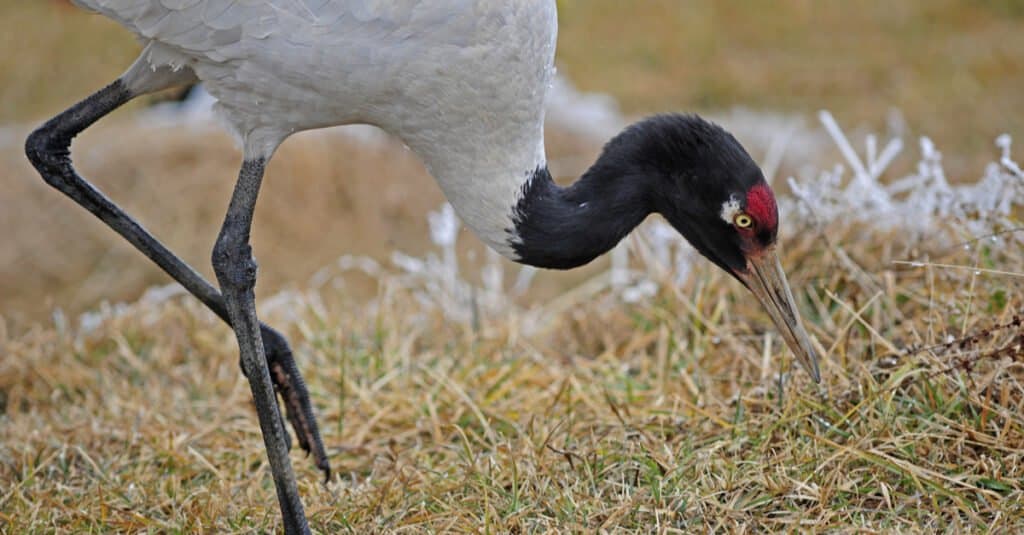
The black-necked crane lives on the slopes of the Himalaya mountains.
©Perry chang/Shutterstock.com
- Height: 4.3 feet
- Wingspan: 7.7 feet
- Weight: 12 pounds
Black-necked cranes (Grus nigricollis) are the world’s only alpine cranes and are found on the slopes of the Himalayas at elevations up to 16,000 feet above sea level. During the winter, these cranes retreat to the low valleys of Bhutan and Southern China to escape the cold. Because of the difficulty of accessing their alpine habitats, black-necked cranes were among the last crane species to be described by ornithologists in 1876. They are whitish-gray in appearance, with a black head, red crown patch, black upper legs and neck, and a small white patch behind the eye.
The black-necked crane is currently listed as Near-Threatened by the IUCN but is federally protected in Bhutan, China, and India. They are celebrated at a festival in Bhutan and are the state bird of the Ladakh territory in India. Although some crane mortalities have been attributed to herders’ dogs, in general, the people living in the crane’s habitat have a good deal of respect for the bird and do not hunt or poach it. Habitat loss is a prime concern for the species because of shifting agricultural practices and the sensitivity of alpine wetland ecosystems.
6. Common Crane
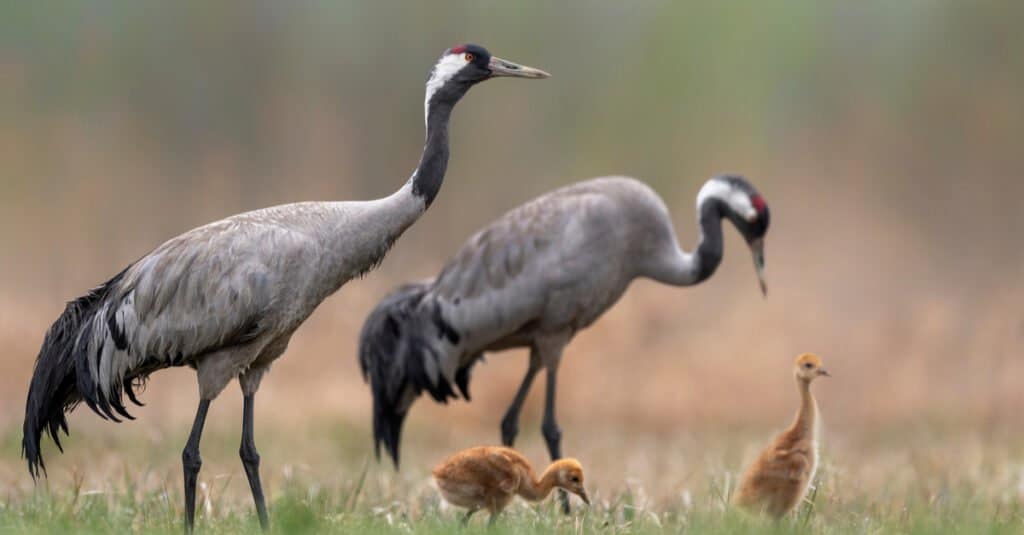
The common crane has a wide territory.
©Piotr Krzeslak/Shutterstock.com
- Height: 4.3 feet
- Wingspan: 7.9 feet
- Weight: 6.5 to 13.4 pounds
The common crane (Grus grus) is a large and stately bird. Because of its long-distance migratory patterns, the common crane is found in Northern and Eastern Africa, Mesopotamia, India, China, Turkey, Northeastern Europe, and parts of Scandinavia. The common crane is one of only four crane species to be listed as Least Concern by the IUCN.
The common crane lives in bogs, moors, and wetlands for its breeding grounds and is monogamous once it mates. Couples mate for several years in a row, but will always perform the same courtship rituals. The common crane usually lays two eggs, though instances of one or as many as four eggs have been documented. The common crane’s overall coloration is gray, with a black chin, throat, and neck. There is a red featherless patch on this crane’s head. Broad white stripes also extend from behind the eyes down the sides of the neck.
5. Brolga Crane
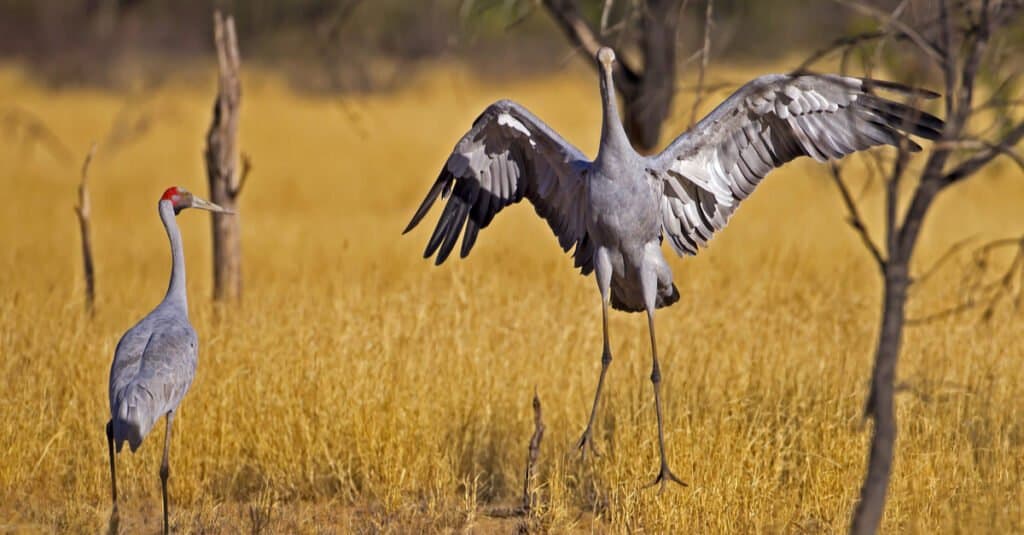
The brolga crane is one of the largest crane species in Australia.
©Wright Out There/Shutterstock.com
- Height: 4.6 feet
- Wingspan: 7.9 feet
- Weight: 12.5 to 19.2 pounds
The brolga crane (Antigone rubicunda), or Australian crane, is one of the largest crane species in Oceania, with breeding populations in North and Eastern Australia and New Guinea. It was originally classified in the genus Grus, but genetic studies have shown it is most closely related to the white-naped crane. There are more than 100,000 brolgas in the wild, enough to be considered Least Concern by the IUCN.
Adult brolgas have a gray-green skin-covered crown as well as a red, featherless area behind their eyes that surrounds a small patch of gray feathers by the ears. Their general body plumage is gray.
In their range, brolgas are relatively widespread and abundant. Brolgas, like many cranes, rely on wetlands to feed and nest. Wetlands are often poorly understood by the public and are subject to dredging for urban development or agriculture. Consequently, habitat loss is the primary obstacle to their long-term survival.
4. Wattled Crane
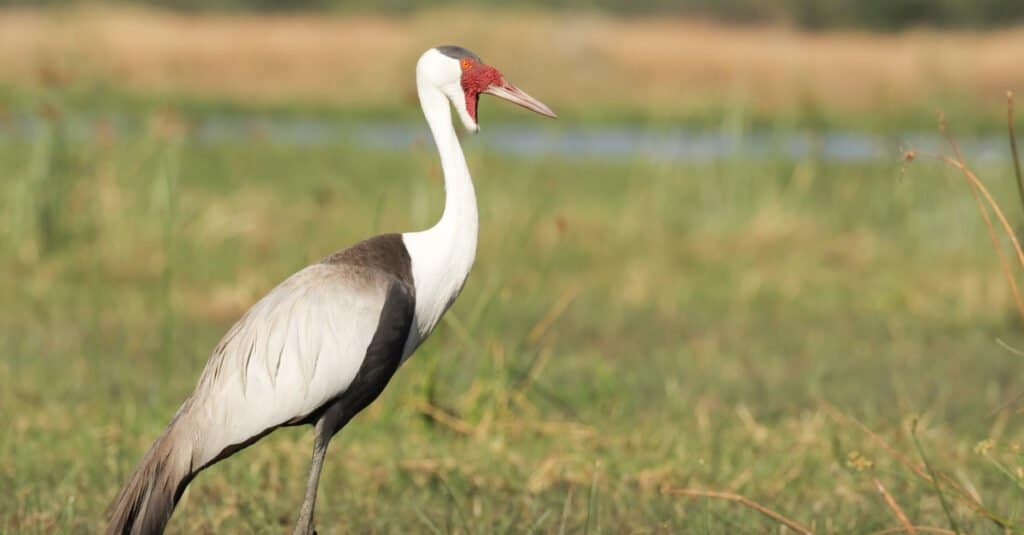
Wattled cranes live in Sub-Saharan Africa.
©Bildagentur Zoonar GmbH/Shutterstock.com
- Height: 5.7 feet
- Wingspan: 7.9 feet
- Weight: 14 to 20 pounds
The wattled crane (Bugeranus carunculatus) is the tallest crane in Africa and among the largest crane species, living in Sub-Saharan Africa. They are found in at least 11 countries, but the largest population occurs in the Okavango Delta in Botswana. True to its name, the wattled crane has a wattle that hangs below its beak. The IUCN currently lists the wattled crane as Vulnerable.
Typical adult wattled cranes have a white-feathered neck and throat, an ashy-gray back and wings, a sleek gray-feathered patch above the eye, black legs, and black feathers on their breast. The featherless skin below the eye and extending to the wattle is red in appearance and covered in small bumps. As with all cranes, the destruction of wetlands is a major concern for the species, especially concerning the Okavango Delta.
3. Siberian Crane
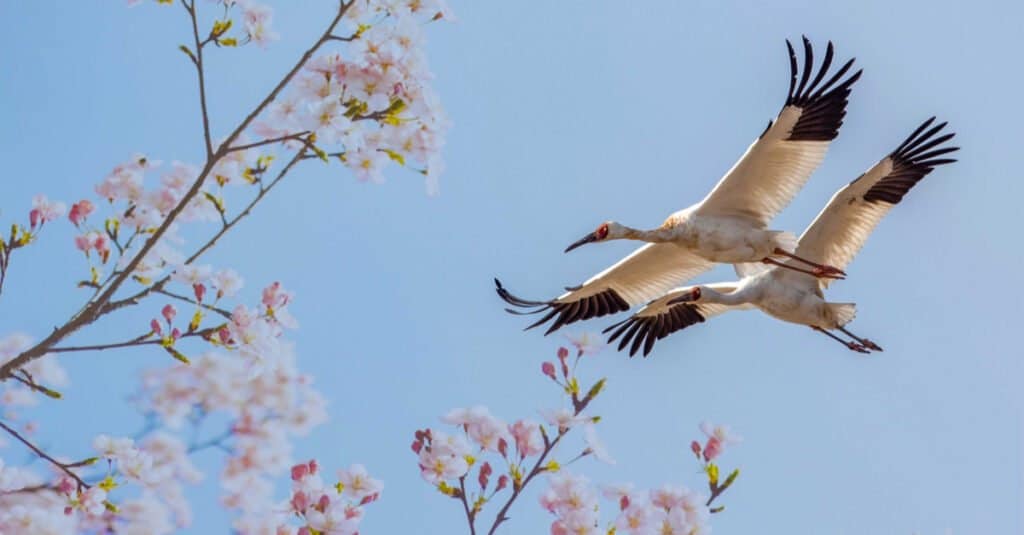
Two Siberian cranes in the sky.
©Wang LiQiang/Shutterstock.com
- Height: 4.6 feet
- Wingspan: 8.5 feet
- Weight: 11 to 19 pounds
Also known as the snow crane, the Siberian crane (Leucogeranus leucogeranus) is characterized by its distinctive coloration. The forehead, face, and sides of the head are covered in red skin, the majority of their plumage is white, the wingtips are black, and the legs are pinkish-red. The Siberian crane is Critically Endangered, according to the IUCN, with an estimated total population of 3,200 or fewer.
The remaining members of the species breed in Northern Siberia and winter in either Poyang Lake, China, Bharatpur, India, or Northern Iran. Like all cranes, it is an omnivore that breeds in wetlands. The serrated beak is unique among Siberian cranes and allows them to catch slippery prey more effectively.
While habitat loss and hunting along migratory routes have pushed the species close to the brink, it is still commonly sighted at Poyang Lake. Any significant long-term environmental damage related to the crane’s winter habitat could accelerate the decline of the Siberian crane. The construction of the Three Gorges Dam has been cited as a factor affecting water levels in Poyang Lake, potentially disrupting Siberian crane habitat.
2. Red-crowned Crane
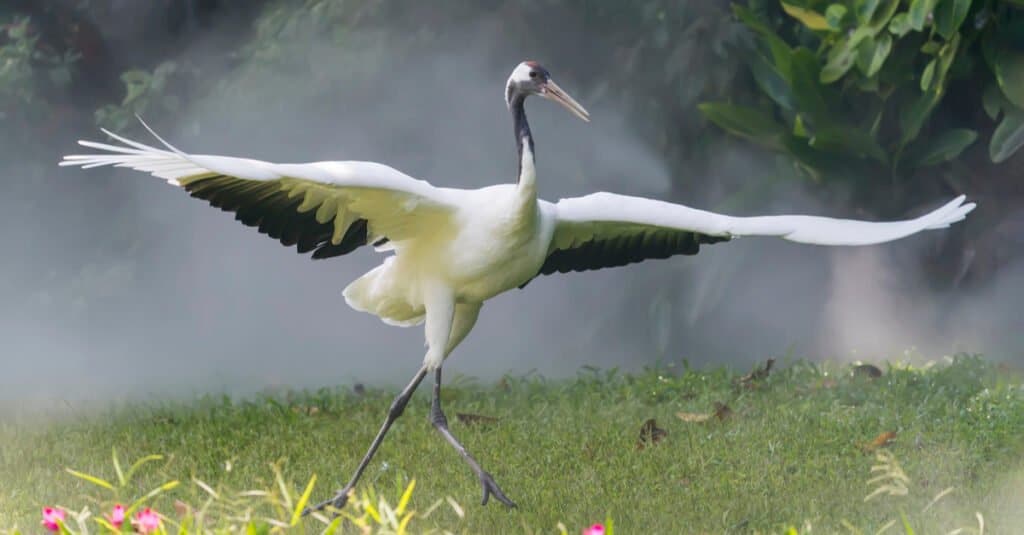
Red-crowned cranes can weigh up to 23 pounds.
©asharkyu/Shutterstock.com
- Height: 5.2 feet
- Wingspan: 8.2 feet
- Weight: 11 to 23 pounds
Adult red-crowned cranes (Grus japonensis) are named for the distinctive red patch on their heads. The body plumage is largely white, like the whooping crane, but differs because of the black coloration along the neck and hindquarters. The throat and lower face are black, a white-feathered band covers the middle third of the face, and the upper part contains the red crown. The birds are omnivorous and build their nests in wetlands, which contain one to two eggs. Population numbers have been rising in Japan, but the continental population is reportedly declining. Some red-crowned cranes in China migrate long distances, while others, like the population in Hokkaido, Japan, travel fewer than 100 miles between their summer and winter sites.
The red-crowned crane is known for its complicated mating ritual, although they have been observed dancing in duets well outside of breeding time. The social implications of their dances are multifaceted, but it is generally agreed that the dancing is intended to strengthen bonds between crane pairs. According to the IUCN, the red-crowned crane is listed as Vulnerable.
1. Sarus Crane
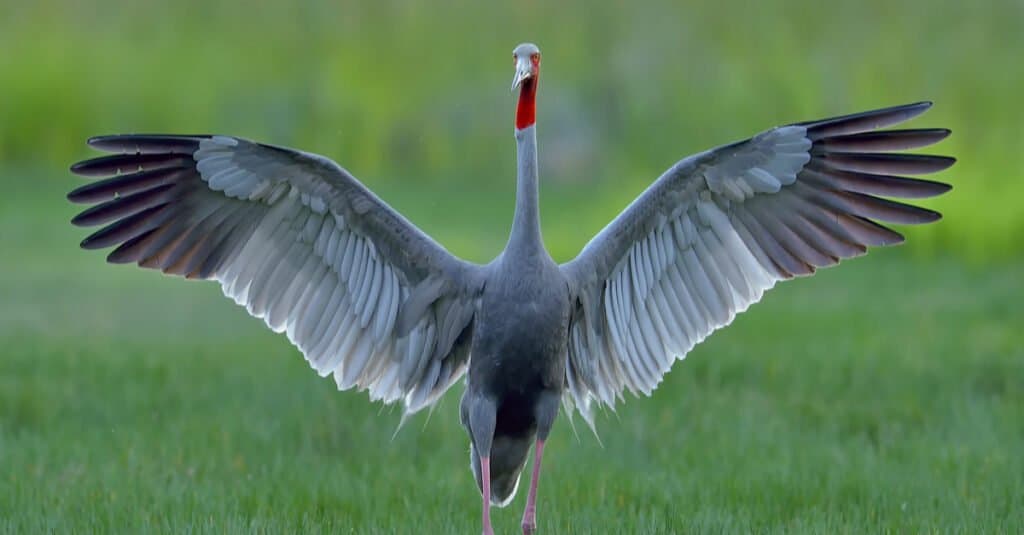
The sarus crane is considered sacred.
©vanchai/Shutterstock.com
- Height: 5.9 feet
- Wingspan: 8.2 feet
- Weight: 15 to 17 pounds
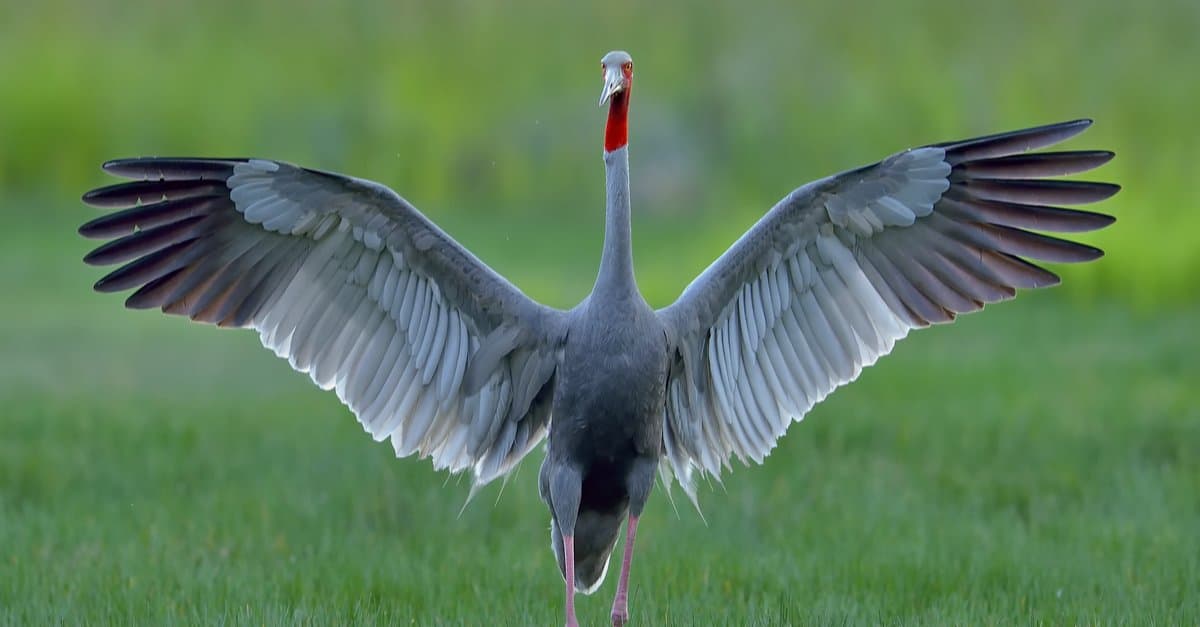
The largest crane species in the world is the sarus crane (Grus antigone). This massive non-migratory crane is found in the Indian subcontinent, Australia, and Southeast Asia. Its coloration is unique among cranes because the red crown extends down the neck. Currently, the IUCN lists the sarus crane as Vulnerable.
Aside from the red crown and upper neck, the sarus crane has large gray wings with black wingtips, a gray body, a gray ear patch of feathers within the red crown, and a greenish-gray bill. Despite a global population of 20,000 to 30,000 individuals, the crane is considered sacred and is not usually hunted by humans. They do experience egg poaching by jungle crows, and in Australia, their young are susceptible to predation by wild dogs. In India, the sarus crane is widely revered. According to legend, the poet Valmiki cursed a hunter for killing a sarus crane and was then inspired to write the Hindu epic Ramayana.