
Its impressive wings, swathed in unique patterns and colors, provide a pleasant sight as it flits gracefully between flowers, lapping up the nectar with its uncoiled proboscis. Butterflies, majestic creatures of the order Lepidoptera, are closely related to moths and evolved more than 200 million years ago. Butterflies rely heavily on their visual sense for survival. Their eyes help them detect predators, navigate around their environment, and find suitable sources of nectar from which they can drink. Continue reading to learn fascinating details about the number, structure, and visual capabilities of butterfly eyes.
Butterfly Eyes
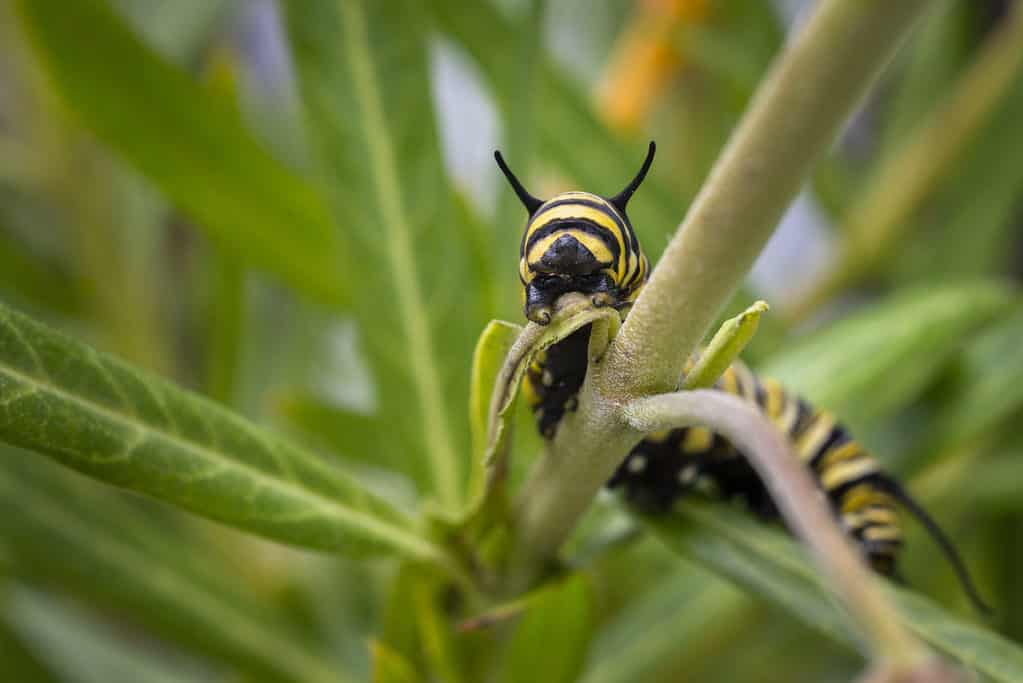
Butterfly larvae have up to 14 eyes, arranged in a semicircle on their face.
©iStock.com/Janice Chen
The number of eyes a butterfly has depends on its life stage. Once it hatches, the caterpillar, or larva, has 10 to 14 (though usually 12) small eyelets arranged in a semicircle around its face. However, these very simple eyes can only detect light and dark, rather than precise images or color. The larva navigates its environment almost entirely blind, using its other senses to find its way.
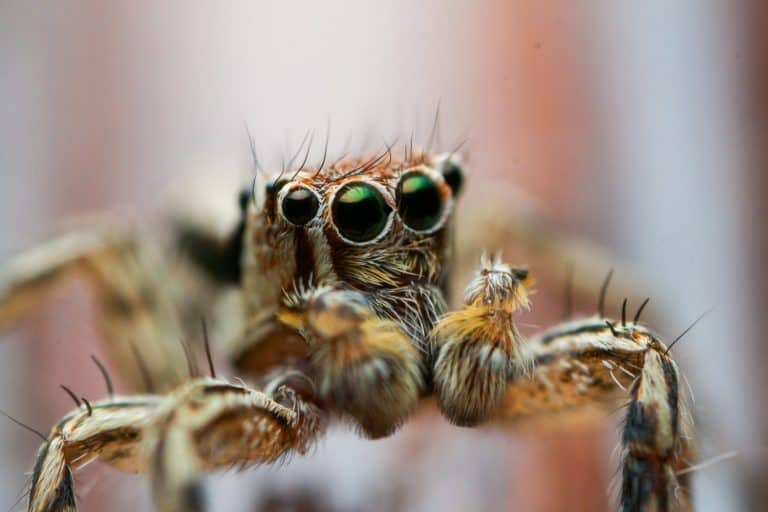
After metamorphosis, the adult butterfly has two large, fully developed compound eyes, one on each side of its head, which can now see shapes and colors. This is typical for butterflies. Two eyes are a typical number for most adult insects. It’s actually a misconception that insects tend to have more than two eyes; this trait is more common in spiders, crabs, and other arthropods.
Compound Eyes
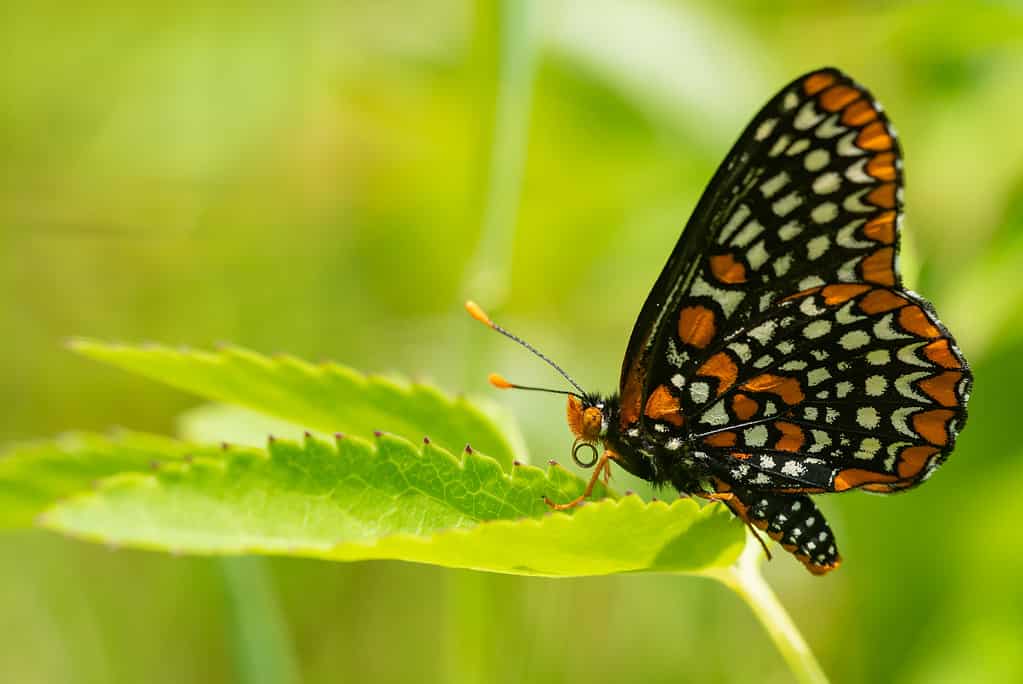
Adult butterflies have two eyes with up to 17,000 photoreceptors in each eye.
©bookguy/iStock via Getty Images
The structure of the insect eye is what gave rise to the misconception. Unlike the simpler lenses of most animals, the compound eye of an insect is composed of many thousands of individual photoreceptors. Each receptor effectively has its own cornea and lens, but still operates as part of a single eye. Altogether, each butterfly eye can contain up to 17,000 of these receptors, though many species have fewer.
Photoreceptors distinguish color and brightness. In a human eye, many light-sensitive cells work together to form an image, and various mechanisms control the amount of light entering the lens. In contrast, each individual butterfly photoreceptor contains only a few cells for the light to focus on, which affects the quality of the butterfly’s vision. However, butterflies compensate for this in other ways.
Butterfly Vision

Butterflies have compound eyes with thousands of lenses.
The compound eye of the butterfly has both advantages and disadvantages compared to a typical non-compound eye. The most important advantage it confers is the ability to see in many different directions at once. This means the insect eye remains fixed in place, unable to move, yet still achieves a better field of vision than a typical animal eye. For a small, vulnerable animal like an insect, this allows it to act almost instantly the moment it detects a threat.
The major downside to a compound eye, however, is a loss of acuity, meaning quality of vision. Even with lots of individual lenses, the insect eye cannot achieve the same visual acuity as a non-compound eye with a particularly dense arrangement of cells. It’s estimated that the acuity of the human eye is about a hundred times better than that of the best insect eye, which is thought to be the dragonfly’s, with some 30,000 lenses per eye. The shape of the lens does not change in compound eyes, so insects must move closer or farther away to focus on an object.
What are the eyes on the wings?
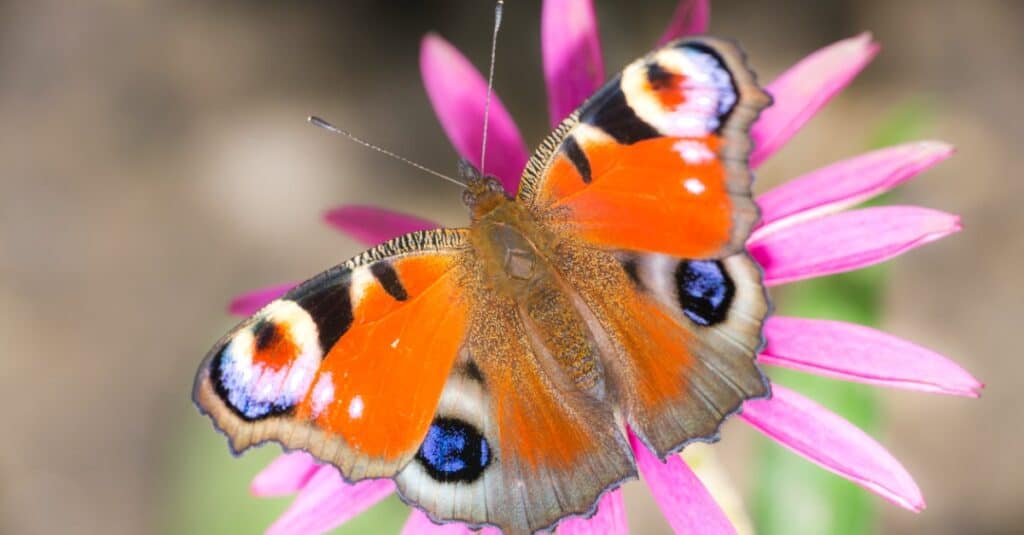
The eyespots on a Peacock butterfly’s wings are the most distinctive feature of the insect.
©iStock.com/Dirk Daniel Mann
Many butterfly species have false eyespots on their wings. These markings aren’t true eyes and cannot provide any vision, but they do serve an important purpose: to ward off predators. Eyespots mimic the eyes of more fearsome creatures, fooling potential predators and making them think twice about approaching. Another hypothesis is that the eyespots deflect attacks away from the head and toward less vulnerable body parts. Recent research shows that in some butterfly species, eyespots also play a role in attracting mates.