
Quick Take
- Rainbow mantis shrimp have 360-degree awareness thanks to their unique vision.
- Rainbow Mantis Shrimp possess 16 photoreceptors that allow for depth and distance differential.
- People differentiate more colors than the rainbow mantis shrimp, despite the sophisticated vision the shrimp possesses.
- Hyperspectral imaging has translated shrimp’s incredible vision into early cancer detection.
With only 5% of the ocean being explored, it is not surprising that creatures exist beneath its surface that are a complete mystery. As new species are discovered, scientists work diligently to learn everything there is to know about the marine animal and its function in the ocean. Sometimes, this proves to be an easy task. Other times, scientists work for years and only scratch the surface of how some animals operate.
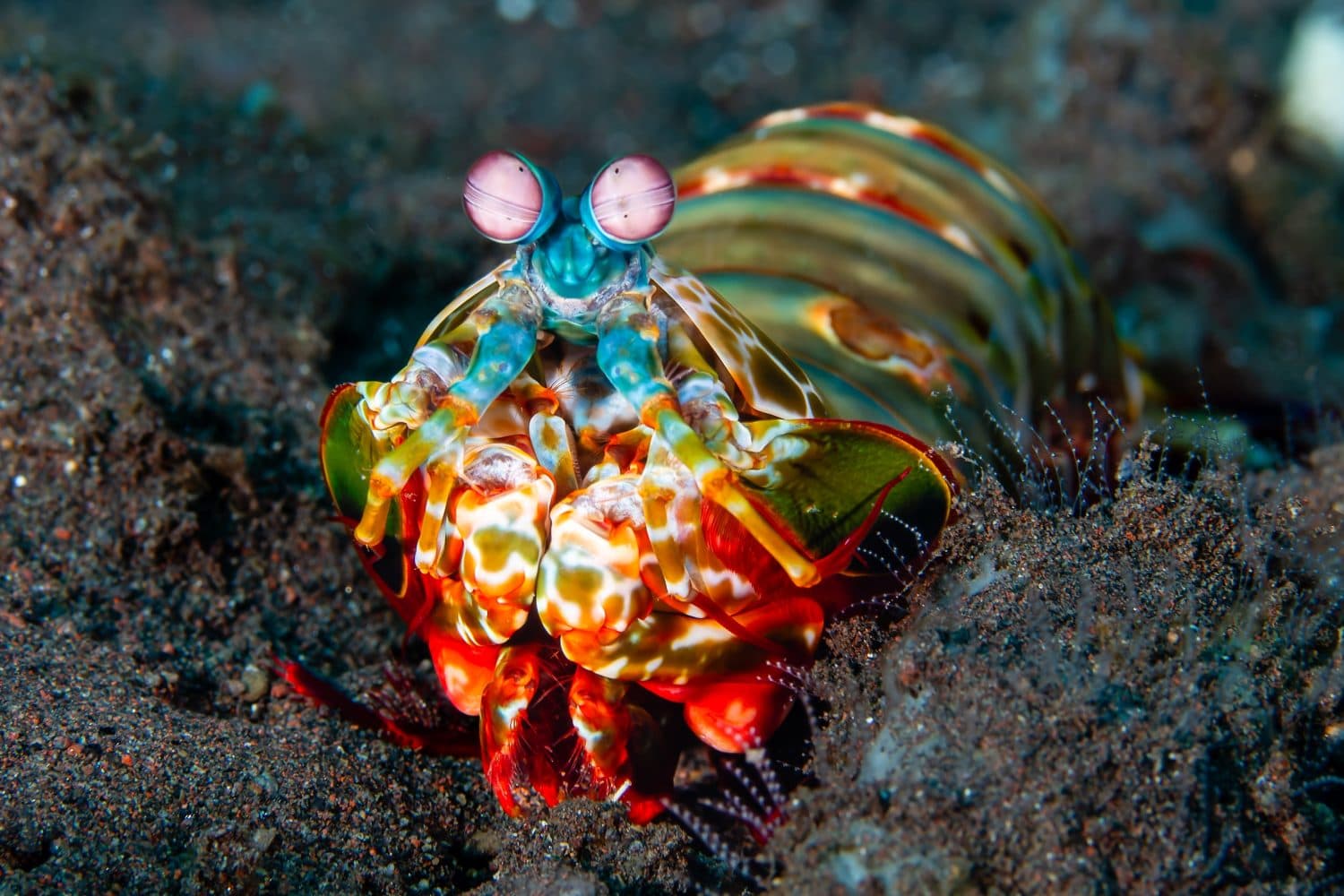
Take, for example, the shrimp with the crazy eyes. The rainbow mantis shrimp has eyestalks that give it an alien look. With multiple pupils, it is hard to discern just where these shrimp are looking. As it turns out, they are looking everywhere all at once to make sense of the watery habitat they live in.
The Rainbow Mantis Shrimp’s Eyes Allow It to See 360 Degrees
Horizontally, people can see 180 degrees, allowing them to see what is in front and to the periphery. Imagine being able to see 360 degrees at all times and always being aware of your surroundings. This is something that a rainbow mantis shrimp’s eyes can do, as seen from a recently published Instagram video that has already garnered thousands of views.
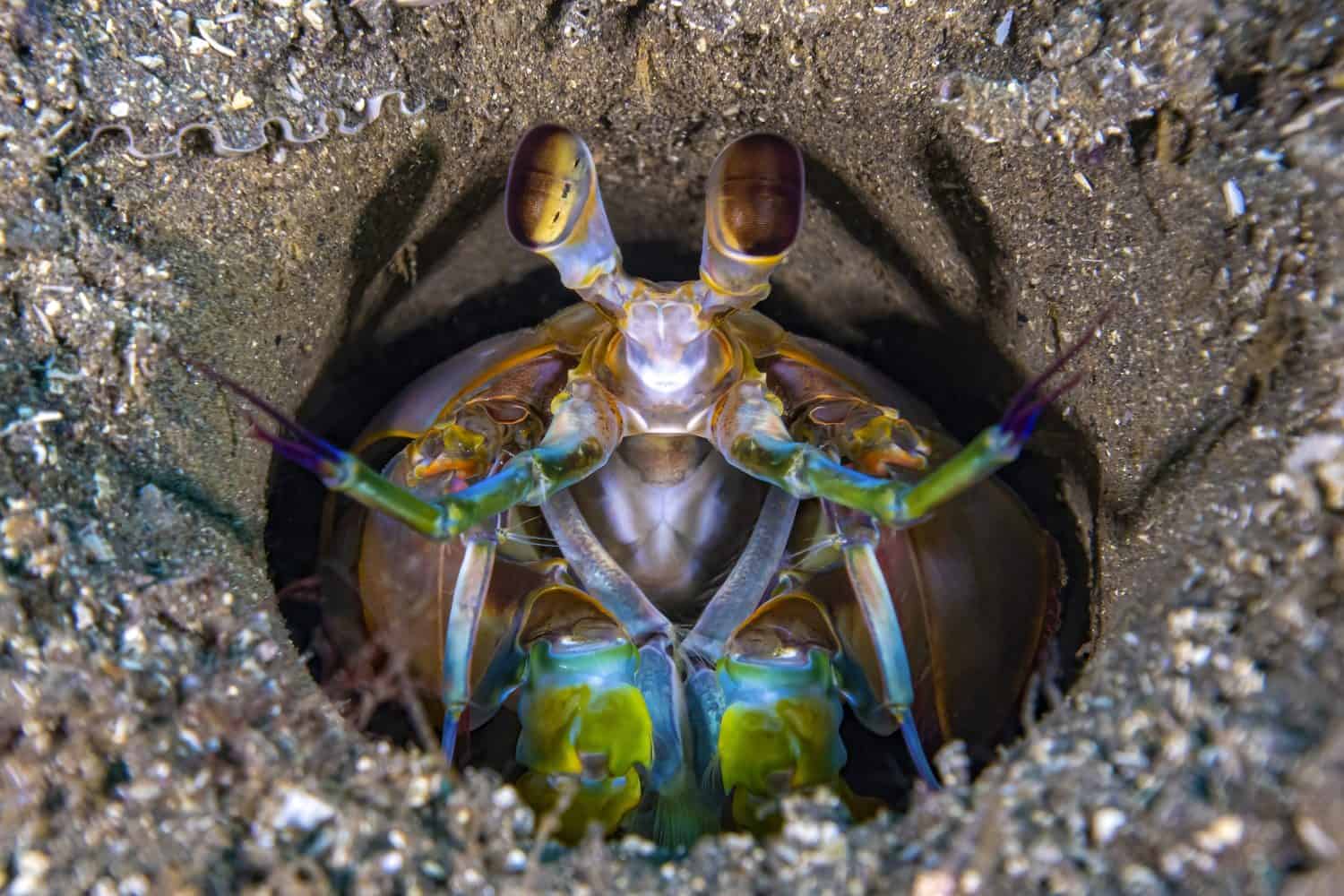
Rainbow mantis shrimp can see 360 degrees around themselves.
©Dmitry Demkin/Shutterstock.com
As seen in the video, the mantis shrimp has purple eyes that dart about. But upon closer inspection, it looks as though there are multiple pupils in the eye. This is because each eye is split up into three sections. Those sections include:
- Dorsal hemisphere
- Ventral hemisphere
- Midband
Each of the sections has six rows of photoreceptors that create “trinocular vision.” This means that the rainbow mantis shrimp can tell depth and distance just by looking at an object. Additionally, the eyes being split into three distinct sections allows the rainbow mantis shrimp to easily scan their surroundings. While they cannot see 360 degrees at one time, as the eyes move, they can scan 360 degrees around the mantis shrimp. Therefore, they can see prey before prey sees them, spot predators, and get away before being snuck up on. Their eyesight is truly almost too incredible to be real.
Rainbow Mantis Shrimp’s Eyes Can See Wavelengths People Can’t
Given the unique structure of the rainbow mantis shrimps’ eyes, it should come as no surprise that they can see how the light reflects off objects differently than other creatures. People may believe they have excellent vision, but when it comes to the light wavelengths that rainbow mantis shrimp see, the shrimp have a clear advantage.
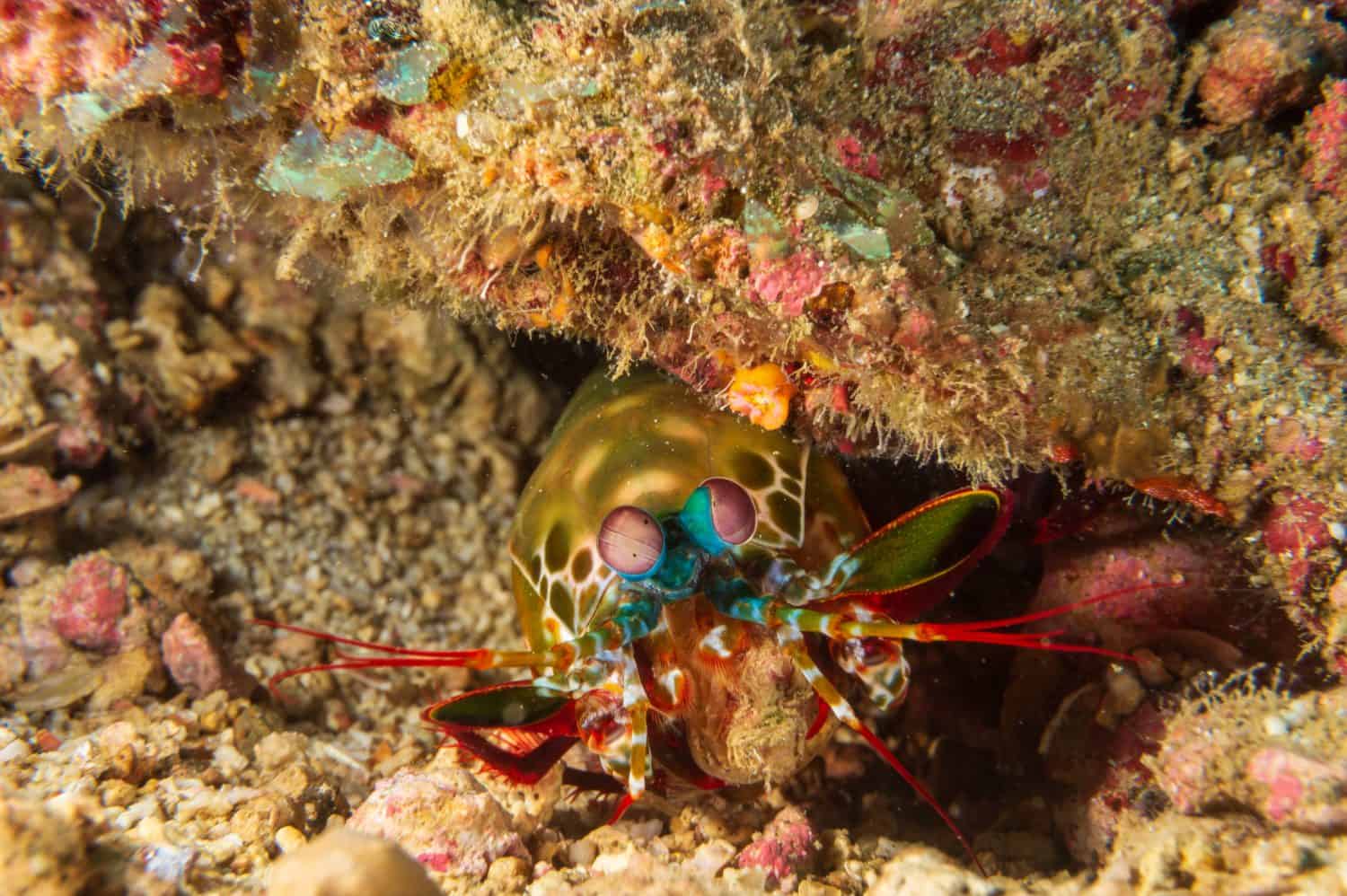
Rainbow mantis shrimp can see wavelengths, including ultraviolet light and polarized light.
©alonanola/Shutterstock.com
People’s eyes have a singular lens. This lens helps bring light into the retina, where three types of photoreceptors are present. The muscles in the eye help the lens change shape to bend light, allowing red, blue, and green light to enter the eye.
Rainbow mantis shrimp have between 12 and 16 photoreceptors in their eyes. As a result, the shrimp not only see a significantly greater number of colors than people do, but also different types of light. Everything on the spectrum of polarized light to ultraviolet light is utilized by the rainbow mantis shrimp, making their eyesight far more advanced than any other animal on the planet.
People Can Differentiate More Colors Than Rainbow Mantis Shrimp?
What is interesting is that, while rainbow mantis shrimp can see more different light wavelengths than any other creature on the planet, their ability to see color is not as advanced. This means that when it comes to the overall number of colors that can be seen, people have the upper hand over the mantis shrimp.
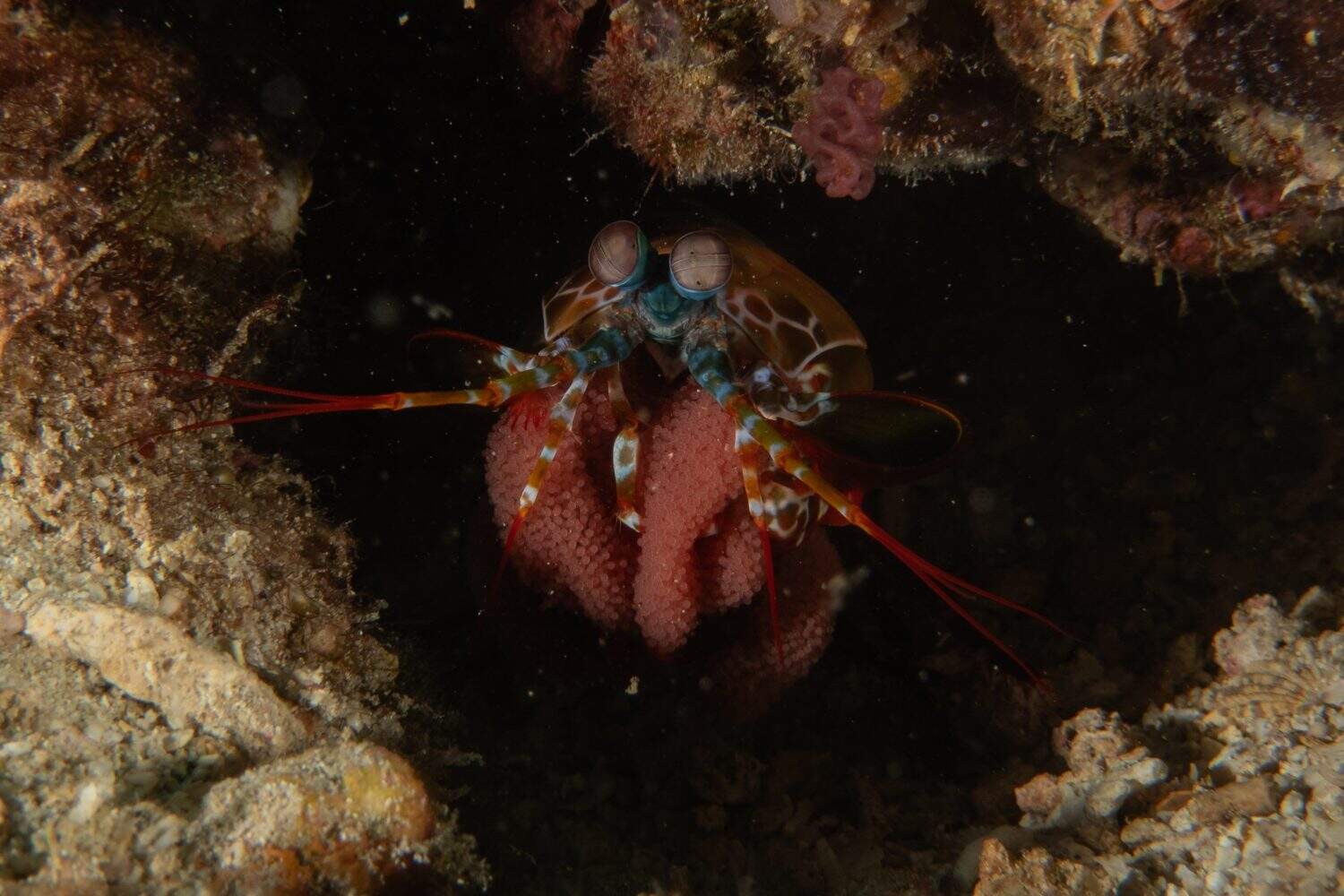
Rainbow mantis shrimp see fewer colors than people do, seeing blocks of color instead.
©yeshaya dinerstein/Shutterstock.com
With the trinocular vision the rainbow mantis shrimp have, the quick snapshots they take with their eyes provide them with details about the depth and distance of an object. Instead of seeing the exact color of what they are looking at, the rainbow mantis shrimp see a “broad color category.” Just how many different colors can be differentiated is not known.
Compare this to the colors that people can see, and the difference is shocking. People can see between one million and 10 million different colors. There are nuances and varieties to colors that make each one within a color family unique. However, this inability to see a wide range of colors does not negatively affect the rainbow mantis shrimp. Instead, the vision they have helps them in a variety of ways that seeing colors alone would not.
How Does the Rainbow Mantis Shrimp Use Its Vision to Show Intelligence?
With their amazing eyesight, the thought would be that there is a brilliant cranium processing information from the eyes to the brain. As it turns out, this is absolutely correct. Thanks to their advanced vision, the rainbow mantis shrimp are sophisticated creatures skilled in everything from hunting to communication.
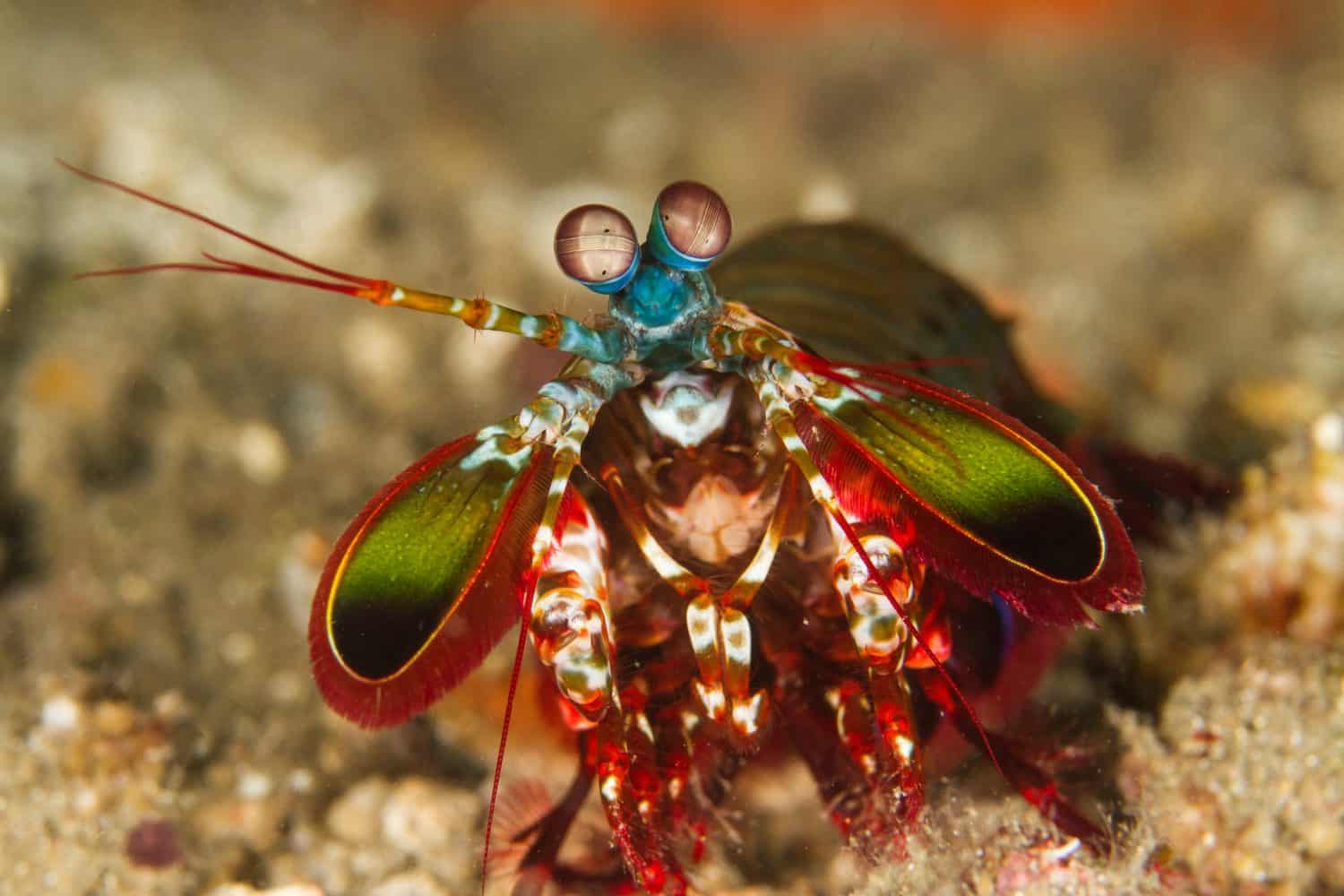
Rainbow mantis shrimp are sophisticated creatures thanks to their visual acuity.
©Tracey Jones Photography/Shutterstock.com
The different ways that rainbow mantis shrimp use their vision to display their intelligence include:
- Ability to recognize other rainbow mantis shrimp, toward whom they are less aggressive toward
- Vision depth helps the mantis shrimp navigate cracks and crevices in the ocean to get at prey that other creatures cannot see
- Once prey has been located at a location, rainbow mantis shrimp will return in hopes of finding more
- Spatial awareness comes into play with remembering successful hunting grounds and safe places to rest
- Rainbow mantis shrimp emit chemicals that only other rainbow mantis shrimp can see, aiding in communication
Rainbow mantis shrimp prove that seeing a variety of colors is not necessary to survive. These shrimp not only survive but thrive. The way mantis shrimp see the world is quite unique, so much so that it has been replicated in the medical field to detect cancer and save lives.
Rainbow Mantis Shrimp’s Vision Is Being Used in Cancer Detection
Despite the fact that there is still much to be learned about how the rainbow mantis shrimp’s eye operates, what is clear is that its ability to see a variety of light wavelengths helps it to see objects that would otherwise be camouflaged in the ocean. With that in mind, researchers have developed technology inspired by the mantis shrimp’s vision to aid cancer detection.
In the last handful of years, hyperspectral imaging has been used to help detect skin cancer. Using visible, ultraviolet, and infrared light wavelengths, doctors receive a 3D image of potential tumors. The light wavelengths are the same ones that the rainbow mantis shrimp can access when identifying mates, prey, or predators. It does not matter what the color of the object is. It is more important to have the depth and size to assess whether what is in the vicinity is a threat.
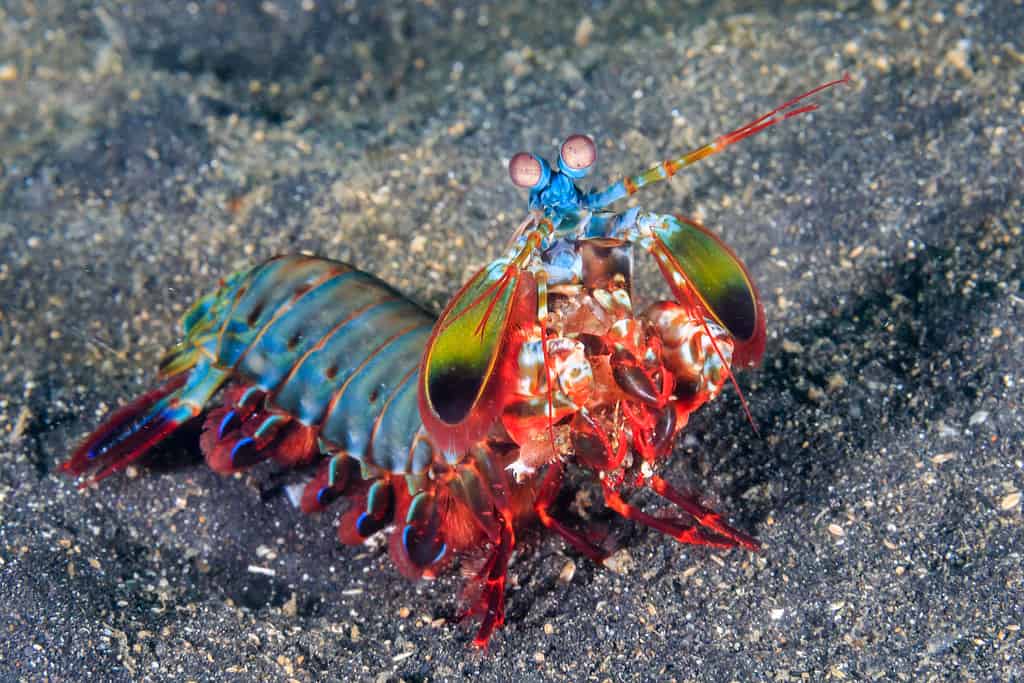
Rainbow mantis shrimp’s eyesight inspired more specialized skin cancer detection.
©WhitcombeRD/iStock via Getty Images
The same principles stand for scanning for skin cancer. Doctors do not care about the color, but rather, they focus on whether any imperfections are noted during the scan using light wavelengths. This has led to earlier skin cancer detection and more saved lives.
There is still much to understand about the rainbow mantis shrimp’s vision. What is known is that it is incredibly special, allowing these animals to detect what is in front of or behind them by size and shape alone. Color is not factored in, and it does not need to be, when the mantis shrimp’s life depends on whether the creature is a friend or a foe.