
Quick Take
- Dragonflies and mammals share a molecular mechanism in their eyes, and what that convergence means for medicine is genuinely surprising. See the medical surprise →
- Those three tiny eyes on a dragonfly's head help detect changes in light. Explore the five eyes →
- Some optical treatments use blue light, but dragonfly biology may point toward an alternative. See the surgical implications →
Imagine being able to see the world through a 360-degree, polarized, slow-motion view. In humans, this would be a genetic mutation of X-Men proportions. But for a dragonfly, this enhanced HD vision is just another day. They arguably have the best sight of any winged insect. This evolutionary trait enables them to be skilled hunters and agile fliers.
And now, researchers at Osaka Metropolitan University suggest that this goes even further. Humans can’t compete with a five-eyed insect, but it turns out that we do have something in common with dragonflies: red light detection.
Continue reading
Dragonfly Eyes Contain 30,000 Individual Lenses
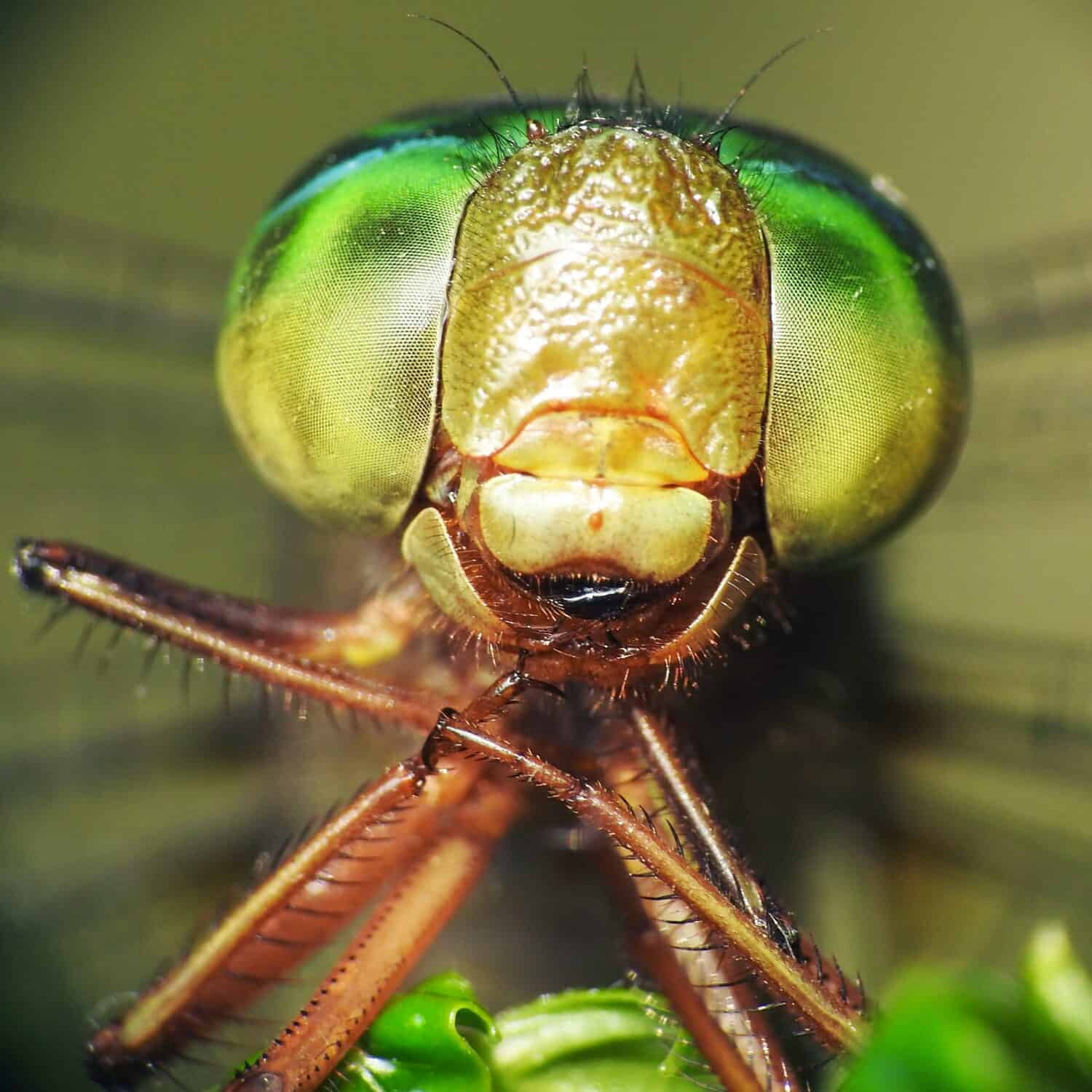
Many call them bug-eyed, but those huge “eyes” on a dragonfly’s head are actually composed of up to 30,000 individual lens cones. Each cone, known as an ommatidium, helps to shape the 360-degree view of the world. Dragonflies can see in front, to the side, and even behind them, thanks to full-circle coverage. These two compound eyes make up a total of five eyes, including three “simple” eyes.
These tiny eyes at the front of a dragonfly’s head are called ocelli. Instead of forming images, these eyes detect light and depth. This is what orients the dragonfly while flying, keeping its horizon line steady. These three eyes also help it detect depth and determine changes in polarized lighting.

Each dragonfly has up to 30,000 lenses in its two compound eyes, giving it a 360-degree view.
©Haiduchyk Aliaksei/Shutterstock.com
In humans, the closest we’ll ever get to having polarized vision is by wearing polarized sunglasses. Dragonflies have this ability 24/7, which allows them to detect minute changes throughout the day. In addition to detecting light fragments, they can also see the wavelength of polarized light. Detecting this movement (which is invisible to us) helps them locate bodies of water, where they lay their eggs.
And these simple eyes may do more than detect polarization. Researchers at Osaka Metropolitan University have discovered that dragonflies can detect the same red light that mammals can, through a similar molecular mechanism called opsin.
A Red-Light Detection System 10x Better Than a Human’s
Compared to a dragonfly, human eyes are relatively limited in what we can see. But with the study by Osaka Metropolitan University, researchers have finally answered a lifelong question: How far does a dragonfly’s red light detection go?
Study results revealed that a dragonfly’s opsin can pick up wavelengths around 720 nanometers. This makes it the longest-wavelength-sensitive opsin ever recorded. By comparison, humans can typically detect red light at 600 nanometers. In rare cases, it’s possible the human eye can detect light at 700 nanometers. But at 750 nanometers, red light becomes difficult for humans to see with the naked eye.
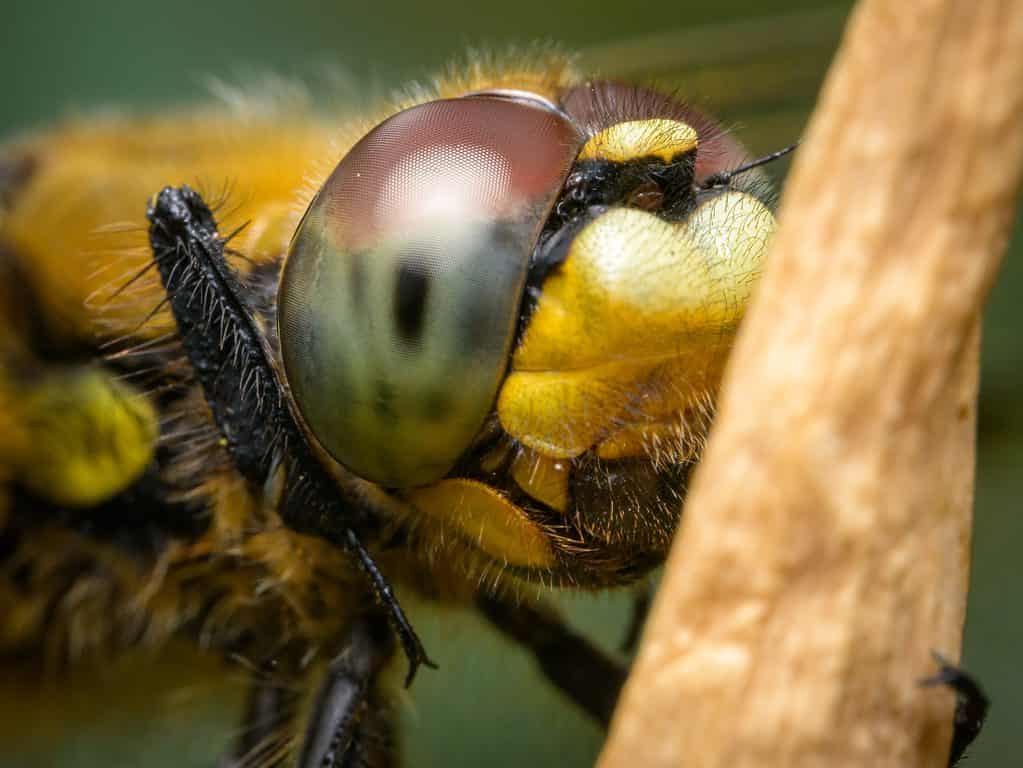
Three simple eyes help dragonflies detect light and the movement of light waves in places such as lakes and ponds, which are crucial egg-laying locations.
©Stefan Rotter/Shutterstock.com
Scientists also discovered that these extreme red-light-detecting proteins help males locate females during mating season. This unique detection mechanism is similar to that of mammalian opsins, which are light-sensitive G protein-coupled receptors. When bound to the retina, mammals can detect changes in light–including red light–but not usually to the same extent as the dragonfly.
This Similarity May Lend Itself to Medical Treatments
Discovering this could bring a revolutionary change to the medical community. Despite the difference in species, dragonfly red opsins use a mechanism identical to that of mammalian red opsins. Knowing this, researchers believe there is potential to develop medical treatments from these proteins. At the very least, it could address an optogenetic challenge, potentially making future treatments much more effective.
In modern eye procedures, doctors use blue light, which does not penetrate tissues as deeply as red light does. This also limits treatments, as blue light cannot pass through skin and bone. Near-infrared opsins—which dragonfly opsins can detect—can penetrate tissue and bone layers more deeply, making them exceptionally valuable for optical science.

Science is still a long way from developing a treatment based on dragonfly opsins.
©Martin_Davis/Shutterstock.com
Additionally, because of the similarities between proteins found in dragonfly and human eyes, doctors may be able to use this to activate cellular responses. This would be far less invasive than traditional procedures. In some cases, it could also offer quicker recovery times. Depending on its application, it may also yield more substantial results, potentially making it more effective than current methods.
Although this is positive news, the medical community is still a long way from developing this technology. More studies must be conducted on dragonfly opsins to determine their compatibility with human biology.