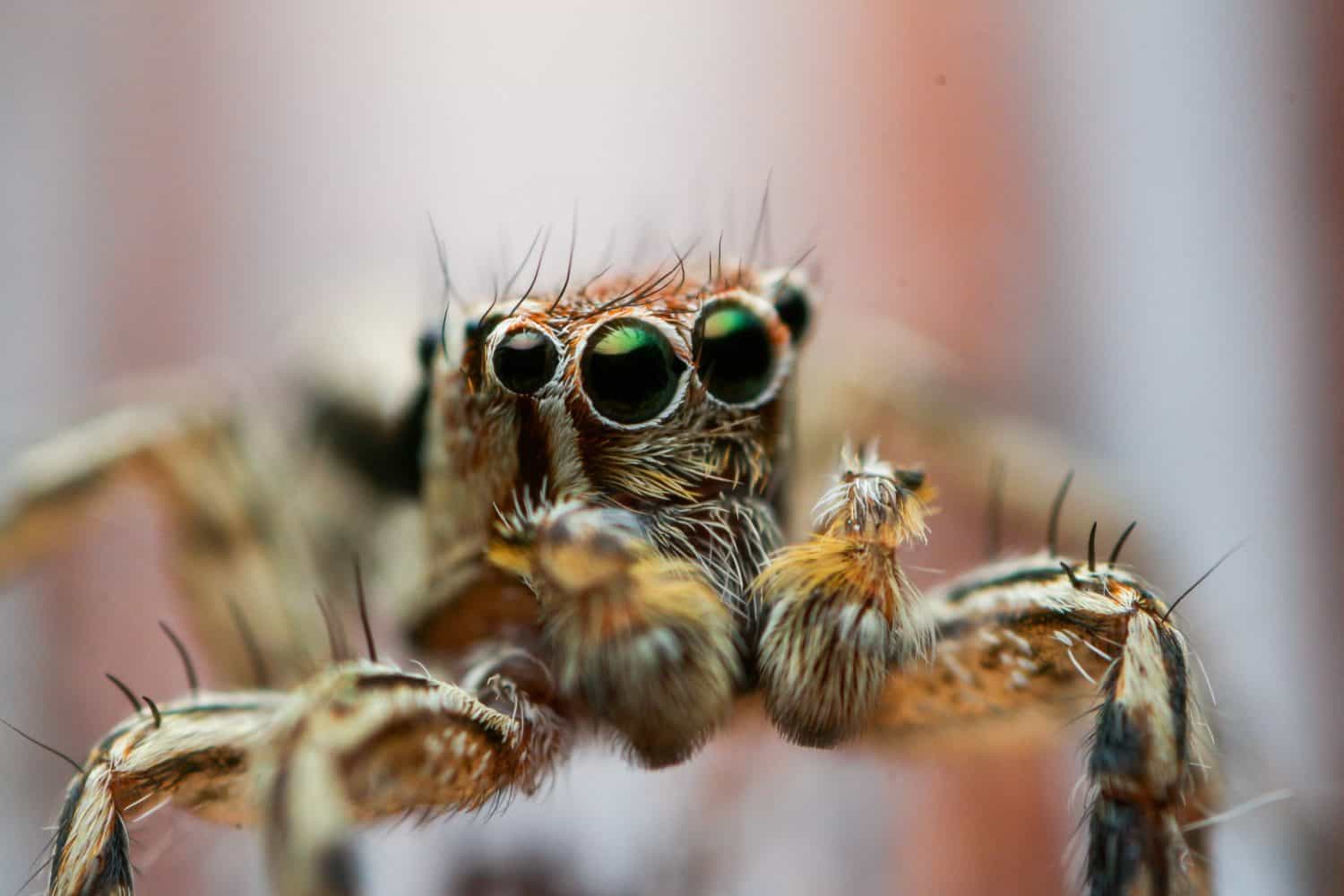

Jumping spiders are famous for their big, beady eyes that look disproportionate to their size. With eight eyes in four sets, each pair has a unique purpose. Interestingly, when jumping spiders are young, you can actually observe their eyes moving. This YouTube Short by @Oneminmicro shows a baby jumping spider in action! Read on to learn how you can observe this through a telescope and discover more about jumping spiders’ eyes.
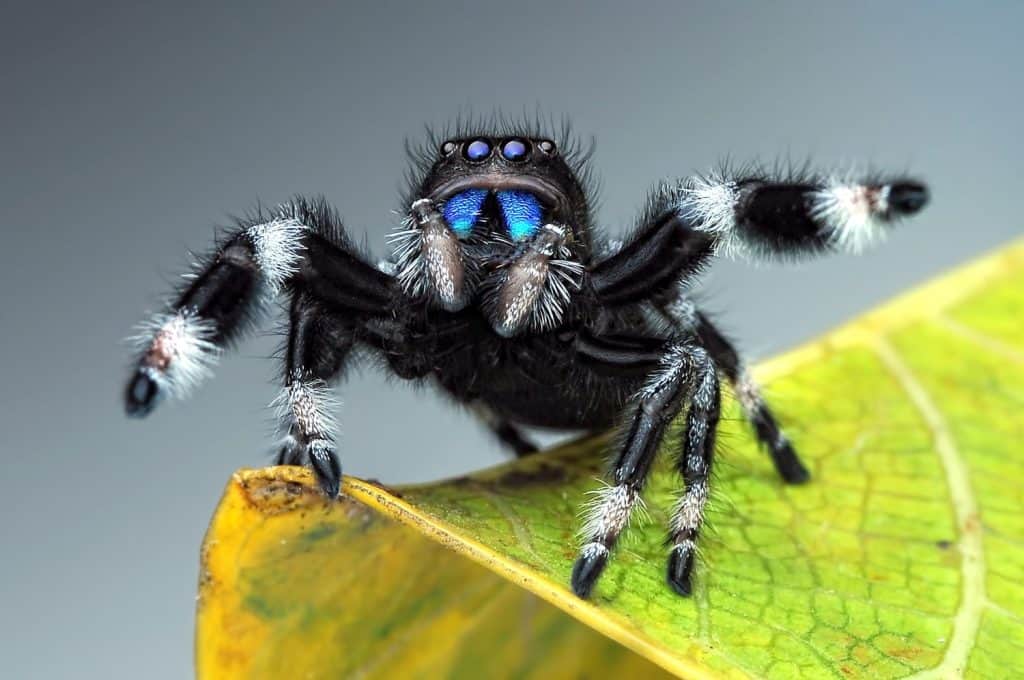
Jumping spiders have eight eyes, and each pair has its own function.
©Arif Supriyadi/Shutterstock.com
Jumping Spider Eyes
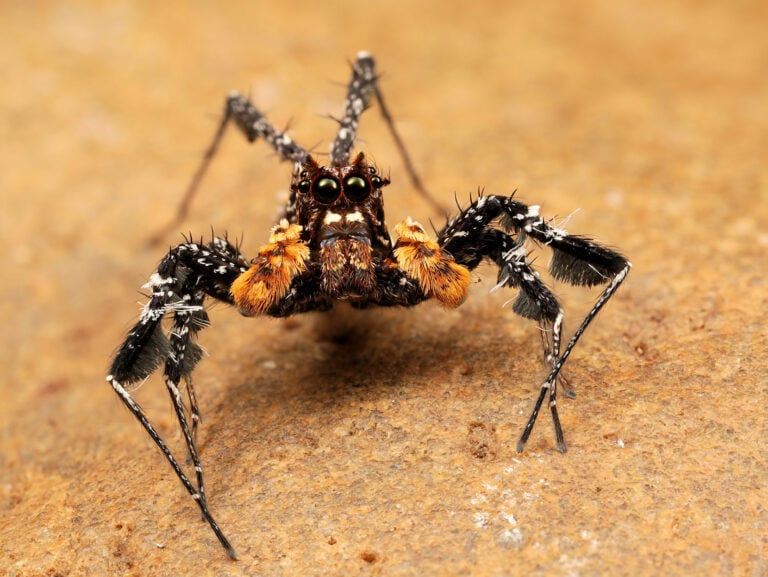
Jumping spiders have eight eyes in total, in four pairs. They’re easier to understand when you break the pairs down into their individual functions. The anterior median, or the principal eyes, are the two large eyes on a jumping spider. As they are the primary pair, they easily have the best vision out of the pairs. The other three pairs are known as the secondary eyes and are made up of the anterior lateral, posterior lateral, and posterior medial eyes. These eyes are less used for focused vision and more for detecting motion from the spider’s periphery. Each pair has a unique function that allows the jumping spider to react quickly, which would not be possible otherwise.
Anterior Median Eyes
The anterior median eyes are located on the front and center of the spider’s face. These eyes have a variety of purposes. The most important thing is the high-resolution vision they provide. These eyes are what make out the surroundings, such as color, depth perception, and silhouettes. This helps the spider to identify prey, rival spiders, and mates, as well as to determine their jumping length. The eyes are tubular in design. This creates a very narrow field of view, so rather than flicking their eyes around like humans, they instead pan them like a camera.
Anterior Lateral Eyes
The anterior lateral eyes are located to the direct left and right of the anterior median eyes. While separated from each other, these eyes provide motion detection to the forward and side peripherals. This helps jumping spiders when faced by a threat that would otherwise be outside their point of view. Unlike the anterior median eyes, these eyes have a lower resolution, meaning they are used more for detection than for actual identification.
Posterior Median Eyes
The posterior median eyes, or the rear middle eyes, are further back and inward on the head. The function of these eyes varies by species, mainly depending on whether they are still functional or have become vestigial. The eyes are small and not very functional for vision, and may be vestigial in some species. In other species, where the eyes have not lost their function through evolution, they help detect motion above or behind the spider, giving it almost 360-degree vision. It is still largely unclear why these eyes have lost their purpose in so many jumping spiders, but it is believed that the other eye sets have compensated for this loss.
Posterior Lateral Eyes
The posterior lateral eyes are the backside eyes, wider than the posterior median eyes. These eyes compensate for the vestigiality of the PMEs, allowing the spider to detect movement to the rear and sides. They can be thought of as similar to a car’s rearview mirrors. The eyes can spot predators behind the spider and can also track prey moving behind it. With the posterior lateral eyes, jumping spiders have nearly 360-degree vision, which aids in escape and defense.
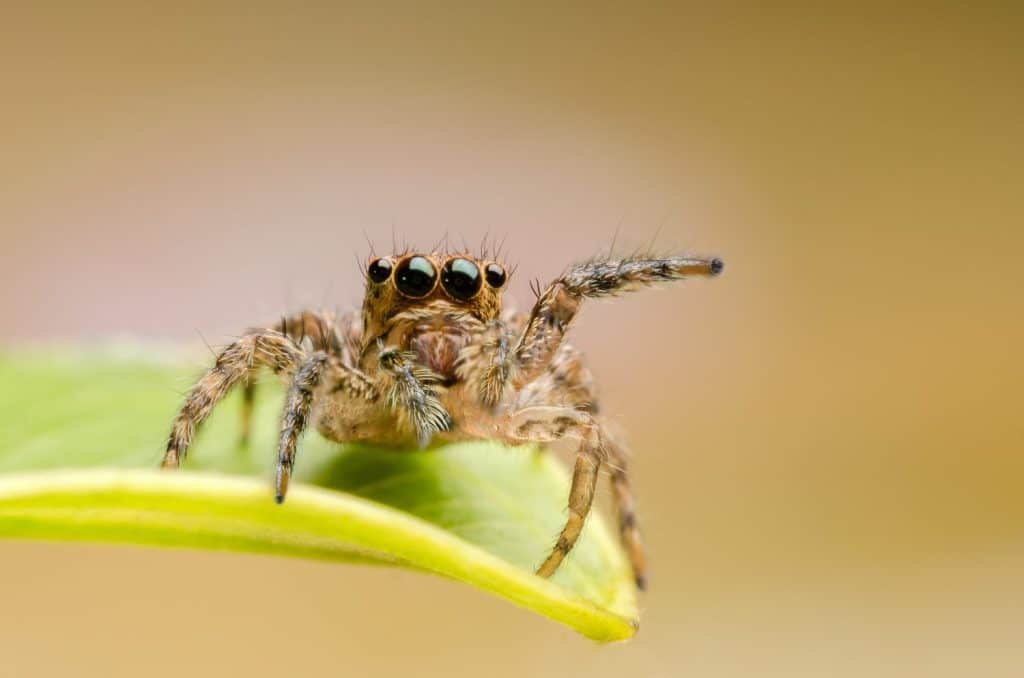
The jumping spider has incredible vision.
©common human/Shutterstock.com
Telescopic Eyes
While calling them “telescopic eyes” may sound like a fun analogy, it is actually somewhat accurate for jumping spiders’ eyes. Unlike human eyes, jumping spiders have camera-like eyes. Their eyes have one surface lens and a second inner lens. The second lens sits at the end of a tube, creating the telescope-like structure. By shifting and adjusting the inner lens, a jumping spider can zoom in on whatever they are trying to look at. While this seems complex enough already, there are more features to the eyes that seem unreal. The retina at the end of the tube has four different layers, each creating a different perception of what is being seen. One photoreceptor is responsible for detecting UV light, while another is specialized for intentional defocusing. These lenses help during different circumstances, such as varied light levels or when hunting.
These amazing, complex eyes work well with the jumping spider’s active lifestyle. Unlike other spiders, jumping spiders do not build webs for hunting and instead rely on actively pursuing their prey. Having a strong, precise vision is extremely important here. The principal eyes help lock onto prey, while the secondary eyes provide awareness of the spider’s surroundings. With such strong vision, their eyesight is among the sharpest of all invertebrates, and is sometimes compared to that of much larger animals, like cats. Moreover, there are studies examining how jumping spiders may avoid toxic prey through their color vision. Their eyes are a marvel among spiders, sharp and focused for whatever may come.