
Quick Take
- The King Cobra requires 500 mg of venom to successfully eliminate a wild elephant.
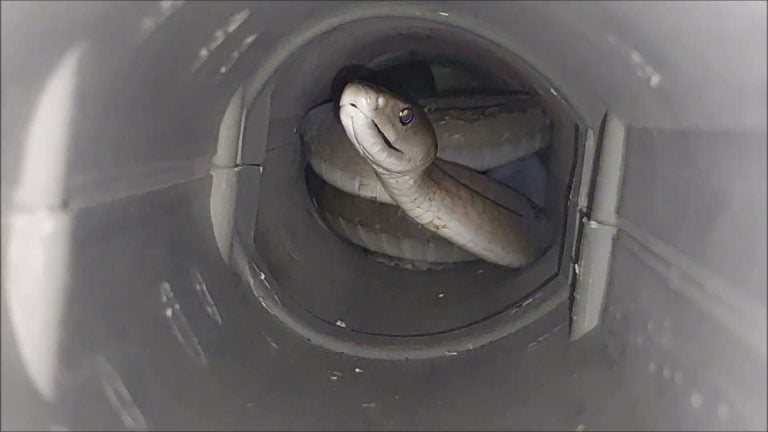
- A 20-minute delay in treatment creates a fatal risk after a Black Mamba strike.
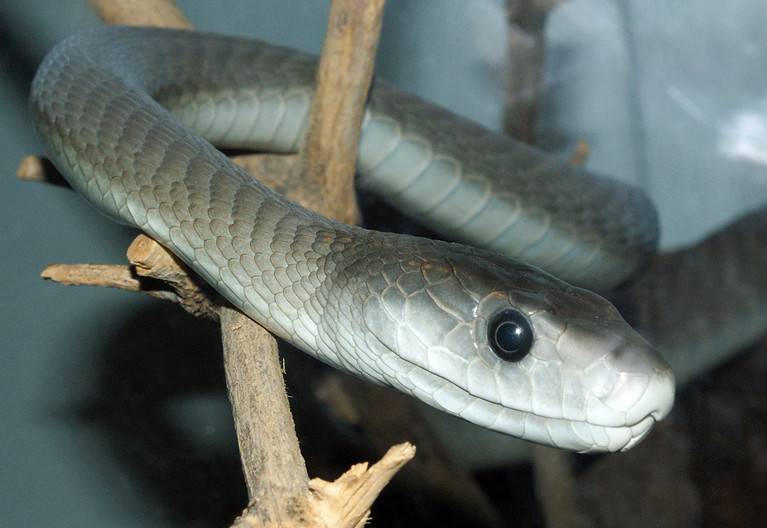
- The Black Mamba is gray or brown instead of its namesake color.
- Female King Cobras must complete nest building to ensure the survival of their offspring.
You would be hard-pressed to find two snakes that evoke more fear than the black mamba and the king cobra. Both species are so venomous that they can easily kill a human, and, they both grow to over 10 feet in length. But, when it comes to differentiation between the black mamba vs king cobra, how do you tell the difference?
In this article, we’ll learn the exact differences between black mambas and king cobras. To do this, we’ll go over each species’ size, appearance, location and habitat, behavior, diet, and lifespan. By the end, you’ll be able to tell black mambas from king cobras, and you’ll know exactly what makes each species unique.
Keep reading to learn more about black mambas and king cobras.
Comparing Black Mamba vs. King Cobra
| Category | Black Mamba | King Cobra |
|---|---|---|
| Size | 6-14 feet long; 5-10 pounds | 10-18 feet long; 15-20 pounds |
| Appearance | Gray to dark brown body with pale belly and black inside of mouth. Has a small hood which it flattens when threatened. | Ranges from black or dark brown to yellow or green. Babies are black with white markings. |
| Location and Habitat | Sub-Saharan Africa: lives in rocky hillsides, savannahs, grasslands, and woodlands. Prefers to stay near freshwater | Southeastern Asia: frequents mangrove swamps, forests, bamboo forests, and the edges of farmlands |
| Behavior | Non-aggressive, but capable of biting multiple times when threatened | Only bites when threatened; females guard eggs until hatching |
| Lifespan | 10-15 years | 15-20 years |

Key Differences Between Black Mamba vs. King Cobra
Black mambas are smaller than king cobras by several feet. The king cobra lives in India and Southeastern Asia, while the black mamba makes its home in sub-Saharan Africa. Both species have extremely potent venom, and both are responsible for many human deaths every year. King cobras have impressive hoods, while black mambas have no hood.
Let’s take an in-depth look at the key differences between the black mamba vs king cobra.
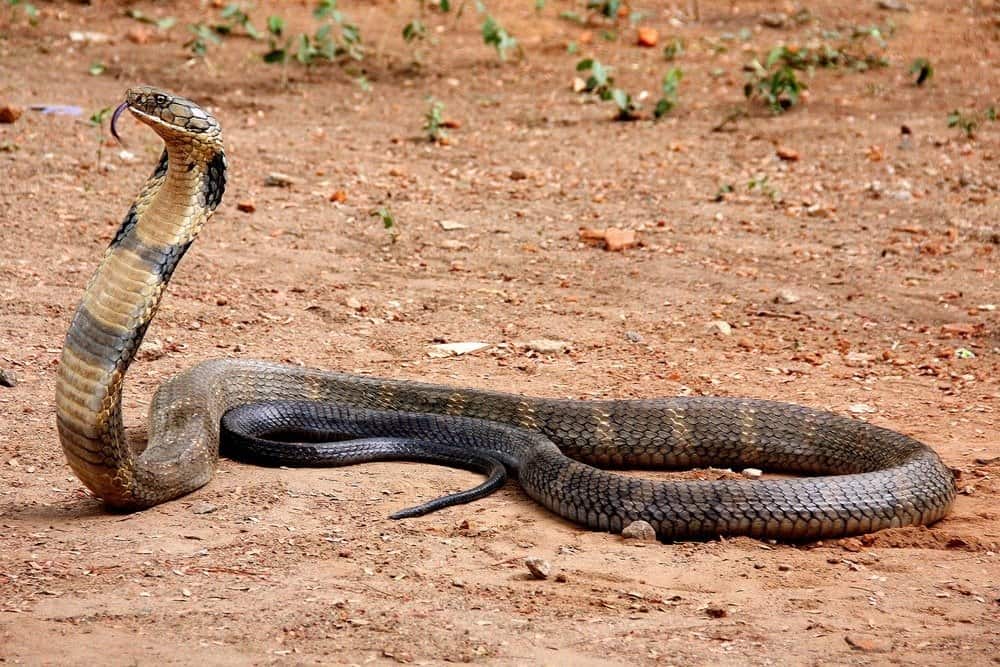
King cobras are heavier than black mambas, weighing about twice as much on average when full grown.
©Jolly Therattil/Shutterstock.com
Size and Weight
When it comes to the king cobra and black mamba, length is everything. Both species are exceptionally long snakes, but only one can be the longest venomous snake in the world. That’s the king cobra. A true monster among snakes, it can grow to nearly 20 feet long. The black mamba is no small fry either, though it’s not quite as impressive as the king cobra. Black mambas can reach up to 14 feet in length.
The king cobra isn’t just longer than the black mamba, it’s heavier too. Black mambas generally weigh less than 10 pounds, while the king cobra can weigh up to 20 pounds. King cobras are heavy snakes, much heavier than the black mamba.
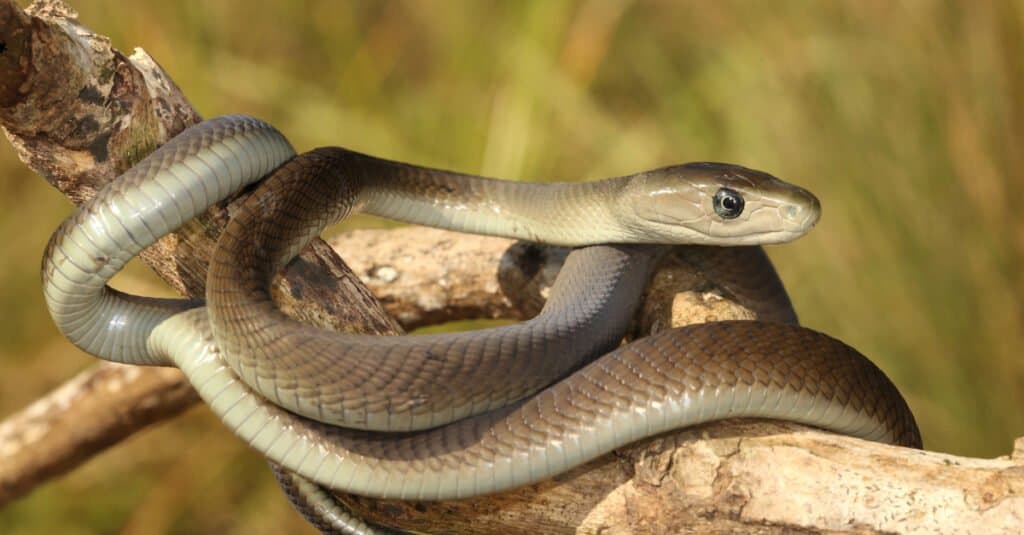
Black mambas grow quickly, and within one year of hatching can reach 6 feet in length.
©NickEvansKZN/Shutterstock.com
Location and Habitat
Black mambas and king cobras live on entirely different continents. The black mamba lives in parts of South and East Africa in sub-Saharan areas. In contrast, the king cobra lives in India, China, Indonesia, and the Philippines.
Locally, the black mamba vs king cobra live in distinct habitats. Black mambas prefer woodlands, hilly areas, savannas, and grasslands. They don’t like to stray too far from freshwater, and at night they prefer sleeping in hollow trees or empty burrows. King cobras stick mostly to forested areas, mangrove swamps, bamboo forests, and the edges of agricultural zones. Although king cobras spend much of their time in trees and bushes.
Appearance
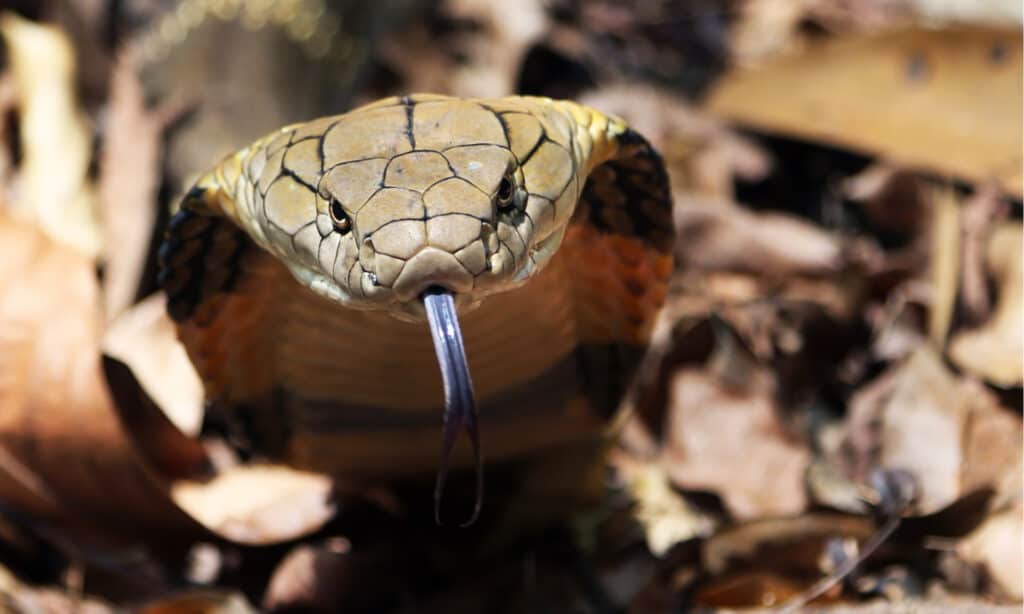
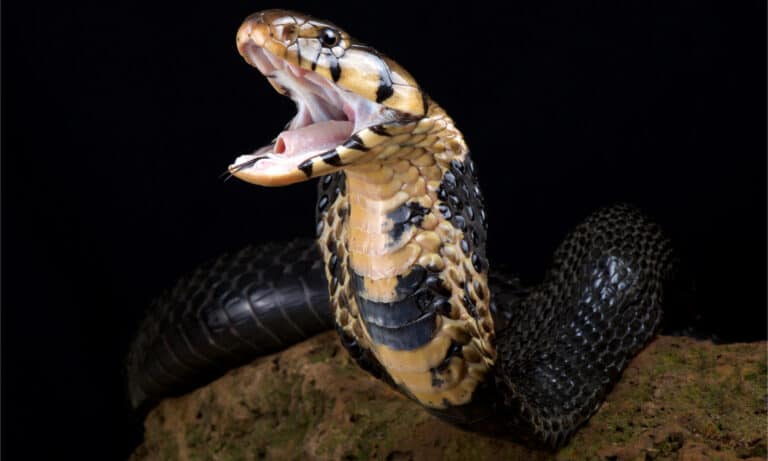
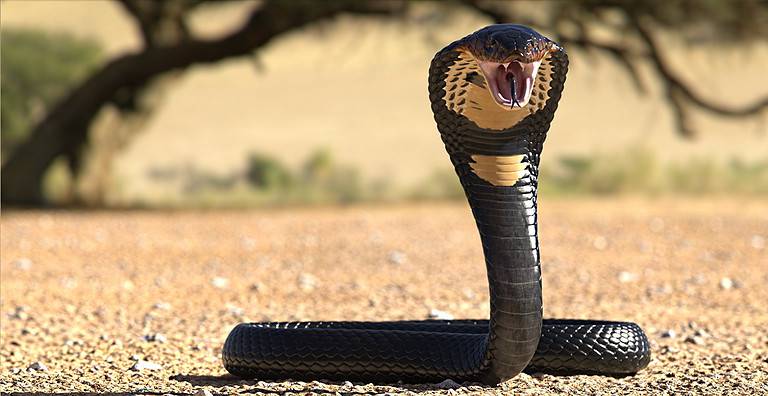
King cobras are well-known for their wide hoods made of flattened neck ribs that extend from their bodies.
©Suresh Suryasree/Shutterstock.com
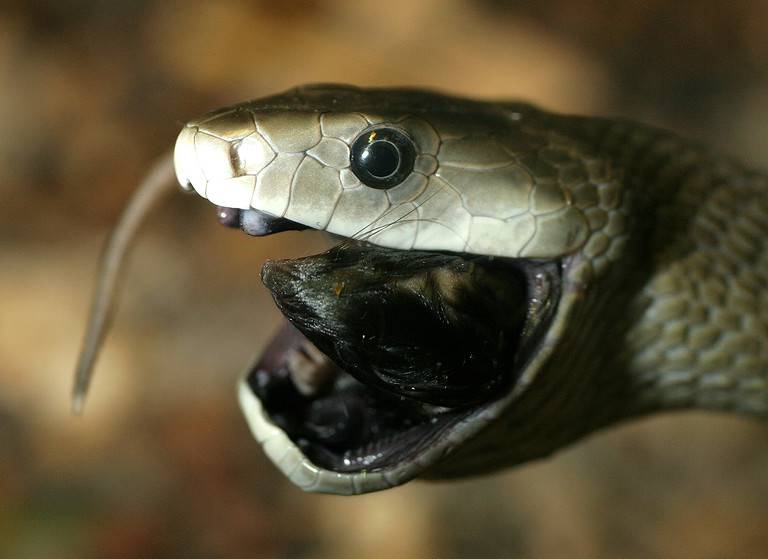
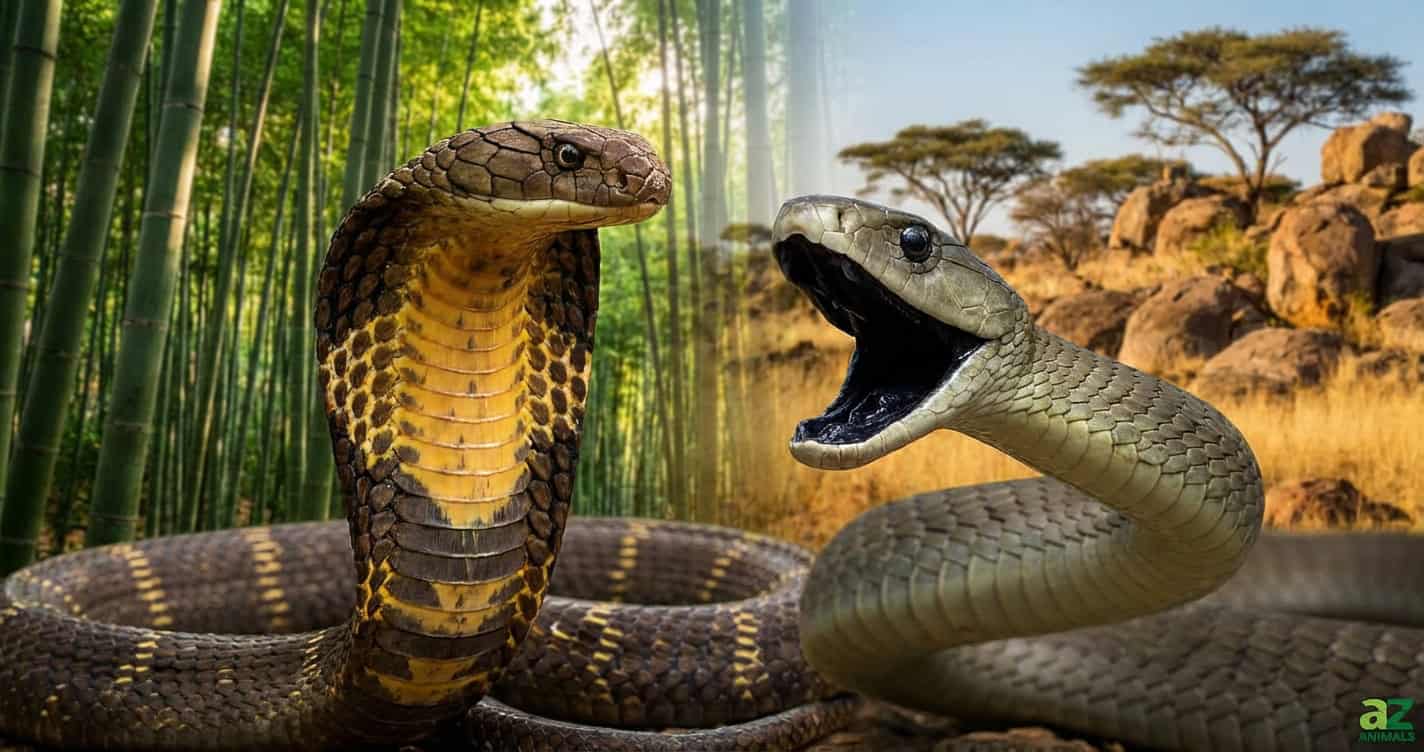
When it comes to the appearance of the black mamba vs king cobra, the biggest difference is in the king cobra’s hood. Black mambas lack a large hood; what they do have is a pitch-black mouth. The king cobra has one of the largest hoods of all snakes, while black mambas sport only a small, narrow hood.
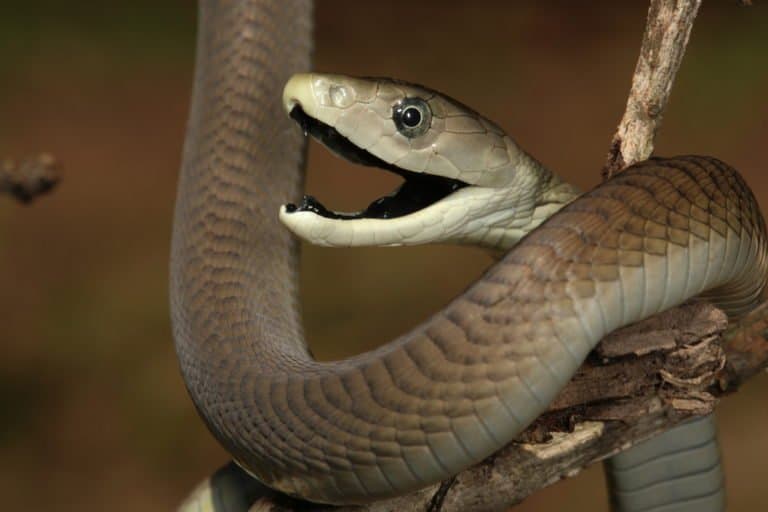
In terms of coloring, the only part of the black mamba that’s actually black is its mouth. The rest of the black mamba’s body ranges from gray to brown, with a light belly. King cobras tend to be darker brown or black, with white or yellow crossbars, and markings on the undersides of their hoods.
Behavior
Despite their differences, black mambas and king cobras share many behaviors. Both species lay eggs, rather than give birth to live young. Female black mambas lay their eggs in underground burrows, and female king cobras actually build nests for their eggs.
Black mambas are generally shy and would rather flee than engage in conflict. If cornered, however, they will raise their heads up high and spread their neck flaps, taking on the appearance of a cobra.
King cobras are also shy and even docile, but can be very vicious if threatened. When mating season arrives, king cobras become very territorial and aggressive.
When it comes to the black mamba’s and king cobra’s diets, both hunt rodents and small mammals, as well as other snakes.
Venom
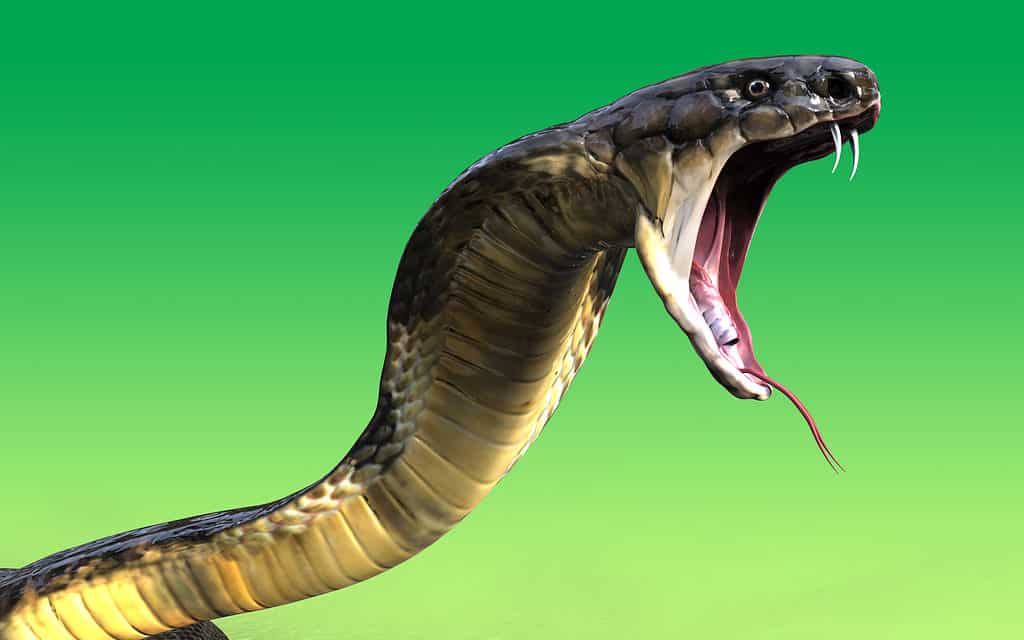
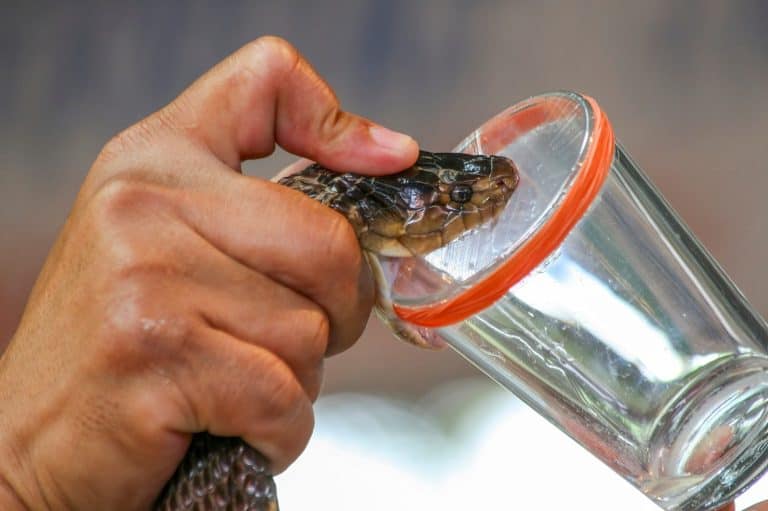
King cobras are capable of injecting 400-500 mg of venom in a single bite.
©mrjo/Shutterstock.com
Contrary to popular belief, king cobra venom is by no means the most potent among venomous snakes. However, its true danger lies in the copious quantities released by an enraged king cobra in full attack mode. One of these elapids is capable of injecting 400-500 mg into its victim — a quantity sufficient to kill an elephant.
The active compound is a fast-acting neurotoxin, which attacks the parts of the brain that control breathing, causing respiratory failure.
While experts are yet to figure out the true nature of black mamba venom, they do know that it is neurotoxic and cardiotoxic. It is delivered in far smaller quantities compared to a king cobra’s: a black mamba can inject up to 100-120 mg per bite, and is also capable of striking several times. However, if no medical attention is provided within 20 minutes, it will most likely prove fatal.
Lifespan
King cobras have been known to live up to 20 years in the wild, while black mambas live up to 15 years. In captivity, they may live even longer.