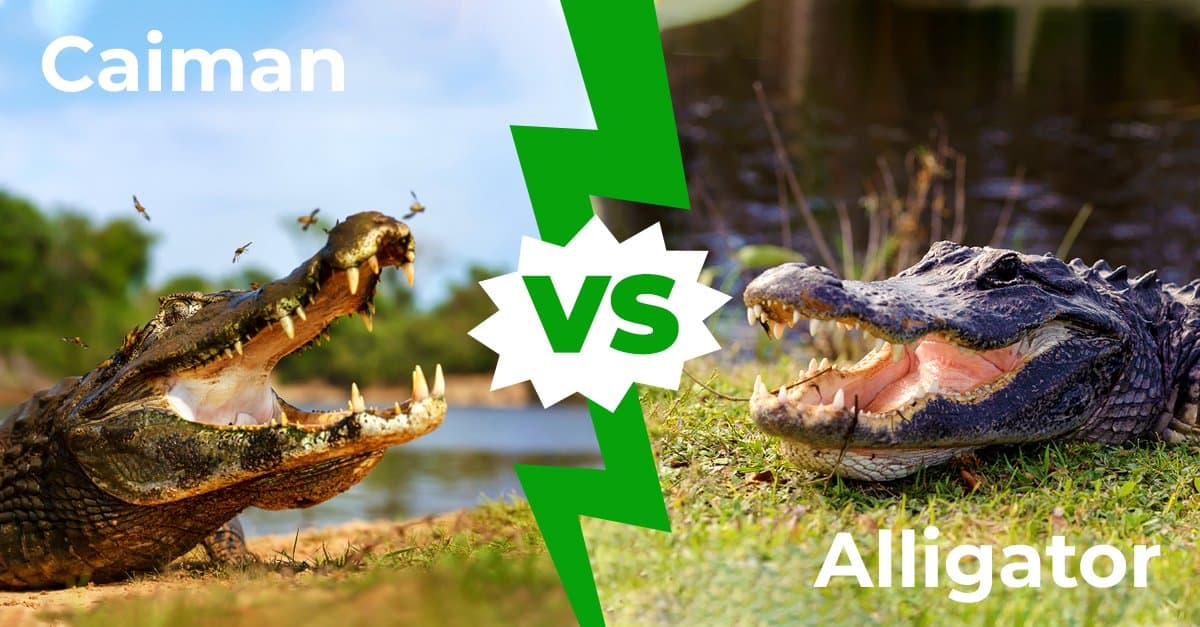

There are 23 species of crocodilians, divided among three families. Both caimans and alligators belong to the family *Alligatoridae*. While these animals look and behave similarly, there are subtle differences in their appearance, size, and habitats. Continue reading to discover how to tell these two reptiles apart.
Alligators
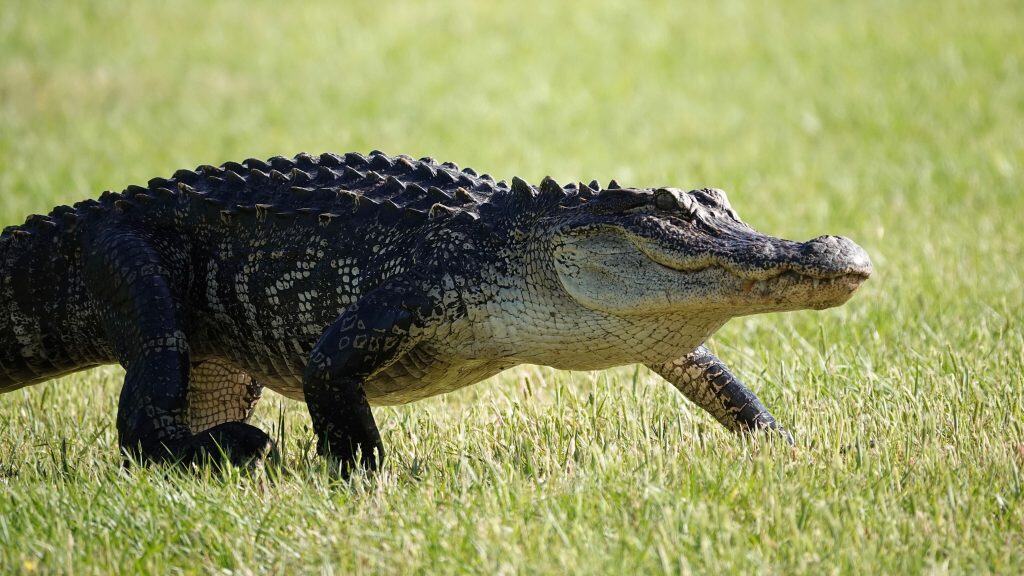
American alligators are much larger than Chinese alligators.
©Chris Klonowski/Shutterstock.com
There are two extant (living) species of alligators, the American alligator (Alligator mississippiensis), which is native to the Southeastern United States. The Chinese alligator (A. sinensis), also called the Yangtze alligator or muddy dragon, is endemic to China.
Chinese alligators are significantly smaller than American alligators. Adult Chinese alligators reach about 5 feet in length and weigh under 100 pounds, while adult American alligators can grow to 11–15 feet long and weigh over 1,000 pounds.
Caimans
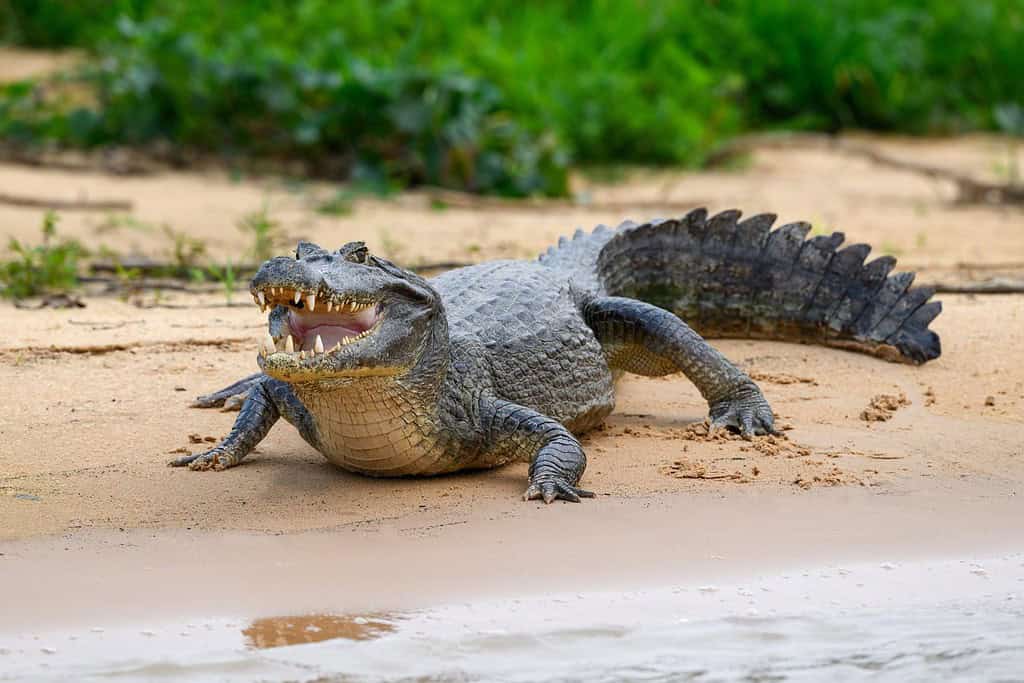
Native to Central and South America, caimans range from 4 feet long to over 16 feet long.
©FotoRequest/Shutterstock.com
There are six distinct species of caiman, all of which belong to the Alligatoridae family and are native to Central and South America:
- Cuvier’s dwarf caiman (Paleosuchus palpebrosus): The smallest caiman species, native to Brazil and its surrounding countries.
- Smooth-fronted caiman (P. trigonatus): The second-smallest caiman species, also known as Schneider’s dwarf caiman.
- Yacare caiman (Caiman yacare): Also called the red caiman, averaging less than 10 ft (3 m) in length.
- Spectacled caiman (C. crocodilus): Also known as the common caiman, there are three subspecies found throughout Central and South America – the common spectacled, Rio Apaporis, and brown caimans.
- Broad-snouted caiman (C. latirostris): An average-sized caiman occupying a more southern territory than its cousins.
- Black caiman (Melanosuchus niger): The largest caiman species, known to reach lengths and weights rivaling the American alligator.
For this comparison, our focus will be on the American alligator and the black caiman.
Location
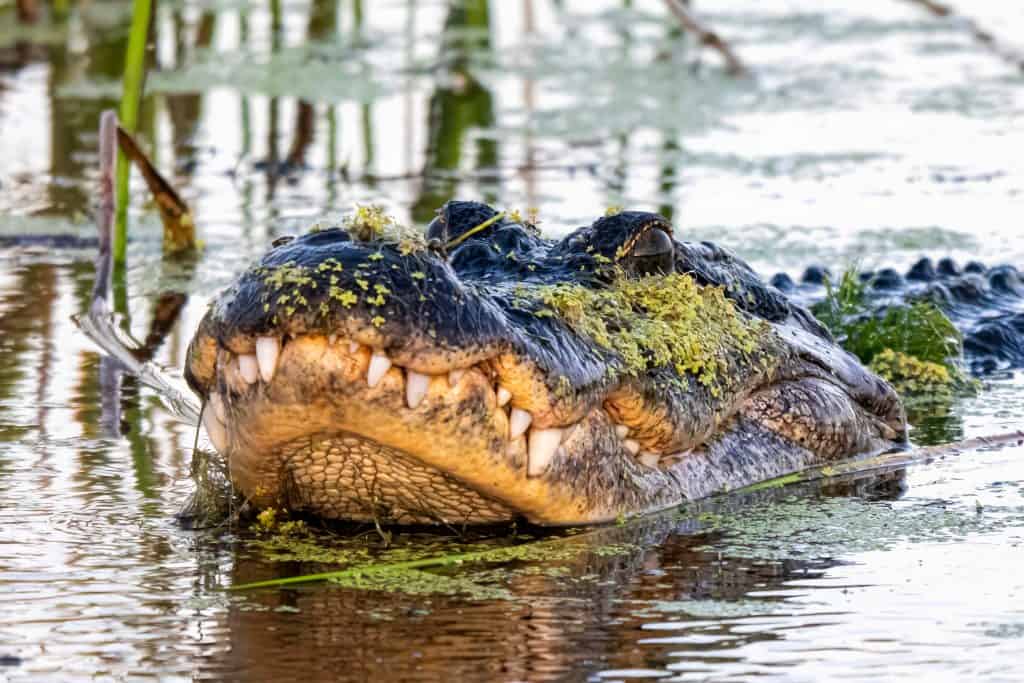
American Alligators are not typically aggressive and are more likely to fear humans and retreat than attack, though they can become dangerous if provoked.
©Christopher J Barger/Shutterstock.com
American alligators are found in the Southeastern United States, with their range stretching from the coastal plains of North Carolina to Florida, west along the Gulf Coast to Texas, and inland to include parts of Oklahoma and Arkansas. They inhabit freshwater swamps, marshes, lakes, and rivers, as well as some brackish (mixed fresh and saltwater) environments.
Black caimans are found in South America, specifically throughout the Amazon River basin, inhabiting freshwater environments like slow-moving rivers, lakes, and swamps. Their range includes Brazil, Bolivia, Peru, Colombia, Ecuador, Guyana, and French Guiana.
Size
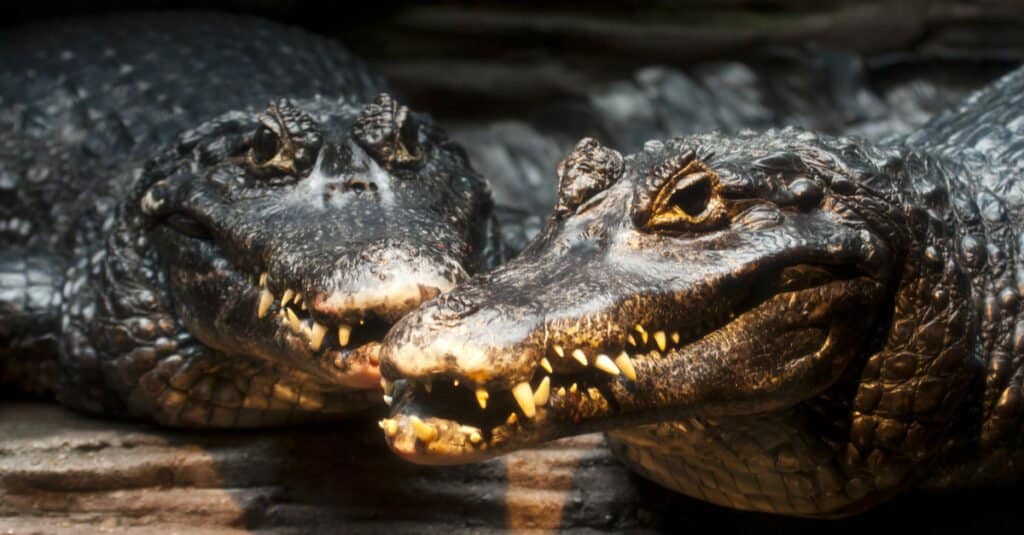
TThe largest caiman species, the black caiman, rivals the American alligator in terms of size and strength.
©Glenn Young/Shutterstock.com
The average size of an American alligator varies by sex: males average about 11 feet long, while females average about 8 feet. Weight also varies; large males can exceed 1,000 pounds, though most American alligators weigh between 300 and 800 pounds.
The average male black caiman is 13 to 16 feet long and weighs around 770 pounds. Female black caimans are smaller, generally reaching about 9 feet in length and weighing 150 to 220 pounds.
Skin

American alligator skin is found in products like handbags and footwear.
©meunierd/Shutterstock.com
An American alligator’s skin provides significant protection due to its unique armor of bony plates called osteoderms or scutes, which make the hide tough and resistant to injury and predation. This natural shield protects them from physical threats, including attacks from other animals and, in some cases, even bullets. The thick, armored skin also helps the American alligator move through vegetation without harm and assists in thermoregulation by absorbing and dissipating heat.
A black caiman has dark, thick, armored skin that is scaled and provides camouflage in its aquatic environment. While adults are largely black or dark greenish-black, juveniles have more prominent white or pale yellow bands on their body and flanks, along with grey banding on the lower jaw, which fade as they mature.
Both American alligator skin and black caiman skin are used to make luxury products such as belts, wallets, shoes, and handbags. Black caiman skin is generally considered less desirable in the luxury market; however, its price can vary depending on market demand and legal restrictions.
Teeth and Mouth
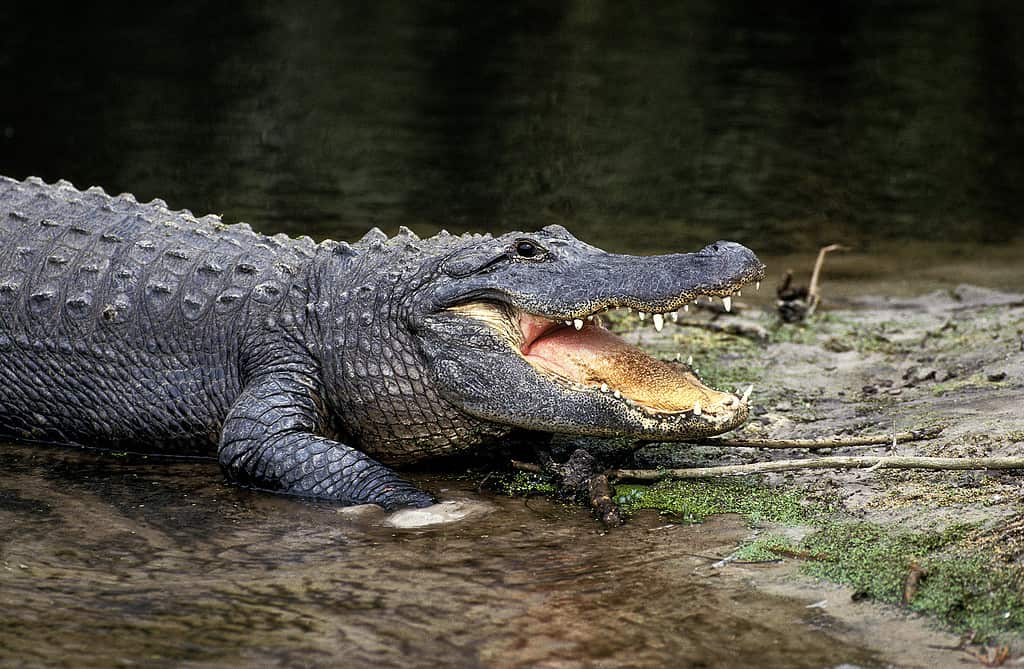
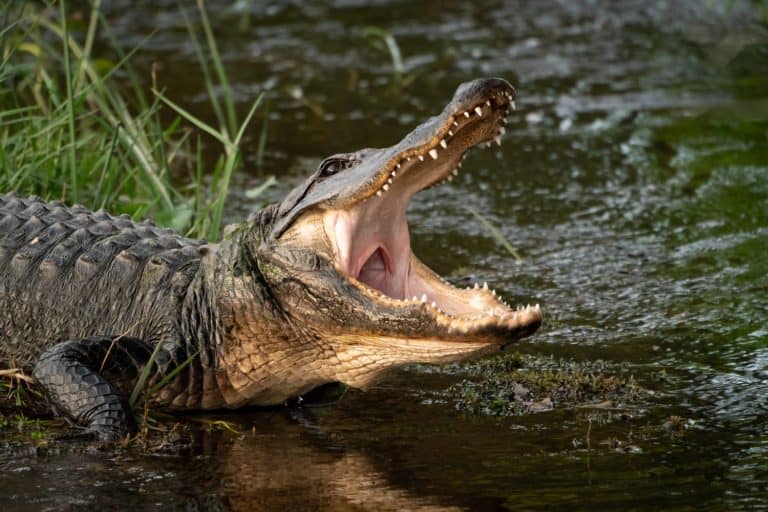
American alligators use their open mouths, a behavior called gaping, to regulate their body temperature by dissipating heat.
©slowmotiongli/iStock via Getty Images
Both American alligators and black caimans have visible teeth at the sides of the snout.
American alligator teeth are conical, and number around 80 at any given time, but they continuously grow and are replaced throughout the animal’s life, with a single alligator going through thousands in a lifetime. Unlike human molars, their teeth are not used for grinding food but rather for grabbing, holding, and crushing prey.
A black caiman’s teeth are sharp and designed for grasping prey rather than chewing. The upper jaw overlaps the lower jaw, so only the upper teeth are visible when the mouth is closed. They possess 72–76 teeth in total, which are consistently replaced throughout their lifetime, a system known as polyphyodonty, which ensures that they maintain a functional and sharp set of teeth.
Snout
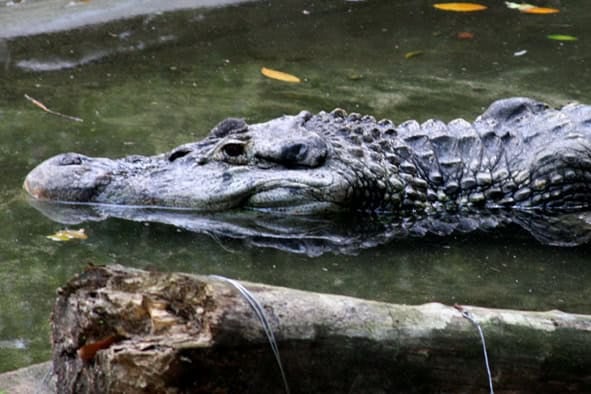
Black caiman use their snouts for hunting and building.
An American alligator’s snout is broad and U-shaped, providing the force needed to crush prey and supporting their habitat-creating activities, like digging alligator holes to retain water for survival during dry periods. Their broad snout also houses sensory organs that detect vibrations, which aid in hunting.
The black caiman has a broad and powerful snout, but it is more V-shaped or intermediate in shape compared to the distinctly U-shaped snout of the American alligator.
Population
American alligators were classified as endangered in 1967 by the US Fish and Wildlife Service. As a result of the government protections, the American alligator population has surged to 3 million, making them no longer endangered.
Like the American alligator, black caiman populations were once depleted to near extinction. However, their numbers have rebounded in the Amazon Basin, with some estimates exceeding a million individuals. Despite this recovery, they still face challenges from habitat loss and illegal hunting.