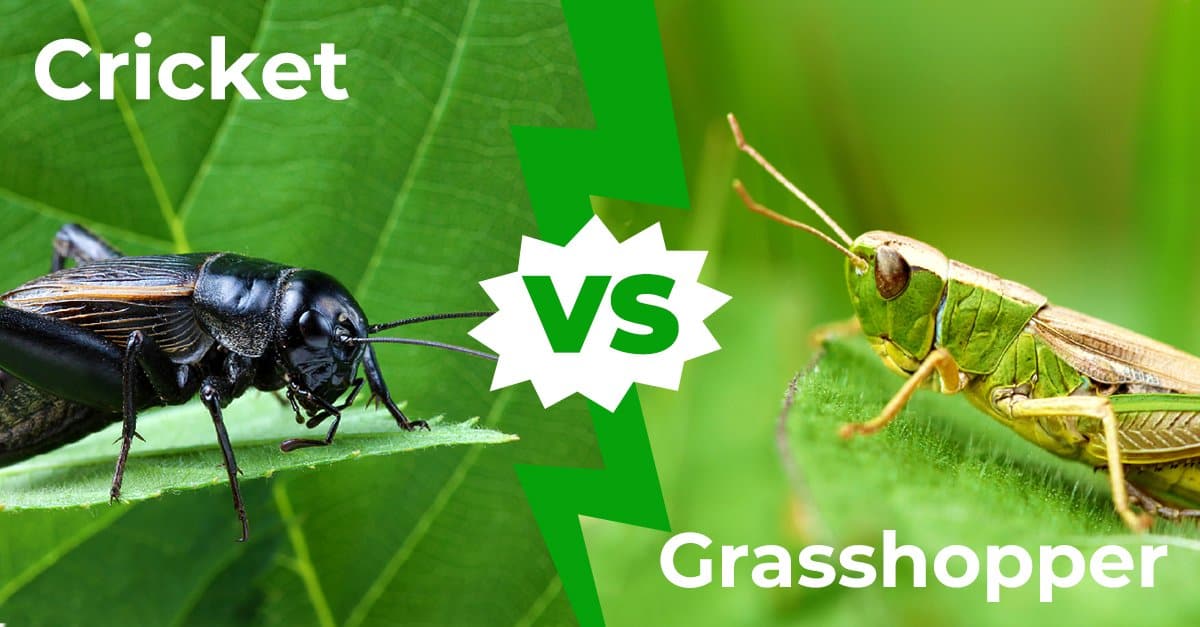

Crickets and grasshoppers are common backyard insects. There are over 10,000 species of grasshoppers and over 2,400 species of crickets living throughout the world, except in Antarctica. Have you ever wondered about the differences between crickets and grasshoppers? Do both insects have wings? How do they make noise? Are they both active at the same time of day? Although they may appear similar, there are nine main differences that set these two insects apart. We will break these differences down in terms of their physical characteristics and behavior. Learn the answers to your questions about crickets vs. grasshoppers, along with other intriguing facts about these tiny jumping insects.
Crickets vs. Grasshoppers Quick Comparison
| Cricket | Grasshopper | |
|---|---|---|
| Size: | 2 inches | Upwards of 4 inches |
| Color: | Black, grey, brown | Green, brown |
| Antennae: | Long and wispy | Short and stubby |
| Location of Tympanal Organs: | On the forelegs | On the abdomen near the thorax |
| Habitat: | Dark, cool, and humid | Sunny and dry |
| Active Period: | Night | Day |
| Diet: | Omnivore | Herbivore |
| Jumping Distance and Mechanics: | Up to 60 times body length in some species; muscle activated | Up to 20 times body length in some species; spring loaded |
| Sounds: | Chirping noises made by wings rubbing together | Scratching noises made by hind leg rubbing on wing |
Crickets vs. Grasshoppers Physical Characteristics
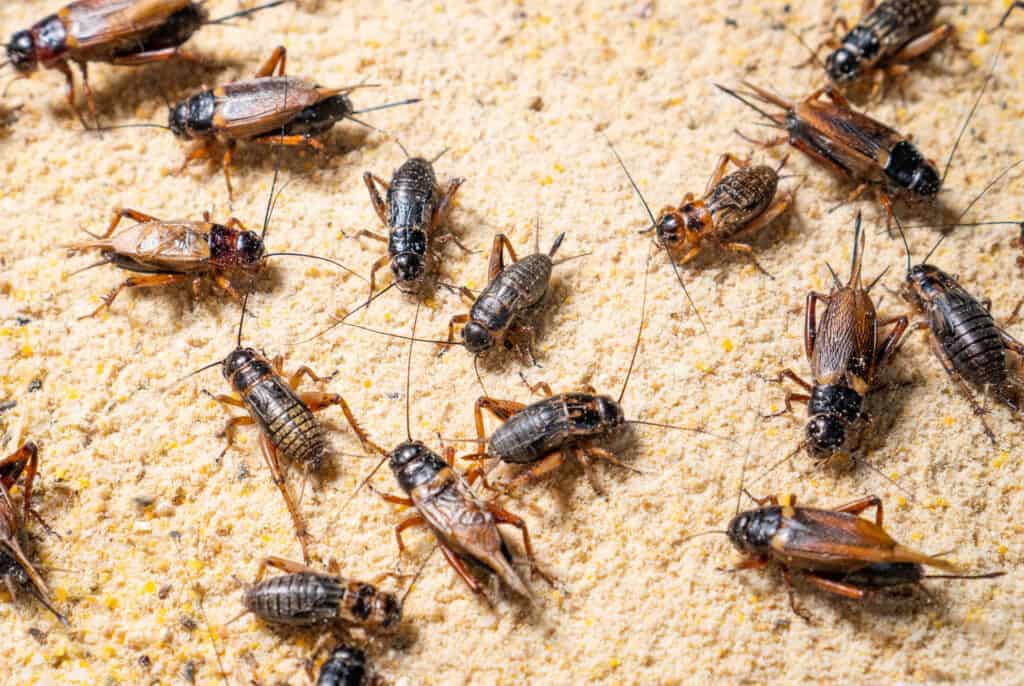
Field crickets are some of the most common crickets in the U.S.
©iStock.com/amnat jomjun
Both crickets and grasshoppers are part of the order Orthoptera. They have roughly cylindrical bodies, wings, and long hind legs adapted for jumping. They both have compound eyes and mandibular mouthparts to bite and chew their food. However, they differ in size, color, antennae length, and the location of their tympanal organs, which are specialized organs used for detecting sound.
Size
Generally speaking, crickets are smaller than grasshoppers. Crickets typically reach a maximum of 2 inches in length, depending on the species. The most common crickets in the U.S. are field crickets, such as the southeastern field cricket (Gryllus rubens) and the fall field cricket (Gryllus pennsylvanicus), and house crickets (Acheta domesticus). These crickets reach between 0.5 and 1.25 inches in length.
Alternatively, some species of grasshopper can reach lengths upwards of 4 inches. Some common U.S. grasshopper species include the spur-throated grasshopper (Melanoplus ponderosus), the red-legged grasshopper (Melanoplus femurrubrum), and the two-striped grasshopper (Melanoplus bivittatus). They typically measure between 0.4 and 2.8 inches long.
Color
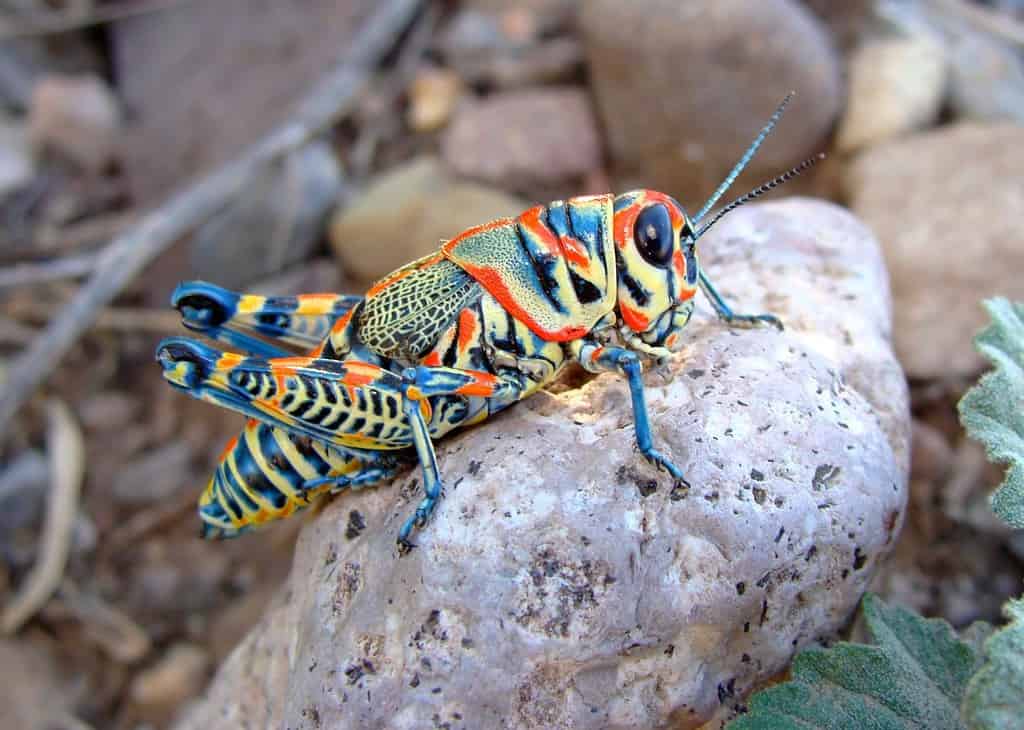
Grasshopper species typically have a wider range of colors than crickets.
©Matt Jeppson/Shutterstock.com
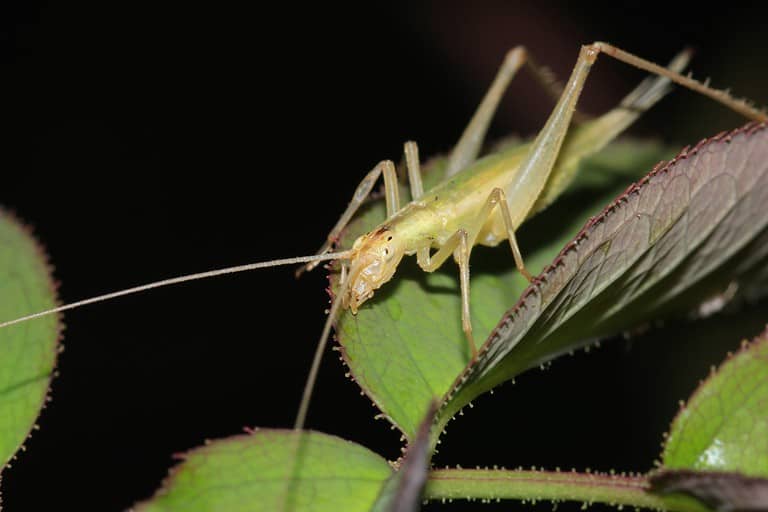
Crickets are generally darker in color than grasshoppers. Crickets are most often black, grey, or dark brown. Although it is less common, some crickets are green, such as the great green bush cricket (Tettigonia viridissima), but it is not native to North America.
Grasshoppers are typically green or brown to blend in with their grassland and woodland habitats. However, grasshopper species typically have a wider range of colors than crickets. Some grasshoppers can have red, pink, yellow, and orange coloration.
Antennae
While both crickets and grasshoppers have antennae, a cricket’s antennae are much longer. They have thin, wispy antennae that are as long as, or longer than, their bodies. In addition to using their antennae as “feelers” to navigate their surroundings, crickets use them to fight for dominance.
Grasshoppers generally have shorter, stouter antennae. Their antennae usually measure less than half the size of their bodies. However, some grasshoppers may have longer antennae, depending on the species. Grasshoppers primarily use their antennae as sensory organs.
Location of Tympanal Organs
Crickets and grasshoppers belong to different suborders based on the location of their tympanal organs, which serve as their ears. Tympanal organs vibrate in response to sound waves, allowing them to hear other insects, as well as predators. Crickets belong to the Ensifera suborder, which is characterized by a thin membrane on their forelegs, specifically the tibiae, that functions as ears.
Grasshoppers belong to the Caelifera suborder, which is distinguished by abdominal ears. They have thin, eardrum-like membranes on the sides of their abdomens, near the thorax. These membranes are sometimes tucked under the wings.
Crickets vs. Grasshoppers Behavior
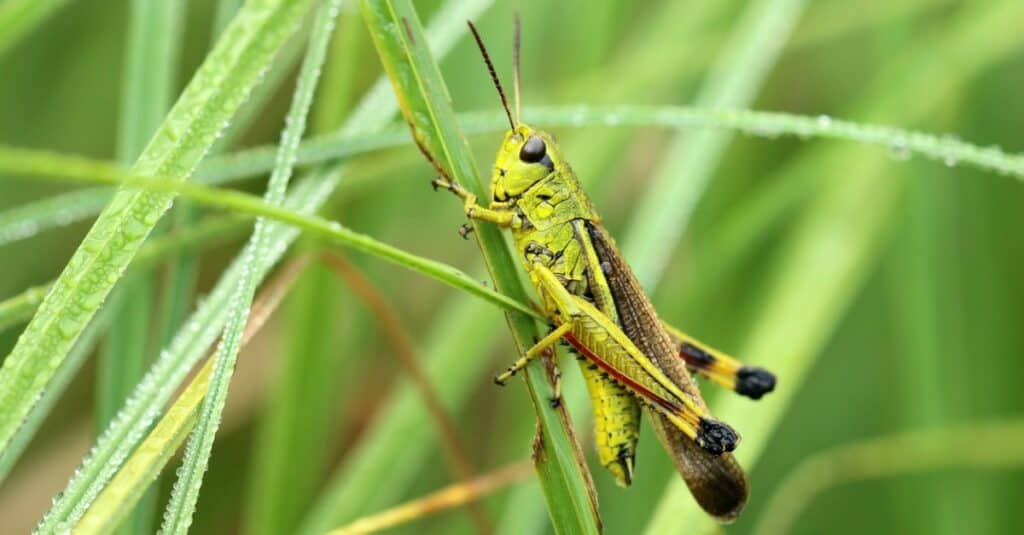
Grasshoppers are diurnal and prefer drier, sunnier habitats than crickets.
©iStock.com/Eileen Kumpf
Crickets and grasshoppers can both be found near vegetation, can both jump long distances, and both use sound to communicate. However, when it comes to specifics, they differ in their preferred habitats, active periods, diets, jumping ability and mechanics, and the sounds they make.
Habitat
Crickets and grasshoppers prefer different habitats. Crickets favor dark, humid, and cool environments, such as under leaf litter, rocks, or within the soil. This is why they are often found in basements and bathrooms when they enter homes.
Grasshoppers prefer sunny, dry habitats with dense vegetation, such as open fields, meadows, lawns, and the edges of gardens. Some species can even be found in deserts, as long as there are some grasses and shrubs.
Active Period
These two insects are also active at different times. Crickets are nocturnal, which means they sleep during the day and are active at night. This allows them to avoid many daytime predators, such as birds. So, if you hear chirping somewhere in your home at night, it is most likely a cricket.
Grasshoppers are diurnal. They need the sun to help raise their body temperatures so they have enough energy for activity. They begin their day by basking in the sun for several hours before going in search of food or mates.
Diet
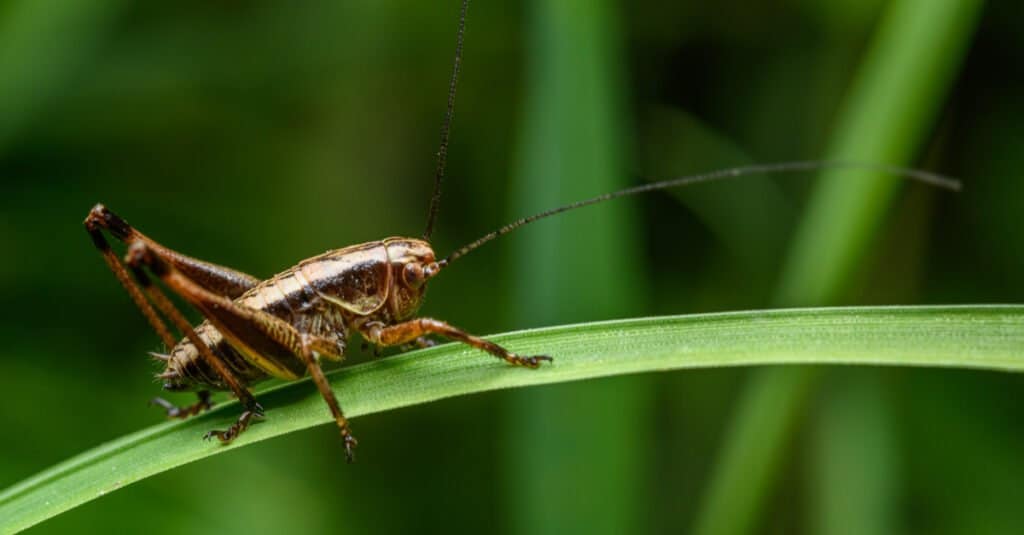
As omnivores, crickets eat both plant and animal matter.
©iStock.com/Petr Ganaj
Crickets are omnivores, which means they eat both plant and animal matter. They typically eat aphids, bug larvae, seeds, grass, fruit, vegetables, and flowers. However, crickets will also eat grains and other food items if they get into homes.
Grasshoppers are herbivores and primarily eat plant matter. Their diet generally includes grasses, stems, flowers, leaves, and seeds. Grasshoppers are also known to be agricultural pests, eating crops such as corn, wheat, and alfalfa.
Jumping Distance and Mechanics
Both grasshoppers and crickets use their powerful, elongated hind legs to jump long distances. However, crickets have the advantage. Some species are able to jump up to 60 times their body length. This means they can jump at least 2.5 feet, with some sources suggesting they can jump as far as 3 feet. These crickets rely on their muscles for extension, using their long hind legs as levers.
Grasshoppers can jump up to 20 times the length of their bodies, with larger species capable of reaching distances of approximately 2.5 feet. However, grasshoppers utilize a spring-loaded jump, unlike the muscle-activated jump of crickets. They contract their flexor muscles to lock their hind legs in place, allowing them to store elastic energy. When the flexor muscle relaxes, it releases the stored energy, causing the hind legs to extend rapidly.
Sound
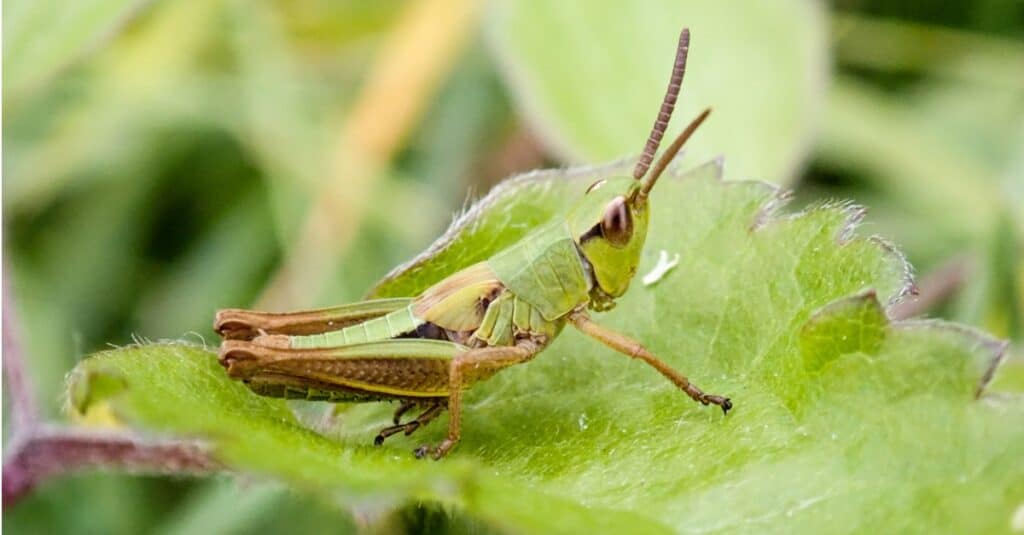
Grasshoppers rub their hind legs against the front edge of their wings to make sound.
©iStock.com/Peter Fleming
While both insects use their wings to emit sound, they do so in different ways, and the sounds they produce are distinct. Crickets make high-pitched chirping sounds by rubbing the edges of their wings together, which is called stridulation. However, only the males chirp to attract females, as females do not have the ridged structures on their wings necessary to make the sound.
In contrast, a grasshopper makes more of a scratching sound, sometimes likened to rubbing sandpaper together. It makes these sounds by rubbing one of its hind legs against the front edge of its wing. Grasshoppers have spines on their hind legs that they rub across a scraper on their wings. Although males usually make this sound to attract a mate, females may occasionally make sounds during courtship as well.