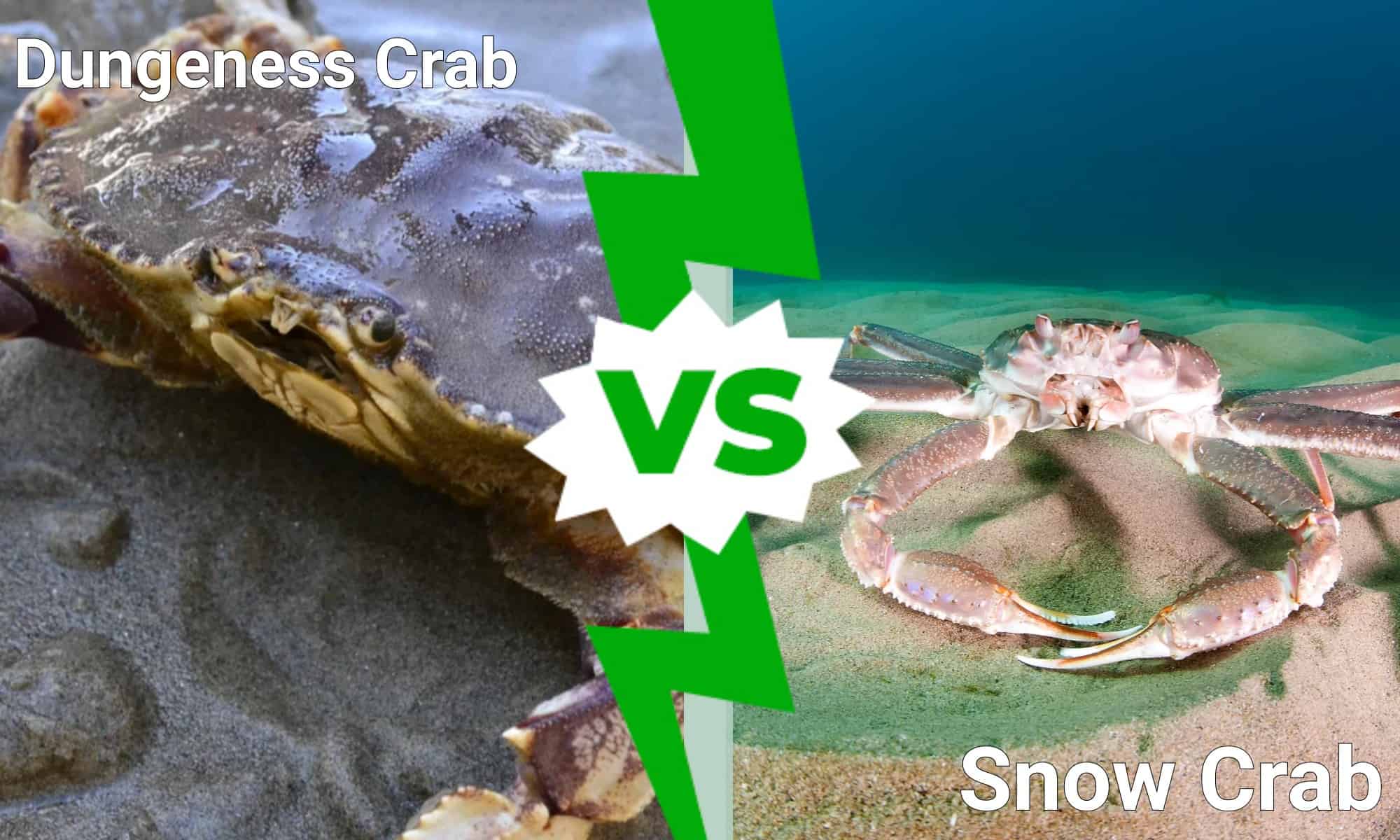

There are many key differences between the Dungeness crab (Metacarcinus magister) and the snow crab (Chionoecetes opilio). The body of the Dungeness crab grows larger than the body of a snow crab. However, snow crab legs are much longer than the legs of a Dungeness crab. Snow crabs also outlive Dungeness crabs by 3-7 years on average. The habitat preferences and geographical locations of these crabs also differ greatly. Continue reading to learn more about the differences between these two crab species.
Size
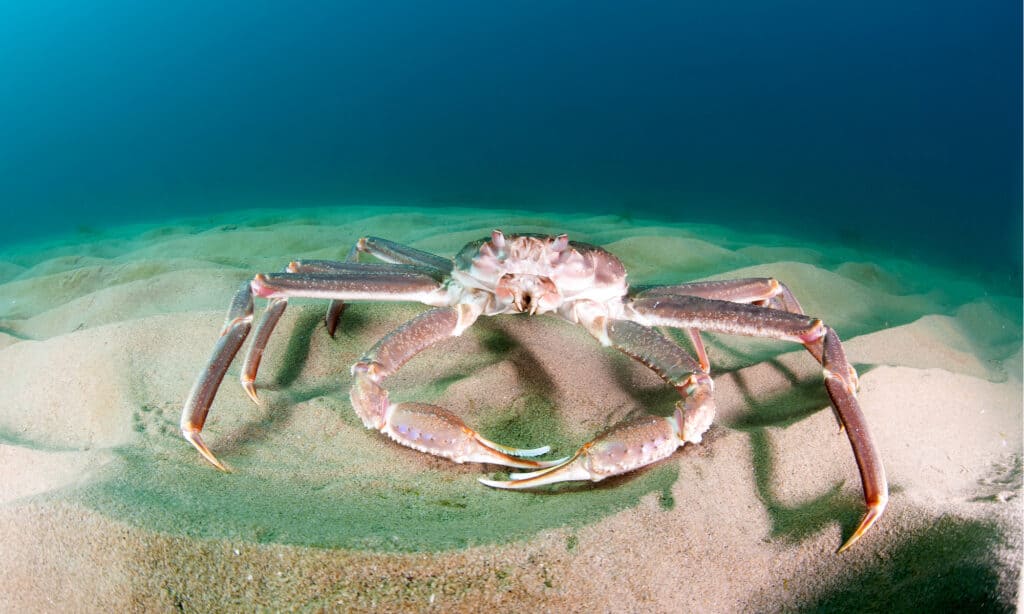
A Snow Crab takes a defensive stance on the seabed.
©Kondratuk Aleksei/Shutterstock.com
The size and weight of Dungeness crabs and snow crabs are defining differences. Dungeness crabs have bodies that are 8-10 inches across and weigh 2-3 pounds, while snow crabs typically weigh 2 to 4 pounds and have 6-8 inch wide bodies. Snow crabs tend to weigh more than Dungeness crabs on average because their legs are much longer.
Distribution and Habitat
©Yellowj/Shutterstock.com
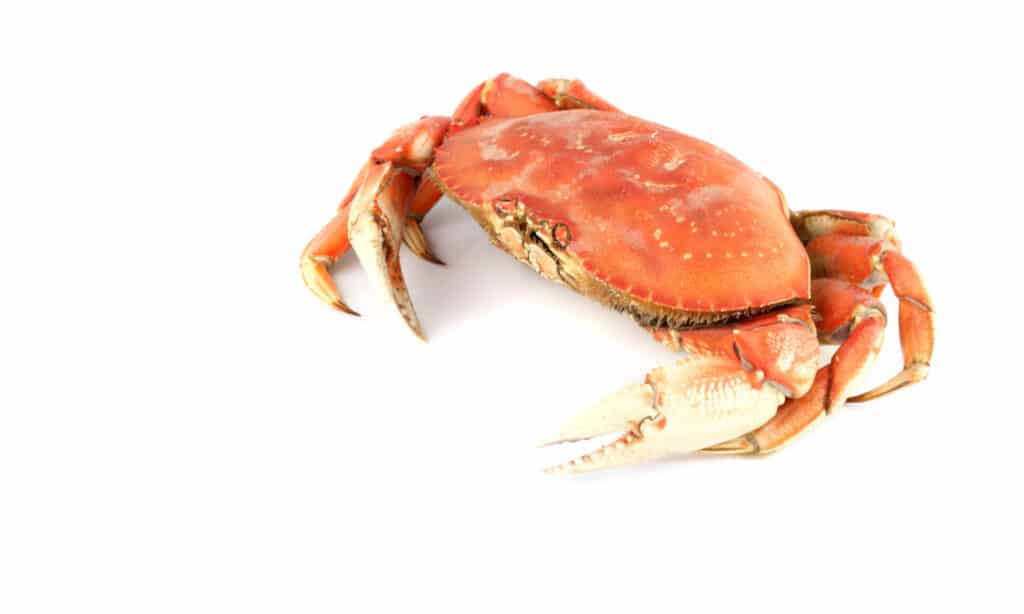
Dungeness crabs are found in the coastal waters of the Northern Pacific Ocean.
Dungeness crabs are named after the town of Dungeness, Washington, where the first commercial fishery for this species was established in 1848. They are distributed along the Pacific coast of North America, from the Aleutian Islands in Alaska south to Magdalena Bay in Baja California, Mexico. They are most abundant in coastal waters from Alaska to Central California and are commonly found in sandy bottoms, eelgrass beds, and estuaries. They are also found in U.S. and Canadian fisheries.
Snow crabs are found in the Northern Pacific and Atlantic Oceans, inhabiting subarctic and arctic regions. Their range in the Pacific includes the Bering Sea, Sea of Japan, and waters around Alaska and Japan, while in the Atlantic, they are located from Greenland and Canada to areas like the Gulf of Maine and Nova Scotia. They prefer cold, deep waters and can be found on soft mud or sandy bottoms.
Appearance and Behavior
Snow crabs are only orange or red in color when they are young, while dungeness crabs remain a rusty orange for the majority of their life.
©Kondratuk Aleksei/Shutterstock.com
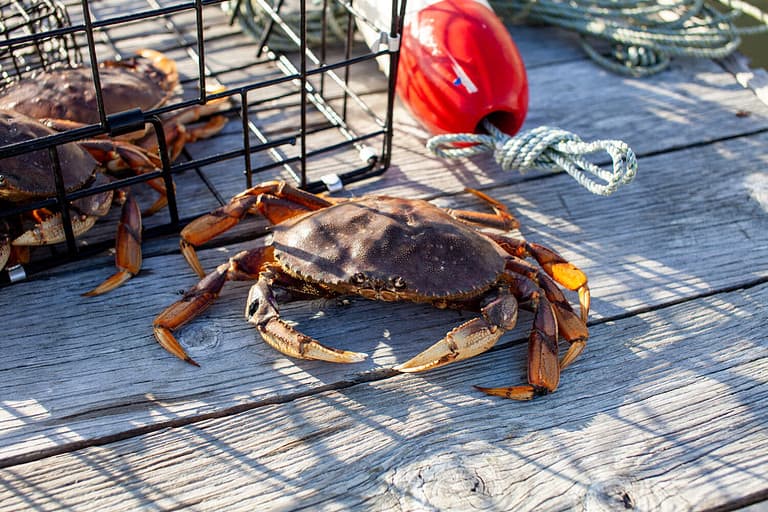
Dungeness crabs have a broad, oval, carapace that is yellowish-brown to purple. They have four pairs of walking legs and a pair of claws. Their claws have distinctive hooks and serrated teeth, and the tips are light-colored. Dungeness crabs use their claws for feeding, defense, and mating, utilizing them to tear apart food, grip prey, and fend off rivals. They use their strong claws to tear open and process food like clams and other crustaceans, and to defend themselves from predators. During mating season, they may also use their claws to fight with other males or to attract a mate. Dungeness crabs are solitary, burrowing crabs that molt frequently during their adolescence and then annually once they reach adulthood. They are typically found in sandy areas of temperate waters.
Snow crabs have a round, flat carapace with a reddish-brown top and lighter underside, ten long legs, and one pair of claws. They are omnivores that scavenge on the ocean floor. Males of the species are distinguished by a triangular abdomen while females have a more rounded abdomen. Snow crabs are social crabs that are frequently found in groups. Once they have reached maturity, snow crabs cease to molt.
Lifespan
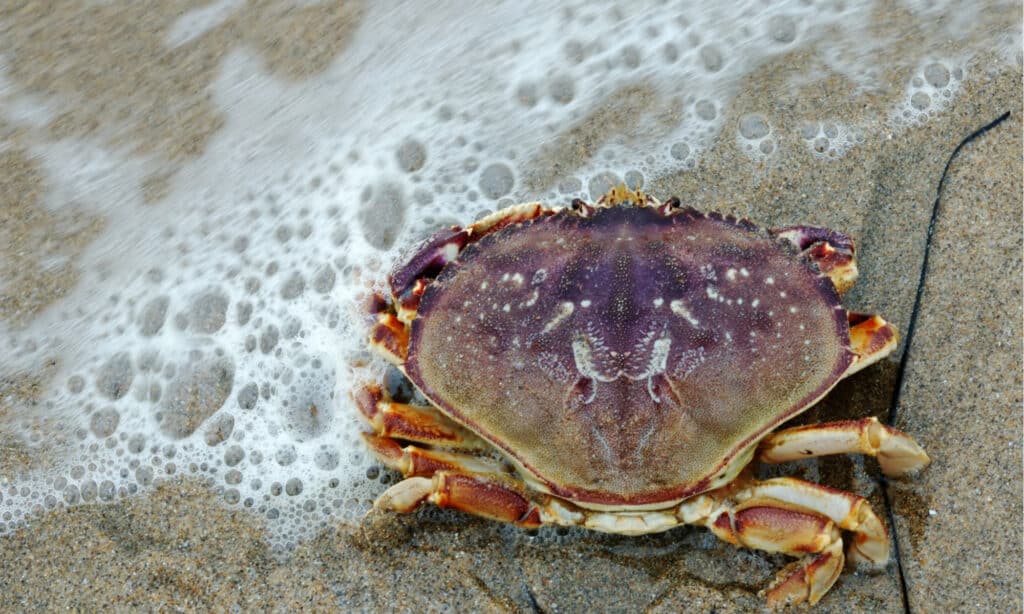
The Dungeness crab lives an average lifespan of 8 to 13 years, while the snow crab lives an average lifespan of 15 to 20 years.
©Justin Kral/Shutterstock.com
Snow crabs have greater life expectancy than Dungeness crabs. The snow crab’s longer lifespan is a result of their life cycle and environment. Snow crabs live in colder waters and have a slower molting process as they age, which can contribute to their longer life.
Dungeness crabs have shorter lifespans due to differences in their biology and environment. Dungeness crabs have a more limited habitat range and may be more vulnerable to environmental stressors during their life cycle, which can affect their growth and survival. Many Dungeness crabs are caught by the time they are four years old, significantly lowering the average lifespan in harvested populations.
As a Meal

Dungeness Crab claws are a delicacy, but an expensive one.
©Bochkarev Photography/Shutterstock.com
Dungeness crabs tend to be sweeter compared to the mild flavor of a snow crab. However, that doesn’t mean that snow crabs don’t taste as good. To get the most flavor out of a snow crab, go for the leg meat, as the legs tend to have a more intense flavor.