
Quick Take
- A crab less than an inch wide naturally executes a spatial strategy that mathematicians and computer scientists deliberately engineer, and it does so without a brain built for planning. Explore the spatial strategy →
- The sunburst patterns look like deliberate art, yet the real reason they form is far more mechanical and far more impressive. See how patterns form →
- These crabs aren't just reacting to whatever sand is in front of them. They're making decisions based on something researchers didn't expect to find. Discover their decision-making →
- Every incoming tide erases their work completely, and that reset is entirely the point. Learn about the daily reset →
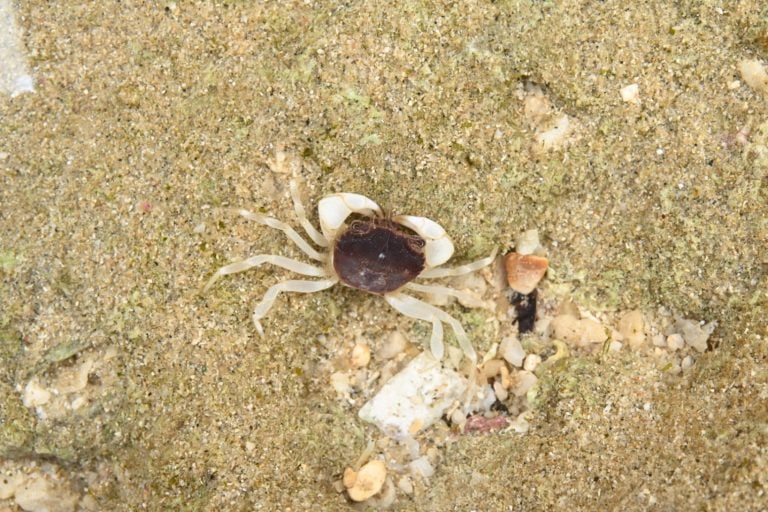
A strange kind of “art show” appears with every low tide across the sandy shores of the Indo-Pacific and Australia — only to vanish just a few hours later. The artists? Sand bubbler crabs. Less than an inch wide, these tiny crustaceans are easy to miss. Their round, sand-colored bodies blend seamlessly into the beach. They spend much of their lives tucked inside vertical burrows just below the high-tide line. But when the tide retreats, they emerge in staggering numbers and get to work.
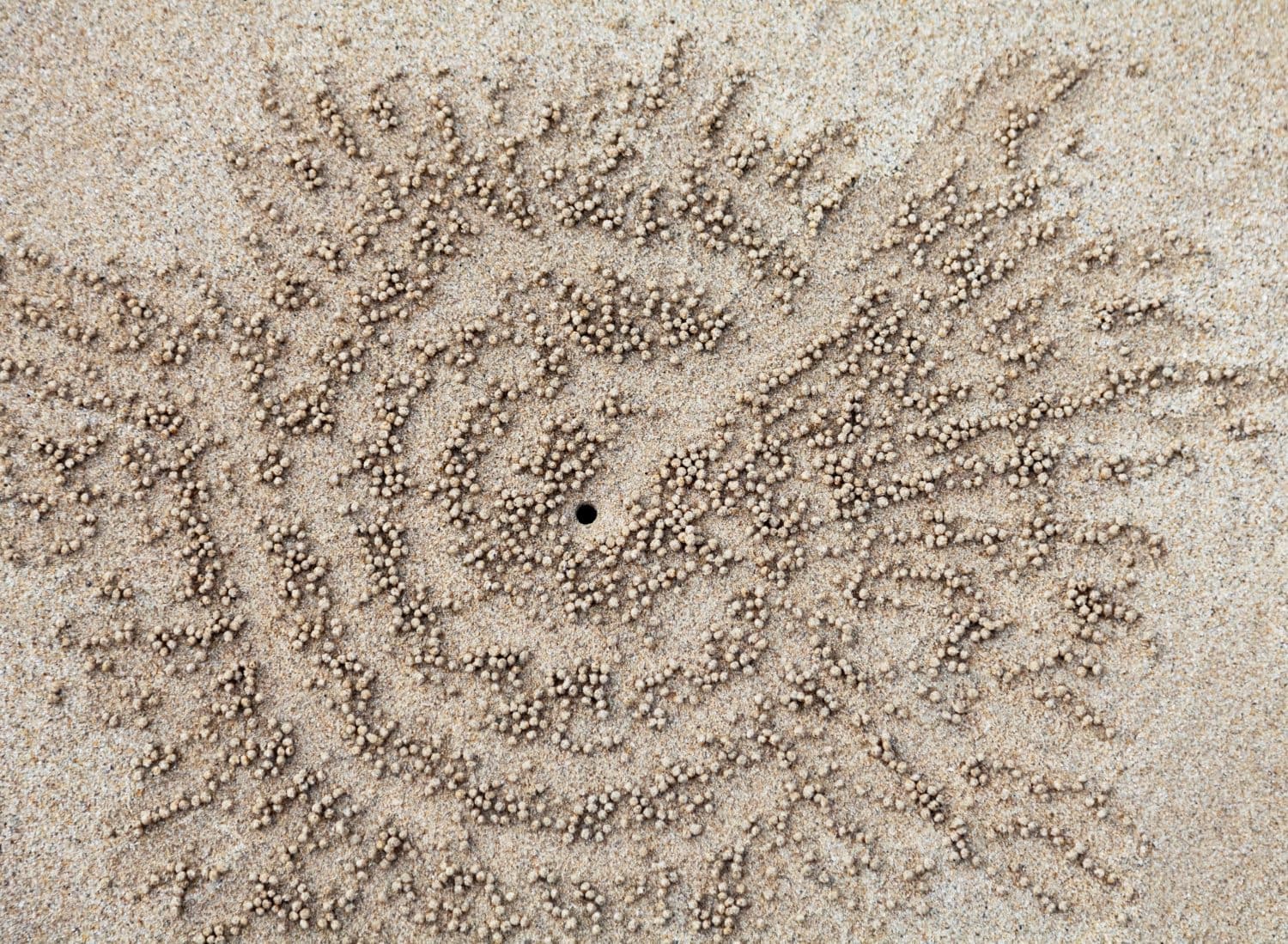
What they leave behind looks deliberately designed: delicate sunbursts, spirals, and radiating lines made of thousands of tiny sand balls. However, this isn’t art for art’s sake — it’s the result of hunger, efficiency, and instinct playing out with mathematical precision.
Anatomy of a Sand Artist
Sand bubbler crabs are built to process sand quickly during the short low-tide window. Their tiny size is actually a strategic advantage rather than a limitation. Their compact bodies allow them to scurry across wet sand, staying nearly invisible to predators.
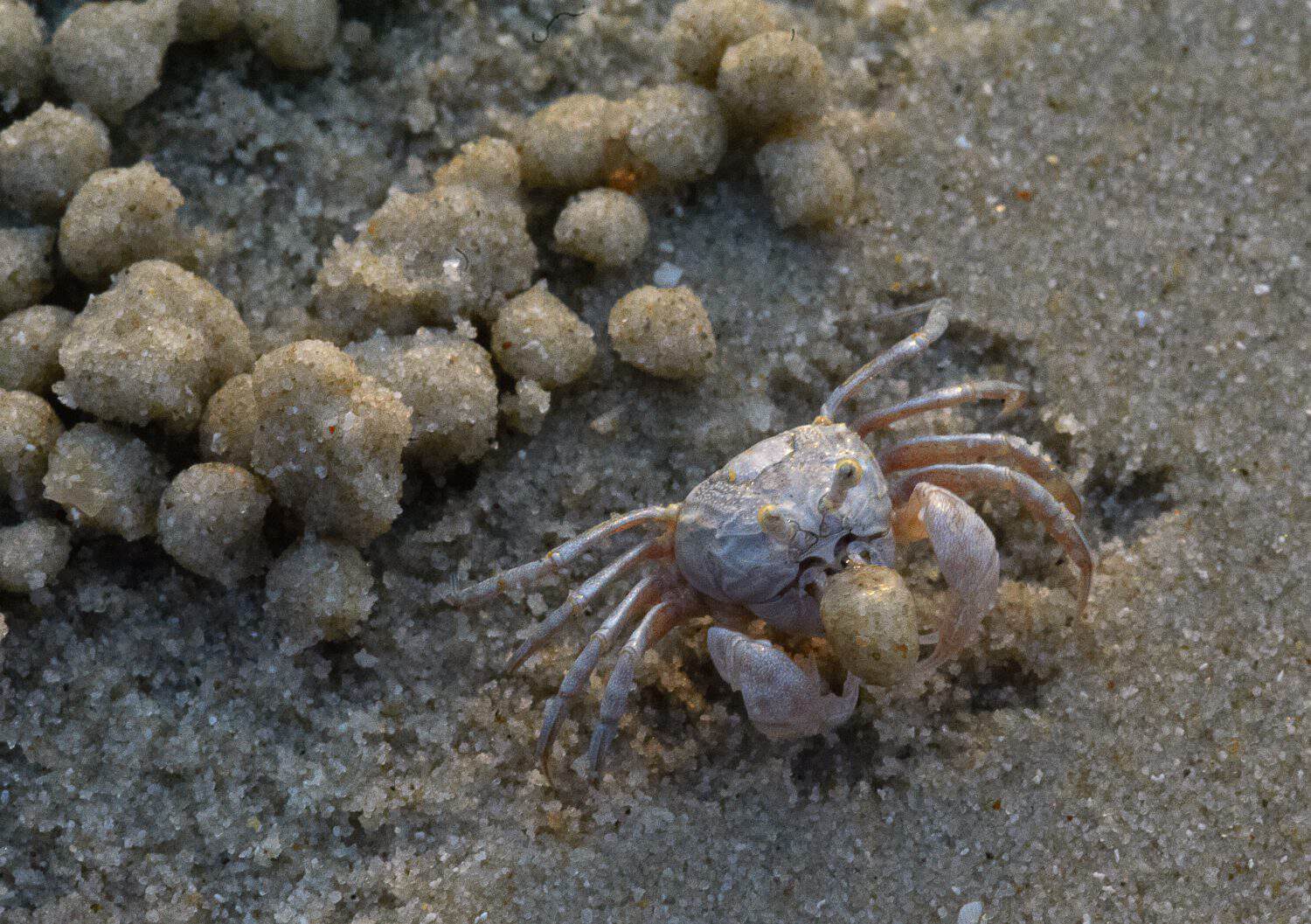
Sand bubbler crabs are only about the size of a human fingernail.
©vic_nick/Shutterstock.com
While many crabs are fully aquatic, sand bubblers are uniquely adapted for life on the surface. They breathe air through special leg membranes. Meanwhile, fine body hairs trap water to keep their gills moist while they work in the sun.
Sand bubbler crabs also have specialized mouthparts lined with setae — dense, hair-like structures that function as microscopic filters. The crabs scoop up a mouthful of moist sand. Their vibrating setae then sift through the grains, separating organic debris and plankton from the heavy sand. Once the crab filters and swallows all the nutrients, it spits out the remaining sand. Instead of simply leaving the rejected sand behind, the crab rolls it into one of the signature balls that form their famous beach art.
Turning Hunger Into Patterns
Sand bubbler crabs do not intentionally decorate the beach. Their impressive designs are simply the byproduct of a highly efficient feeding strategy.
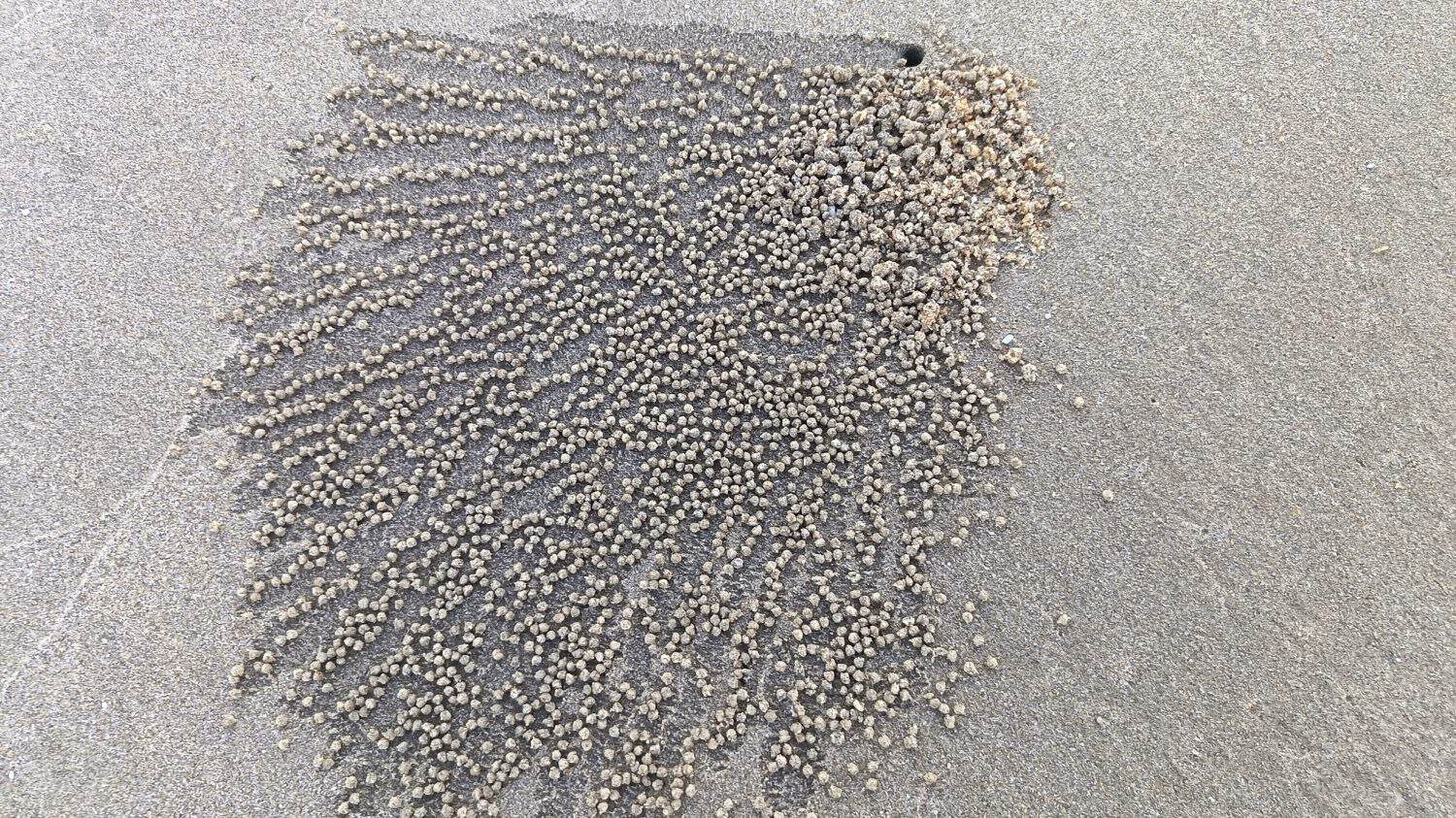
These crabs get their name from the pellets or “sand bubbles” they leave behind.
©AzzBinTan/Shutterstock.com
Much like a production line, the process is simple, mechanical, and incredibly precise. The crab uses its claws to gather damp sand, passing it through its mouthparts to extract bits of food. It then packs the filtered sand into a small, uniform ball and places it in a neat, organized row behind itself as it moves forward.
The Geometry of a Sunburst
While the sand bubbler crab’s designs may appear to be intentional decorations, they’re actually all about efficiency. Every pattern starts at the crab’s burrow. From this central point, the crab moves outward in straight, evenly spaced lines, creating narrow feeding trenches. After completing a pass, it adjusts its angle slightly and repeats the process. Over time, this systematic rotation creates a perfect fan or a full circle of radiating trenches.
This process isn’t about creating art; it’s a survival strategy that prevents the crab from wasting energy on the same sand twice. Each rounded ball of sand marks a spot already scoured for food, mapping the crab’s progress in real time. As it works methodically outward, these discarded spheres form a radial sunburst pattern that expands until the tide returns or a predator interrupts the work.
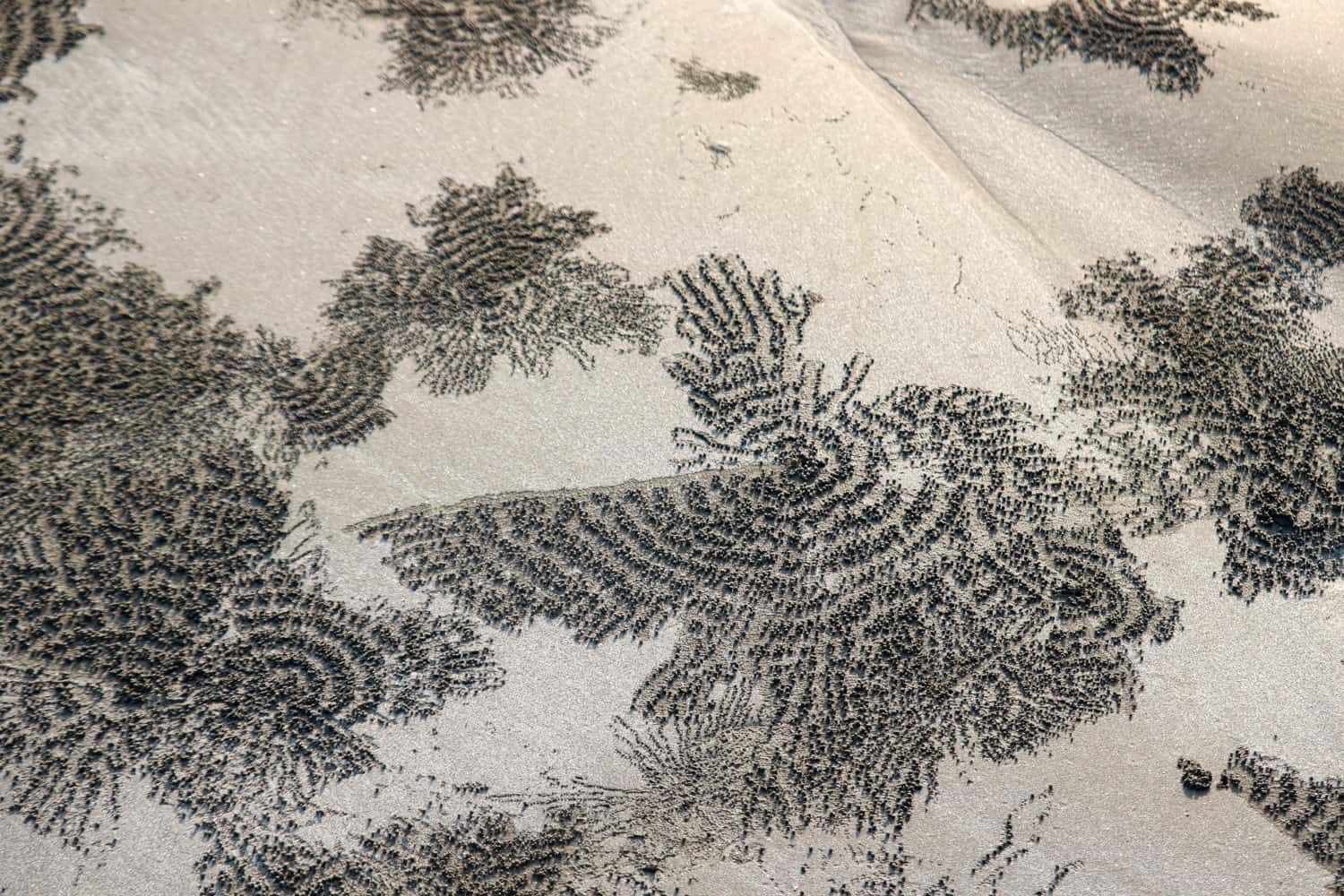
Sand bubbler crabs help clean sand and support the complex food chains of their habitats.
©Anonna kundu/Shutterstock.com
While the fundamental blueprint remains consistent, the final pattern depends on three main factors: the crab’s size, the duration of the low tide, and the number of crabs in the area. Larger crabs have a greater reach and can extend their feeding lines up to eight to nine times their body length. The longer the tide stays out, the more lines a crab can add to its “sunburst” — unless the colony is crowded and overlapping territories force the patterns into jagged, intersecting boundaries.
Even with interruptions, this system is incredibly effective. Research shows that more than 90 percent of a sand bubbler crab’s feeding paths do not overlap — meaning almost no energy is wasted reprocessing old sand. Even without a conscious plan, the sand bubbler crab naturally follows a “space-filling algorithm,” ensuring that it expends almost no energy reprocessing old, nutrient-poor sand.
Memory and Decision-Making
Sand bubbler crabs are not mindless machines reproducing mechanical patterns; their patterns are flexible and highly responsive. Research on species like Scopimera intermedia shows that these crabs adjust their behavior based on recent experience. Instead of simply reacting to the sand directly in front of them, these crabs use a short-term “reference window.” This allows them to compare the quality of their current spot with what they just encountered.
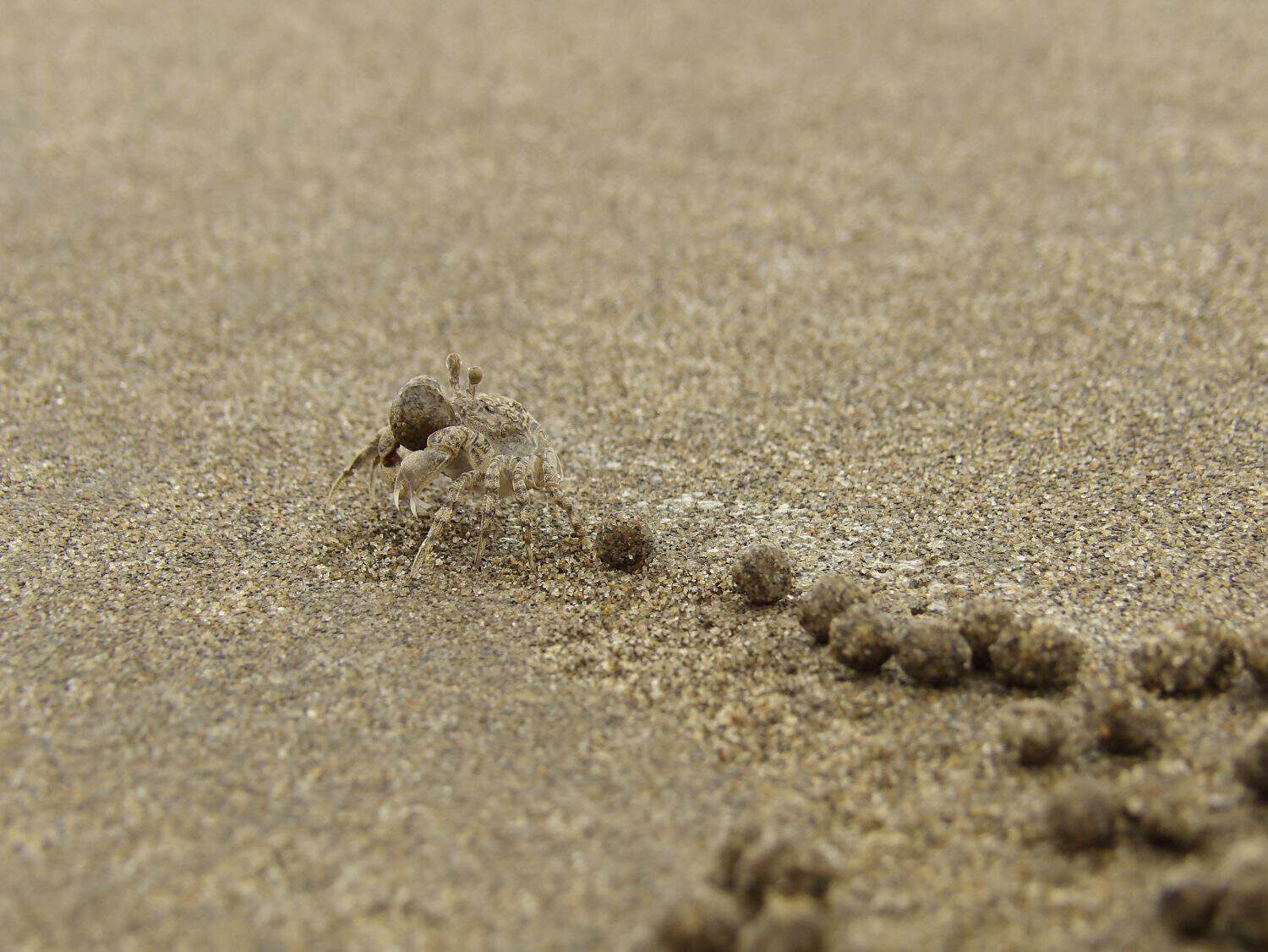
There are several types of sand bubbler crabs in the genera Scopimera and Dotilla.
©Hank Asia/Shutterstock.com
If food is evenly distributed, the crab stays close to the safety of its burrow. However, if it detects better nutrients further away, it will move quickly toward that area. If it hits a rich patch of food, it may abandon straight lines for curved or looping paths to thoroughly harvest the area. By combining sampling with memory, the crab can maximize its energy intake in an environment that the ocean reshapes every few hours.
To survive while wandering far from home, the sand bubbler crab relies on an internal navigation system known as path integration. Even if the crab has spent the last hour moving in complex arcs or loops, it always knows its exact position relative to the burrow. When a predator appears, it doesn’t need to retrace its steps; it simply bolts home in a perfectly straight line.
Ecological Impact and the Daily Reset
Beyond their visual appeal, the sand bubbler crab’s patterns also indicate a massive, natural filtration system for the coastline. Large colonies of crabs — sometimes numbering in the hundreds of thousands — process vast areas of shoreline. By sifting the top layer of sand, the crabs remove organic debris that would otherwise decay and foul the beach. Additionally, they convert microscopic nutrients into biomass, serving as a crucial food source for shorebirds and larger predators.
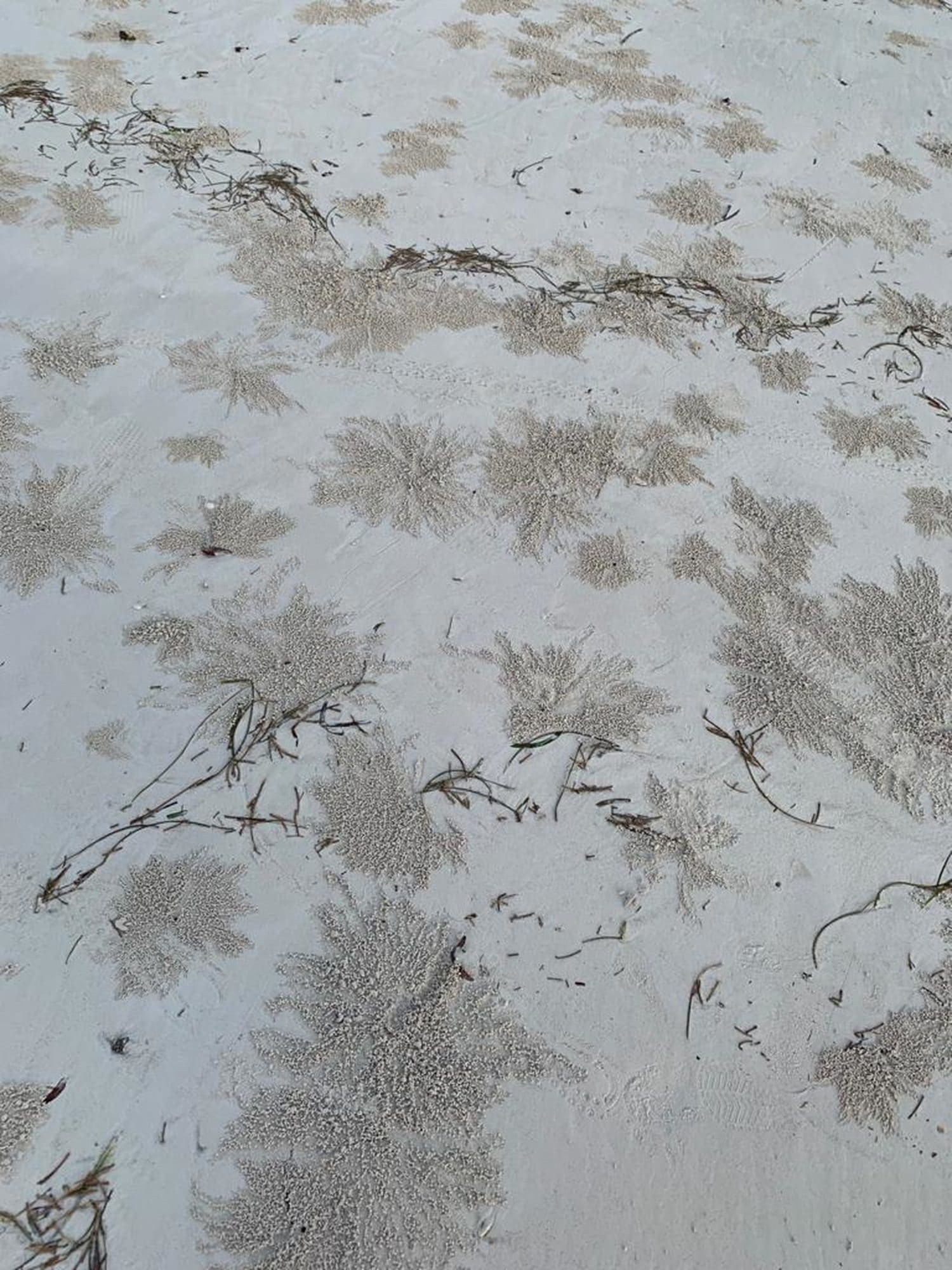
Sand bubbler crabs eat plankton, detritus, and meiofauna.
©LoveMyself/Shutterstock.com
Unfortunately, because sand bubblers rely entirely on the thin, topmost layer of the beach, they are highly sensitive to human activity. Heavy foot traffic or vehicles can pack the sand so tightly that the crabs cannot burrow or feed. Microplastics and oil spills are particularly dangerous, as they can clog the crabs’ delicate mouthparts or introduce toxins directly into their diet.
A sand bubbler crab’s life is strictly governed by the tides. Low tide is their work shift, providing a fresh layer of organic material trapped between the grains of sand. As the water recedes, the crabs emerge from their burrows to feed and create their radial patterns. Later, as the tide rises, the crabs return to their burrows and seal the entrances, trapping a bubble of air to survive while submerged. The incoming waves wash away the tiny balls of sand and smooth the surface, redistributing nutrients and erasing every trace of the crab’s work. By the next low tide, the sandy canvas is perfectly clean, and the tiny artists return to begin the cycle all over again.