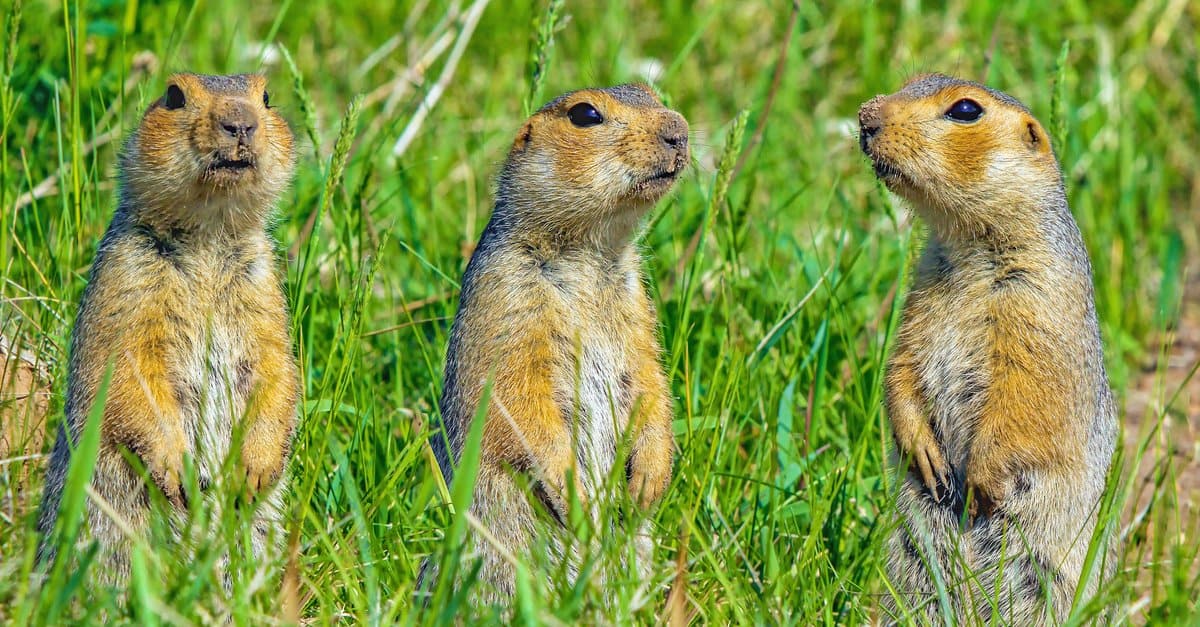

Although gophers and prairie dogs resemble one another, prairie dogs are in the squirrel family (Sciuridae), while gophers belong to their own family, Geomyidae. Both gophers and prairie dogs are native to North America. Prairie dogs are found in the grasslands of the American West, while gophers can be found in various habitats across North and Central America. While they are both burrowing rodents that are sometimes confused, they have key biological differences, including size, physical characteristics, habitat, and diet. Continue reading to learn what sets these two animals apart.
Size and Appearance
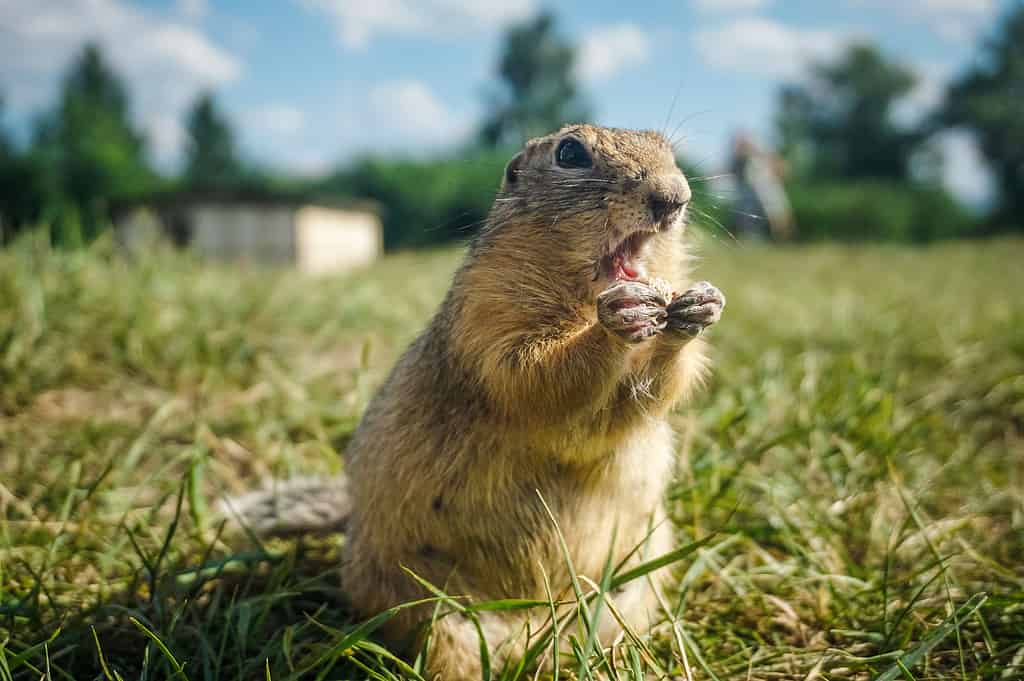
Gophers are noticeably smaller than prairie dogs.
©paha1205/Shutterstock.com
One of the most significant differences between gophers and prairie dogs is their size. Prairie dogs are notably bigger and longer than gophers, measuring 12 to 16 inches long, while gophers are only half that size, reaching lengths of 6 to 8 inches. While gophers weigh approximately 2.2 pounds, prairie dogs can weigh up to 3 pounds. Gophers, unlike prairie dogs, do not have a distinct neck and store and transport food in pouches in their cheeks, from which they got their name, pocket gophers.
Gophers have smooth, pliable fur in colors like dark brown, yellow-brown, or gray, while prairie dogs have coarse, light brown fur that may have white or black accents. Other physical differences include that gophers have long claws for digging, whereas prairie dogs have shorter claws, and prairie dogs have bushy tails, while gopher tails are usually hairless.
Gophers have large, visible front teeth that stick out and are yellow. Their teeth are adapted for digging and can even be used to cut through roots, and they often keep their mouth closed while digging to prevent dirt from getting in. Prairie dogs have smaller, less noticeable incisors. Their teeth are not as specialized for digging as a gopher’s.
Habitat and Distribution
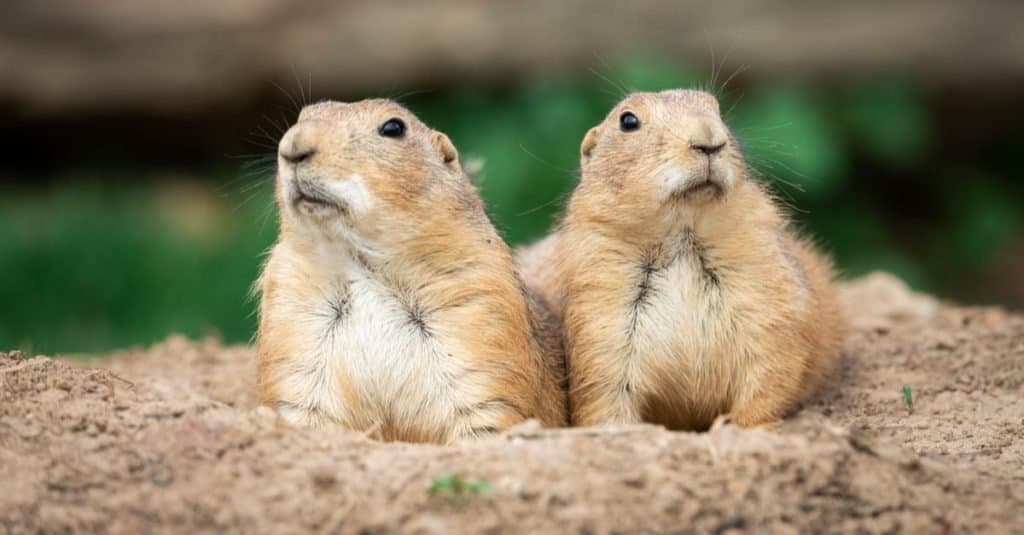
Prairie dogs have complex underground networks of burrows they use for sleeping, raising young, and storing food.
©AB Photographie/Shutterstock.com
Prairie dogs are native to the prairies of Central and Western North America, with populations historically ranging from Mexico to Canada, though their current distribution is more fragmented and limited to specific regions in central and western North America. Their habitats include short-grass and mid-grass prairies, mountain valleys, and shrublands, though they are most commonly associated with dry, flat grasslands.
Gophers are found across Central and North America, particularly in grassland and agricultural areas, though their specific distribution varies by species. They prefer habitats with loose, sandy soil and edible plant cover, though some species can adapt to other environments like forests with open canopies, as long as there is sufficient ground cover and appropriate soil conditions.
Behavior and Activity
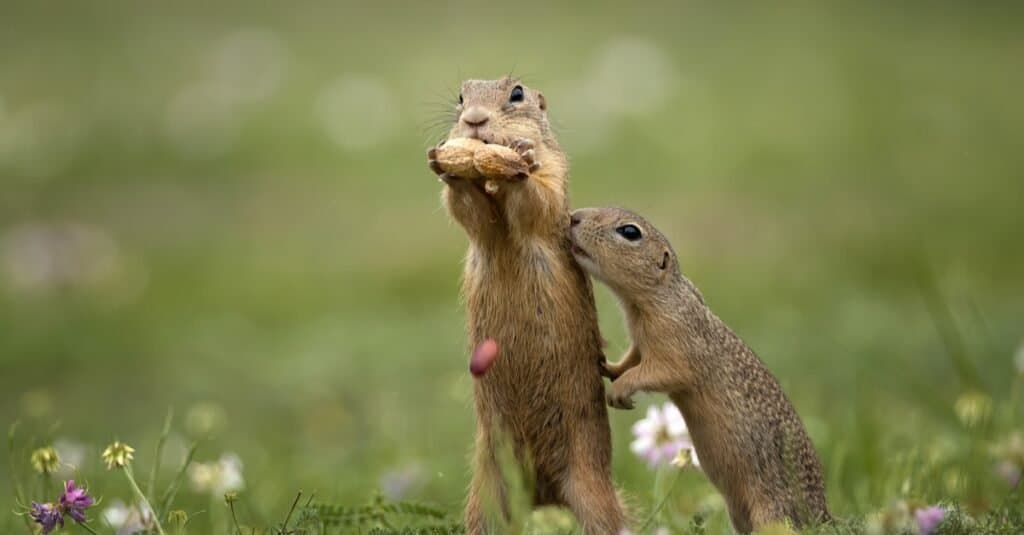
Gophers are less social compared to prairie dogs.
©eumates/Shutterstock.com
Prairie dogs are more social than gophers. They share food, live in family groups with other prairie dogs, and protect themselves from predators. Black-tailed prairie dogs live in towns, which are extensive networks of burrows, with historical records of some towns covering thousands of square miles, though most are now much smaller. Prairie dogs breed once each year in the spring.
Gophers are solitary creatures and only come together to mate. Most gopher species breed once or twice a year, typically in spring or early summer. Gophers are rarely spotted during the day as they like to hide in their tunnels, while prairie dogs are most active during the day and can often be seen above the ground, away from their burrows.
Diet
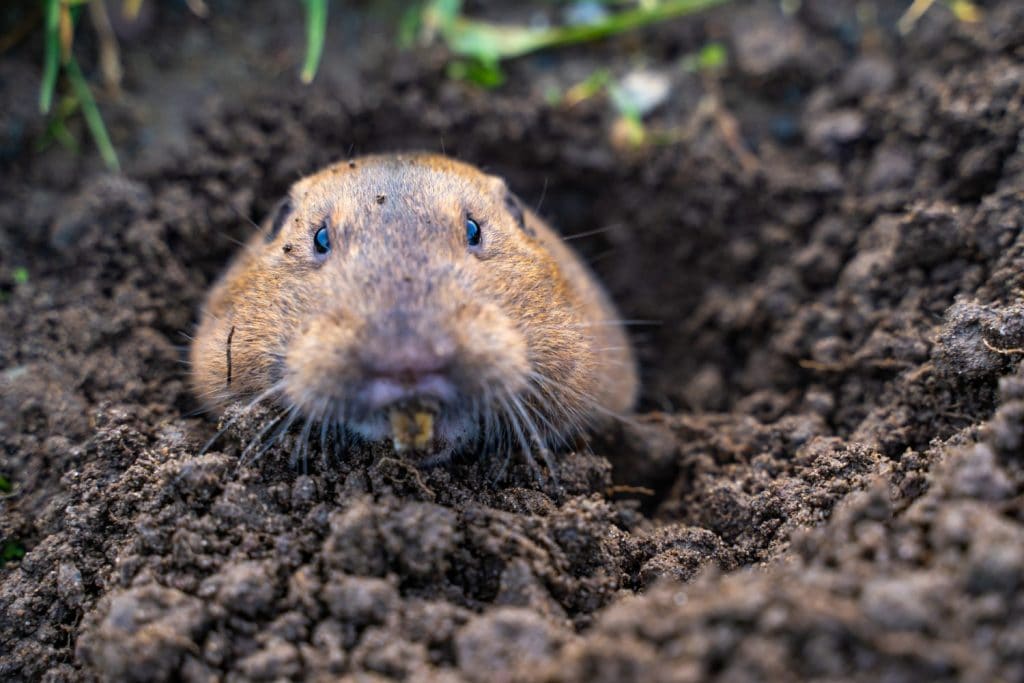
Gophers have large, continuously growing incisors that are adapted for burrowing.
©Iv-olga/Shutterstock.com
Gophers and prairie dogs are herbivores, which means they eat plants exclusively. Although both eat grasses, roots, and seeds, their diets have some key differences. Gophers have a stronger preference for roots, tubers, and bulbs, which they often pull into their burrows, while prairie dogs focus more on above-ground grasses, roots, and flowering plants.
Gopher tunnels can damage irrigation systems, utility lines, and even building foundations. They can kill young trees by eating their roots or by girdling the base of the trunk underground, and may occasionally damage established trees.
Prairie dogs can also cause significant damage to yards, gardens, and agricultural areas due to their extensive burrowing and grazing habits, and in some regions, their impact can be as great as or greater than that of gophers.