
Quick Take
- Dolphin brains are actually bigger than human brains, though the full comparison reveals a surprising reversal that changes everything. Compare the brain sizes →
- Scientists still can't pinpoint exactly where a dolphin's prefrontal cortex is, yet somehow dolphins manage to plan, coordinate, and problem-solve regardless. Explore the dolphin cortex →
- Dolphins have a relatively tiny hippocampus, but their ability to navigate rivals species with far larger ones. The reason why is unexpected. See how dolphins navigate →
- The metric scientists use to rank animal intelligence puts humans first and dolphins second, though it comes with a major caveat that most people overlook. Check the EQ rankings →
Humans and bottlenose dolphins (Tursiops truncatus) have a number of similarities. They are both highly intelligent, self-aware, capable of problem-solving, and use complex communication. However, they have evolved along separate paths, resulting in significant differences in brain structure and function. Continue reading to discover the surprising differences between dolphin and human brains.
Relative Brain Size
In absolute terms, dolphins’ brains are larger than human brains. The average dolphin brain weighs roughly 3.5 to 3.7 pounds, while the average human brain weighs 2.9 to 3.1 pounds. However, when considering brain size relative to body size, humans have larger brains than dolphins. Scientists often calculate brain size to body size when comparing the intelligence of different animal species. This is called the encephalization quotient (EQ).
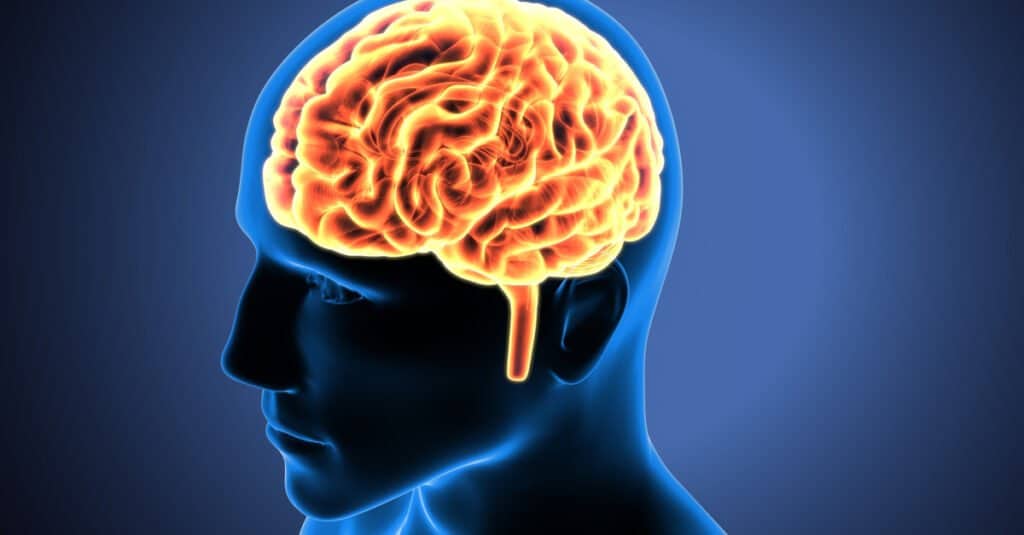
Dolphin and human brains are among the most complex in the animal kingdom.
©Life science/Shutterstock.com
The Encephalization Quotient
The EQ is determined by dividing the mass of an animal’s brain by the mass of its body. Humans have the highest EQ at about 7.4–7.8. Dolphins, particularly bottlenose dolphins, are considered the second-most intelligent animals with an EQ up to 5.3.

Humans have the highest encephalization quotient of any animal.
©Gorodenkoff/Shutterstock.com
Although EQ was designed to measure intelligence across different species, there are a number of limitations. EQ measures an animal’s total brain weight rather than the number of neurons in the brain. It also fails to account for body mass scaling, which cannot distinguish between human weights, much less the relative sizes of different species. Scientists note that EQ is biased toward mammals and also assumes there is a standardized brain structure across significantly different taxa.
The Hippocampus
The human brain has a more developed hippocampus than the dolphin brain. The hippocampus is a seahorse-shaped part of the human brain that is primarily responsible for memory, learning, and emotion. It also plays a important role in spatial navigation, converting short-term memories to long-term memories in the cerebral cortex, and connecting emotions to memories.
The dolphin’s tear-shaped hippocampus is noticeably small compared to its large brain size. Dolphin evolution, including the loss of the sense of smell, may have contributed to changes in the structure and function of the hippocampus. As a result, other brain regions have become more complicated tasks like episodic memory and complex navigation.

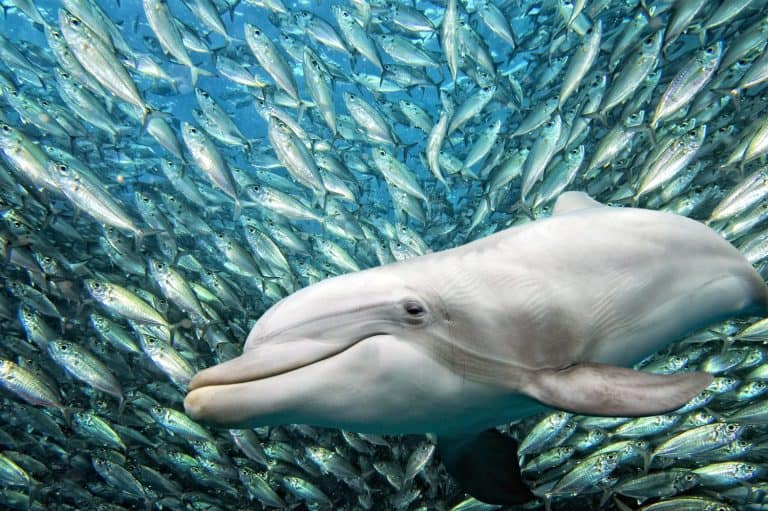
Bottlenose dolphins communicate with each other using unique whistles and clicks.
©Tory Kallman/Shutterstock.com
The Cerebral Cortex
The cerebral cortex controls higher-level thinking, motor functions, and other forms of information processing. Both human and dolphin cerebral cortices have evolved complex structures to support different cognitive skills. Humans have a highly developed cerebral cortex with extensive folding and a large surface area. In humans, the cerebral cortex controls higher cognitive functions, voluntary physical movements, language comprehension and speech, and sensory processing.
Dolphin brains have a highly folded cerebral cortex with a large surface area relative to their brain size, but the exact percentage difference compared to humans is debated. A dolphin’s cerebral cortex is used for processing sound, echolocation, memory, reasoning, managing complex environments, and social cognition.

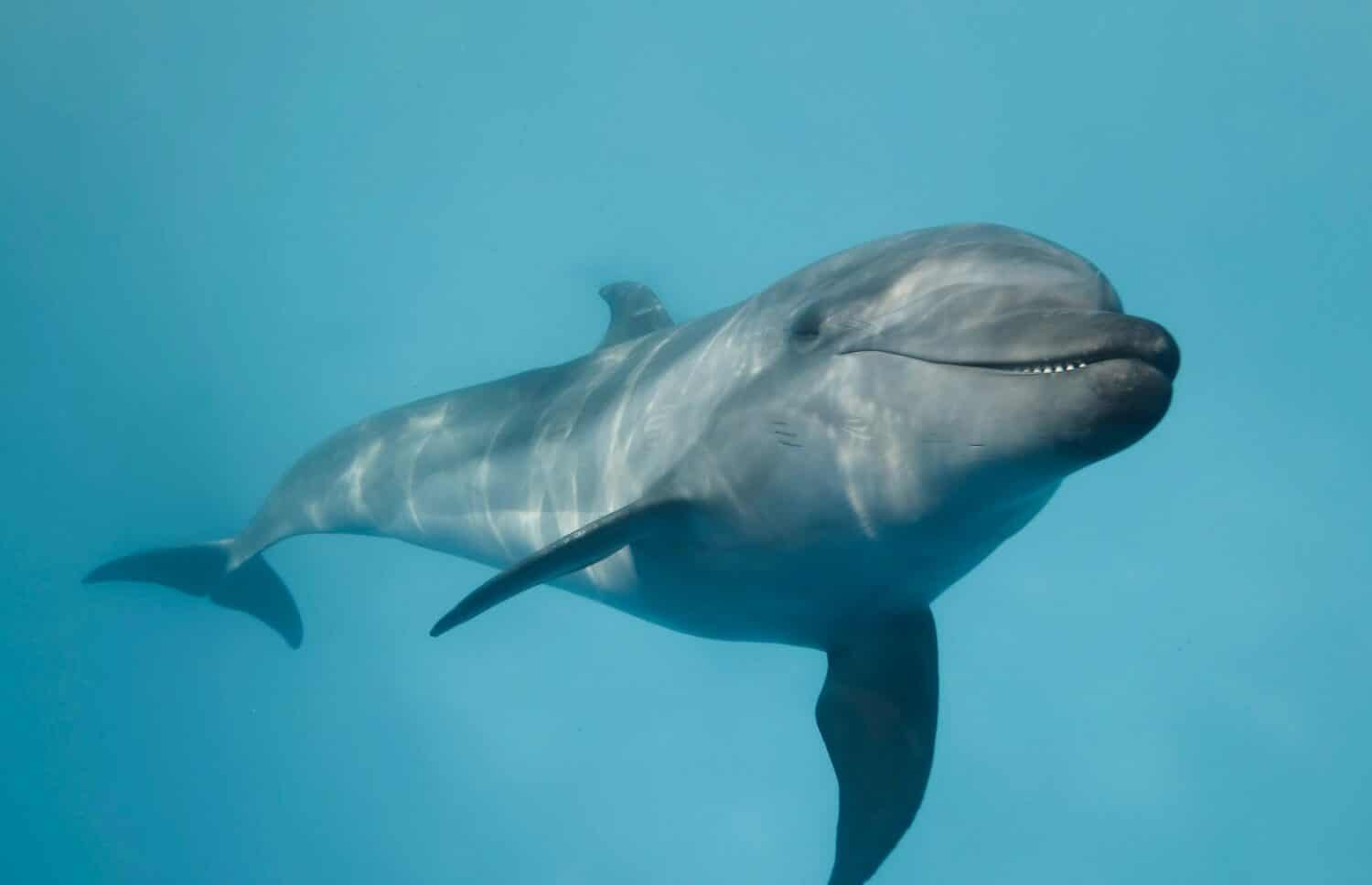
Dolphins have a large cerebral cortex relative to brain size.
©Lefteris Papaulakis/Shutterstock.com
Bottlenose dolphins use echolocation for navigation, hunting, and communication. They generate high-frequency clicks, which are projected by a structure in the forehead called the melon. These echoes bounce off objects in the water. The echoes are received through the lower jaw and transmitted to the inner ear. The dolphin’s brain interprets the transmissions into a 3-D picture of the environment, allowing it to determine size, shape, distance, and density. They also use clicks and other calls to communicate with other dolphins.