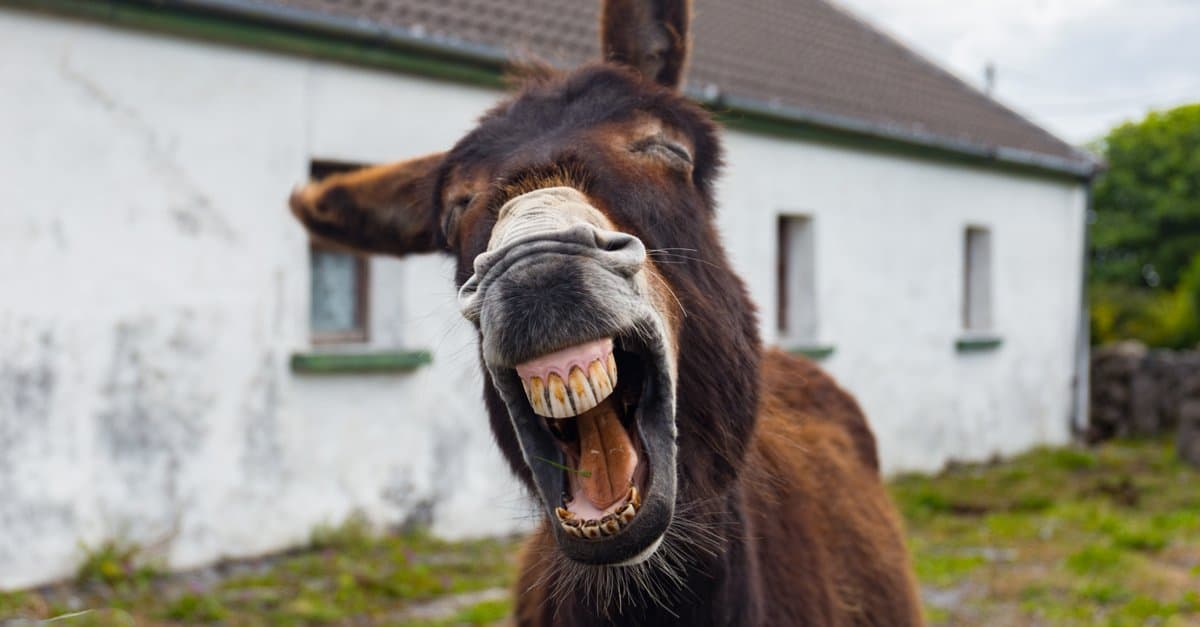

Donkeys are domesticated members of the Equidae family. They’re well known for their harsh braying noises and stubborn nature. They diverged from their wild cousin, the African wild ass, about 5,000 years ago in Egypt. Today, there are many varieties of donkeys used as pack animals, pets, and means of transportation all over the world. But no matter the size or purpose, these jacks (male donkeys) and jennies (female donkeys) all have the same type of teeth.
Here, we’ll learn more about the specific dental structure of donkeys and what kind of teeth they have. Then, we’ll take a look at some of the common dental problems donkeys run into, and what you should look out for if you own a donkey. Finally, we’ll explore how veterinary specialists treat dental ailments in these domestic asses.
Donkey Milk teeth
Most donkeys gestate for about a year (anywhere from 10-14 months). They almost always have only one foal, which is born toothless. The donkey’s first sustenance comes from its mother’s milk, but it only takes the foal a few weeks to start growing its first set of ‘baby’ teeth. Like horses, donkeys have 24 milk teeth, which begin erupting within the first couple of weeks of their life. As they grow, these teeth are eventually replaced, one by one, by their permanent dentition.
How Many Teeth Do Donkeys Have?
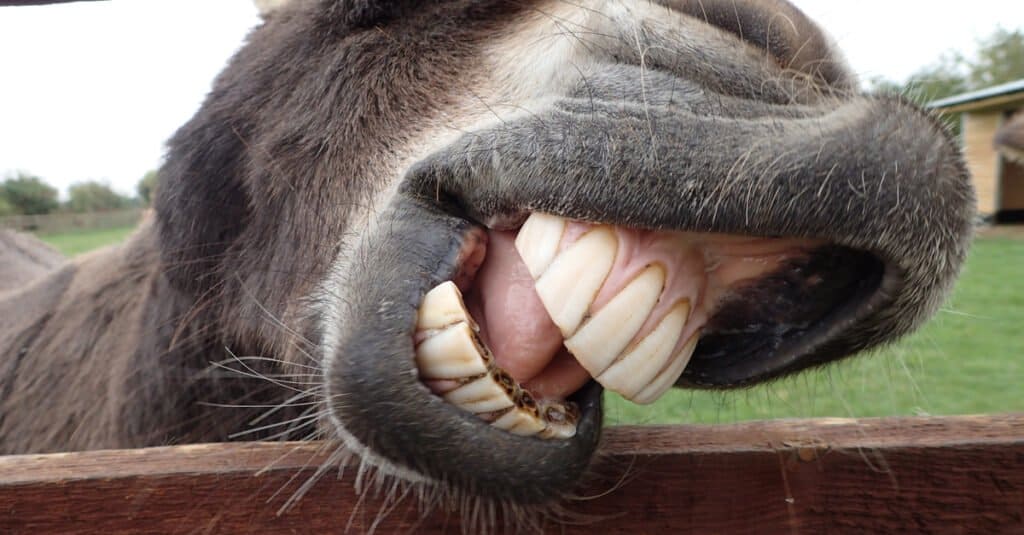
Donkeys have 40 teeth: 12 incisors, 4 canines, 12 premolars, and 12 molars.
©alan payne/Shutterstock.com
By the time they’re five years old, donkeys have all of their adult teeth, though they don’t start replacing the baby teeth until they’re about 2.5 years old. Adult donkeys have 40 teeth: 12 incisors, four canines, 12 premolars (up to 16 if wolf teeth are present), and 12 molars. Their adult teeth continually erupt throughout their lives as the surface is worn away by the action of chewing and grinding food.
Incisors
The first teeth in the donkey’s mouth, and the most visible, are the incisors. Donkeys have 12 total incisors: six on the top and six on the bottom. They’re used primarily to pull vegetation from shrubs, trees, and branches. Then, they chop this food up into smaller pieces before the tongue pulls it back into the mouth for additional chewing.
Canines
Canine teeth are located just behind the incisors, and there’s typically one in each quadrant of the jaw. Functionally, canine teeth don’t do much. However, not all donkeys have canine teeth as they’re found in males, but not in all females. That’s not to say that females can’t have canine teeth, but if they are present, then they are usually smaller than those in a male donkey. A large gap called a diastema separates the canines from the next teeth in the donkey’s jaw, the premolars.
Premolars and Molars
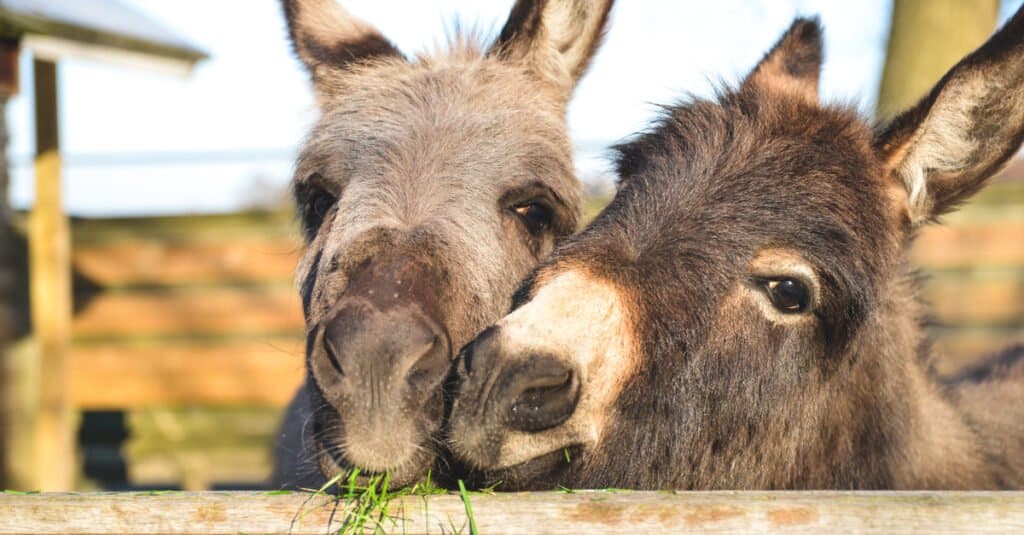
The molars and premolars are known as “cheek teeth”.
©babeaudufraing/Shutterstock.com
Donkeys normally have 24 total cheek teeth: 12 premolars and 12 molars. However, some donkeys (more males than females) are born with extra premolars called ‘wolf teeth’. These wolf teeth are small and are located in front of the normal first premolar. They can sometimes cause issues, such as cuts to the tongue or cheeks, and are often extracted at a young age.
The rest of the donkey’s cheek teeth are used for chewing and masticating the tough foods (like hay and grass) that donkeys thrive on. Their high crowns and irregular ridges grind against each other and make short work of anything the donkey decides to chew on.
Ageing a Donkey
It’s possible to determine the age of a donkey by looking at their incisors. For a start, if they have some adult teeth, but not all of them, then seeing which adult teeth have erupted will give an age range. This is because the central incisors erupt between the ages of three and 3.5 years, the middle incisors at four years, and the corner incisors at five to 5.5 years.
You can also age donkeys by their teeth once they have all of their adult incisors, this time by looking at the flat (table) surface of the teeth. This part of the teeth has distinctive markings on them, which are called “cups” and “stars”. Cups are brown indentations in the surface of the tooth, which are worn away as the donkey ages and have usually disappeared entirely by the time the donkey is 11 years old.
The stars appear in donkeys earlier than they do in horses, often appearing at around five years old and initially appearing as a dark-colored line. However, as the donkey ages and more of the tooth surface is worn away, more of this mark is exposed, meaning that it gradually becomes a large, round spot. Dental stars appear first on the central incisors (3.5 to four years), and then appear on the middle incisors (four to 4.5 years) and third incisors (5.5 to seven years). It’s also important to note that the shape of the incisors changes as the donkey ages. In a young donkey, the teeth appear uniform and straight, but as it ages, the teeth slope and become more angled when viewed from the side.
Why Do Donkeys Smile?
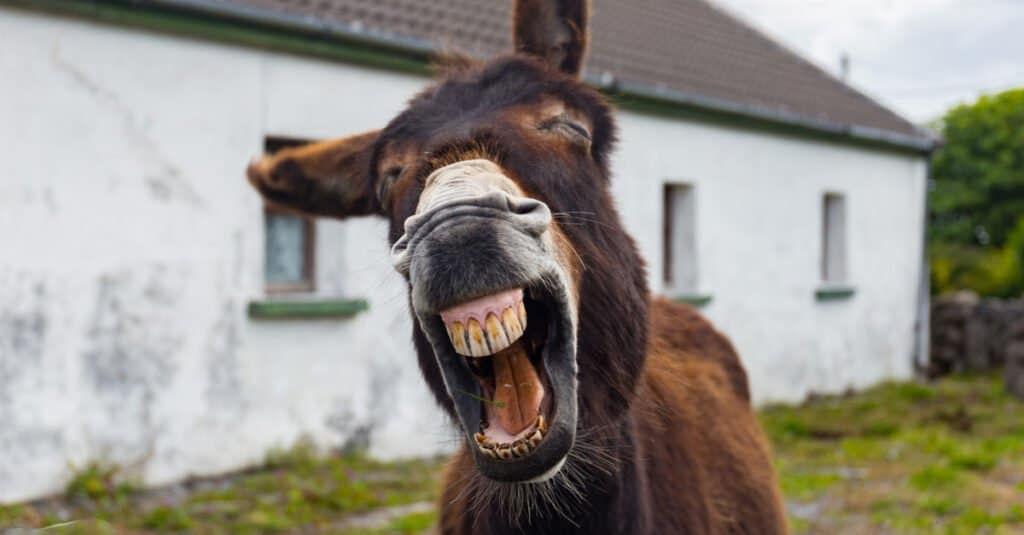
Donkeys smile when they smell something interesting to get the smell straight to their olfactory organs
©ElDuderino/Shutterstock.com
If you’ve ever been around a donkey, you know that they’re prone to pulling their upper lip up and displaying their teeth in an expression that looks similar to a human smile. Donkeys, however, aren’t doing it because they’re happy or excited; they’re doing it to better smell something interesting. Donkeys smile because of something called a Flehmen Response — a behavior they exhibit when they catch wind of something interesting. Lifting their upper lip helps them deliver the smell directly to their smelling organs.
Dental Problems
Dental ailments are some of the most common medical issues in donkeys. They may break or even lose teeth in the course of their life. Donkeys are stoic, and often won’t show any sign of something being wrong. Owners should watch out for weight loss, difficulty chewing, excessive drooling or nasal discharge, and bad breath. Any one of these signs could be an indication that your donkey is having a bad tooth day.
One additional problem donkeys may encounter with their cheek teeth is overgrowth. This happens when either the donkey is missing a tooth or the teeth aren’t occluding against each other properly. Overgrown teeth can develop high, sharp ridges that may cut the tongue or cheek and interfere with eating. When this happens, the teeth need to be rasped by a vet or an equine dental technician to remove the sharp edges. It’s advised that you have your donkey’s teeth examined by a veterinarian at least once a year, and more frequently (such as every six months) for older donkeys or those with known dental issues, to determine if rasping or other dental care is needed.