Quick Take
- Bala sharks aren't actually sharks, and that case of mistaken identity shapes everything about choosing the right tank mates.
- One popular fish on this list is technically territorial and aggressive, yet it somehow earns a spot as a compatible bala shark companion. Meet the territorial exception →
- Picking the wrong tank mate won't just cause conflict. It could stunt your bala shark's growth and cut its lifespan short. See ideal size-matched companions →
- One fish on this list navigates its tank using electric fields, and that unusual trait turns out to make it a surprisingly low-drama neighbor for bala sharks. Explore the electric-field navigator →
Bala sharks ( Balantiocheilos melanopterus) originate from tropical Southeast Asian waters, where they inhabit rivers and lakes. Despite their name, they aren’t true sharks; they’re minnows. Bala sharks have a reputation for being easily stressed and are sensitive to sudden changes in their environment. Their large size and specific water conditions make them challenging to keep. For these reasons, they suit more experienced fish keepers.
Bala sharks typically reach an average size of 12 to 14 inches, requiring a spacious environment. Keeping bala sharks in small tanks will severely stunt their growth and shorten their lifespan. Because they are active, fast-swimming schooling fish that must be kept in groups, they require a massive aquarium that is between six and seven feet long and holds a minimum of 125 to 150+ gallons.
Because they tend to be anxious, it’s best to house bala sharks with peaceful tank mates. Continue reading to learn about nine fish that pair well with bala sharks.

Only consider adding tank mates once the bala shark’s care requirements are met.
©Arunee Rodloy/Shutterstock.com
Black Ghost Knifefish
The black ghost knifefish (Apteronotus albifrons) is a unique-looking aquarium fish that resembles an eel. Their bodies are black with a white blaze on the nose and two white bands around their tail. They lack dorsal and caudal fins and instead have an elongated anal fin and a pair of pectoral fins.
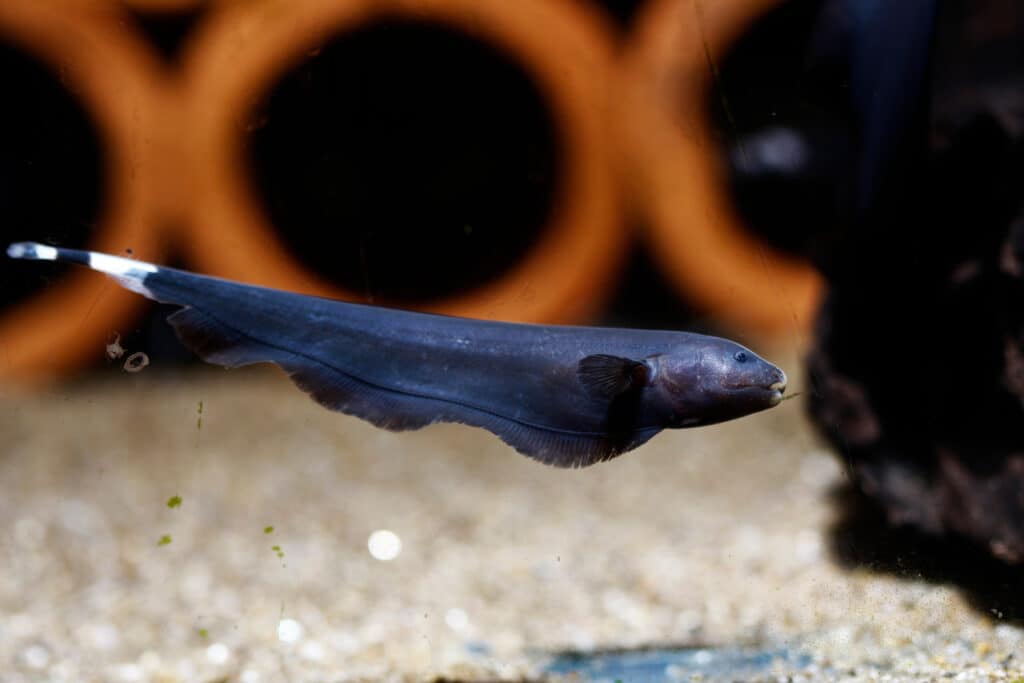
Black ghost knifefish produce electric fields to help them navigate their environment.
©Pavaphon Supanantananont/Shutterstock.com
Black ghost knifefish typically grow up to 20 inches long and require a spacious aquarium of at least 100 gallons in size. When kept with bala sharks, the tank must be well over 150 gallons and fully cycled.
Their natural habitat consists of sandy, slow-moving waters such as tributaries and creeks, which should be replicated in the aquarium. They are highly sensitive to poor water quality, which can make them ill. They are highly sensitive to poor water quality, which can make them ill, so pristine water conditions are crucial for their health.
Black ghost knifefish are nocturnal, so they will be more active at night. They usually keep to themselves in an aquarium and won’t interact with bala sharks much unless they feel disturbed.
Clown Loaches
The striped and red-finned clown loach (Chromobotia macracanthus) is a large bottom-dwelling fish from Southeast Asia. Clown loaches can grow up to around 12 inches long, though in captivity they typically reach 8–12 inches, with 12 inches being a maximum rarely achieved in home aquaria. These peaceful shoaling fish need to be kept in groups of five or more.

Clown loaches have banded bodies with red fins, making it seem like they are wearing clown suits.
©Joan Carles Juarez/Shutterstock.com
Keeping clown loaches in same-species groups allows them to be more active and feel safer in aquariums. Like bala sharks, clown loaches require good water quality to be healthy and happy. Poor water quality may make them more susceptible to disease, which can prove fatal to these sensitive fish.
Tiger Barbs
The active and social tiger barb (Puntigrus tetrazona) is a schooling fish that grows 2 to 3 inches long. Tiger barbs have yellowish-orange bodies with four vertical black stripes and bright orange fins. Other variants of tiger barbs include the albino and green tiger barbs, which have varying appearances.

Tiger barbs are small tank mates that pair well with bala sharks. They grow 3 inches long.
©André Karwath aka Aka, CC BY-SA 2.5, via Wikimedia Commons – Original / License
Fully grown tiger barbs can live with bala sharks, as they are usually too large for bala sharks to eat. Tiger barbs should be kept in groups of six or more because they are highly social. A heater and a good filtration system are important for tiger barbs because they need tropical conditions and good water quality to thrive.
Gold Nugget Plecostomus
Gold nugget plecos (Baryancistrus xanthellus) are bottom-dwelling fish. These suckermouth catfish originate from South American waters in Brazil, specifically the Xingu and Iriri rivers. Gold nugget plecos are one of the more colorful and easily distinguishable species of plecostomus.

The popular gold nugget pleco has striking yellow markings, making it stand out in aquariums.
©Podolnaya Elena/Shutterstock.com
They have a predominantly black body with whitish-yellow spots and markings on their fins. These Plecostomus can grow up to 7–10 inches long, requiring a spacious tank over 75 gallons in size. Gold nugget plecos prefer a solitary lifestyle and do not need to be kept in groups. They rarely interact with bala sharks in the aquarium, as both swim at different water levels.
Tinfoil Barbs
The tinfoil barb (Barbonymus schwanenfeldii) is a species of freshwater fish native to Southeast Asia. They are one of the larger species of barbs at 10 to 12 inches long and have peaceful temperaments. Their preferred water conditions, temperature, and size are similar to those of bala sharks, making them compatible tank mates.

Tinfoil barbs can grow up to 12 inches long in captivity.
©ivSky/Shutterstock.com
Tinfoil barbs thrive in tropical temperatures with good water quality. Their tank should hold over 175 gallons when kept with bala sharks. Tinfoil barbs should be kept in groups of five or more to form a shoal. They are easily stressed alone and do not do well in pairs, even when kept alongside different fish species.
Blood Parrot Cichlid
The blood parrot cichlid (Amphilophus citrinellus × Vieja melanurus) is a hybridized fish created in Taiwan in 1986. Its distinctive yellowish-orange coloration makes it easily recognizable in aquariums. These fish grow to around eight inches long.

Blood parrot cichlids display fascinating behaviors, like nest building.
©Bk87/Shutterstock.com
Nest-building is one of the blood parrot cichlids’ favorite behaviors; they construct crater-like nests on sandy or gravel substrates. Blood parrots may swim up to the glass when you approach the aquarium in hopes of getting fed.
Bala sharks and blood parrot cichlids can coexist peacefully in the same aquarium if it is over 150 gallons in size. Although keeping them in groups is preferred, you do not need to keep blood parrot cichlids in groups.
Kissing Gourami

The kissing gourami is one of the most distinct species due to its protruding mouth.
©Evgenii Predybailo/Shutterstock.com
One of the most interesting gourami species is the kissing gourami (Helostoma temminckii). Kissing gouramis earn their name from their protruding mouths, which they use to lock against other kissing gouramis during ritualized fights.
Kissing gouramis have iridescent greenish-silver bodies. In captivity, kissing gouramis are typically around six inches long, though they can reach up to 12 inches in length. Their size is why they should only be kept in spacious aquariums with a good filtration system.
Although kissing gouramis can be territorial and aggressive, they usually get along with bala sharks.
Banded Severum Cichlid
Banded severum cichlids (Heros severus) are a peaceful cichlid species originating from South America. They grow to around eight inches long and have dark vertical bands across their bodies. These bands are most visible in juveniles and usually fade as the fish age.

Several species of severum cichlids range in color, but the H. severus is the most popular.
©Aleron Val/Shutterstock.com
Banded severum cichlids come in different colors, such as red-spotted, gold, silver, green, and maroon. Their exact coloration depends on their species, although the H. severus is the most common species in aquariums. They can liven up bala shark aquariums with a dash of color. You can keep banded severum cichlids in the same conditions as bala sharks, as both species need a large tank, filter, and heater.