L
Species Profile

Leopard Shark

Triakis semifasciata

Spots of the surf zone
David A Litman/Shutterstock.com

Leopard Shark Distribution

Click a location to explore more animals from that region

Endemic Species

This map shows coastal regions where Leopard Shark are found.

Loading map...
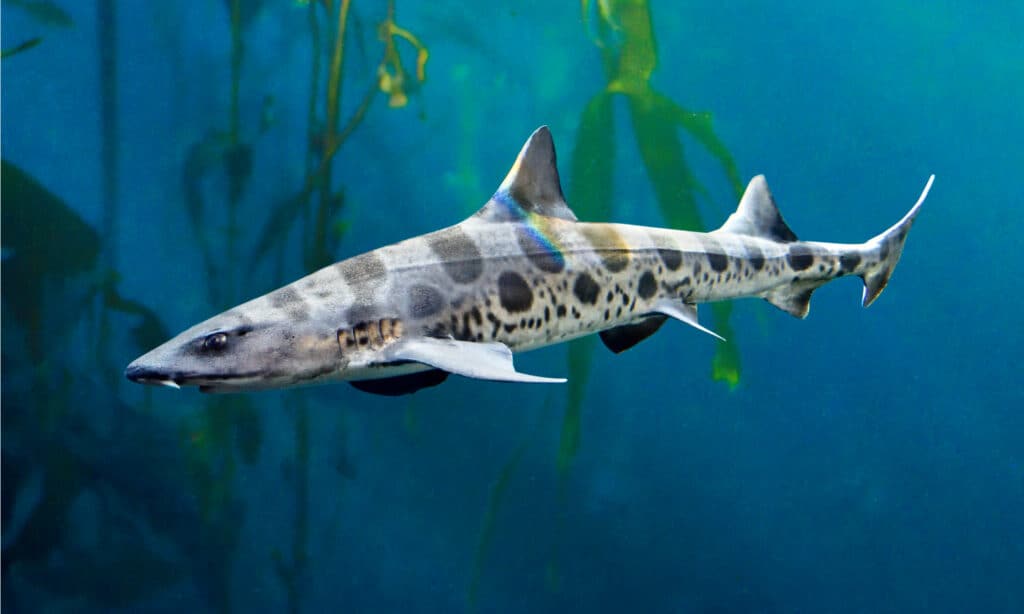
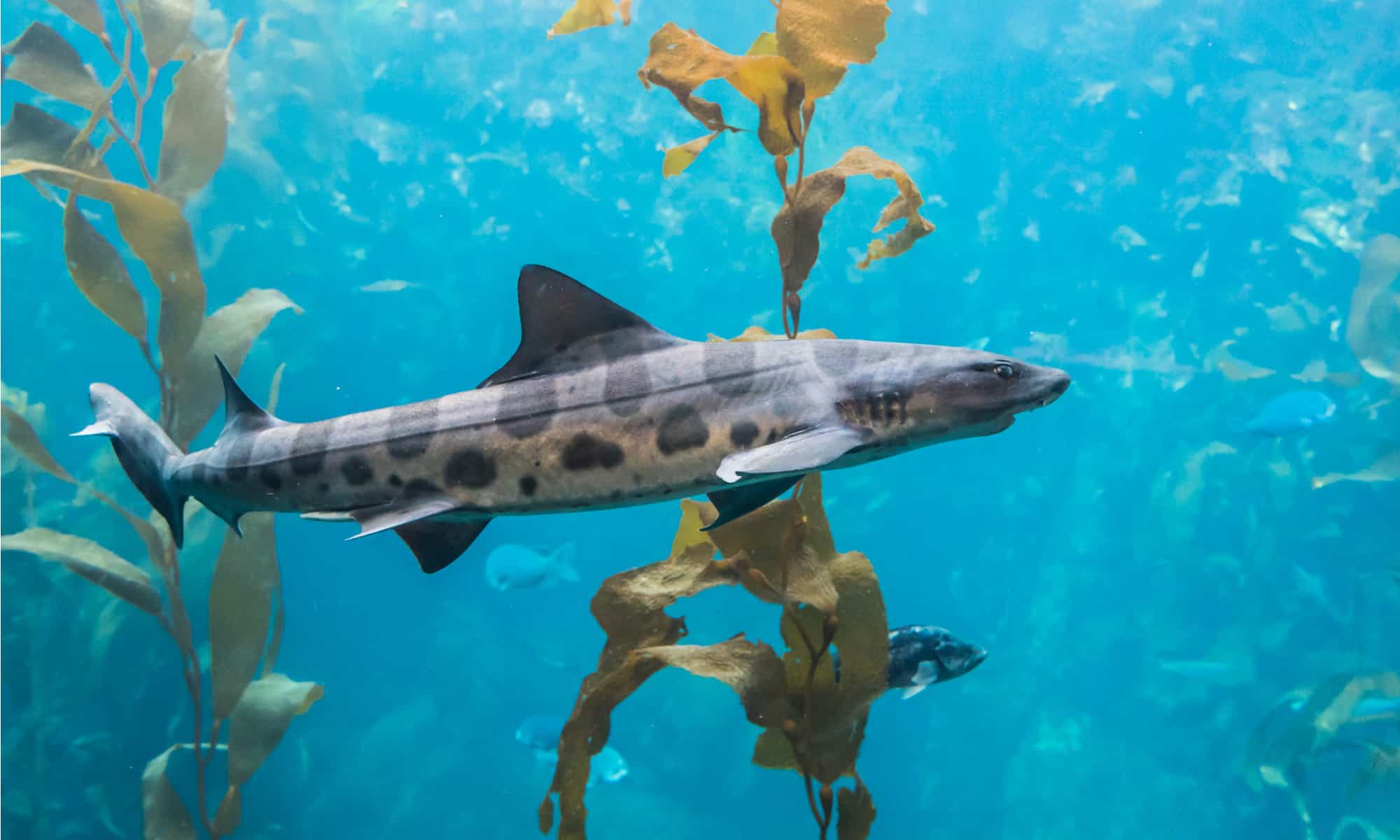
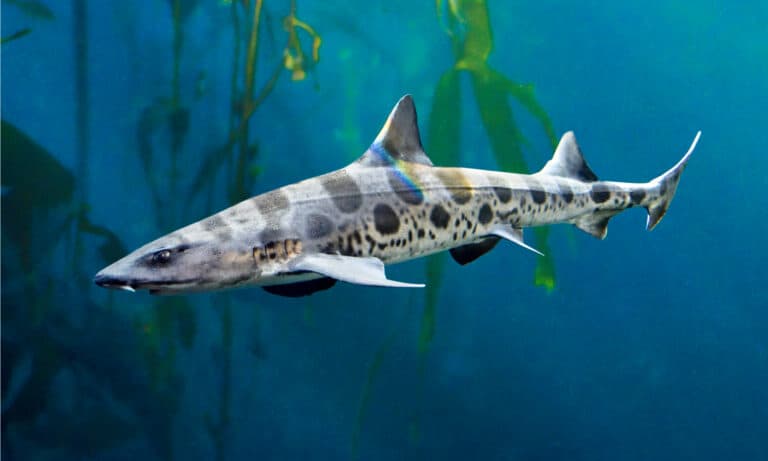
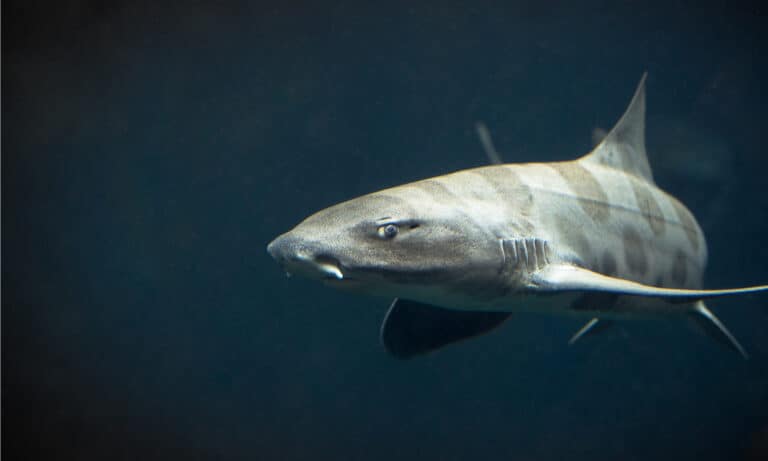
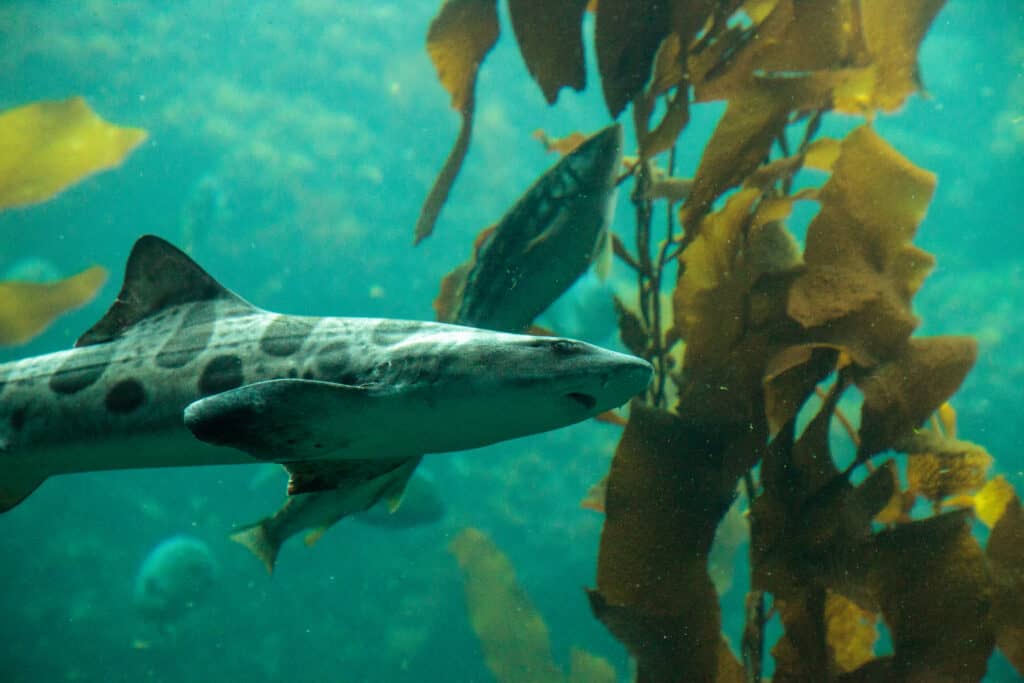
A leopard shark (Triakis semifasciata) swims in a kelp bed along the Pacific Coast of California.

At a Glance

Wild Species
Also Known As Tiburón leopardo, Requin léopard, Tubarão-leopardo, Leopardenhai, Squalo leopardo
Diet Carnivore
Activity Cathemeral+
Lifespan 20 years
Weight 18.4 lbs
Status Least Concern
Did You Know?

Maximum reported total length about 2.0 m; most adults are about 1.2-1.5 m.

Scientific Classification

The leopard shark (Triakis semifasciata) is a medium-sized requiem-like houndshark known for its dark saddle-like blotches and spots. It is a common coastal species in the northeastern Pacific and is generally not considered dangerous to humans.

Kingdom
Animalia
Phylum
Chordata
Class
Chondrichthyes
Order
Carcharhiniformes
Family
Triakidae
Genus
Triakis
Species
semifasciata

Distinguishing Features

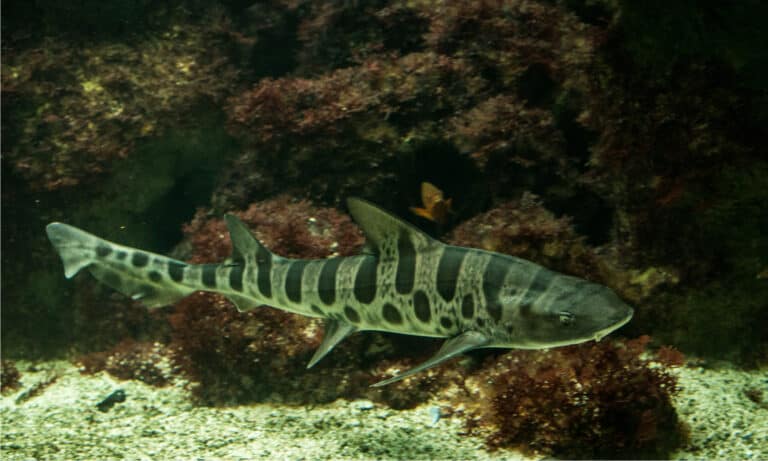
  • Distinctive leopard-like pattern: dark saddles/blotches with spots on a gray to bronze body
  • Slender body with a relatively long tail typical of houndsharks (Triakidae)
  • Nearshore, bay and estuary affinity; frequently seen in shallow water
  • Commonly confused in name with the Indo-Pacific zebra shark in older literature

Did You Know?

Maximum reported total length about 2.0 m; most adults are about 1.2-1.5 m.

Lifespan is commonly reported up to ~30 years for this species.

Reproduction is aplacental viviparous (often called ovoviviparous): embryos develop inside the mother without a placenta; gestation ~10-12 months.

Typical litter size is commonly reported in the range ~4-37 pups; newborns are about ~20 cm long.

Often forms seasonal schools in shallow bays/estuaries (especially in California) and can show strong site fidelity to the same areas year to year.

Despite the name, it's not closely related to "requiem sharks" (family Carcharhinidae); it's a houndshark in the family Triakidae.

Unique Adaptations

  • Disruptive "leopard" patterning: dark saddles and spots break up the body outline over dappled sand/eelgrass-good camouflage in shallow coastal habitats.
  • Carcharhiniform toolkit: has nictitating eye membranes (a protective eyelid) typical of the order, useful during feeding and when prey struggles.
  • Electroreception: like other sharks, uses ampullae of Lorenzini to detect tiny electric fields from buried prey in sand or mud.
  • Houndshark body plan (Triakidae traits): streamlined near-bottom cruiser with two dorsal fins (no spines) and an anal fin-built for steady swimming over coastal shelves.
  • Salinity tolerance for coastal life: frequently enters estuaries and bays where salinity can fluctuate, allowing it to exploit rich invertebrate prey zones.

Interesting Behaviors

  • Nearshore schooling: groups may cruise slowly over sand/mud flats, especially in calm, shallow embayments and estuaries.
  • Tide- and time-linked movements: commonly uses very shallow water and can shift with tides and day/night cycles to forage and reduce risk.
  • Benthic foraging: hunts along the bottom for crabs, shrimp, clams and small fishes; often uses suction-like strikes to pull prey from sand or eelgrass.
  • Seasonal habitat use: regularly uses protected bays (e.g., along California) as important feeding and nursery areas, then ranges more widely along open coast.
  • Generally non-aggressive toward people: interactions with swimmers/divers are typically benign; bites are uncommon and usually involve provocation/handling (e.g., anglers).

Cultural Significance

Leopard shark (Triakis semifasciata), common along the U.S. West Coast, especially California, is often seen by anglers, tidepool watchers, and in aquariums. A nearshore predator in bays and surf, its bold pattern makes it a symbol in California education, showing small houndsharks differ from big ocean sharks.

Myths & Legends

Name-origin tradition: early naturalists and fishers popularized "leopard shark" as a descriptive common name for Triakis semifasciata because its saddle-like blotches and spots resemble a leopard's coat; the name persists in California coastal culture.

In many Polynesian traditions, sharks are seen as protective ancestor spirits or mighty sea beings. These stories are not about leopard sharks specifically but shape how Pacific coastal people respect shore sharks.

Along California coasts, Indigenous and fishing communities have long seen sharks as powerful sea animals. Today, leopard sharks (Triakis semifasciata) are called spotted bay sharks of calm shallows, symbols of living estuaries.

Conservation Status

LC Least Concern

Widespread and abundant in the wild.

Population Stable

Protected Under

  • United States (California): Fishery management regulations for sharks (including recreational take limits and gear rules; specifics vary by year/region)
  • United States (California): Network of Marine Protected Areas that restrict take in designated zones (coverage varies by site)
  • Mexico: Coastal shark fisheries are subject to national fishery regulations and management measures (regionally variable)

Life Cycle

Birth 24 pups
Lifespan 20 years

Lifespan

In the Wild
10–30 years
In Captivity
8–25 years

Reproduction

Mating System Polygynandry
Social Structure Aggregation Group
Breeding Pattern Seasonal
Fertilization Internal Fertilization
Birth Type Internal_fertilization

Leopard sharks form seasonal inshore aggregations; mating occurs in spring-summer with internal fertilization (males use claspers and often bite fins during copulation). Females carry embryos ~10-12 months and deliver ~4-33 pups in shallow nurseries; no parental care or pair bonds.

Behavior & Ecology

Social School Group: 30
Activity Cathemeral, Crepuscular, Nocturnal
Diet Carnivore Benthic crustaceans-especially crabs and shrimp (ghost shrimp Neotrypaea californiensis is repeatedly documented as a common estuarine prey item).

Temperament

Generally non-aggressive toward humans; bites are rare and typically defensive when handled.
Socially tolerant in dense aggregations; low overt aggression and little evident dominance display.
HUBS (Triakidae/houndsharks): flexible-solitary benthic foraging but seasonal schooling/aggregation varies by locality and temperature (e.g., southern California vs. cooler northern sites; Carlisle & Starr 2009; Nosal et al. 2014).

Communication

Olfaction for prey and conspecific cues; follows odor plumes and chemical gradients.
Mechanosensory detection via lateral line to track nearby swimming and schooling alignment.
Electroreception (ampullae of Lorenzini) to localize buried prey at close range.
Vision supports short-range orientation in clear water; likely less important in turbid bays.
Tactile/body contact and subtle body postures in dense schools; spacing maintained without vocal signals.
Seasonal site fidelity and aggregation likely mediated by temperature and social/chemical cues Carlisle & Starr 2009; Nosal et al. 2014

Habitat

Coastal Estuary Kelp Forest Seabed/Benthic Rocky Shore
Biomes:
Terrain:
Coastal Island Sandy Muddy Rocky
Elevation: Up to 298 ft 7 in

Ecological Role

Coastal benthic mesopredator (inshore sandflat/estuary predator) linking benthic invertebrate production to higher trophic levels.

Regulates populations of benthic crustaceans and other invertebrates (top-down control on sandflat/estuary prey communities) Couples energy flow between estuarine/benthic habitats and nearshore food webs through seasonal movements and feeding Provides prey for larger sharks and marine mammals, supporting higher trophic levels Can influence bioturbation dynamics indirectly by consuming key burrowing invertebrates (e.g., ghost shrimp)

Diet Details

Main Prey:
Benthic crustaceans Benthic polychaete worms Bivalve mollusks Cephalopods Small benthic and demersal fishes Fish eggs

Human Interaction

Domestication Status

Wild

The leopard shark (Triakis semifasciata) is wild with no domestication history. It is kept in public aquaria but not bred for pets or production. Adults commonly reach 1.2–1.5 m (max ~2.1 m). They grow slowly, mature late, are aplacental viviparous (gestation 10–12 months), litters 4–30+, pups ~20 cm, lifespan ~30 years. Sources: FishBase, Ebert (2003), FAO/Compagno.

Danger Level

Low
  • Rare defensive bites if handled, hooked, or stepped on in very shallow water
  • Minor lacerations from teeth during capture/handling
  • Standard marine hazards during interactions (hooks/lines, tail strikes in confined handling, bacterial infection from wounds)

As a Pet

Not Suitable as Pet

Legality: Leopard Shark (Triakis semifasciata) is not a typical pet. Laws often limit private keeping and wild collection. Many places ban or tightly control taking or moving live native sharks without permits; aquaria use permits or approved transfers.

Care Level: Expert Only

Purchase Cost: Up to $2,000
Lifetime Cost: $50,000 - $250,000

Economic Value

Uses:
Commercial and artisanal fisheries (food fish) Recreational fisheries (sport catch, often nearshore) Public aquarium display/education Scientific research (nearshore ecology, movement, reproduction) Ecotourism/wildlife viewing (kelp/embayment shark aggregations) HUBS (Triakidae/houndsharks): generally low-risk coastal sharks; several species are taken in mixed coastal fisheries and used for food; some are displayed in aquaria; interactions include bycatch, localized recreational targeting, and research due to accessible nearshore habitats.
Products:
  • Meat (sold fresh or processed; often marketed generically as shark/flake depending on region)
  • Bycatch landings in mixed coastal fisheries
  • Non-consumptive value via aquarium exhibition and education

Relationships

Predators 4

White shark
White shark Carcharodon carcharias
Broadnose sevengill shark Notorynchus cepedianus
Shortfin mako
Shortfin mako Isurus oxyrinchus
Northern elephant seal Mirounga angustirostris

Related Species 6

Sharptooth houndshark Triakis megalopterus Shared Genus
Banded houndshark Triakis scyllium Shared Genus
Spotted houndshark Triakis maculata Shared Genus
Brown smoothhound Mustelus henlei Shared Family
Gray smoothhound Mustelus californicus Shared Family
Soupfin shark Galeorhinus galeus Shared Family

Ecological Equivalents 6

Animals that fill a similar ecological role in their ecosystem

Brown smoothhound Mustelus henlei Overlaps with leopard sharks in the California Current as common coastal bottom-dwelling sharks on sandy flats and in bays and estuaries, feeding on crabs, shrimp, and small fish. Leopard sharks reach about 1.8 m, can live around 30 years, and form seasonal inshore groups.
Soupfin shark Galeorhinus galeus Also known as tope. Shares temperate northeastern Pacific shelf and coastal waters and can co-occur in nearshore zones; both are mid-to-upper trophic mesopredators. Soupfin sharks tend to be more pelagic and roving, while leopard sharks are more demersal and bay-associated, but both influence similar coastal food webs.
California bat ray Myliobatis californica Uses the same shallow, soft-bottom habitats (bays, sandy flats) and forages on similar benthic invertebrates (bivalves, crabs). Bat rays are durophagous specialists, while leopard sharks are more generalist benthic predators, but both occupy overlapping benthic invertebrate predator roles.
Broadnose sevengill shark Notorynchus cepedianus Co-occurs in estuaries and bays on the US West Coast and occupies a higher trophic level. Sevengills are major nearshore apex/upper-mesopredators and can prey on smaller sharks, including leopard sharks, thereby linking the same coastal embayment food webs.
Pacific angel shark Squatina californica Shares a demersal nearshore habitat (sandy bottoms, often shallow) and an ambush-foraging lifestyle centered on the seafloor. Both interact with similar prey fields (small fishes and benthic invertebrates), though angel sharks are more specialized ambush piscivores.
Zebra shark
Zebra shark Stegostoma fasciatum Ecological analogue (not geographic): both are benthic/coastal sharks that often forage on bottom-dwelling invertebrates and small fishes. They occupy a similar patterned, demersal, shallow-water forager niche, though zebra sharks occur in the tropical Indo-Pacific and can reach much larger sizes.

Graceful and strikingly patterned, the leopard shark (Triakis semifasciata) is one of the most recognizable coastal sharks of the Pacific Ocean. Despite their fierce appearance, these harmless sharks are gentle and slow-moving. Found along the western coast of North America from Oregon to Mexico, these sleek, medium-sized predators are often spotted by beachgoers and snorkelers. Prized by aquariums for their distinctive pattern of black saddles and spots, leopard sharks play an important role in their ecosystems.

This post was updated on October 28, 2025 to clarify adult diet and shark predators.

Leopard shark

Leopard sharks can live up to 30 years.

Appearance

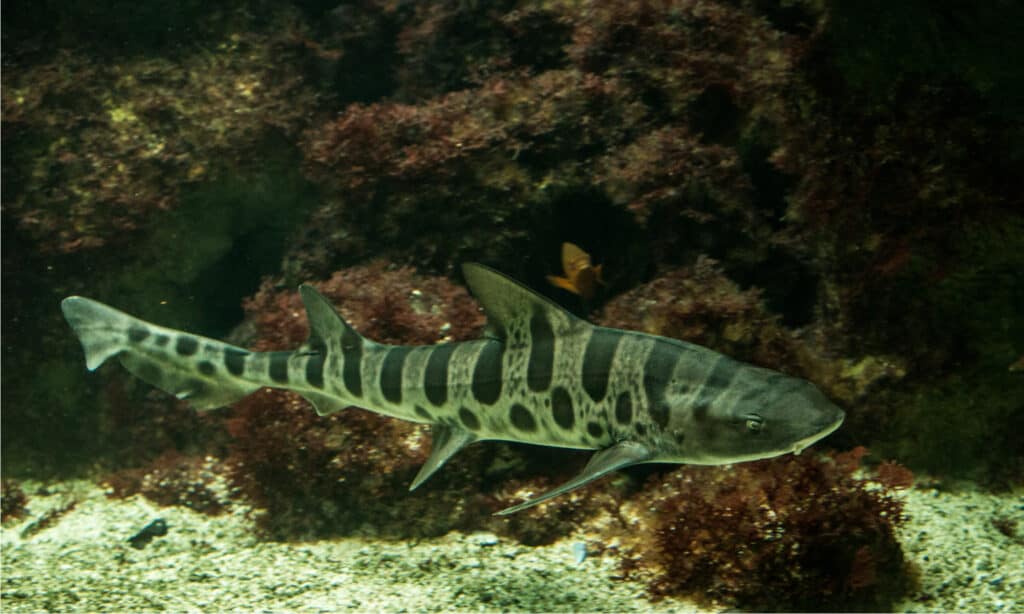
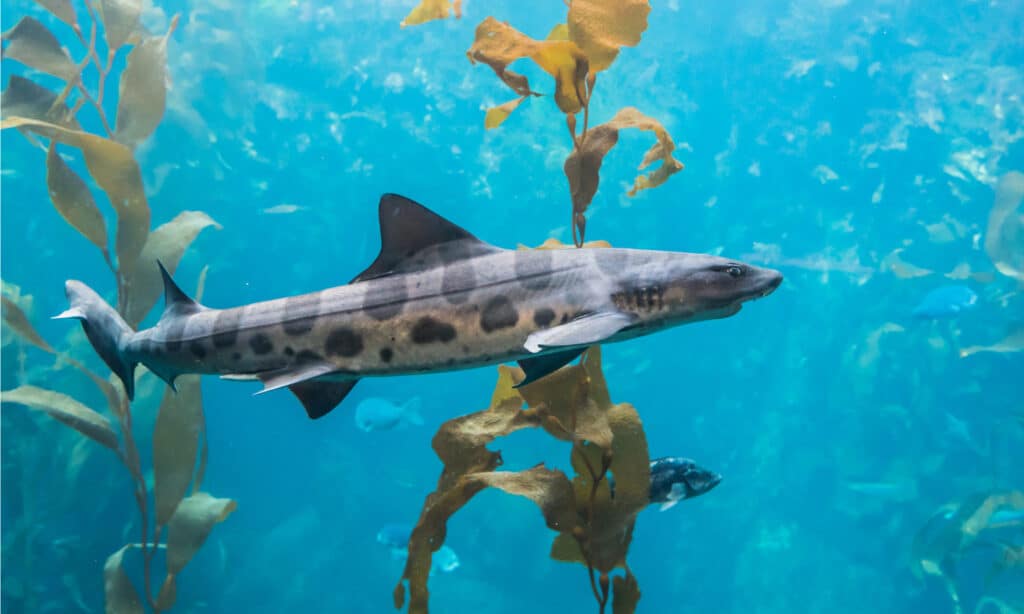
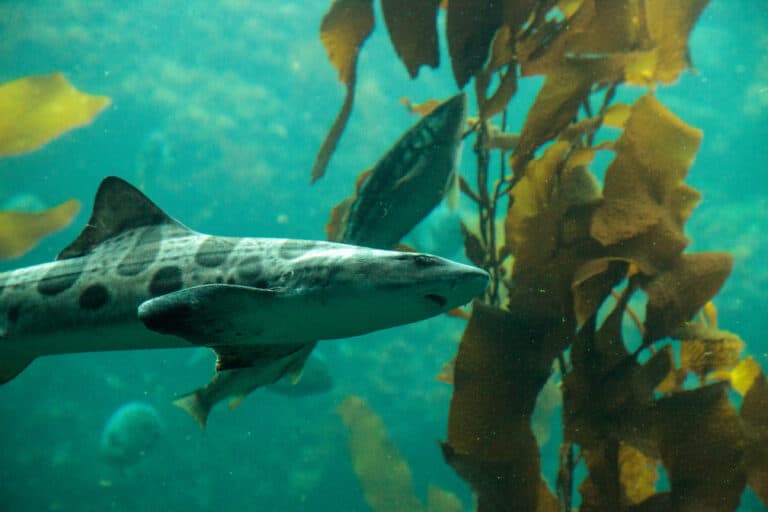
The most recognizable feature of the leopard shark is the banded pattern on its back. These sharks have white underbellies, gray bodies, and black or dark brown bands, with lighter-colored markings in the center. Dark circular spots dot their backs in between the bands. They have translucent eyelids, called nictitating membranes, that protect their eyes while allowing vision

Leopard sharks weigh 20 pounds on average and measure between 4 and 5 feet long, and they have short, compact bodies. Females are larger than males, often by up to a foot in length. The largest leopard shark on record weighed just over 40 pounds.

Leopard sharks have two dorsal fins that are about the same size and one anal fin that is much smaller. These fins help them move through the water. Leopard sharks swim near the ocean floor to easily find food. They have three-pointed teeth, which have a smooth-edge pointed cusp in the center and two smaller cusps on each side.

Leopard sharks have three-pointed teeth.

Distribution and Habitat

Leopard sharks live off the West Coast of the United States and Mexico in the Pacific Ocean. They like to explore inlets, making them easy to spot and study. They like to swim near the ocean floor, where they find their food. Many fish have air sacs to maintain buoyancy, which means that they float when they are not swimming. Leopard sharks do not have air sacs, though, so they sink when they aren’t swimming.

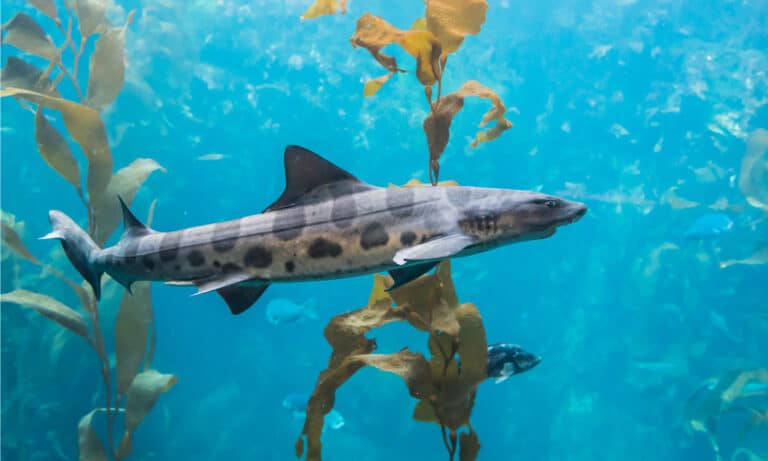
Leopard Shark swimming in kelp bed

Leopard sharks live in the Pacific Ocean and can be found off the coasts of Mexico and the western United States.

Predators and Prey

Leopard sharks’ mouths open downward, bringing up food from the ocean floor. They suck up crabs, clams, shrimp, and fish eggs like a vacuum. Adult diet includes small fish (anchovies, surfperch, midshipmen), crustaceans, and clam siphons.

Larger sharks (especially sevengill and white sharks) and marine mammals may prey on them. However, their risk for survival comes from their dwindling habitat. They are also occasionally caught for their fins or by large-scale fishing operations.

Reproduction and Lifespan
Leopard shark, Triakis semifasciata, is a species of carpet shark and is found throughout the tropical Indo-Pacific.

A mother leopard shark gives birth to an average of 20 live young. Her babies are called pups.

Leopard sharks give birth to live babies, called pups. The eggs hatch inside the mother, and she gives birth to an average of 20 pups at a time. They are around 8 or 9 inches long when they’re born.

It takes around 10 years for a female leopard shark to reach breeding age. Researchers take special interest in pregnant female leopard sharks and their habits to help with conservation efforts.

The Leopard shark is an active fish that swims with an undulating motion.

The average size of a leopard shark is 4-5 feet long and weighs around 20 pounds.

Population

Leopard sharks are listed as least concern by the IUCN. They have protected waters to live in and are not hunted regularly by humans. They are occasionally caught and eaten, but they contain high levels of mercury due to their long lifespans, making them less than ideal for human consumption.

View all 130 animals that start with L

Sources

  1. San Diego Zoo / Accessed June 17, 2022
  2. UCSD / Accessed June 17, 2022
  3. Monterey Bay Aquarium / Accessed June 17, 2022
Abby Parks

About the Author

Abby Parks

Abby Parks has authored a fiction novel, theatrical plays, short stories, poems, and song lyrics. She's recorded two albums of her original songs, and is a multi-instrumentalist. She has managed a website for folk music and written articles on singer-songwriters, folk bands, and other things music-oriented. She's also a radio DJ for a folk music show. As well as having been a pet parent to rabbits, birds, dogs, and cats, Abby loves seeking sightings of animals in the wild and has witnessed some more exotic ones such as Puffins in the Farne Islands, Southern Pudu on the island of Chiloe (Chile), Penguins in the wild, and countless wild animals in the Rocky Mountains (Big Horn Sheep, Mountain Goats, Moose, Elk, Marmots, Beavers).
Connect:

Thank you for reading! Have some feedback for us?


Leopard Shark FAQs (Frequently Asked Questions)

While you can eat Leopard Shark, you should do so sparingly due to the high mercury content in the fish.