Quick Take
- One Massachusetts hawk breeds so far north that it makes all other soaring hawks look cold-sensitive by comparison. Can you guess which one? Meet the Arctic breeder →
- Not all hawks hunt the same way. One species skips vision entirely and tracks prey using sound alone. See the sound-hunting hawk →
- The shyest, most secretive hawk in Massachusetts transforms into something terrifyingly aggressive under one specific condition. Discover the aggressive defender →
- One of these hawks is regularly hunted by another hawk on this very list, and predator and prey share the same Massachusetts skies. Learn about the hunted hawk →
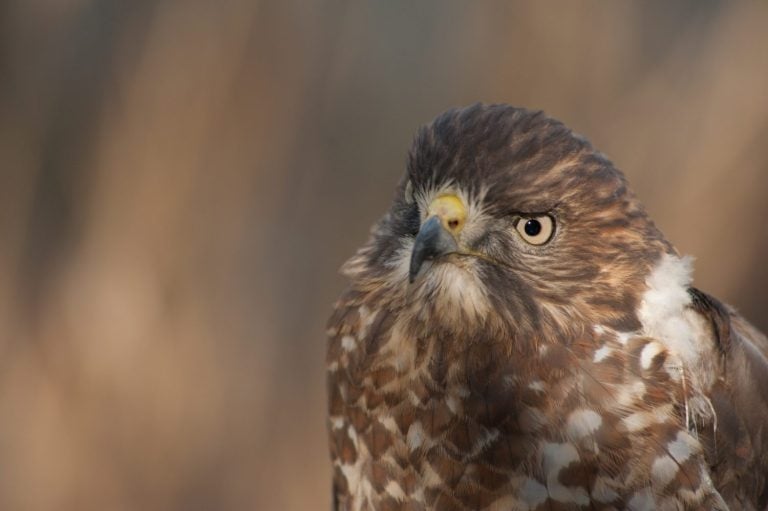
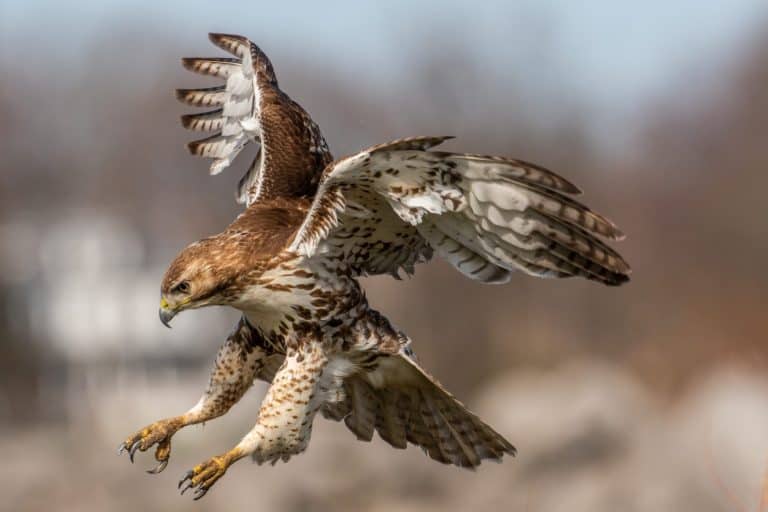
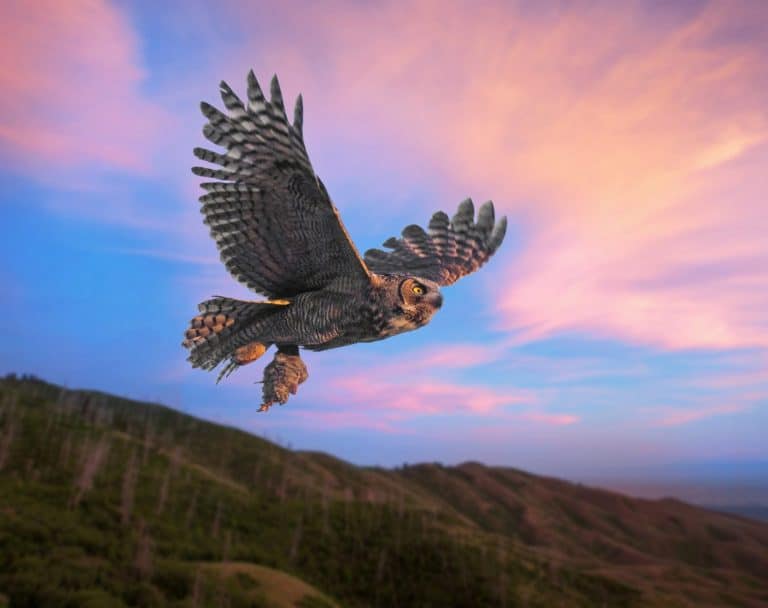
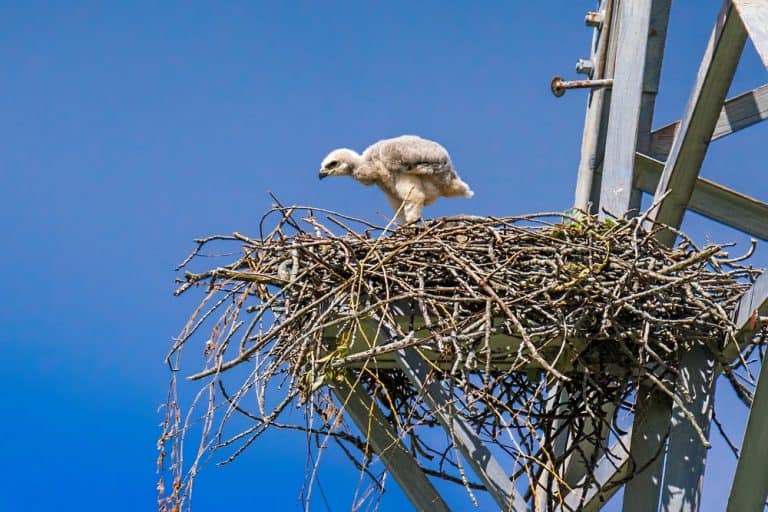
There are approximately 524 bird species found in Massachusetts, including eight types of hawks. From the curving arm of Cape Cod to the Parker River National Wildlife Refuge, hawks soar over the Bay State. Within the state, they inhabit rocky shores, marshy areas, mountainous regions, sandy beaches, and dense forests. Continue reading to learn about eight hawks found in Massachusetts.
Rough-legged Hawk
| Scientific name | Buteo lagopus |
| Color | Dark-brown |
| Weight | 1.32-3.66 pounds |
| Height | 18-24 inches |
| Wingspan | 52-54 inches |
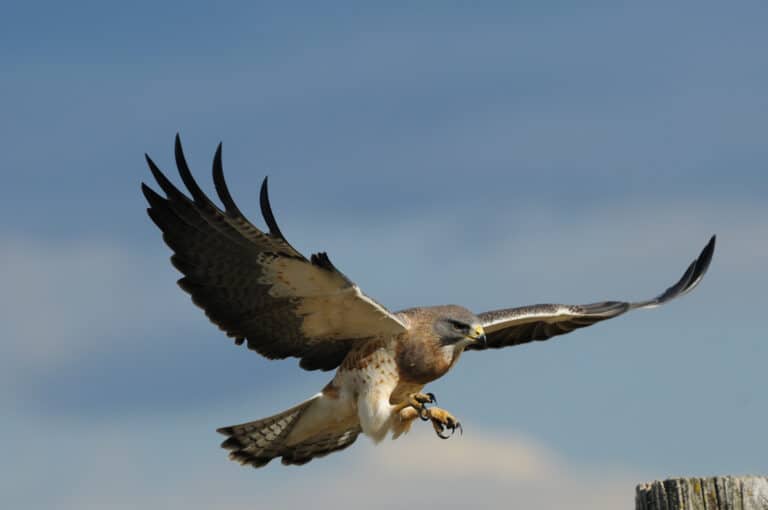
Named for their feathered legs, rough-legged hawks are not very common in Massachusetts, except during winter. Among all soaring buteo hawks, rough-legged hawks breed the furthest north, making them the most cold-adapted of the group. They are often spotted perched on poles or hovering over open fields and marshes during winter.
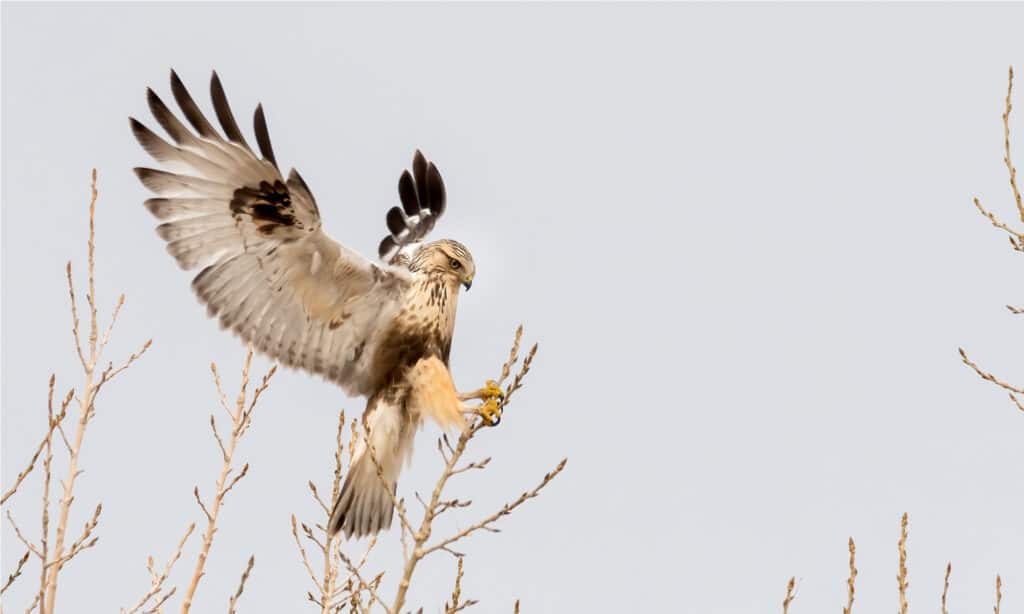
Rough-legged hawks have chunky bodies, tiny feet, broad wings, and elongated bodies.
©Eivor Kuchta/Shutterstock.com
Rough-legged hawks have chunky bodies, broad wings, and tiny feet. They fan their tails while soaring. They are grayish-brown on top, with brown markings on their whitish underparts.
Rough-legged hawks consume voles, lemmings, songbirds, shorebirds, waterfowl, shrews, mice, ground squirrels, large insects, and many other small animals. They hunt almost exclusively by hovering over open fields, occasionally perching to watch for prey, and sometimes scavenging road-killed animals.
Rough-legged hawks breed mainly in the Arctic, usually in tundra regions. They build their nests either on a high cliff ledge or on a narrow rock ledge. Their main criterion is a site that offers a broad view of the surroundings.
Female rough-legged hawks lay between three and five eggs. Incubation lasts about 30 days, and males may help incubate the eggs when the female is temporarily away from the nest. Young hawks begin to fly at around five to six weeks of age, with males typically fledging slightly earlier than the larger females.
Red-tailed Hawk
| Scientific name | Buteo jamaicensis |
| Color | Brown, pale, cinnamon-red, and dark |
| Weight | 1.5-3.5 pounds |
| Height | 18-26 inches |
| Wingspan | 45-52 inches |
Red-tailed hawks are commonly sighted in Massachusetts throughout all seasons. They are often found along roadsides, on plains, prairies, and in mountains. They live in any habitat that provides open fields for hunting and tall perches from which to watch for prey.
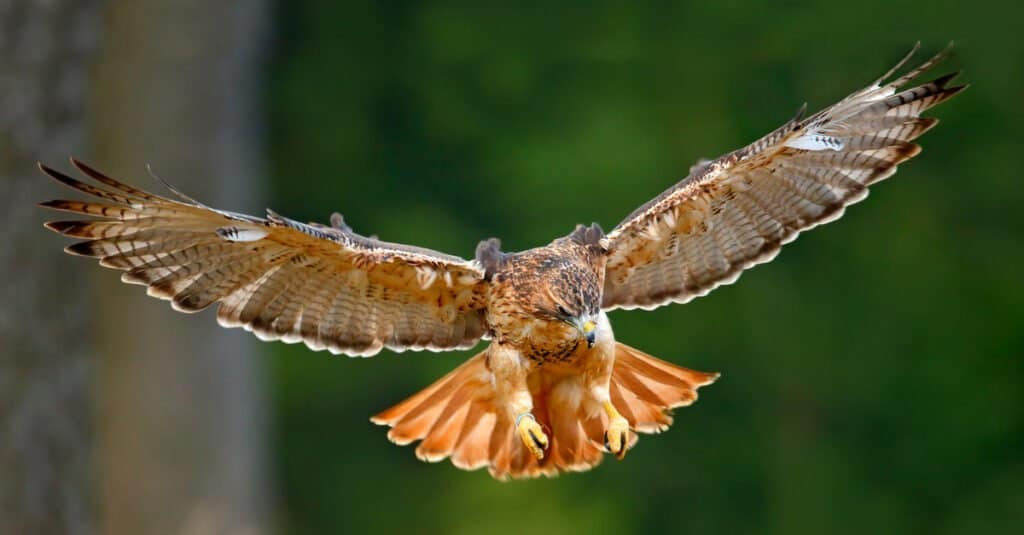
Red-tailed hawks feed primarily on mice and rats.
©Ondrej Prosicky/Shutterstock.com
Red-tailed hawks feed primarily on mice and rats, but also eat ground squirrels, rabbits, toads, lizards, snakes, fish, and other small-to-medium-sized animals. These hawks nest on cliff ledges, tall trees, and artificial structures such as tall buildings, and sometimes even among the arms of giant cacti.
Female red-tailed hawks lay between one and five eggs. Incubation takes around 28–35 days. Both sexes take turns incubating the eggs. Young hawks leave the nest about six to eight weeks after hatching.
Northern Goshawk
| Scientific name | Astur atricapillus |
| Color | Brown, grey, red, black, and white |
| Weight | 1.4-3.4 pounds |
| Height | 18-27 inches |
| Wingspan | 43-50 inches |
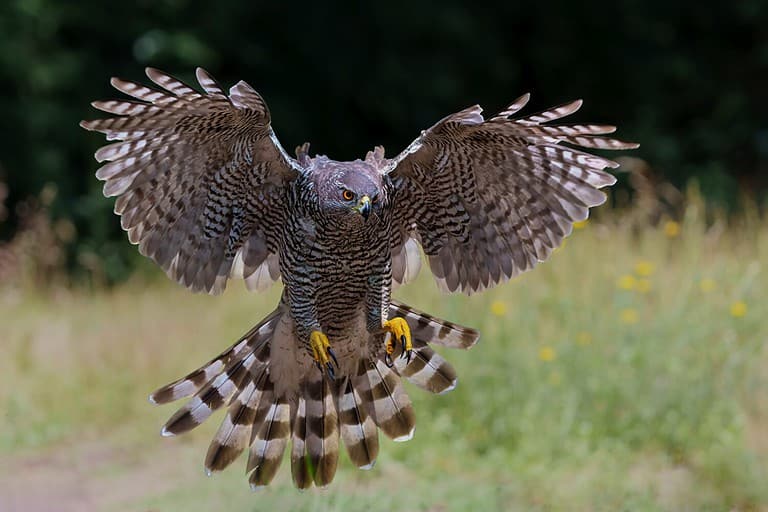
Northern goshawks are medium-sized hawks with mottled white, gray, and black feathers. Adult northern goshawks have orange to red eyes, while juveniles have yellow eyes that darken as the bird matures. They are very secretive and shy birds of prey, but they become extremely loud when defending their nests from intruders. They aggressively chase animals even larger than themselves.
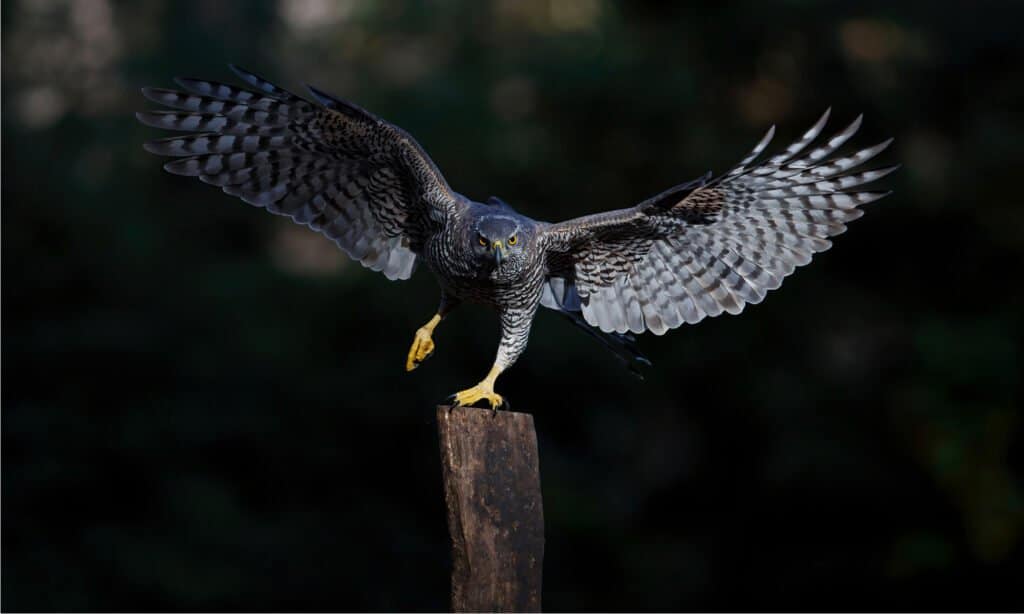
The northern goshawk’s diet consists of crows, grouse, rabbits, snakes, insects, rodents, squirrels, and snowshoe hares.
©Henk Bogaard/Shutterstock.com
Northern goshawks consume crows, grouse, rabbits, snakes, insects, rodents, squirrels, and snowshoe hares.
Northern goshawks build their nests in the main forks of deciduous trees in mixed forests. Female northern goshawks lay between one and five eggs after the nest is complete. The incubation period lasts for 32-38 days. Young hawks begin flying at around five to six weeks of age.
Sharp-shinned Hawk
| Scientific name | Accipiter striatus |
| Color | Blue-gray, red-orange, brown, and dark |
| Weight | 2.9-7.7 ounces |
| Height | 9.1-15 inches |
| Wingspan | 17-27 inches |
Sharp-shinned hawks are among the smallest hawks in Massachusetts. They are not very common in the state but can be found year-round. Sharp-shinned hawks live in a wide range of habitats, including forest edges, open deciduous woodlands, and coniferous forests. They tend to avoid open habitats, even during winter.

Sharp-shinned hawks live in a wide range of habitats, including forest edges, open deciduous woodlands, and coniferous forests.
©Pierre Leclerc/Shutterstock.com
Sharp-shinned hawks are slate blue-gray on top with red-orange bars on their underparts. Their Juveniles are mostly brown with vertical streaks on their underparts. Both adults and immature hawks have long, dark-banded tails.
Sharp-shinned hawks prey on small birds and rodents. They also prey on toads, frogs, lizards, and insects. They either hide in foliage and wait for small birds to approach, or watch for prey from a perch.
Female sharp-shinned hawks lay between four and five eggs, which take about 30–35 days to hatch. Females are responsible for incubation, while males provide food during this period. Young hawks begin to fly at five to six weeks of age.
Northern Harrier
| Scientific name | Circus hudsonius |
| Color | Gray, white, black, and brown |
| Weight | 11-27 ounces |
| Height | 21-25 inches |
| Wingspan | 41-46 inches |
Northern harriers are very common in Massachusetts during winter but can be found during all seasons. They inhabit prairies, fields, and marshes. They live in both dry and wet habitats, preferably in open terrain with excellent ground cover.
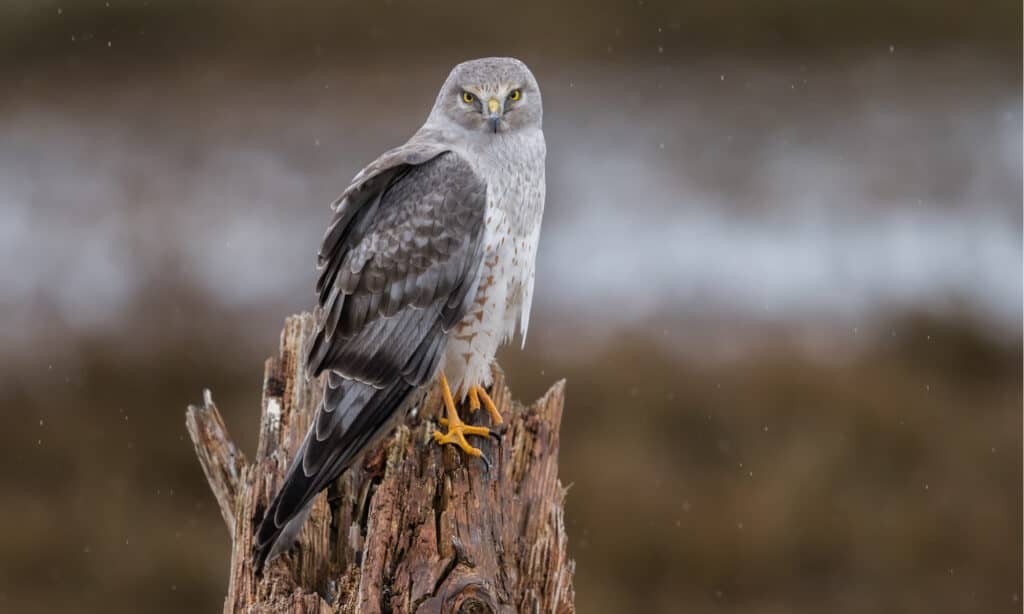
Northern harriers are either brown or gray on top, with whitish undersides.
©Harry Collins Photography/Shutterstock.com
Northern harriers are either brown or gray on top, with whitish undersides. Both the immature hawks and adults have black-banded tails. The only difference is that young hawks have buffy, less-streaked underparts.
Northern harriers prey on small birds, rats, voles, large insects, frogs, toads, snakes, carrion, and small rabbits. Northern harriers hunt by hovering over open fields and also locate prey by sound.
Northern harriers nest in marshes or densely vegetated areas. Females build the nests, while males supply the nesting materials. Females lay between four and six eggs, which take about 30–32 days to hatch.
Cooper’s Hawk
| Scientific name | Astur cooperii |
| Color | Brown, grey, white |
| Weight | 7.8-14.5 ounces |
| Height | 14-20 inches |
| Wingspan | 24.4-35.4 inches |
Cooper’s hawks are found in Massachusetts year-round. They inhabit riparian groves, woodland edges, and open woodlands. These medium-sized hawks resemble sharp-shinned hawks in many ways, but they are larger. They are blue-gray above with reddish bars on their underside.
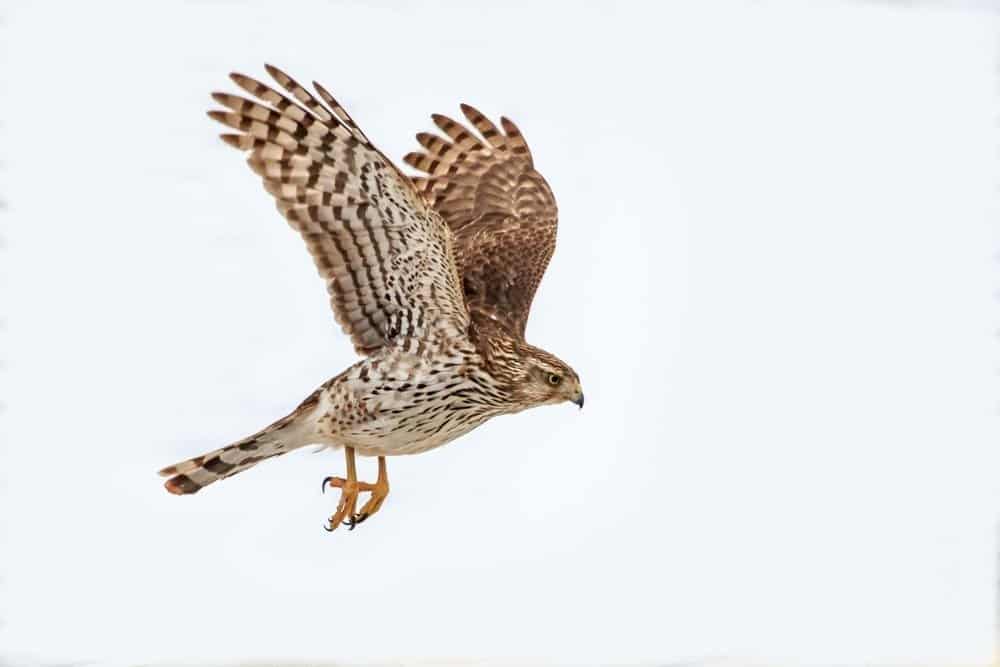
Cooper’s hawks feed on mice, bats, tree squirrels, ground squirrels, chipmunks, reptiles, and insects.
©Richard G Smith/Shutterstock.com
Cooper’s hawks prey on small mammals and medium-sized birds, including mice, bats, tree squirrels, ground squirrels, chipmunks, reptiles, and insects. They prefer hunting in dense cover, moving from one perch to another as they watch and listen for prey. Cooper’s hawks are preyed upon by great-horned owls, raccoons, and red-tailed hawks.
Cooper’s hawks build their nests on top of trees in deciduous or coniferous forests. Females lay between three and five eggs, which take approximately 34–36 days to hatch. Young hawks start flying at around four to five weeks of age.
Red-shouldered Hawk
| Scientific name | Buteo lineatus |
| Color | Dark, white, red |
| Weight | 1-1.7 pounds |
| Height | 15-24 inches |
| Wingspan | 35-50 inches |
Red-shouldered hawks can be found throughout all seasons in Massachusetts. They inhabit swamps, wooded stream banks, and bottomland woods. They shift to more open habitats during winter. Red-shouldered hawks are named for the reddish barring on their shoulders.
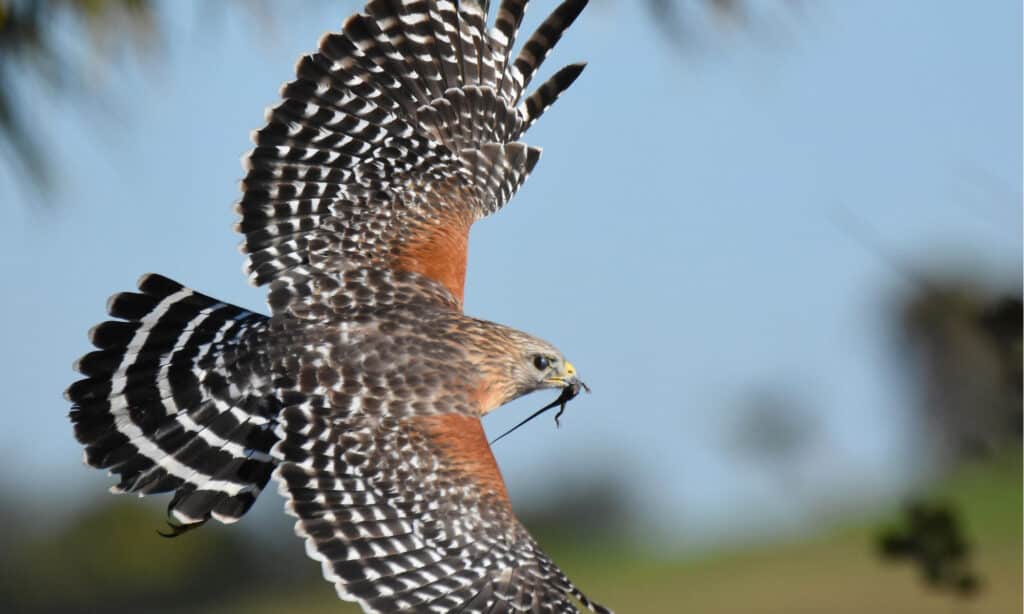
Named for the rusty plumage on their shoulders, red-shouldered hawks are year-round residents of Massachusetts.
©MTKhaled mahmud/Shutterstock.com
Red-shouldered hawks consume small birds, chipmunks, voles, toads, frogs, crayfish, snakes, and large insects. They hunt either by flying low over an open field or by watching for prey from a perch. They use their sharp hearing and eyesight to locate prey.
Red-shouldered hawks build their nests in deciduous or coniferous trees. Females usually lay three to four eggs. The incubation period lasts approximately 33 days. Young hawks begin flying within five to seven weeks of hatching.
Broad-winged Hawk
| Scientific name | Buteo platypterus |
| Color | Black, white, reddish-brown |
| Weight | 9.3-19.8 ounces |
| Height | 13.4-17.3 inches |
| Wingspan | 29.0-39.0 inches |
Broad-winged hawks are found in northern Massachusetts. They inhabit groves and open woodlands but breed in deciduous or coniferous forests. They have reddish-brown heads with black-and-white banded tails.
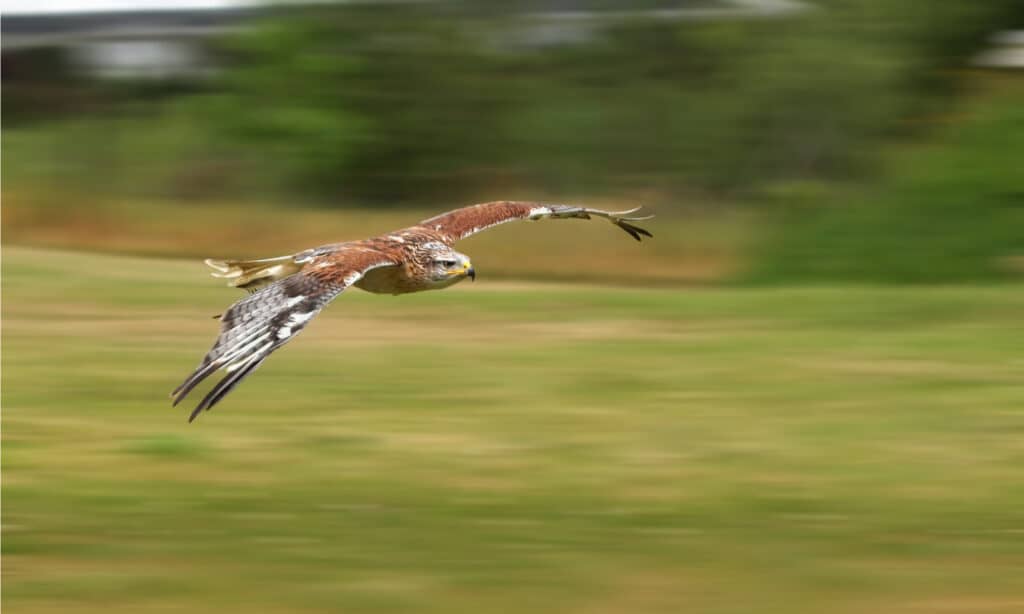
Broad-winged hawks are found in Northern Massachusetts.
©pr2is/Shutterstock.com
The broad-winged hawk’s diet consists of squirrels, voles, mice, young turtles, lizards, frogs, toads, and small birds. They hunt by flying through the woods or by watching for prey from a perch. They swoop down rapidly to capture prey the moment they spot it.
Once broad-winged hawks finish building their nests in large coniferous or deciduous trees, they begin breeding. Females lay between two and three eggs, which take around 28–31 days to hatch. Young hawks may begin flying as early as five to six weeks old.