Quick Take
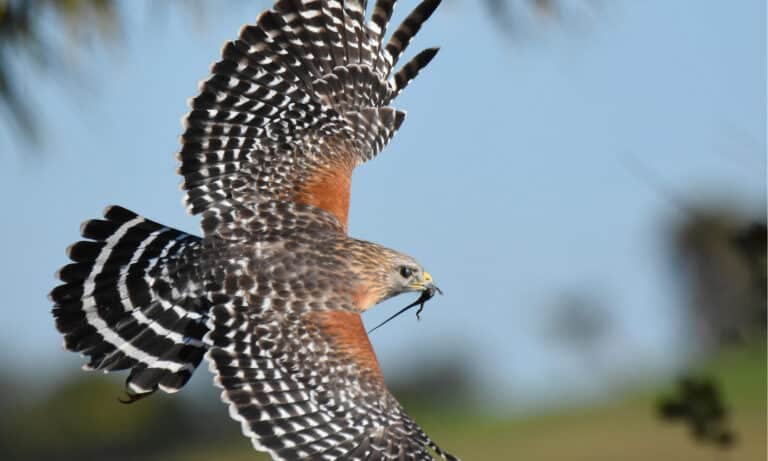
- One Kentucky hawk can fly through dense forest at a speed that would surprise most birders, and it also uses a trick to stay hidden until the last second. See the forest speedster →
- Not all of Kentucky's hawks actually live there. Some are just passing through, and knowing which is which changes where and when you'd ever spot one. Meet the winter visitor →
- One hawk on this list has feathered legs, which is a trait so rare that it sets it apart from nearly every other hawk in North America. See the feathered legs →
- One of these hawks nests in a spot most people would never expect a bird of prey to choose. Discover the ground nest →
Hawks are powerful birds with sharp, curved talons and hooked beaks. Their sense of hearing is unmatched, and their vision ranks among the sharpest in the animal kingdom. North America is home to 16 species of true hawks, although that number rises to 36 when including eagles, kites, harriers, and falcons. Kentucky has six resident hawk species that nest and live in the state (some year-round, others breeding seasonally), and two migratory or winter-visiting species documented regularly in the state. Continue reading to learn about the eight hawks found in Kentucky.
Red-tailed Hawk
| Scientific name | Buteo jamaicensis |
| Color | Brown, pale, cinnamon-red, and dark |
| Weight | 1.5-3.5 pounds |
| Height | 18-26 inches |
| Wingspan | 43-56 inches |
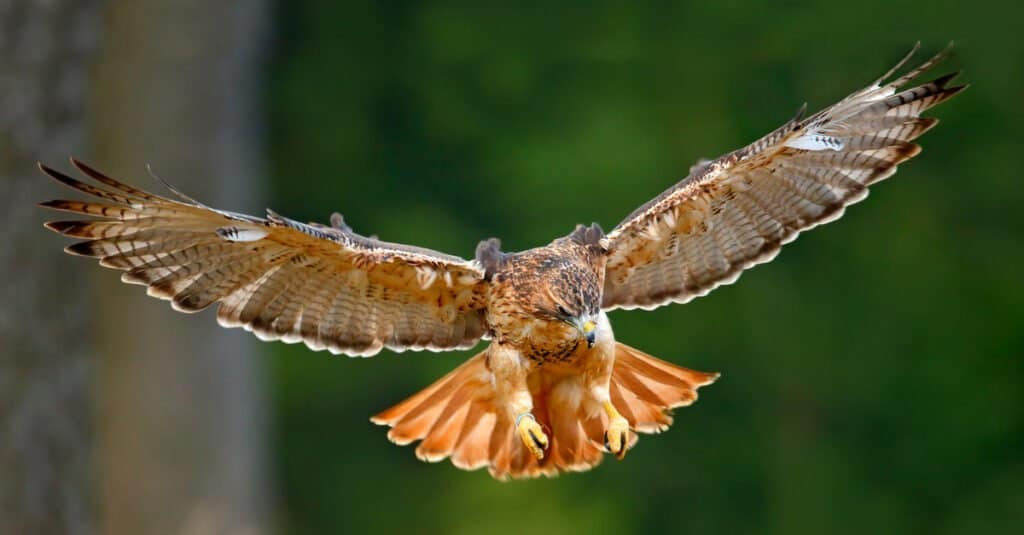
Red-tailed hawks build their nests on top of the tallest buildings, cliff ledges, and the tallest trees.
©Ondrej Prosicky/Shutterstock.com
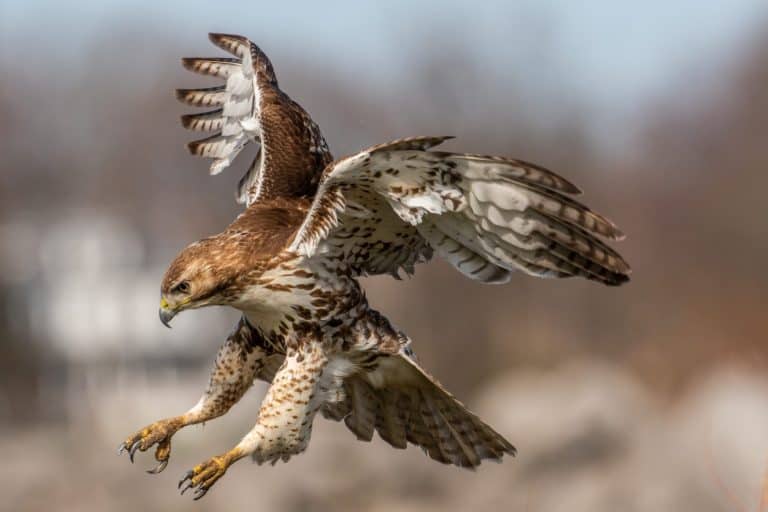
Kentucky has a population of year-round resident red-tailed hawks (Buteo jamaicensis) and a population of migratory red-tailed hawks from the north that overwinter in the state.
The red-tailed hawk’s wings are large and rounded like those of a goose. As the name suggests, they have a distinctive red tail, which is short and wide. They also have a brown back and pale underside with a streaked belly.
Red-tailed hawks consume moles, ground squirrels, rabbits, small raccoons, mice, and voles. Great-horned owls and bobcats are the primary predators of red-tailed hawks.
Red-tailed hawks build their nests on top of the tallest buildings, cliff ledges, and tall trees. Females lay between one and five eggs per clutch.
Their numbers increase in winter when birds from the far north join the resident year-round population.
Cooper’s Hawk
| Scientific name | Astur atricapillus |
| Color | Brown, grey, white |
| Weight | 7.8-14.5 ounces |
| Height | 14-20 inches |
| Wingspan | 24.4-35.4 inches |
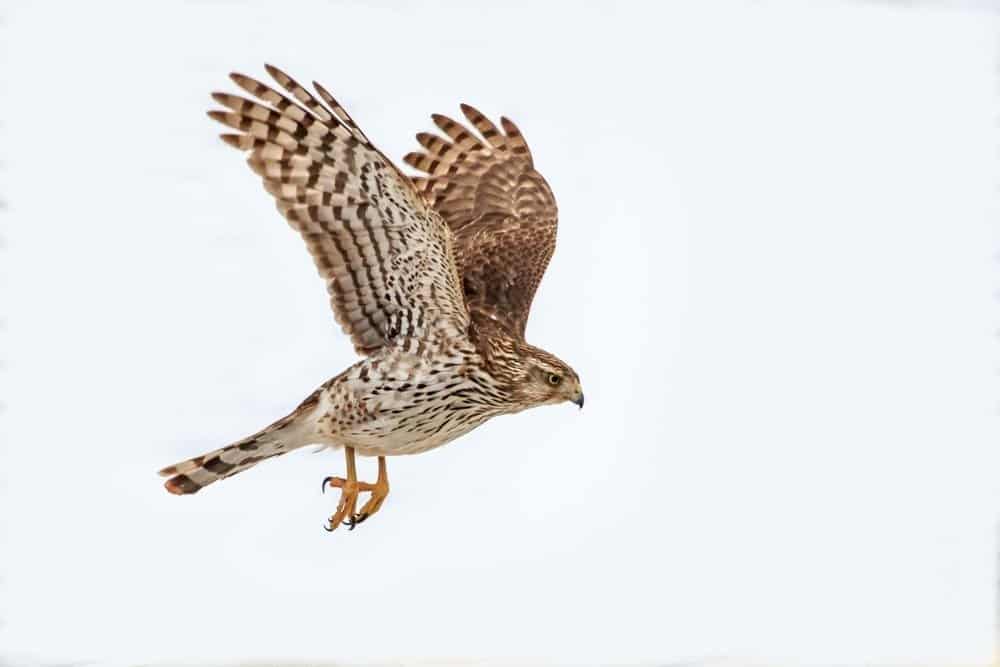
Cooper’s hawks only stick to one mate per season.
©Richard G Smith/Shutterstock.com
The Cooper’s hawk (Astur atricapillus) is a bird of prey that is notable for its small to medium size. They are the size of crows but have the appearance of sharp-shinned hawks. Females are larger than males, and adult male Cooper’s hawks are pale with orange barring on the feathers underneath.
Their diet consists mainly of woodpeckers, quails, domestic fowl, chickens, and smaller mammals. They are patient hunters and spend many hours perched in woodland canopies waiting for prey. Their camouflaged feathers help them blend in among the tree branches.
Cooper’s hawks’ main predators are eagles and other large raptors. Beyond predation, their only major threat is the widespread use of pesticides, which has killed thousands of hawks and other predatory animals.
Cooper’s hawks mate with only one partner per season. Like most hawks, they are solitary. Females lay two to six eggs.
Broad-winged Hawk
| Scientific name | Buteo platypterus |
| Color | Black, white, reddish-brown |
| Weight | 9.3-19.8 ounces |
| Height | 13.4-17.3 inches |
| Wingspan | 29.0-39.0 inches |
Broad-winged hawks are medium-sized birds of prey with compact, stocky bodies like those of geese and crows.
©pr2is/Shutterstock.com
Broad-winged hawks(Buteo platypterus) are compact hawks with broad wings. They resemble red-shouldered hawks but have browner overall coloration. In Kentucky, they can only be found during the breeding season, from April to August.
Broad-winged hawks are medium-sized birds of prey with compact, stocky bodies like those of geese and crows. Their diet mainly consists of snakes, lizards, young turtles, frogs, and other small mammals.
Adult broad-winged hawks are sometimes preyed upon by other hawks, eagles, and great horned owls. Other major threats include collisions with vehicles, poisoning, hunting, and habitat destruction.
Females lay one to four whitish eggs with brown spots. The incubation period lasts for 28-31 days. Both parents care for their young until they can fly and hunt for themselves.
Red-shouldered Hawk
| Scientific name | Buteo lineatus |
| Color | Dark, white, red |
| Weight | 1-1.7 pounds |
| Height | 15-24 inches |
| Wingspan | 35-50 inches |

Female red-shouldered hawks lay two to five eggs per clutch.
©Chase D'animulls/Shutterstock.com
Red-shouldered hawks (Buteo lineatus) are common in suburban areas, wooded swamps, and deciduous forests. They get their name from their reddish shoulder patches; the rest of their bodies are marked with white and black feathers.
Red-shouldered hawks are opportunistic in their diet, preying on reptiles, rodents, rabbits, crayfish, amphibians, and other small mammals. However, humans, snakes, peregrine falcons, martens, and fishers threaten red-shouldered hawks.
They inhabit wet areas and typically fly close to the ground. They build their nests in the forks of tree branches.
Female red-shouldered hawks lay two to five eggs. The incubation period is about 33 days. They are monogamous and begin breeding at two years old.
Sharp-shinned Hawk
| Scientific name | Accipiter striatus |
| Color | Blue-gray, red-orange, brown, and dark |
| Weight | 2.9-7.7 ounces |
| Height | 9.1-15 inches |
| Wingspan | 17-27 inches |
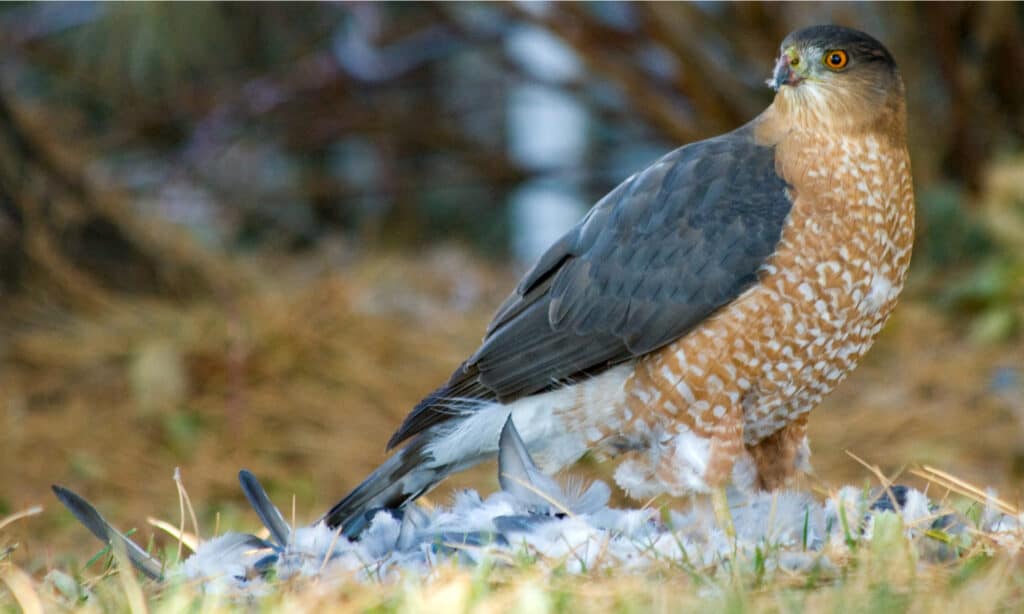
Sharp-shinned hawks are small, long-tailed hawks with rounded wings and square-tipped tails.
©Wyatt W/Shutterstock.com
Sharp-shinned hawks (Accipiter striatus) are small, long-tailed hawks with rounded wings and square-tipped tails. Typically, they weigh less than a pound. Their heads are tiny and barely visible when viewed from below against the sky. Female sharp-shinned hawks are bigger than males. They get their name from their sharply keeled, featherless legs.
Sharp-shinned hawks fly through dense forests at speeds of about 60 miles per hour to surprise prey. Their flap-and-glide flight pattern is distinctive. They feed primarily on small birds like songbirds and quails, but also on large insects, snakes, frogs, squirrels, and rodents.
Sharp-shinned hawks inhabit the deep interior of forests and can only be sighted high in the sky or in open habitats during migration. They build their nests in conifer trees, usually on top of the tallest trees with dense cover. Females lay between four and five eggs, which take about 30–32 days to hatch.
Rough-legged Hawk
| Scientific name | Buteo lagopus |
| Color | Dark-brown |
| Weight | 1.32-3.66 pounds |
| Height | 18-24 inches |
| Wingspan | 52-54 inches |
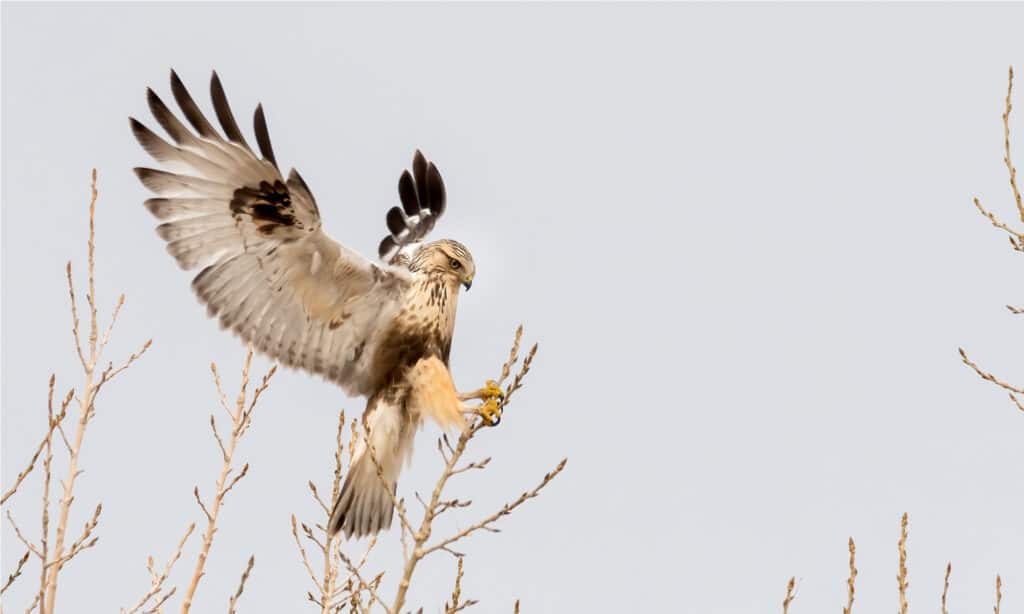
Rough-legged hawks have a diet that consists of rodents, including lemmings and voles.
©Eivor Kuchta/Shutterstock.com
Rough-legged hawks (Buteo lagopus) are medium to large, with broad but thin wings. Their flight pattern is distinctive: they often hover or kite, tilting into the wind. The ones you see in Kentucky are most likely non-breeding winter visitors, as rough-legged hawks do not breed in the state.
These hawks diet primarily on rodents, including lemmings and voles, and they occasionally feed on birds and amphibians. They inhabit the Arctic tundra during summer to hunt and raise their young.
Females lay three to five eggs, which are incubated for about 31 days.
Northern Harrier
| Scientific name | Circus hudsonius |
| Color | Gray, white, black, and brown |
| Weight | 11-27 ounces |
| Height | 21-25 inches |
| Wingspan | 41-46 inches |
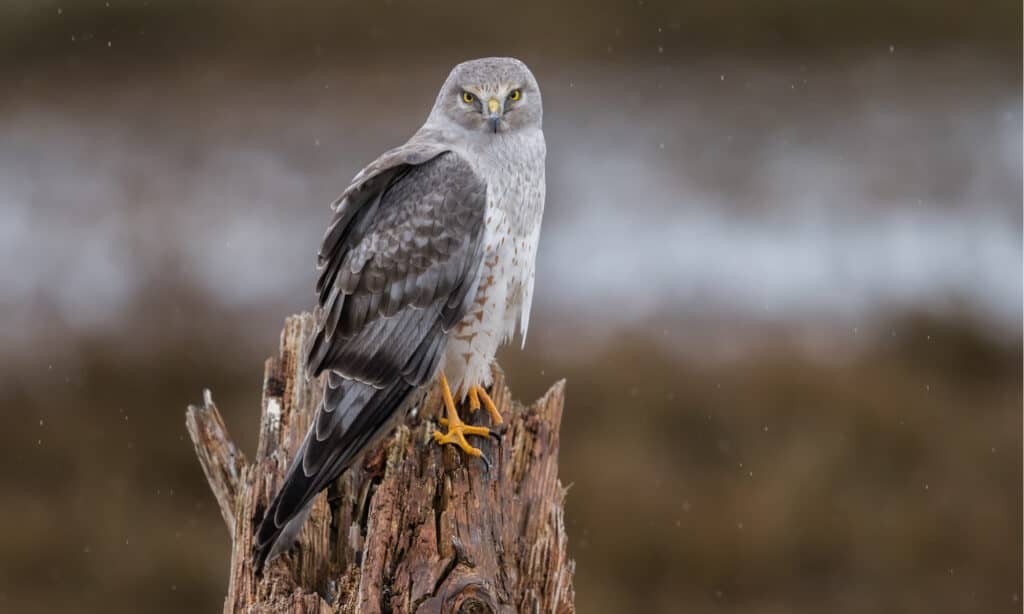
Northern harriers live in marshes, prairies, and open fields.
©Harry Collins Photography/Shutterstock.com
Northern harriers (Circus hudsonius) are notable for nesting on the ground. You can easily spot them gliding low over grasslands or marshes. They are slender, medium-sized birds of prey with rounded tails, broad wings, and striking owl-like faces.
Northern harriers feed on small birds and small mammals. They can also carry bigger prey like ducks and rabbits. However, their diet varies with the season and location. They fly back and forth over the ground while watching and listening for small animals to prey on.
Northern harriers live in marshes, prairies, and open fields. They conceal their nests on the ground and nest in colonies. Females lay two to four eggs, which hatch in 30–32 days.
Ferruginous Hawk
| Scientific name | Buteo regalis |
| Weight | 32 to 80 ounces |
| Height | 20 to 27 inches |
| Wingspan | 52-56 inches |
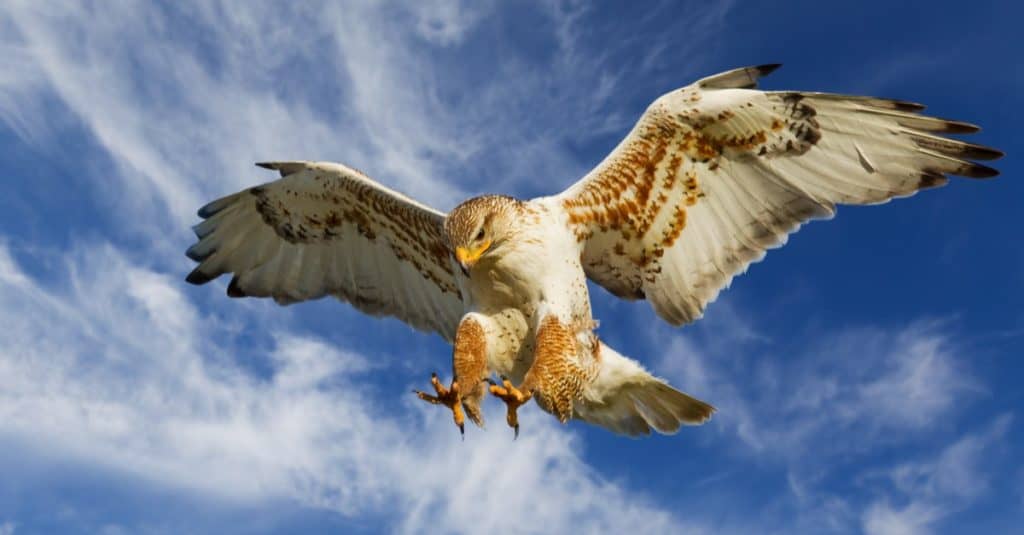
Ferruginous hawks prefer to hunt near open plains such as deserts, sage brushes, and old prairies.
©Stephen Mcsweeny/Shutterstock.com
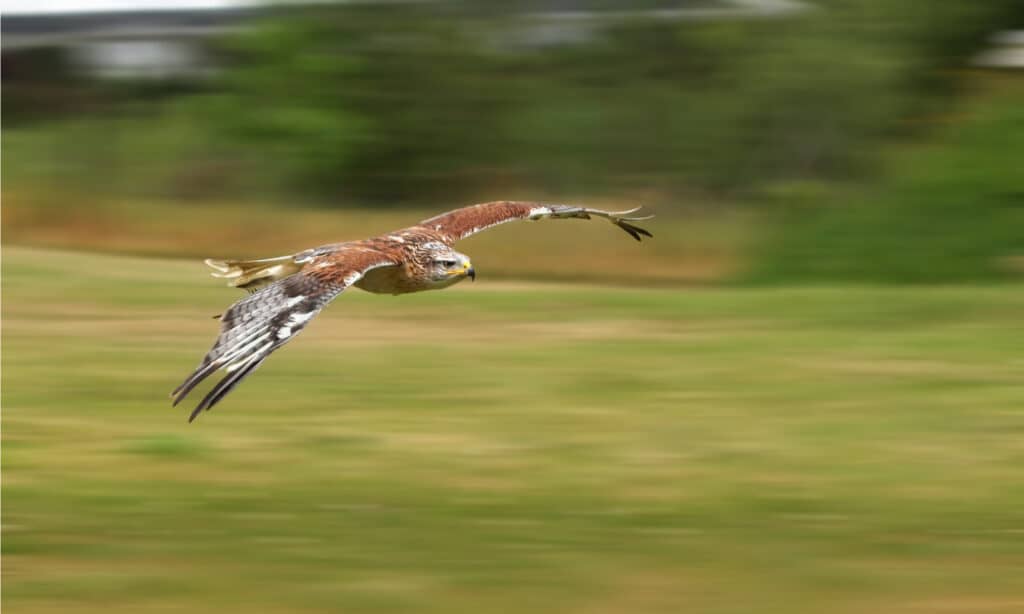
The bird’s name is derived from the Latin word ferrum, meaning iron, which describes the rusted-iron color of its feathers. Its unique color pattern, large size, and feathered legs are key identification features.
The ferruginous hawk prefers to hunt near open plains such as deserts, sagebrush, and old prairies to swoop in on its unsuspecting prey. To identify it, look for feathered legs, a trait uncommon among other hawks except for the rough-legged hawk.
The ferruginous hawk’s diet consists mainly of mice, squirrels, rabbits, hares, gophers, reptiles, amphibians, small birds, and even insects. When they catch prey, they either swallow it whole or tear it apart with their beaks.
Although they face few natural predators, their main threats include disturbance to nesting sites caused by agricultural activities and overgrazing. Golden eagles still pose a threat to them in territorial disputes, and bobcats are threats to the juveniles.
The female lays three to five eggs, which take about 32 days to hatch. Male ferruginous hawks also help incubate the eggs and brood the hatchlings until the young fledge at five to six weeks of age.