
Quick Take
- Hippo milk is actually cream colored or off-white.
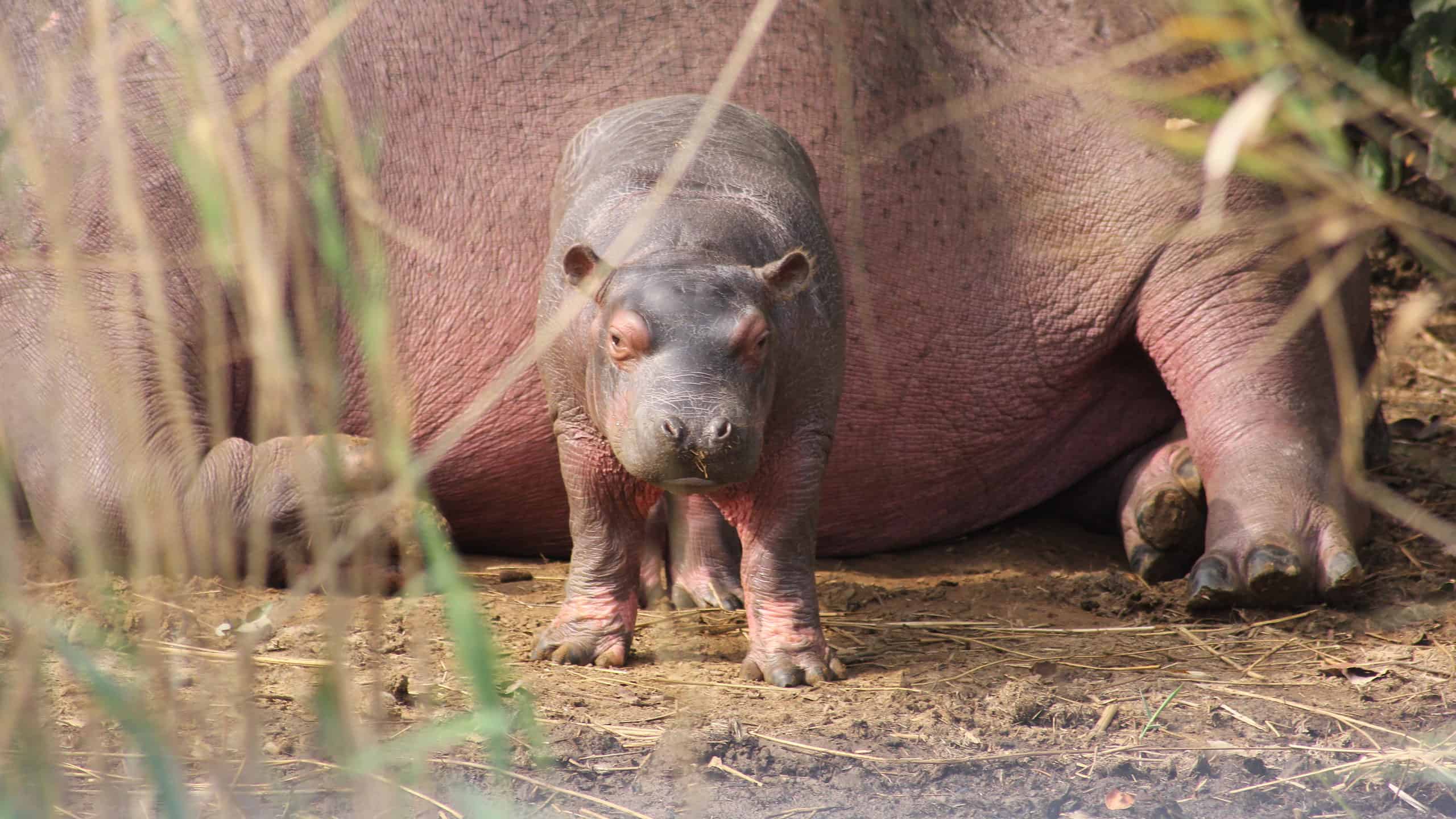
- It is possible that a hippo’s reddish sweat was accidentally mixed with a baby hippo’s milk, making the milk appear pink.
- The sweat emerges from the hippo’s skin clear, but after exposure to the air, it turns a reddish shade.
Many have heard rumors that hippo milk is unique in the animal kingdom, if only for its color. Such beliefs have not only sparked memes, but they have caused “fact-checkers,” and social media “fact posters” to be misinformed or incorrect. In fact, one of the most famous scientific publications in the world may have contributed to some of the controversies around this potentially pink substance. Let’s take a look and find out if hippo milk is actually pink.
Is Hippo Milk Really Pink?
In a word, no. Hippo milk is not pink. While we might want the rumor to be true, if only for novelty’s sake, it isn’t. There is, however, some interesting information that surrounds the rumor that may lead to the source of the false idea. Let’s take a deeper look.
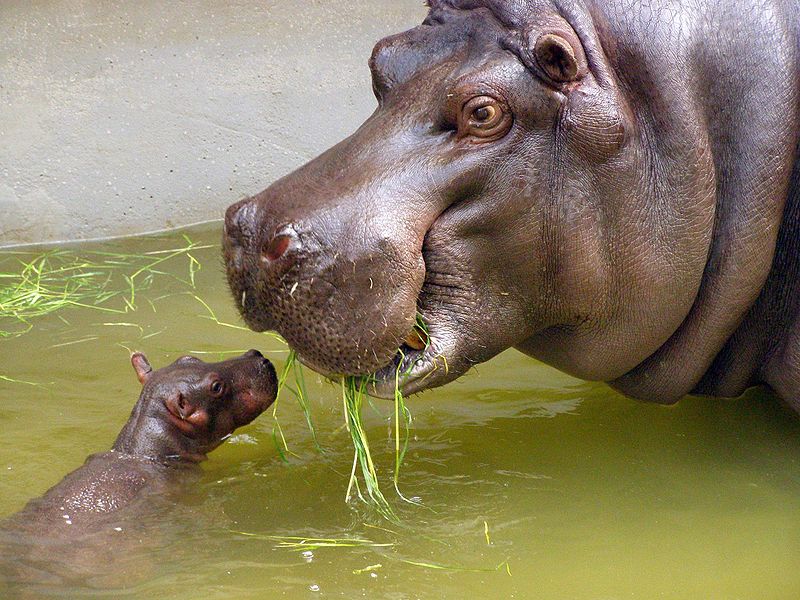
Hippo milk isn’t pink, but there was quite a bit of controversy surrounding it a few years ago.
Where Did the Idea Of Pink Hippo Milk Come From?
While the idea likely isn’t new, it was popularized in recent years to the general public. The actual rumor gained popularity when some social media circles began posting “factoids” with the “interesting fact” that hippo milk was pink. Because the claim seemed believable, it quickly gained popularity across platforms like Twitter and Facebook. However, the rumor didn’t go viral until 2013.
By 2013, social media platforms like Facebook and Twitter were already well-established, but the widespread public awareness and response to misinformation were still developing. In a Facebook post from National Geographic on July 26th, 2013, they incorrectly posted that hippo milk was pink. Once National Geographic posted the “fact,” however, it was soon being repeated and reposted everywhere. Often, accounts would post photos of strawberry milk, calling it “hippo milk,” backed by a post from one of the major contributors to the scientific conversation. If the “fact” isn’t true, however, then how did it come about?
The Likely Origins of Hippo Milk Being Pink
Hippos are semi-aquatic mammals. As they live so close to water, they have developed some particularly interesting anatomical traits to help them better adapt. Hippos have special glands in their skin that secrete oils and fluids that, to a human, would look like reddish-colored sweat. This oily secretion is produced by their glands and spreads across their skin in a thin film. This secretion is often referred to as “blood sweat.”
It is possible that this blood sweat was accidentally mixed with a baby hippo’s milk, which is cream colored or off-white. This combination would result in pinkish-colored milk. It’s also possible that a baby hippo covered in milk could appear reddish if it secreted the oily substance at the same time. Regardless of the origins, the rumor is not true.
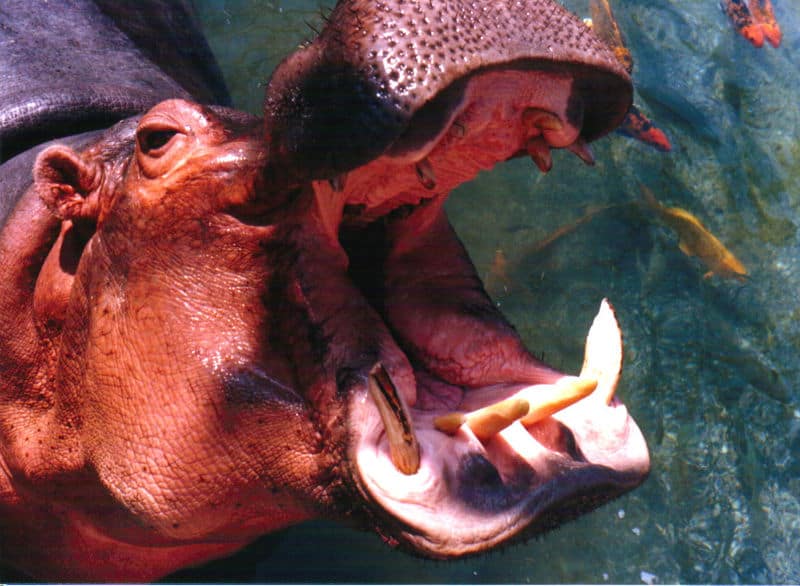
Hippos secrete oily substances to protect their skin that turn red when exposed to air.
©Larry D. Moore / Creative Commons – Original
What Is Blood Sweat?
Blood sweat is the combination of hipposudoric acid and norhipposudoric acid. When these two combine, they are secreted from specialized glands in the hippo’s skin. The sweat emerges from the hippo’s skin clear, but after exposure to the air, it turns a reddish shade.
Hippos are prone to sunburn in spite of their thick, brownish-grey skin. Since the sun is so powerful in sub-Saharan Africa where they live, adaptations are necessary to protect their skin. The blood sweat primarily serves as a sunscreen, blocking UV radiation and keeping the hippos from burning. As they don’t have any fur or hair to cover their bodies, this adaptation is essential. The two acids’ light absorption range peaks around the ultraviolet zone, allowing them to absorb the harmful light without it reaching the skin of the hippo.
Additionally, the acids act as an antibiotic, killing potential growths that would make their home on the hippo’s skin. Since the environments the hippos live in are prone to bacterial growth, this adaptation is truly remarkable. These acids are likely synthesized from the amino acid tyrosine, showing that the secretion isn’t dietary. This allows the hippo to produce the “sweat” wherever it is.
Overall, blood sweat keeps hippos cool, acts as a sunscreen by blocking harmful UV rays, and serves as an antibiotic that stops bacterial growth. They may not have pink milk, but that’s some pretty useful sweat!
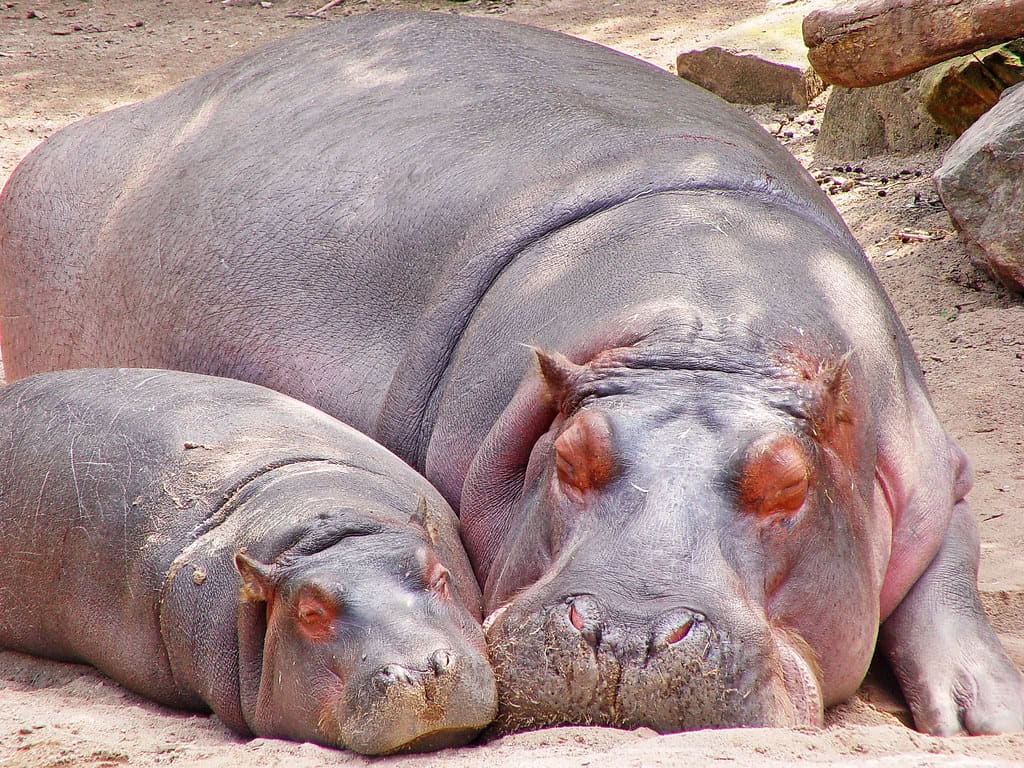
Just one cup of hippo milk provides babies with approximately 550 calories.
©"Mother hippo and calf" by Tambako the Jaguar is licensed under BY-ND 2.0. – Original / License
Interesting Facts About Real Hippo Milk
In the wild, most nursing occurs in the water. Baby hippos are born in the water and generally nurse while totally submerged. Mother hippos nurse their babies for about eight months. Hippo milk is calorically dense, with one cup of hippo milk providing approximately 550 calories. At birth, babies weigh between 60 and 110 pounds, but they can reach up to 500 pounds by their first birthday.
In 2017, Fiona, a baby Nile hippopotamus (Hippopotamus amphibius) was born at the Cincinnati Zoo. Fiona was premature, and her mother lacked interest in nursing, but Fiona had a whole team of caretakers. Hippo milk is so understudied that zookeepers had to rely on limited data and comparative analysis with other species to try to develop a suitable formula for Fiona.
Keepers sent samples of the mother’s milk to the Department of Nutrition Science at the Smithsonian National Zoological Park and Conservation Biology Institute. Using the Smithsonian’s analysis, the zoo was able to adjust Fiona’s formula so it more closely resembled the mother’s milk. As of 2026, Fiona is 9 years old and thriving, and the Cincinnati Zoo has shared its knowledge with other zoos in the hope that their hippo formula recipe might help save other baby hippos.