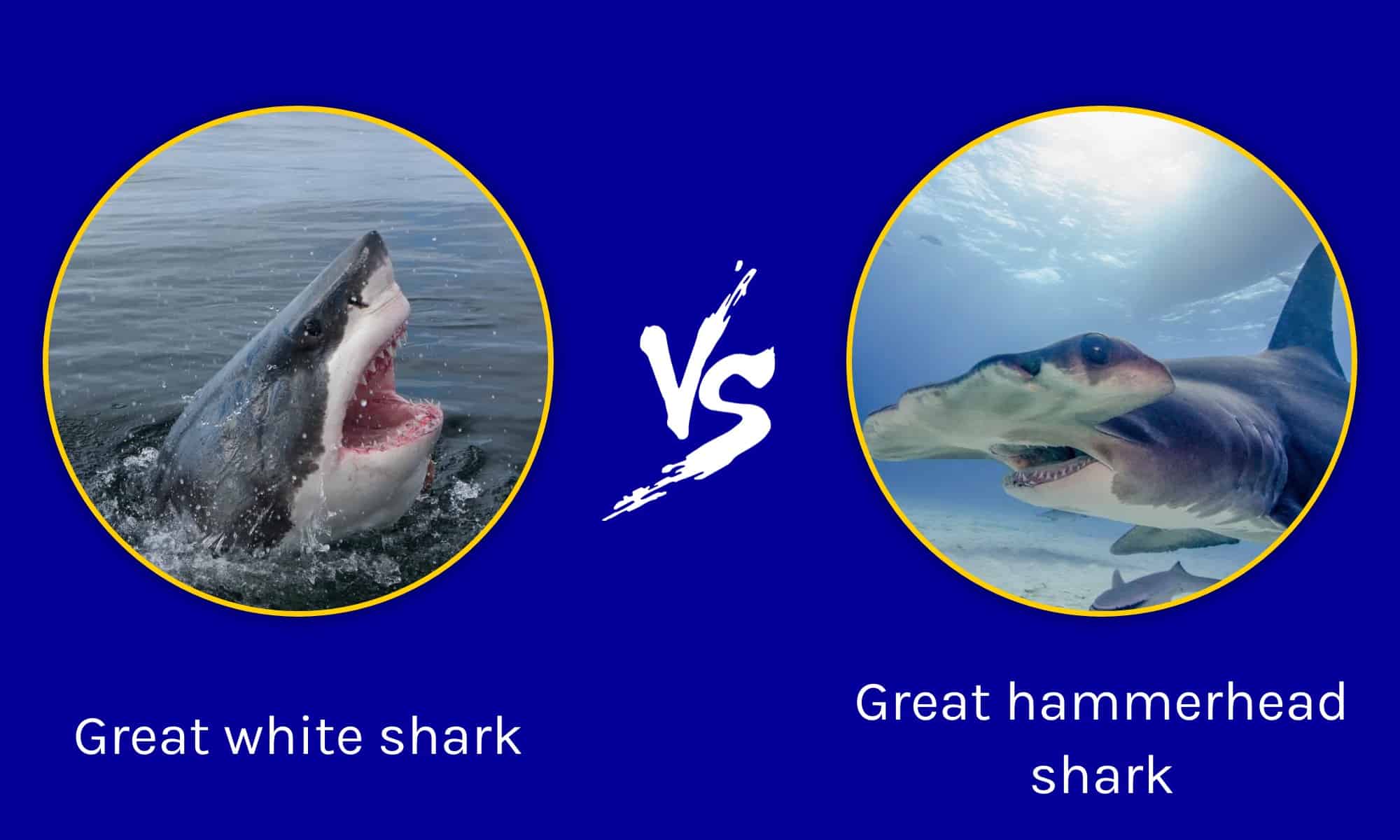

The great hammerhead shark (Sphyrna mokarran) and the great white shark (Carcharodon carcharias) are both large, predatory, widely distributed sharks. However, there are key differences that set them apart, including appearance, habitat, and hunting style, among others. Keep reading to learn more about these marine carnivores and discover the unique characteristics that distinguish great hammerheads from great whites.
Comparing Great Hammerhead Shark vs. Great White Shark
| Great Hammerhead Shark | Great White Shark | |
|---|---|---|
| Size | Length: 10-20 feet Weight: 500-1,000 pounds | Length: 11-21 feet Weight: 1,500 to upwards of 4,000 pounds |
| Appearance | Broad hammer-shaped head; tall, curved dorsal fin, triangular teeth with serrated edges; greyish-brown back with white underside | Streamlined bodies; conical snouts; triangular, highly serrated teeth; crescent-shaped tails; grey to greyish-brown back with white underside |
| Distribution and Habitat | Warm temperate and tropical coastal waters, open ocean, continental and insular shelves, coral reefs; migratory | Cold temperate and subtropical coastal waters, open ocean, insular and continental shelves; migratory |
| Hunting Style and Diet | Active predator and carnivore; stingrays, smaller sharks, bony fishes, crustaceans, squids, and octopuses | Active predator and carnivore; seals, sea lions, fish, rays, squid, and smaller sharks; may scavenge whale carcasses |
| Reproduction | viviparous; gestation period of 11 months; litter size of 6-42 | ovoviviparous; gestation period of 12-18 months; average litter size of 9 |
Key Differences Between Great Hammerhead Sharks and Great White Sharks
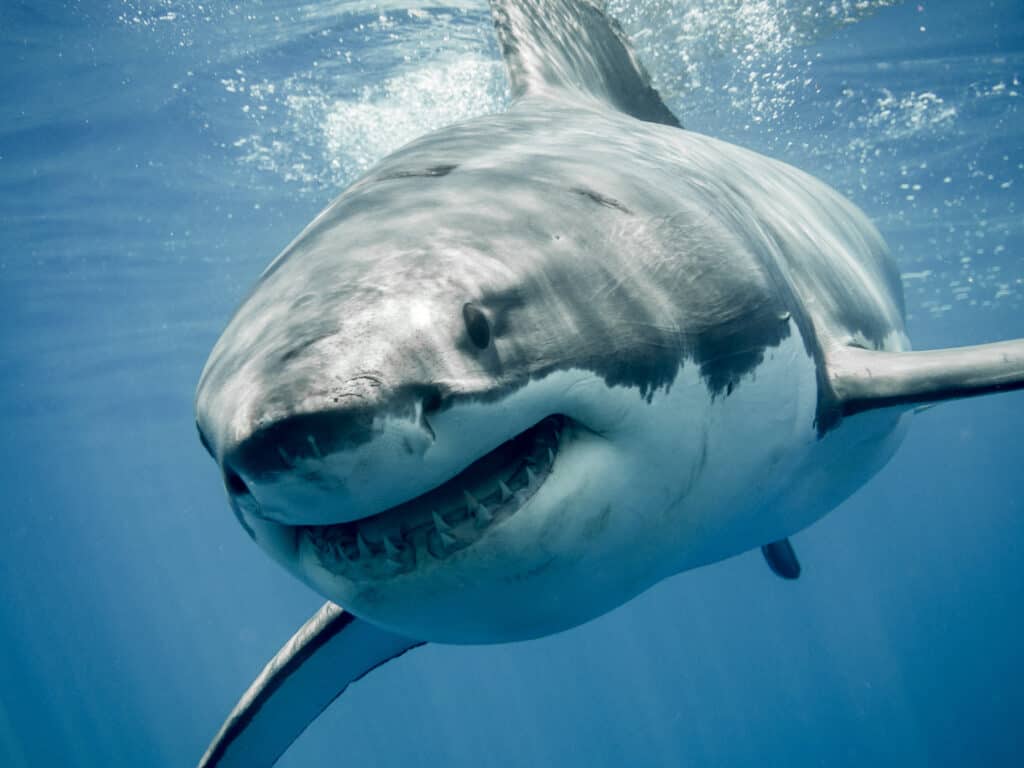
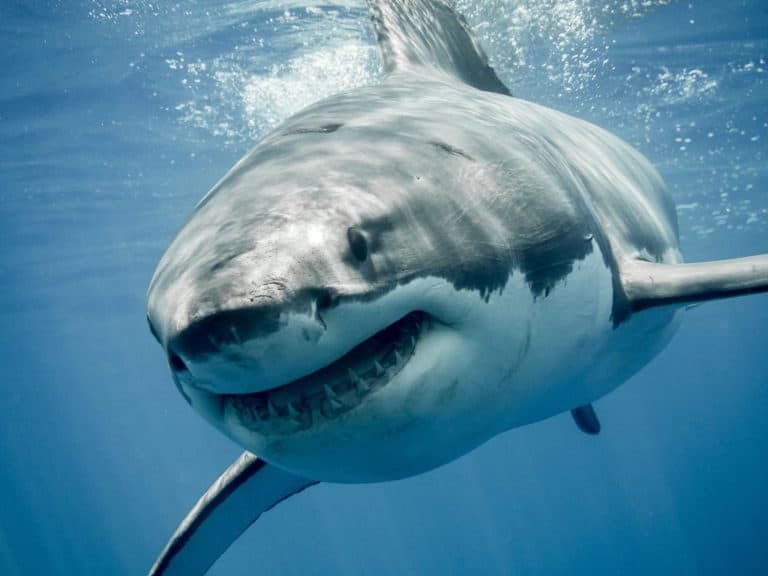
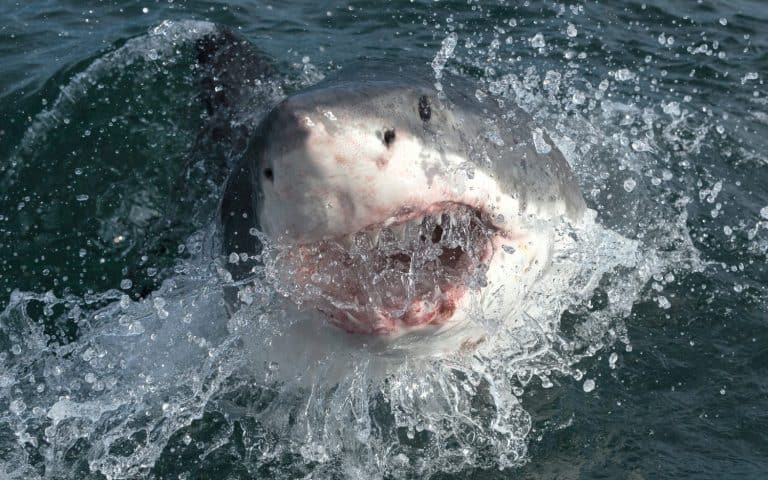
The great white shark measures up to 21 feet in length and can weigh more than 4,000 pounds.
©Ramon Carretero/Shutterstock.com
As mentioned above, great hammerhead sharks and great white sharks do have some similarities. However, there are key differences in size, appearance, distribution and habitat, hunting style and diet, and reproduction. Take an in-depth look at each of these differences in the paragraphs below.
Size
The great hammerhead shark and the great white shark are both called “great” with good reason. They are both large, heavy sharks that grow significantly larger than their relatives. However, great hammerheads reach much smaller maximum sizes than great whites. Great hammerheads generally measure 10-20 feet in length and weigh between 500 and 1,000 pounds. Like most sharks, female great hammerheads are larger than males.
Although great whites reach a similar length of 11-21 feet, they can weigh over 4 times as much as a great hammerhead. Great whites can weigh 1,500 to upwards of 4,000 pounds. The largest recorded great whites have been females.
Appearance
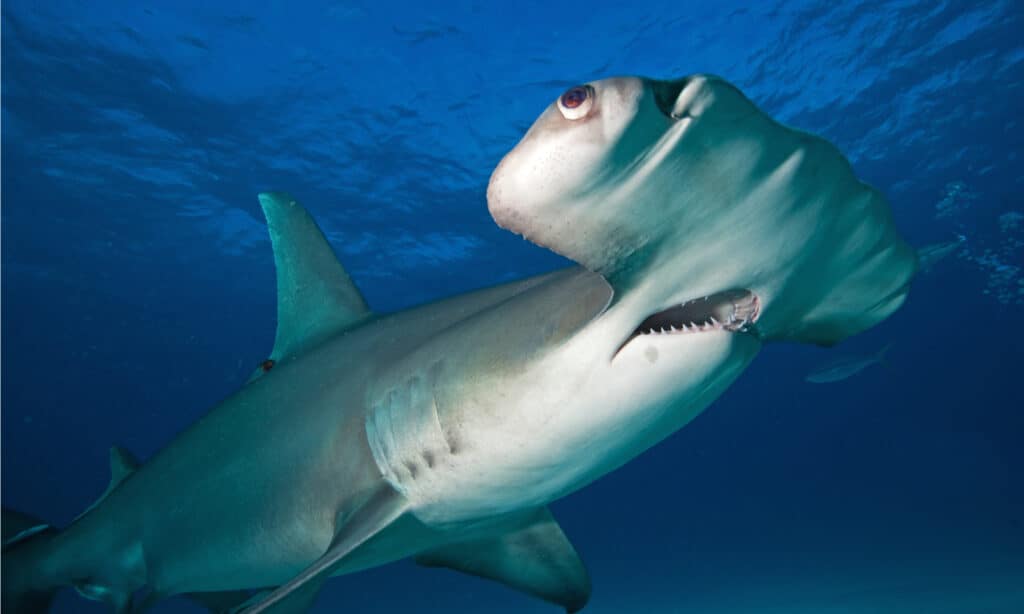
Great hammerhead sharks have straight, hammer-shaped heads with an eye on each end.
©Martin Prochazkacz/Shutterstock.com
The great hammerhead shark and the great white shark also differ in physical appearance. Although they are similarly colored to aid in camouflage, great hammerhead sharks have uniquely shaped heads. They have straight, broad, hammer-shaped heads called a cephalofoil. There is an eye on each end of the cephalofoil, giving them nearly 360-degree vision. These sharks have 17 rows of triangular teeth with serrated edges. Great hammerheads are greyish-brown with white undersides, and they have a very tall, curved dorsal fin.
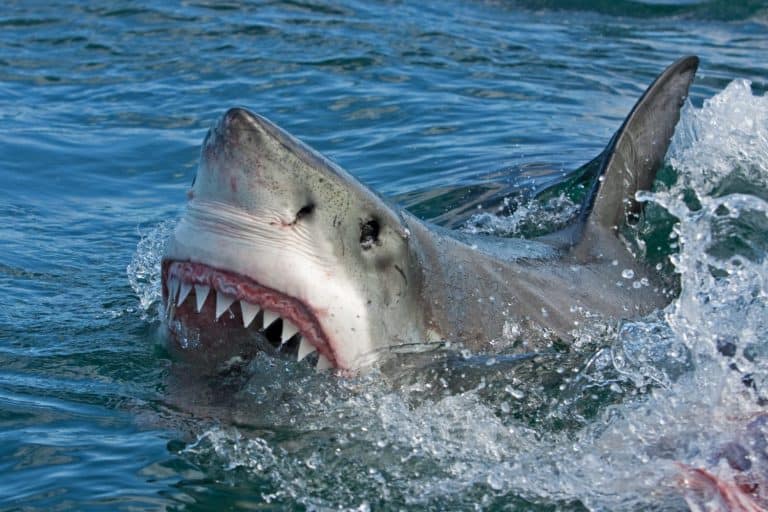
The great white shark is also grey to greyish-brown with white undersides. However, great whites have a more streamlined, torpedo-shaped body with a conical snout. They have large black eyes with one on each side of their head, which gives them a nearly 360-degree field of view. They have up to seven rows of 300 triangular, highly serrated teeth. Their first dorsal fins are large and pointed, and their tail fins are crescent-shaped.
Distribution and Habitat
The great hammerhead shark and the great white shark can both be found in oceans around the world, but there are some variations in habitat preferences. The great hammerhead shark is primarily found in warm temperate and tropical waters, or what is referred to as circumtropical regions. They favor shallow coastal waters, but they can also be found in deep water in the open ocean up to 984 feet. Great hammerheads are commonly seen over the continental shelves, and in coral reefs, lagoons, bays, and inland seas. They are highly migratory, with some populations observed to migrate northward during summer and southward toward the equator during the winter.
Great white sharks favor temperate and subtropical coastal waters, but their preferences sometimes shift as they mature. Juveniles are often found in warmer water over shallow continental shelves, while adults are more often found in the open ocean or coastal areas near sea lion and seal rookeries. Great whites are also migratory, swimming north during the summer and south during the winter.
Diet
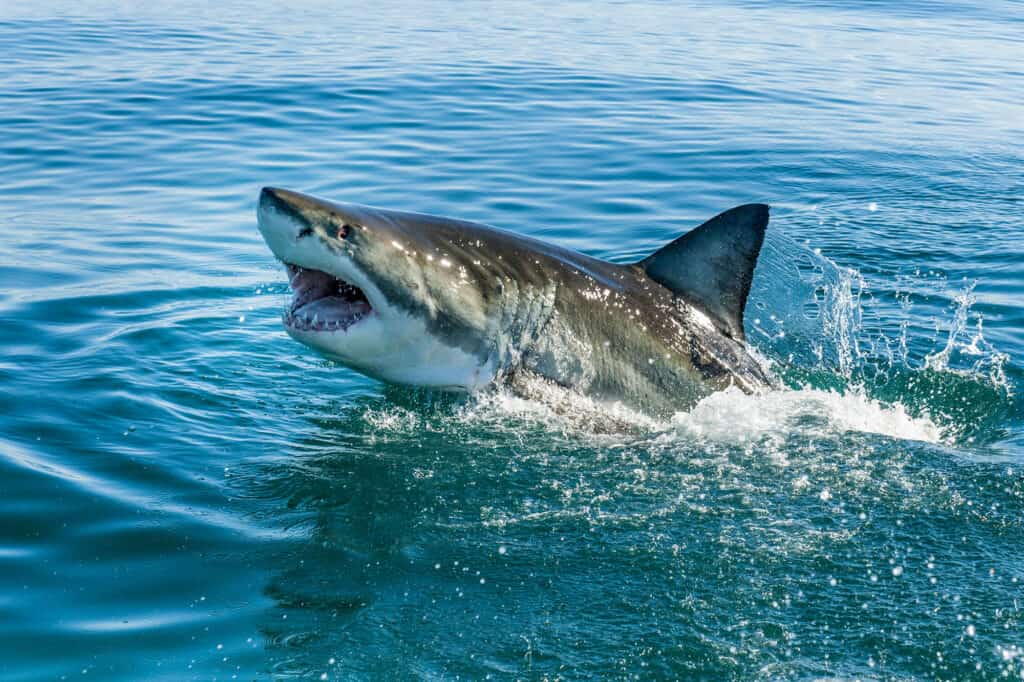
Great white sharks prefer a diet of large marine mammals like seals and sea lions.
©iStock.com/ELizabethHoffmann
Both the great hammerhead shark and the great white shark are active hunters with a strictly carnivorous diet. Great hammerhead sharks are opportunistic predators, with a diet that primarily consists of stingrays, bony fishes, small sharks, crustaceans, octopuses, and squid. They use their acute sense of smell, keen hearing, and excellent vision to locate prey. They also rely on the ampullae of Lorenzini in their snouts to hunt, which are electroreceptor organs that detect the weak electrical fields generated by prey. Great hammerheads have the largest number of ampullae of Lorenzini of any shark due to the size of their snouts. They use their heads to slam prey into the ocean floor and pin it down before attacking.
In contrast, great white sharks prefer large marine mammals such as sea lions and seals. However, they are opportunistic predators, so they also consume fish, rays, squid, and smaller sharks. Great whites will scavenge the carcasses of dead whales as well. These sharks use their excellent sense of smell, keen eyesight, sensitive hearing, and the ampullae of Lorenzini to find prey. They use stealth to ambush their prey from below, often breaching in a surprise attack.
Reproduction
Great hammerhead sharks and great white sharks also have different methods of reproduction. Great hammerhead sharks are believed to breed every two years. They are viviparous, meaning they give birth to live, fully developed pups, similar to mammals. After a gestation period of 11 months, they give birth to a litter of 6 to 42 pups. After the mother gives birth, there is no parental involvement.
The great white shark is also thought to breed every two years, likely due to its long gestation period. However, great whites are ovoviviparous, meaning the embryos develop in eggs that stay inside the mother’s body until they are ready to hatch. Great white sharks have a gestation period of at least 12 months but possibly longer. They typically have a much smaller litter size than great hammerheads, ranging between 2 and 14 pups. The pups are born live and are immediately independent with no further care from the mother.