Quick Take
- One monkey on this list is only active at night, with eyes that evolved in a way that sets it apart from nearly every other primate. Meet the night monkey →
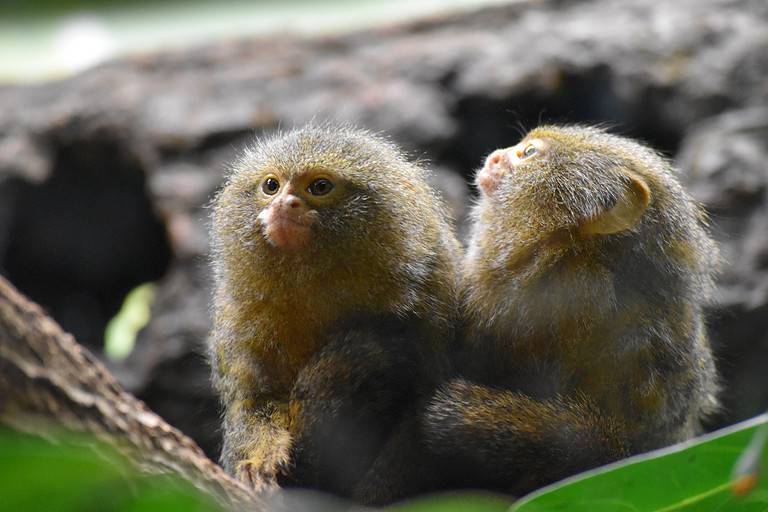
- The world's tiniest monkey weighs less than a chocolate bar and can rotate its head in a way most animals can't. Discover the pygmy marmoset →
- One critically endangered tamarin has a social breeding rule so unusual it mirrors no other primate, given that only one female is allowed to reproduce. See the breeding structure →
- One marmoset survives lean seasons by eating something most monkeys never touch, a feat that required it to evolve a special digestive system. Explore its unusual diet →
As most monkeys are arboreal and adapted to move swiftly through the trees, most of them are small in size, at least when compared to apes such as chimps and gorillas or ground-dwelling monkeys such as baboons. Here is a list of the world’s smallest monkeys, from the largest of the smallest to the tiniest.
The length describes the distance from the nose to the root of the tail. In some of these monkeys, their tail is considerably longer than their body and often prehensile.
10. Talapoin Monkey
The Southern talapoin monkey (Miopithecus talapoin) and the Northern talapoin monkey (M. ogouensis) is one of the smallest monkeys in Africa. Both species of talapoin monkey weigh between 1.76 and 4.19 pounds, and have a body length of between 10 and 16 inches and a tail that is just as long or longer.
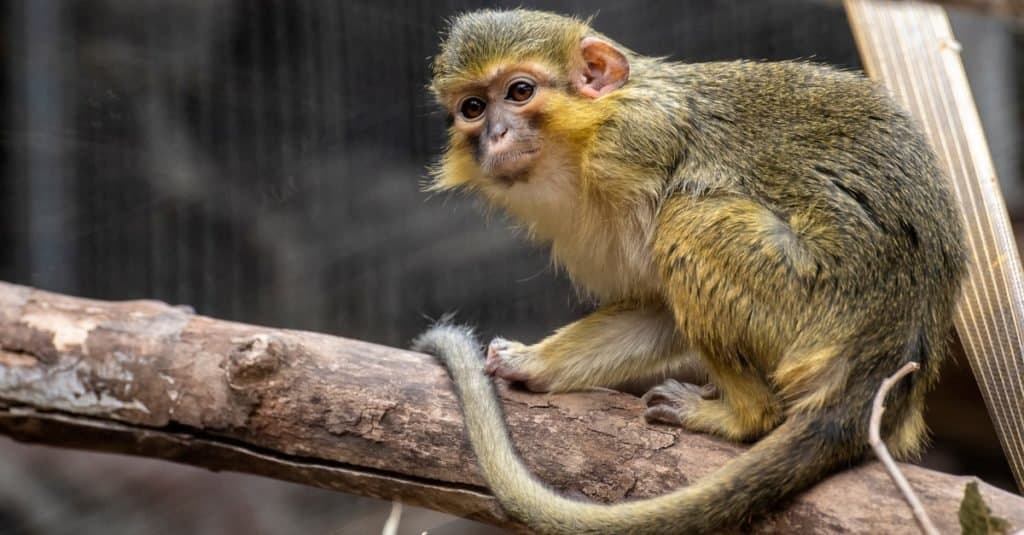
Talapoins are the smallest Old World monkeys. They can live in groups of up to one hundred individuals.
©Jossfoto/Shutterstock.com
Talapoin monkeys live among the trees of the rain forests, mangrove swamps, and even plantations, most often near a body of water. They are omnivores and will eat fruit, leaves, seeds, eggs, insects, and aquatic plants.
The talapoin is a little unusual because the normal color of its fur is light green. Its chest and belly fur are pale, and it has fan-shaped whiskers and prominent ears. It lives in family groups that may join up with others. This monkey breeds once a year.
9. Dusky Titi
The dusky titi (Plecturocebus moloch), also called the red-bellied titi, is only found in central Brazil around the Amazon river basin and near the source of the Orinoco River. It weighs an average of 28.33 ounces, and its head and body length ranges from 10 to 16 inches.
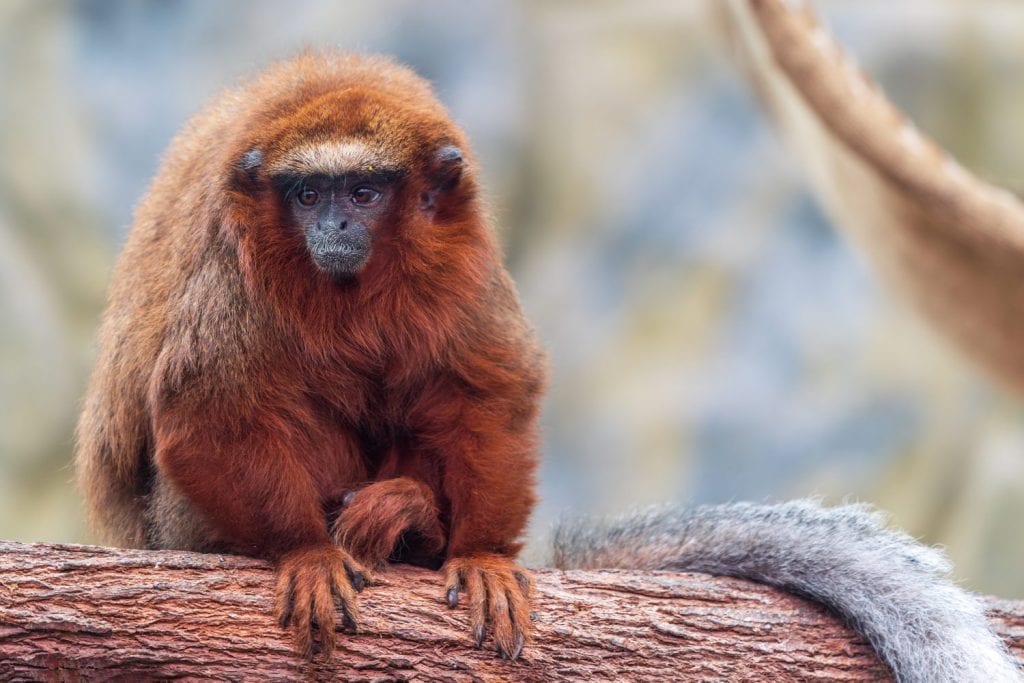
The dusky titi has an extremely limited distribution.
©William2023/Shutterstock.com
Dusky titis are monogamous and often live in family groups consisting of a male, a female, and their offspring. The male usually carries the babies unless they are nursing.
Dusky titis will sit with their tails twined, whether they’re asleep or awake. Like most monkeys, titis are active in the day and enjoy a siesta around noon. They eat mostly fruit, especially figs, but will also take bird’s eggs, leaves, and insects. Titis are exceptionally vocal, and their vocalizations are unusually complex for monkeys.

There are more than 30 species of titi monkeys, including Toppin’s titi, which is found in Southeastern Peru, Southwestern Brazil, and Northwestern Bolivia.
8. Squirrel Monkey
There are at least seven species of squirrel monkeys, including the Central American squirrel monkey (Saimiri oerstedii), common squirrel monkey (S. sciureus), bare-eared squirrel monkey (S. ustus), black-capped squirrel monkey (S. boliviensis), black squirrel monkey (S. vanzolinii), and Collins’ squirrel monkey (S. collinsi). Squirrel monkeys live in the canopies of the Central and South American forests. Squirrel monkeys range from about 10 to 14 inches long, not including their long tail. Male squirrel monkeys weigh somewhat more than females. The weight of a male squirrel monkey ranges from 26 to 39 ounces, while that of a female ranges from 18 to 26 ounces.
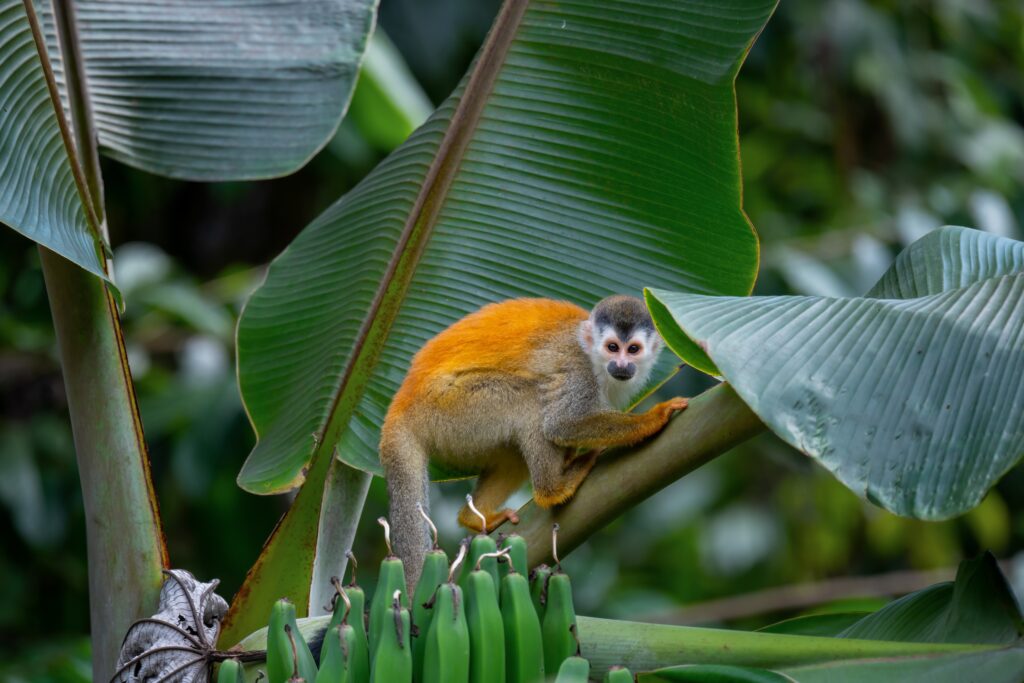
Central American squirrel monkeys are distributed along the Pacific coasts of Costa Rica and Panama.
©Wirestock Creators/Shutterstock.com
Squirrel monkeys live in groups that can contain hundreds of members.
They are omnivores and live around 15 years in the wild.
7. Night Monkey
There are five species of night monkeys in the genus Aotus: the three-striped night monkey (Aotus trivirgatus), Azara’s night monkey (A. azarae), Spix’s night monkey (A. vociferans), the gray-handed night monkey (A. griseimembra), and the Panamanian night monkey (A. zonalis).

Azara’s night monkey is nocturnal, and its large eyes allow for better night vision.
©Salparadis/Shutterstock.com
The night monkey is different from most other monkeys in that it is nocturnal. It’s found in savannas and wet and dry forests as high as 7,900 feet above sea level from Panama down to Argentina. An omnivore, it eats fruit, leaves, spiders, bird’s eggs, and once in a while birds and smaller mammals. As a nocturnal animal, it has large eyes evolved for good night vision.
The night monkey is 9.5 to 18 inches long, depending on the species. The average weight is between 1 pound and around 2.8 pounds. The night monkey is covered with thick gray or reddish-brown fur, with paler underparts. Its head resembles a squirrel monkey’s, with white patches above the eyes.
The female has one or two babies a year, usually between September and March.
6. Cotton-Top Tamarin
At between 8.2 and 10.2 inches long and often less than a pound in weight, the cotton-top tamarin (Saguinus oedipus) is one of the smallest of the New World monkeys. It’s found in the forests of Colombia, and since those forests are being rapidly destroyed, this little monkey is critically endangered. There are only about 6,000 of them alive.
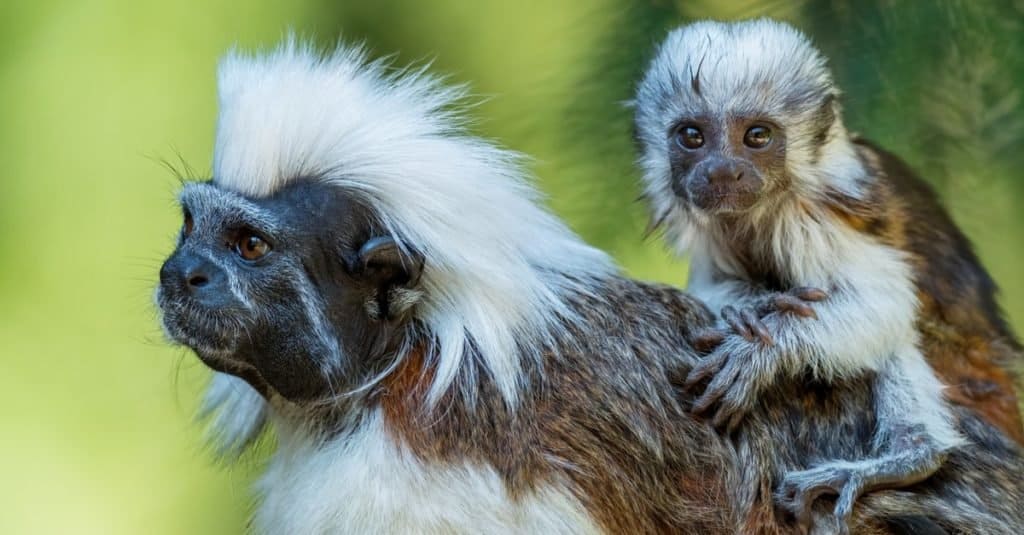
The cotton-top tamarin is one of approximately 30 tamarin species.
©David Havel/Shutterstock.com
The cotton-top tamarin gets its name from the white hair that fans out from the top of its head and continues down the back of its neck and over its shoulders. The monkey has a sagittal crest, much like a gorilla, and depending on the subspecies, the tamarin can be mottled-faced, bare-faced, or hairy-faced. The color of its fur ranges from brown to cream-yellow to reddish-orange, and its density depends on where on the body it is found.
The tamarin also appears to have tusks in its lower jaw.
Another unusual thing about this monkey is that only the dominant female breeds, and all the other monkeys, including males, take care of her young.
5. Graells’s Tamarin
Found in the tropical rainforests of the Amazon region of Ecuador, Peru, and Colombia, Graells’s tamarin (Leontocebus nigricollis graellsi) ranges from 7.8 to 12 inches long without its equally long tail and has a weight ranging between 7.9 and 32 ounces. Males tend to be smaller than females. Its fur is long and silky and fairly uniformly colored in black or dark brown. These tamarins have claws on all of their fingers except their opposable thumb, which has a nail.

Female tamarins almost always give birth to fraternal twins.
©David Havel/Shutterstock.com
Graells’s tamarins differ from other black-mantled tamarins in that they have a dull olive-brown (no reddish-orange) lower back, rump, and thighs. However, the molecular genetic analysis does not support treating Graell’s tamarin as a separate species from the black-mantled tamarin.
Graells’s tamarins are monogamous and, as with the cotton-top tamarin, only the dominant pair reproduces. The dominant female gives birth twice a year, at night, and she almost always has twins after a 130–170-day pregnancy.
4. Common Marmoset

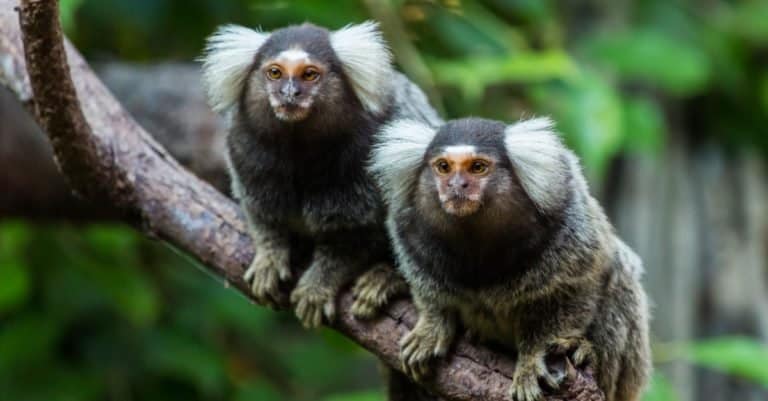
The common marmoset has spectacular white ear tufts and a banded tail.
©konmesa/Shutterstock.com
The common marmoset (Callithrix jacchus) is the first New World monkey to have its entire genome sequenced. Marmosets are a small monkey species in which males average around 7.4 inches in length, and females around 7.28 inches in length. Males are also heavier, with a weight of around 9 ounces compared to the females’ 8.3 ounces.
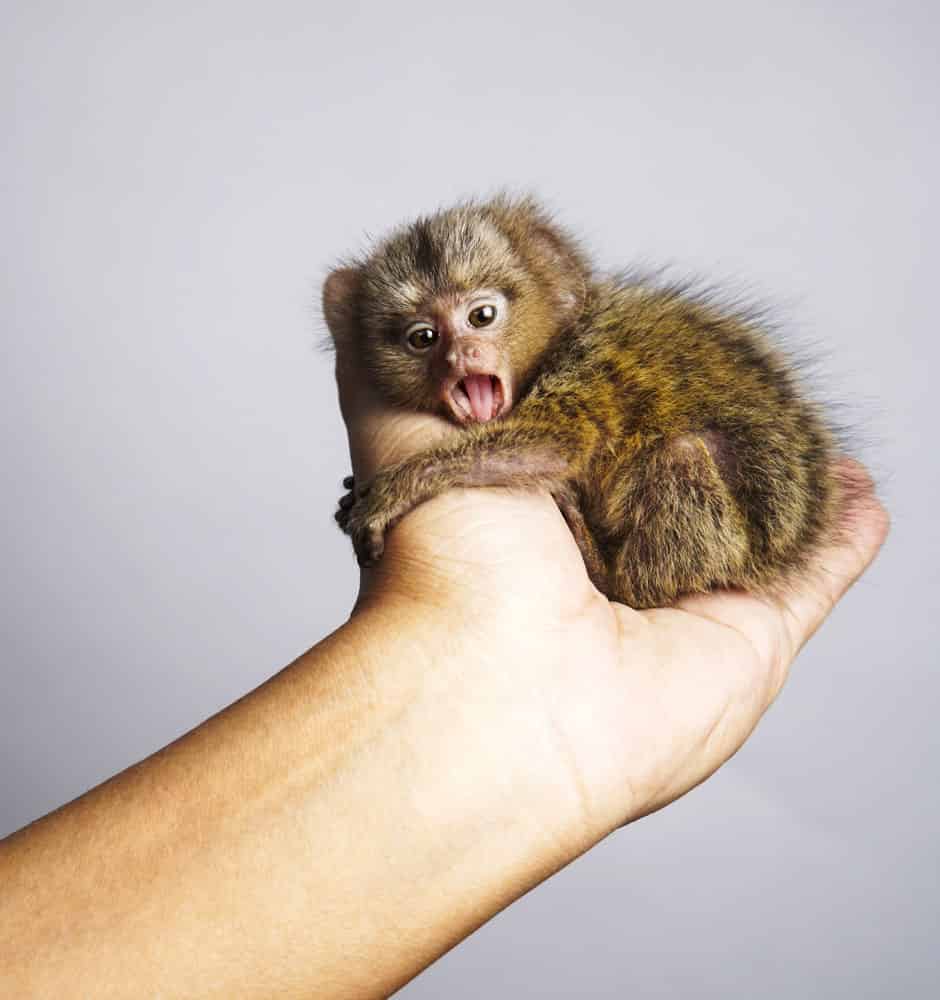
There are 22 species of marmoset, including this pygmy marmoset.
©anythings/Shutterstock.com
The common marmoset has thick, colorful fur with spectacular white ear tufts and a banded tail. Like the tamarins, they have claws or nails that resemble claws on their fingers and a proper nail on their thumb. They are acrobatic, living in the forests of southeastern Brazil. They have even been seen in cities.
This little monkey differs from others in that it eats plant secretions as well as insects, fruit, mushrooms, flowers, seeds, and smaller animals. It gets at the gums, saps, resins, and latex by chewing a hole in the tree and then lapping the secretions up. This adaptation allows the monkey to access food when fruit and flowers are out of season.
A dominant female common marmoset breeds fairly regularly if the conditions are right. Because marmosets often have twins, they need the help of other family members to raise them.
3. Silvery Marmoset
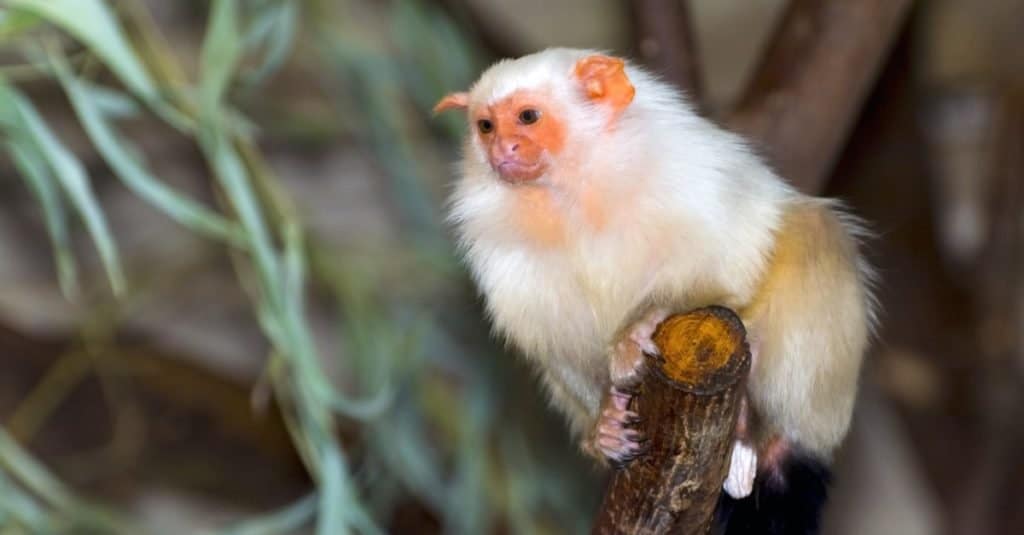
Silvery Marmosets differ from other marmosets in that their jaws come to a point.
©belizar/Shutterstock.com
Also found in the southeastern part of Brazil, the silvery marmoset (Mico argentatus) has a body length of between 7.1 and 11 inches and an average weight of about 4.8 ounces, or 0.3 pounds. Though they can have silver-white fur, there are silvery marmosets whose fur is dark brown. Their ears and faces are naked, and the ears stand out. They are found in rainforests and plantations and live in small groups. They scream or grimace at intruders.
The silvery marmoset eats tree sap, eggs, fruit, and insects. The monkey’s small size allows it to catch insects with ease. Like other marmosets, the entire family helps raise the young.
2. Roosmalen’s Dwarf Marmoset

Unlike other marmosets, the Roosmalen’s dwarf marmoset is a member of the genus Mico.
©iStock.com/Akkarapon_Janthara
This 7-inch-long Roosmalen’s dwarf marmoset (Mico humilis) is found in the Amazon rainforest, and despite its limited distribution, its conservation status is Least Concern. Unlike other marmosets, it’s not a member of the genus Callibella, but the genus Mico, and was only discovered in 1998.
This marmoset is dark brown on top with a dull yellow belly and chest. The face is bare and pink and encircled by white hair and topped with a black crown. The monkey has white eyebrows that reach to its temples. Females are larger than males, and the weight ranges from 5.29 to 6.52 ounces. Like other marmosets, it loves tree secretions. Unlike other marmosets, a female only gives birth to one baby at a time, and more than one female is allowed to give birth.
1. Pygmy Marmoset
The Eastern pygmy marmoset (Cebuella niveiventris) and the Western pygmy marmoset (Cebuella pygmaea) are so similar that they were classified as a single species until 2018.
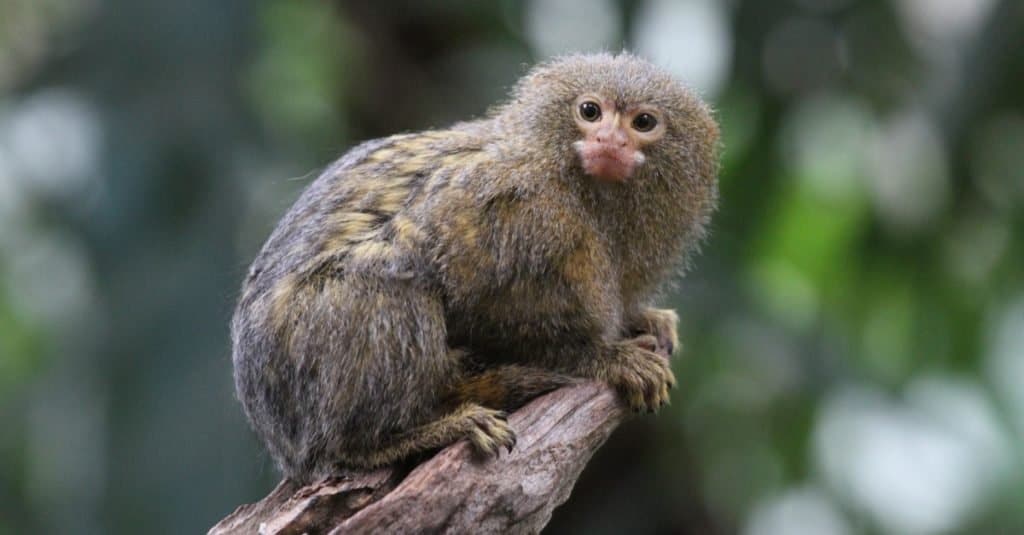
The pygmy marmoset is the smallest monkey on the planet and only weighs around 3.5 ounces.
©Mihai Ivascu/Shutterstock.com
Both the Eastern and Western species average 5.1 inches in length and 3.5 ounces in weight, and are considered the smallest monkeys in the world. Found in the Amazon basin, this tiny monkey is in its own genus, Cebuella. It lives in family groups made up of a male, a female, their offspring, and sometimes one other adult. They use vocalizations, chemical secretions, and visual displays to communicate with each other.
The dense fur of this monkey is a mix of brown, gold, gray, orange-yellow, and black. The tail, which is longer than the body, is ringed. The monkey can swivel its head 180 degrees, leap as far as 16 feet, and has a digestive system made for breaking down tree sap and other exudations.
As with other marmosets, only one female breeds, and the entire family pitches in to care for the young.
Summary Table of the Smallest Monkeys
| Rank | Monkey | Size in Weight |
|---|---|---|
| 1 | Pygmy Marmoset | 3.5 ounces |
| 2 | Roosmalen’s Dwarf Marmoset | 5.29-6.52 ounces |
| 3 | Silvery Marmoset | 4.8 ounces or 0.3 pounds |
| 4 | Common Marmoset | 8.3-9 ounces |
| 5 | Graells’s Tamarin | 7.9-32 ounces |
| 6 | Cotton-Top Tamarin | Less than a pound |
| 7 | Night Monkey | 1-2.8 pounds |
| 8 | Squirrel Monkey | about 28.33 ounces |
| 9 | Dusky Titi | 18-39 ounces |
| 10 | Talapoin Monkey | 1.76-4.19 pounds |