
Quick Take
- That T-shaped head isn't just a sensory array. Great hammerheads also use it as a physical weapon in a way most divers never expect. See how the head is used →
- Despite one of the most bizarre skull shapes in the ocean, hammerheads actually outperform normal sharks at something you'd assume they'd be terrible at. Discover the vision advantage →
- The shark's slow, close pass at the camera isn't random boldness. A specific biological mechanism explains exactly why it approached. Understand the approach behavior →
- Catch-and-release sounds like a conservation win, but for great hammerheads the survival math tells a grimmer story. Check the survival statistics →
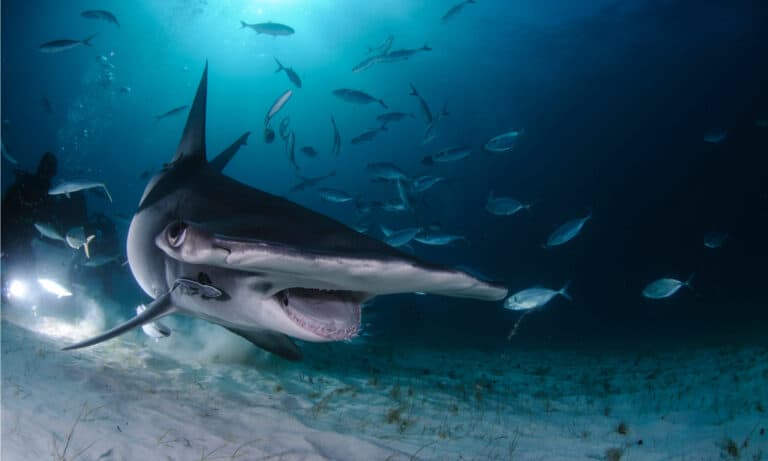
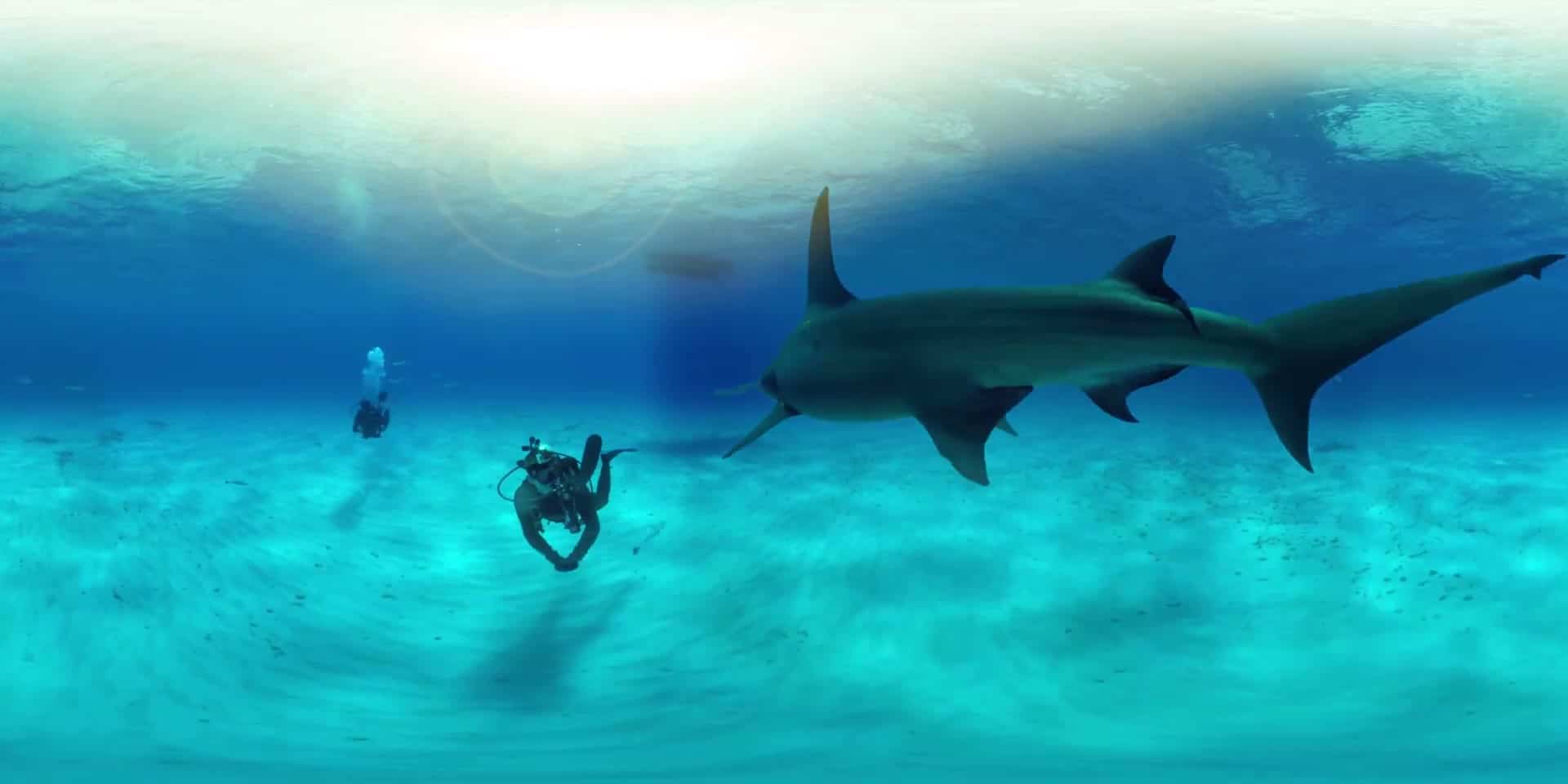
Wildlife filmmaker Andy Casagrande’s 360° footage of a great hammerhead shark passing within arm’s length of divers offers something most ocean documentaries cannot: a steady, unhurried look at how this animal actually moves. No music swell, no jump cut. The shark simply glides past, sweeping its wide cephalofoil through the water column, and that motion is where the biology lives.
The Biology Behind the Hammerhead’s Shape
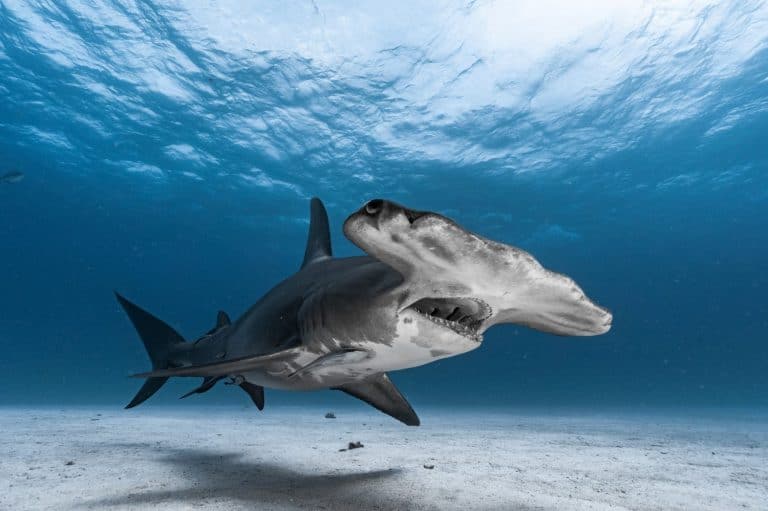
The great hammerhead (Sphyrna mokarran) is the largest hammerhead shark, with large adult females commonly reaching roughly 4.9 to 5.5 meters and the species recorded at up to about 6.1 meters. It is also the most distinctive. That T-shaped head, called a cephalofoil, has been the subject of decades of research, and scientists now agree it serves several overlapping functions rather than a single purpose.
The leading explanation involves electroreception. Like all sharks, hammerheads have ampullae of Lorenzini, gel-filled pores that detect the faint electrical fields produced by living tissue. By spreading those sensors across a wider head, the great hammerhead effectively scans a broader strip of seafloor with every sweep, much like a metal detector. Research by Stephen Kajiura and Kim Holland in the Journal of Experimental Biology compared juvenile scalloped hammerheads with sandbar sharks and found that the hammerhead shape did not increase electrosensory sensitivity to prey-like electric fields, but did provide a wider lateral search area and improved maneuverability.
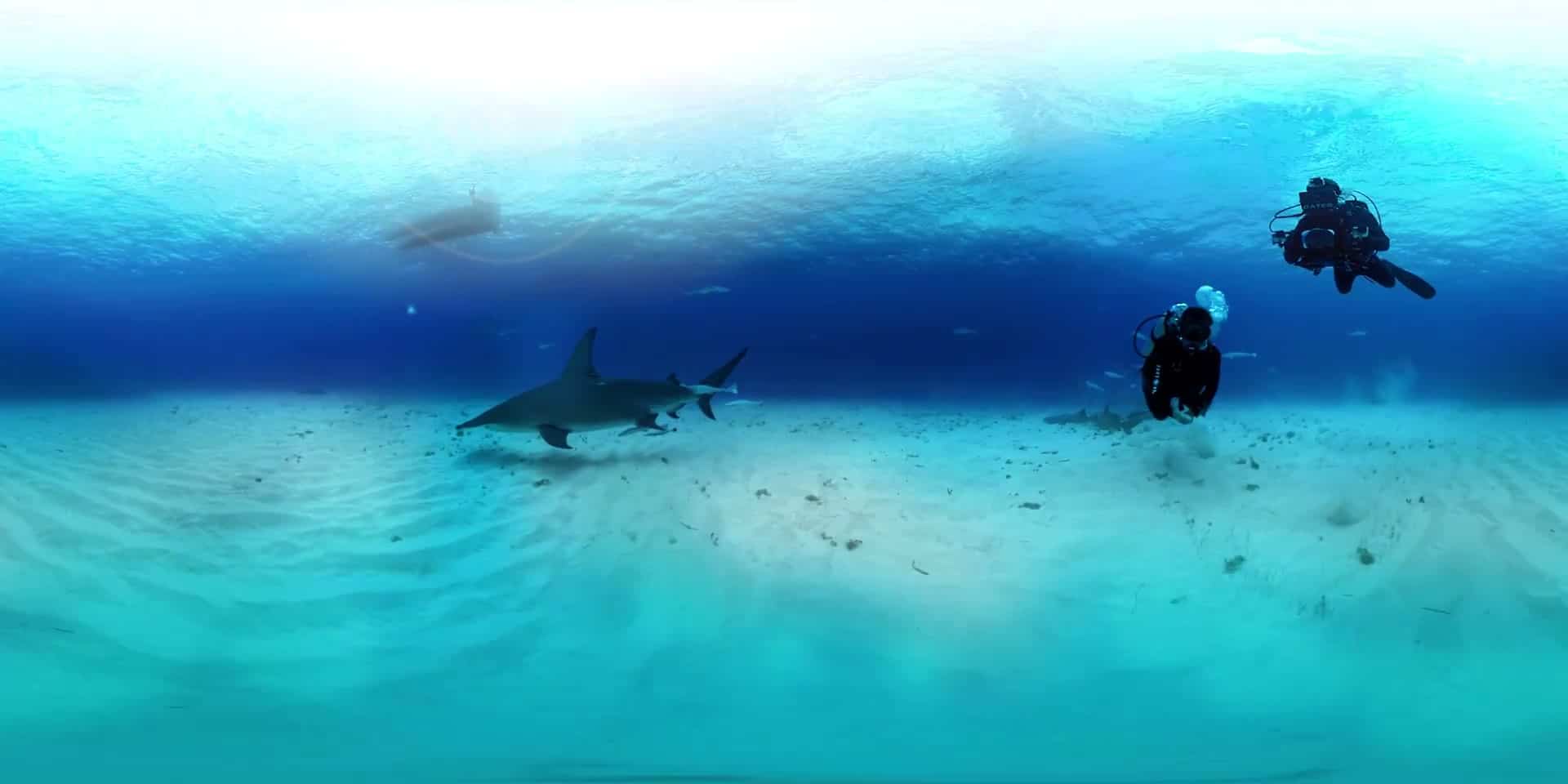
Hammerhead near seafloor with two divers, good depth and atmosphere
©Andy Casagrande – Shark Dreams via YouTube — used under fair use – Original / License
That sweeping head motion seen in the footage is not aimless. Great hammerheads specialize in hunting stingrays, which often lie flat and motionless beneath a thin layer of sediment. Studies tracking wild great hammerheads, including work by Chapman and colleagues at the Bimini Biological Field Station, have documented great hammerheads pinning rays to the seafloor with the underside of their cephalofoil before maneuvering to bite. The cephalofoil is feeding equipment.
The wide-set eyes also matter. A 2009 study by Michelle McComb and colleagues at Florida Atlantic University showed that hammerheads have excellent binocular vision directly ahead, surpassing that of pointed-snout sharks, along with a near-360° vertical field of view when they roll their eyes. The animal in Casagrande’s footage can see the divers clearly without turning toward them.
What the Footage Shows About Risk
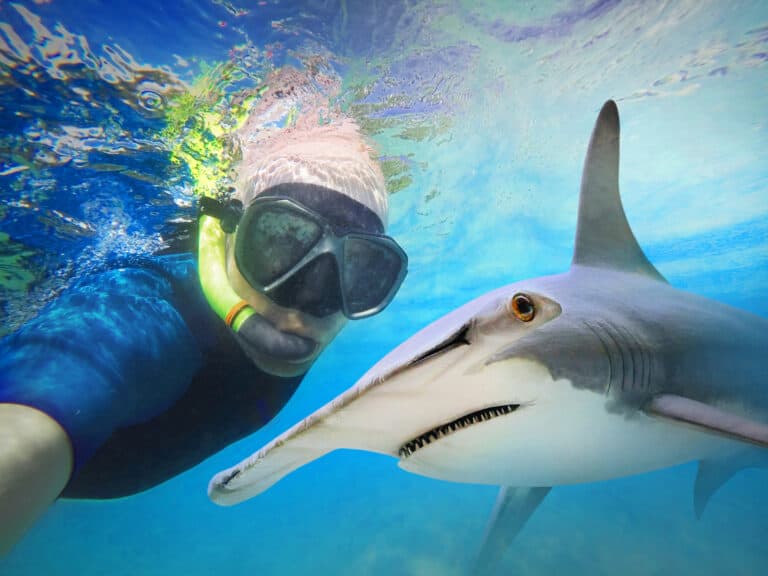
This brings up the question of risk. The International Shark Attack File lists hammerheads as a group (Sphyrna spp.) in 18 confirmed unprovoked, nonfatal bites and no confirmed fatalities, while noting that species identification in shark-bite cases can be difficult. They are large, capable predators, but encounters like the one filmed here — where divers remain calm and the shark passes at a measured pace — reflect the species’ typical behavior around humans. The shark is investigating, not stalking.
Why Bimini Matters for Great Hammerheads
The wider scene in the footage — with multiple sharks visible along the seafloor and a goliath grouper drifting through frame — points to one of the few places this kind of encounter still happens reliably: the shallow banks off Bimini in the Bahamas, where great hammerheads gather during the cooler months, often from winter into early spring. The Bahamas declared its waters a shark sanctuary in 2011, banning commercial shark fishing, and the protection has made the area one of the last predictable aggregation sites for the species.
That predictability is bittersweet. The IUCN Red List classifies the great hammerhead as Critically Endangered. Their large fins are highly valued in the shark fin trade, and the species is especially vulnerable to capture stress, with studies reporting high at-vessel and post-release mortality in several fisheries; Gallagher et al. estimated post-release mortality at around 50 percent for great hammerheads in one Florida study. Global population declines have been estimated at more than 80 percent over three generations.
What to Watch for in the Video
A few details in the footage are worth watching for. The tall, sickle-shaped first dorsal fin is diagnostic of S. mokarran and distinguishes it from the smaller scalloped hammerhead. The slow, almost lazy tail beat is characteristic of a shark in cruising mode rather than hunting. And the close approach to the camera is consistent with curiosity, a behavior well documented in large sharks encountering unfamiliar objects, mediated again by those ampullae picking up electrical signatures from camera housings and dive gear.
Footage like this matters beyond its visual appeal. Long-form, low-drama recordings of apex predators behaving normally give researchers behavioral data and give the public a baseline for what these animals actually do, which is mostly swim, sense, and move on.