Green mambas and green tree snakes are both known for having bright green scales. However, aside from their color and preference for trees, they have little else in common. They live in different parts of the world, have different ways of subduing their prey, and have different diets. These are just some of the characteristics that set these two snakes apart. Keep reading to learn more about the differences between green mambas vs. green tree snakes.
Green Mamba vs. Green Tree Snake Quick Comparison
| Green Mamba | Green Tree Snake | |
|---|---|---|
| Scientific Classification | Dendroaspis genus in the Elapidae family | Dendrelaphis genus in the Colubridae family |
| Distribution and Habitat | Rainforests of eastern Africa or western Africa, depending on species | A wide variety of habitats in Australia, Papua New Guinea, and Indonesia |
| Size | Weight: 2-3 pounds Length: 4-7 feet; western mambas slightly larger on average | Weight: 0.27-0.37 pounds Length: 4-6.6 feet |
| Appearance | Usually bright, glossy green; western mamba fades to more yellowish-orange color near the tail | Body scales are typically bright green, but there can be significant variation in color |
| Venom | Highly venomous; western green mamba more potent and venom acts more quickly | Not venomous |
| Hunting Style and Diet | Active pursuit and ambush; diet includes birds, bird eggs, small reptiles and mammals | Active hunter; diet includes amphibians, lizards, tadpoles, fish, birds |
Key Differences Between Green Mambas and Green Tree Snakes
As shown in the table above, key differences include scientific classification, distribution and habitat, size, appearance, venom (or lack of), and their hunting styles and diets. Take an in-depth look at each difference in the following sections.
Scientific Classification
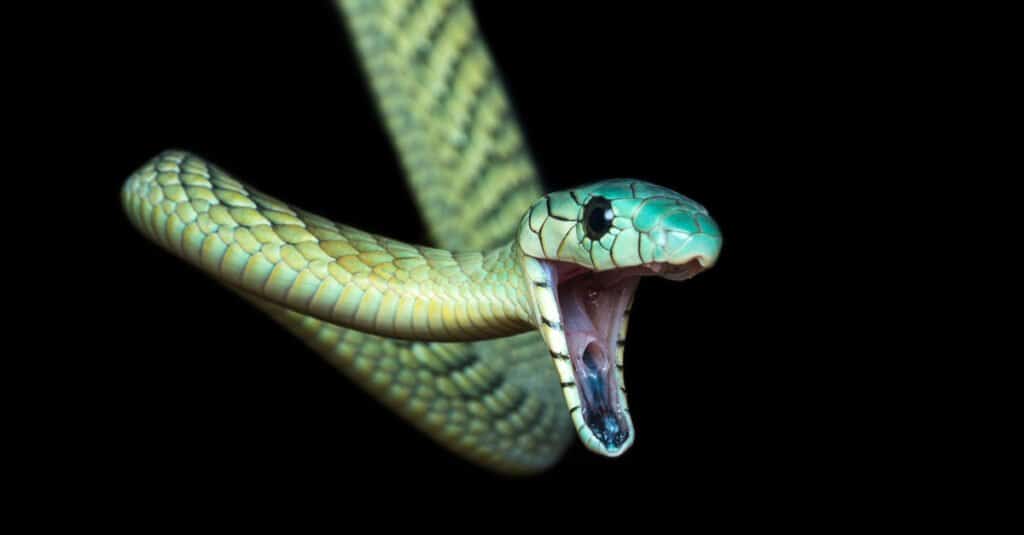
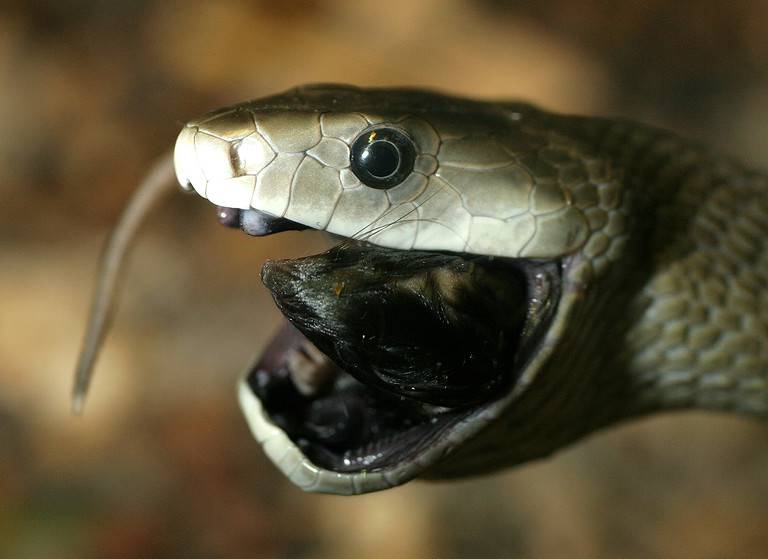
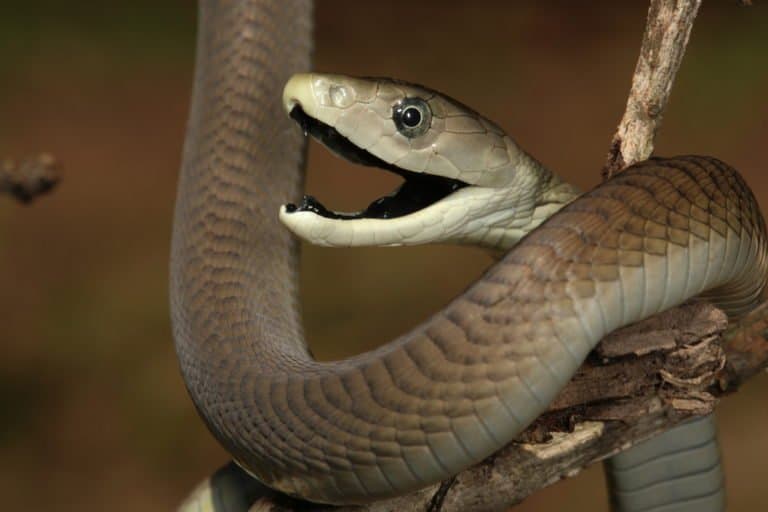
Green mambas have short, fixed fangs at the front of their mouths.
©Sibons photography/Shutterstock.com
There are two green mamba species, the eastern green mamba (Dendroaspis angusticeps) and the western green mamba (Dendroaspis viridis). These snakes belong to the Elapidae family, which is characterized by permanently fixed fangs in their upper jaws.
The common green tree snake (Dendrelaphis punctulatus) belongs to the Colubridae family. Most snakes in this family are not venomous and lack fangs in their upper jaws. However, some may have fangs at the back of their mouths and teeth in their upper jaws.
Distribution and Habitat
The green mamba is native to Africa. The western green mamba is arboreal, so it lives in trees. This snake can be found in densely vegetated coastal woodlands and tropical rainforests of West Africa. The eastern green mamba can be found along the coasts of East Africa, usually in the tropical rainforests, coastal bushlands, dunes, and mountainous woodlands. Like their western cousins, these snakes are arboreal and prefer dense vegetation with plenty of shade.
As their name indicates, green tree snakes are also arboreal. They can be found in tropical rainforests, mangrove swamps, and bushlands near permanent water. As their name indicates, green tree snakes are also arboreal. They can be found in tropical rainforests, mangrove swamps, and bushlands near permanent water. These snakes inhabit the northern and eastern regions of Australia, as well as parts of Papua New Guinea and Indonesia.
Size
Typically, the green mamba can reach between 4 and 7 feet long. They weigh between 2 and 3 pounds, with females being slightly larger to accommodate reproduction. Western green mambas are, on average, larger than eastern green mambas.
Green tree snakes have a similar length, reaching between 4 and 6.6 feet. However, these snakes are more slender and do not weigh as much. One study of snakes in Queensland found that they ranged from 0.27-0.37 pounds, with females being larger.
Appearance
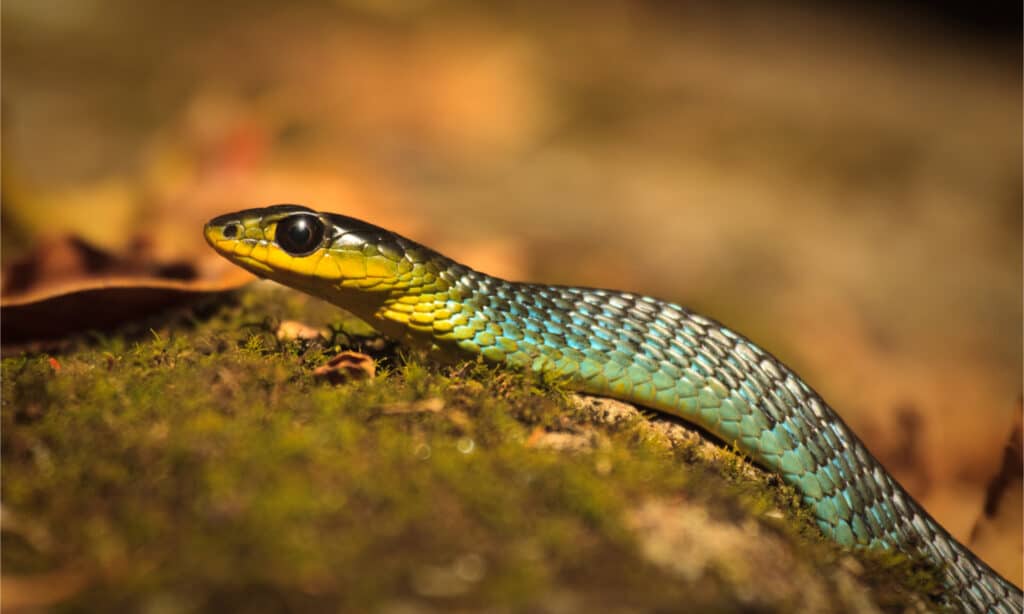
The green tree snake varies more in color than the green mamba.
©Pete Niesen/Shutterstock.com
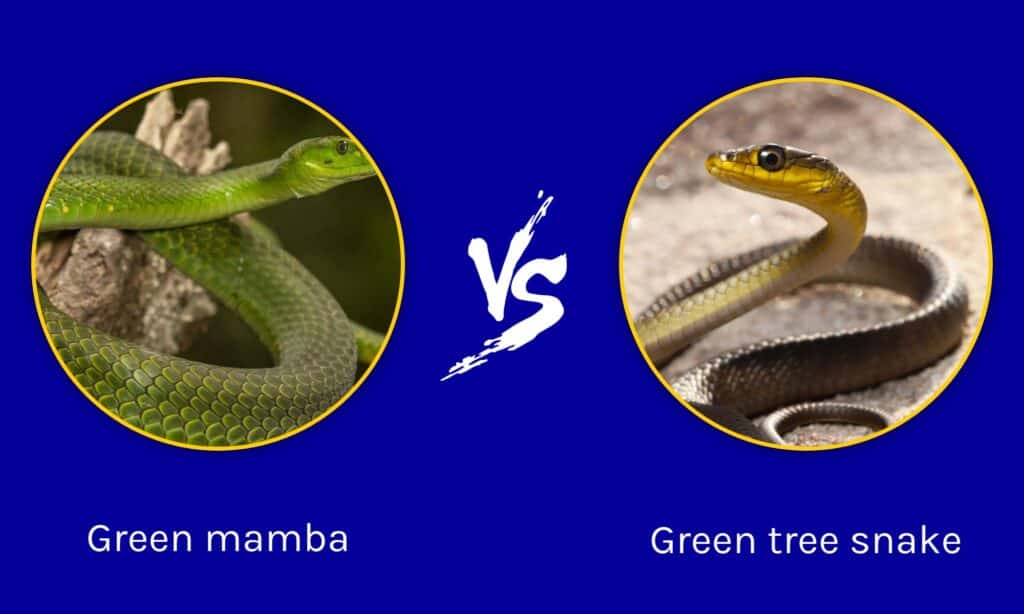
Green mambas are typically very bright green with light green to yellow bellies. They have slender bodies but are surprisingly heavy for their size. This snake has a slim, coffin-shaped head and round eyes with olive green or yellow iris edges. The insides of their mouths are pink to bluish-white, and mature snakes usually have black tongues. They have smooth scales, but eastern green mambas are a more uniform green, while western green mambas have scales with black margins that fade to a more yellowish-orange near the tail.
Green tree snakes vary more in color than green mambas. These snakes may be bright green, olive, blue, brown, or black. They have yellow bellies and throats. Their bodies are slim with long, thin tails. Their heads are relatively small, and they have prominent, round eyes with yellow irises. Green tree snakes also have black tongues and keeled, or ridged, scales.
Venom
The green mamba is a highly toxic venomous snake. Their venom is primarily neurotoxic, quickly impacting the nervous system and causing respiratory distress. If left untreated, their bites can be fatal. The western green mamba is said to have more potent and faster-acting venom than the venom of the eastern green mamba. Fortunately, they are solitary snakes and do not often come into contact with humans. They would also rather avoid a confrontation and are not naturally aggressive toward humans, but they have nervous temperaments, which can cause them to strike.
Green tree snakes are non-venomous. However, they do have fangs at the back of their mouths and may bite if they are cornered. To deter threats, a green tree snake can also produce a strong, foul odor from glands near the base of its tail. These snakes are not aggressive towards humans and are hesitant to bite.
Hunting Style and Diet
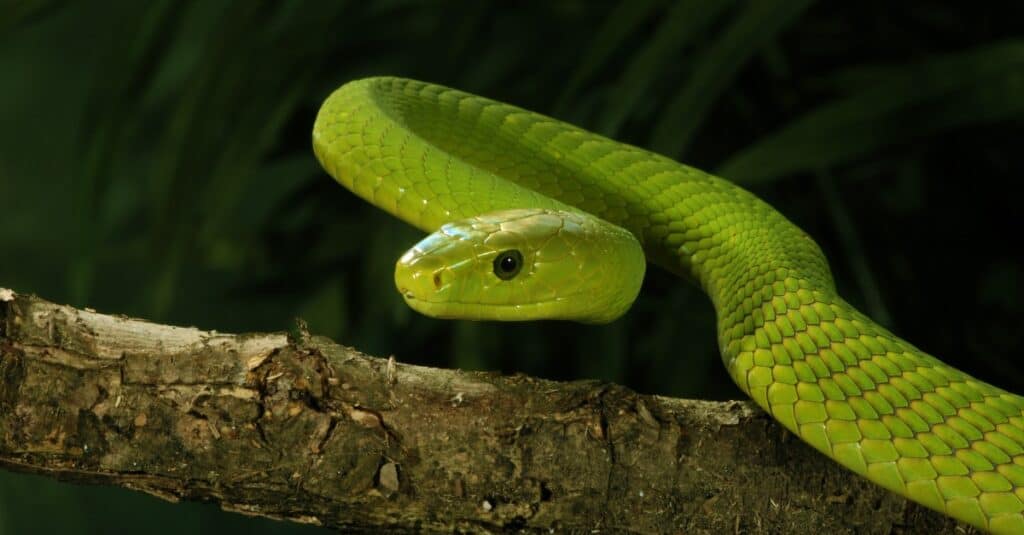
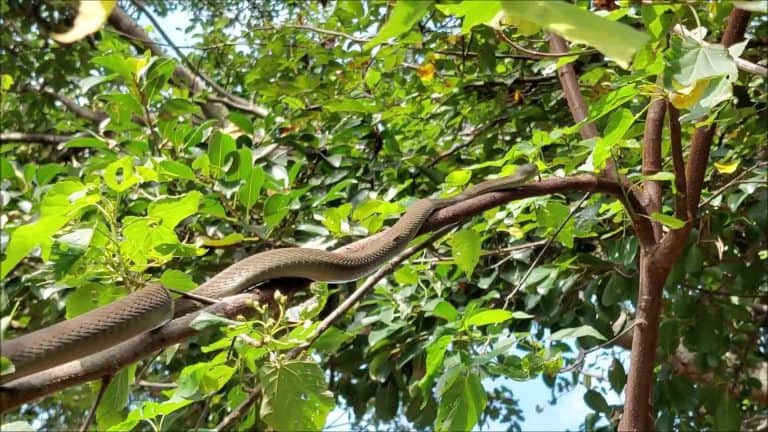
Green mambas actively pursue prey through the canopy.
©iStock.com/through-my-lens
Both green mambas and green tree snakes are carnivores. Green mambas actively pursue their prey through the canopy, but eastern green mambas are more likely to lie in wait to ambush prey. These snakes strike multiple times in rapid succession until their prey is subdued. Their diet primarily consists of birds, bird eggs, and small reptiles and mammals.
Green tree snakes are also active hunters and use camouflage to ambush prey. They spend their days searching for food in the trees and bushlands, striking quickly when prey comes into range. As these snakes prefer habitats near water, their diet includes more aquatic prey. Green tree snakes hunt amphibians, tadpoles, and fish, as well as lizards and birds.