
If you live in the southeastern United States, you may have seen the Florida banded watersnake, the cottonmouth, or both. However, only one of these species is venomous, so it’s important to be able to differentiate between the two. Florida banded watersnakes (Nerodia fasciata pictiventris) are a subspecies of banded watersnakes, or simply southern watersnakes. Cottonmouths (Agkistrodon piscivorus) are also called water moccasins. Here, we’ll discuss the biggest differences between cottonmouths and Florida banded watersnakes. By the end of this article, you’ll know which snake you should look out for, and how to tell the two apart.
The Key Differences Between Florida Banded Watersnakes and Cottonmouths
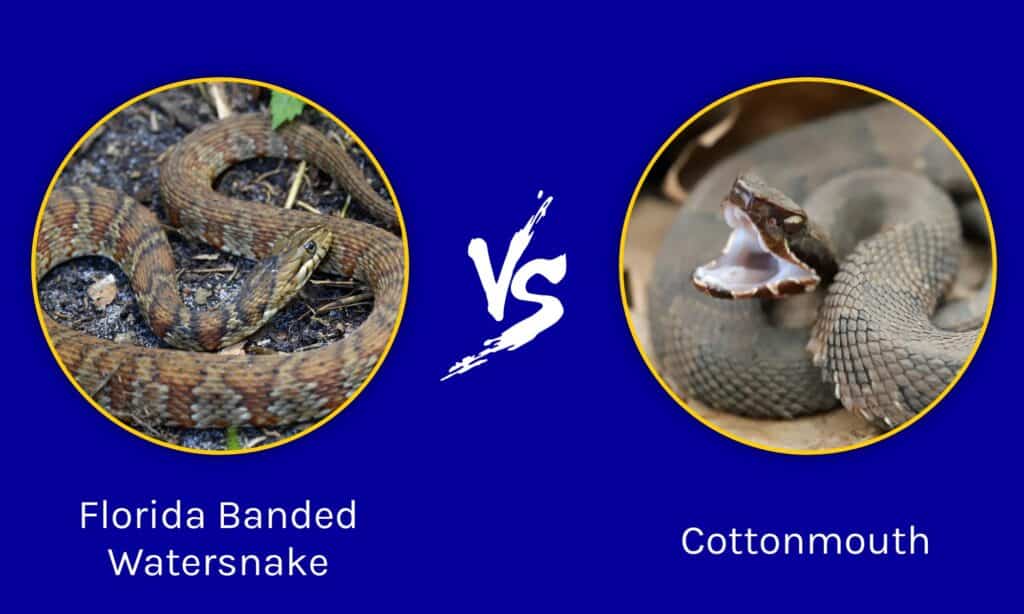
The biggest difference between Florida banded watersnakes and cottonmouths is that Florida banded watersnakes are nonvenomous. While both snakes enjoy water, they differ in physical characteristics, distribution and habitat, behavior, diet, and toxicity. Take an in-depth look at each of these differences in the following sections.
Physical Characteristics
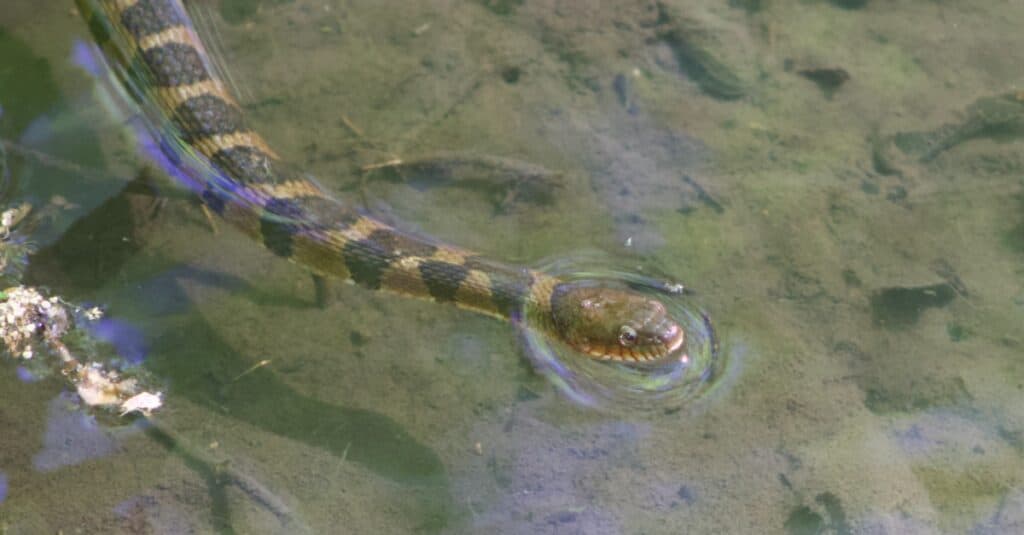
Banded watersnakes rarely grow longer than 3.5 feet.
©iStock.com/Dalene Capps
Out of the two snakes, cottonmouths are the bigger species. Florida banded watersnakes rarely exceed 3.5 feet, although the record length is 5.2 feet. Cottonmouths generally grow up to 4 feet long, with a record length of 6.16 feet. Cottonmouths are also much heavier than banded watersnakes. Most mature cottonmouths weigh 3-4 pounds, with some large individuals weighing up to 10 pounds. Banded watersnakes typically weigh around 1 pound. Additionally, banded watersnakes have round pupils, while cottonmouths have elliptical pupils, like a cat’s eye. Banded watersnakes also lack the heat-sensing pits behind their nostrils that mark cottonmouths as members of the pit viper family.
Both species range anywhere from yellow-brown to reddish or greyish-brown in coloring. Older snakes of both species tend to be darker and less vibrant. Young cottonmouths even have a bright yellow-tipped tail, which they use to attract prey. The biggest difference in coloring between the two lies in their striped patterns. The cottonmouth has dark crossbands that are wider on the sides of its body and thinner on the top, which is the opposite pattern of most water snakes, including the Florida banded watersnake.
Distribution and Habitat
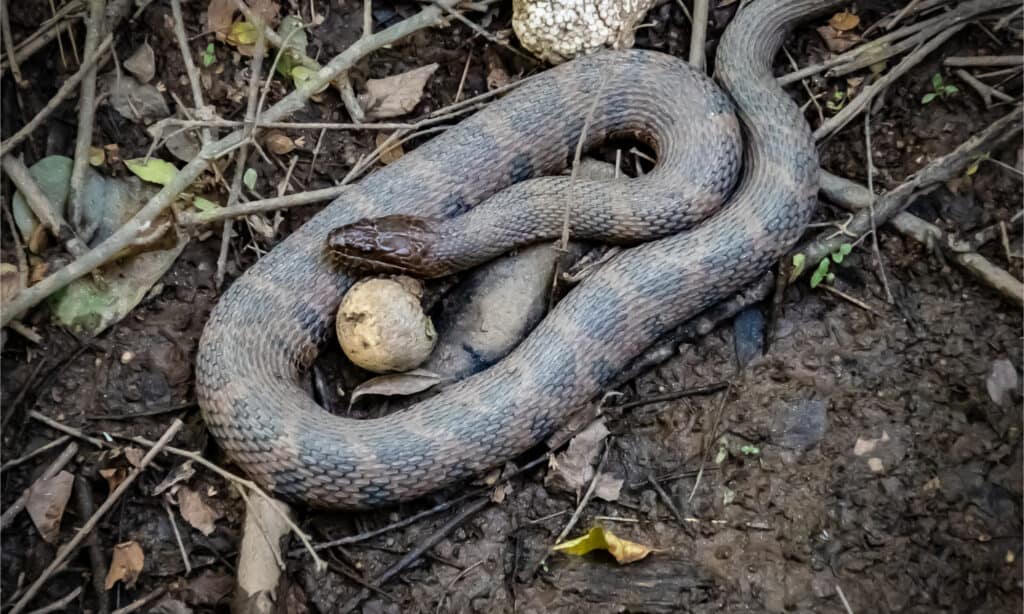
Banded watersnakes live in various types of waterways throughout their range.
©Deborah Ferrin/Shutterstock.com
Cottonmouths can be found throughout much of the southeastern United States. Florida banded watersnakes are endemic to Florida and extreme southeastern Georgia, except for the Florida Keys. The cottonmouth’s range overlaps with the Florida banded watersnake’s range across Florida and extreme southeastern Georgia. However, they can also be found in the upper Keys.
Cottonmouths and banded watersnakes are semi-aquatic; they can often be found draped over branches that hang over sources of freshwater or basking on rocks at the water’s edge. Cottonmouths prefer permanent sources of water, while banded watersnakes will take any source of water they can get. These include rivers, swamps, lakes, marshes, and floodplains. The banded watersnake is almost never found away from water, while the cottonmouth can sometimes be found on dry land far from water.
Behavior
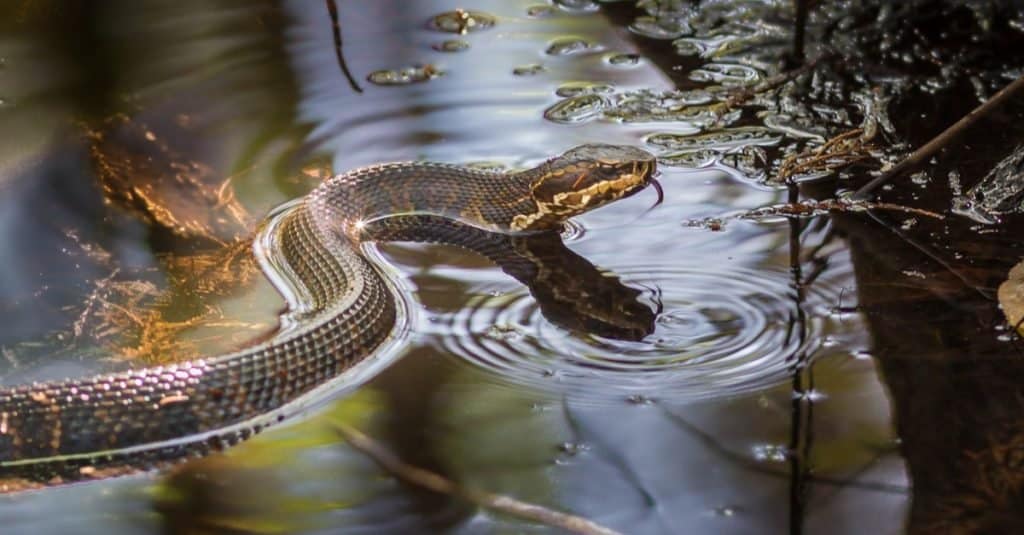
When cottonmouths swim, most of their bodies can be seen above the water.
©jo Crebbin/Shutterstock.com
Both snakes are excellent swimmers. Cottonmouths swim with most of their bodies above the water. They inflate their lungs so they can float on the surface with their heads held high. Florida banded water snakes also swim with their heads above water, but their bodies are mostly submerged. Both species are primarily active at night, but they may also be active during the day when the weather is cooler. Northern cottonmouths and watersnakes may brumate, which means to enter a dormant state, or hibernate during the cold winter months. However, unless their local temperatures drop low enough, neither southern cottonmouths nor Florida banded watersnakes takes a winter break.
Like many species of snake, cottonmouths and Florida banded watersnakes are ovoviviparous, meaning that the female gives birth to live young. Cottonmouths produce 3-14 young at a time, with some sources reporting as many as 20. They typically give birth between August and October, but they breed in alternate years because of the high energy requirements of reproduction. However, Florida banded watersnakes give birth to anywhere from 6 to 83 young. They generally give birth between July and September, and they breed about once a year.
Diet
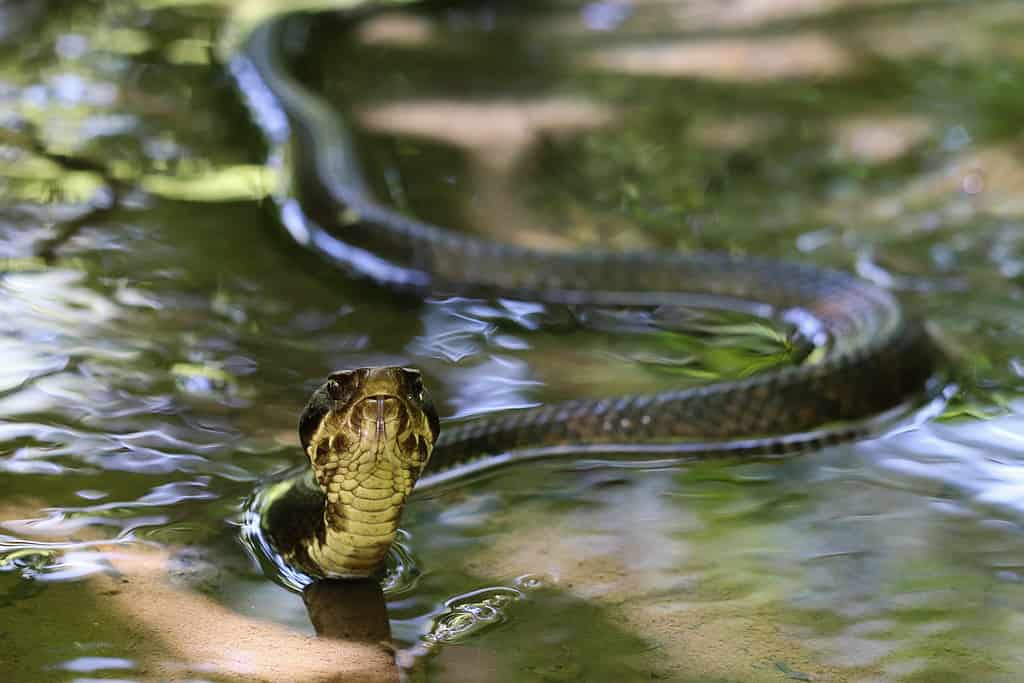
Cottonmouths can eat bigger prey than Florida banded watersnakes due to their larger size.
©Rafael R Sandoval/Shutterstock.com
Cottonmouths and Florida banded watersnakes are carnivores that prey on many of the same aquatic animals. The biggest difference in their diets comes down to size: cottonmouth snakes are larger and heavier than Florida banded watersnakes, so cottonmouths can hunt bigger prey.
Florida banded watersnakes eat mainly frogs, newts, salamanders, toads, crayfish, and fish. Cottonmouths eat all of those things too, especially when they’re young and small. However, a mature cottonmouth can also eat other snakes, reptiles, turtles, small mammals, and even baby alligators.
Toxicity
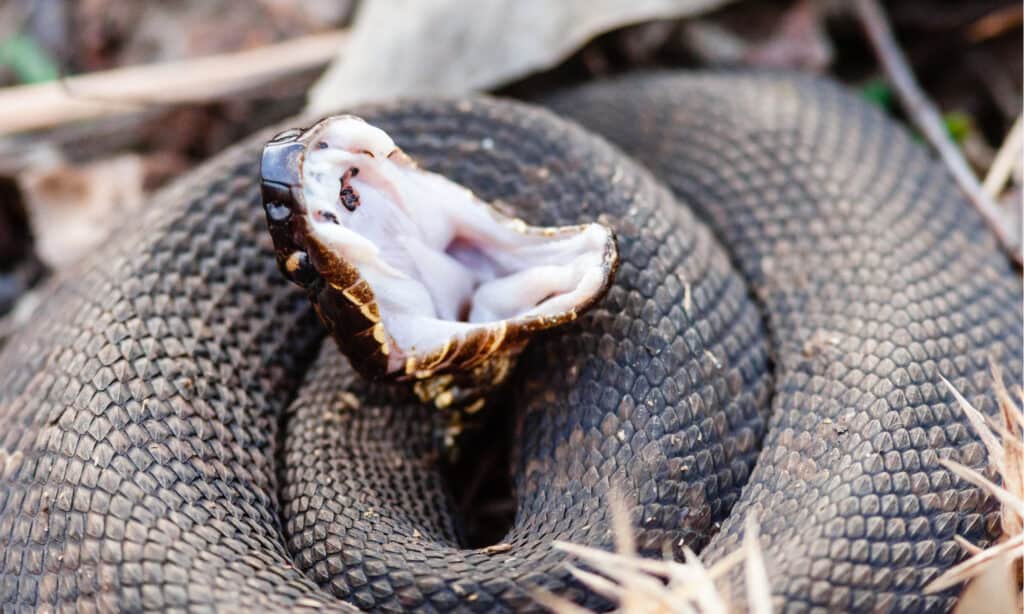
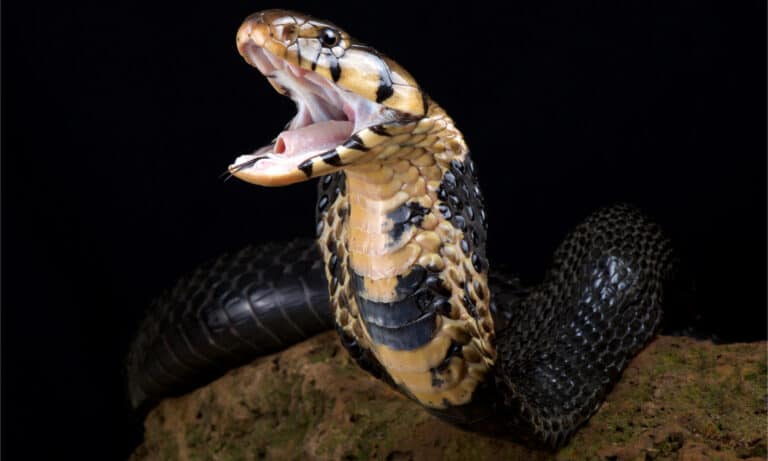
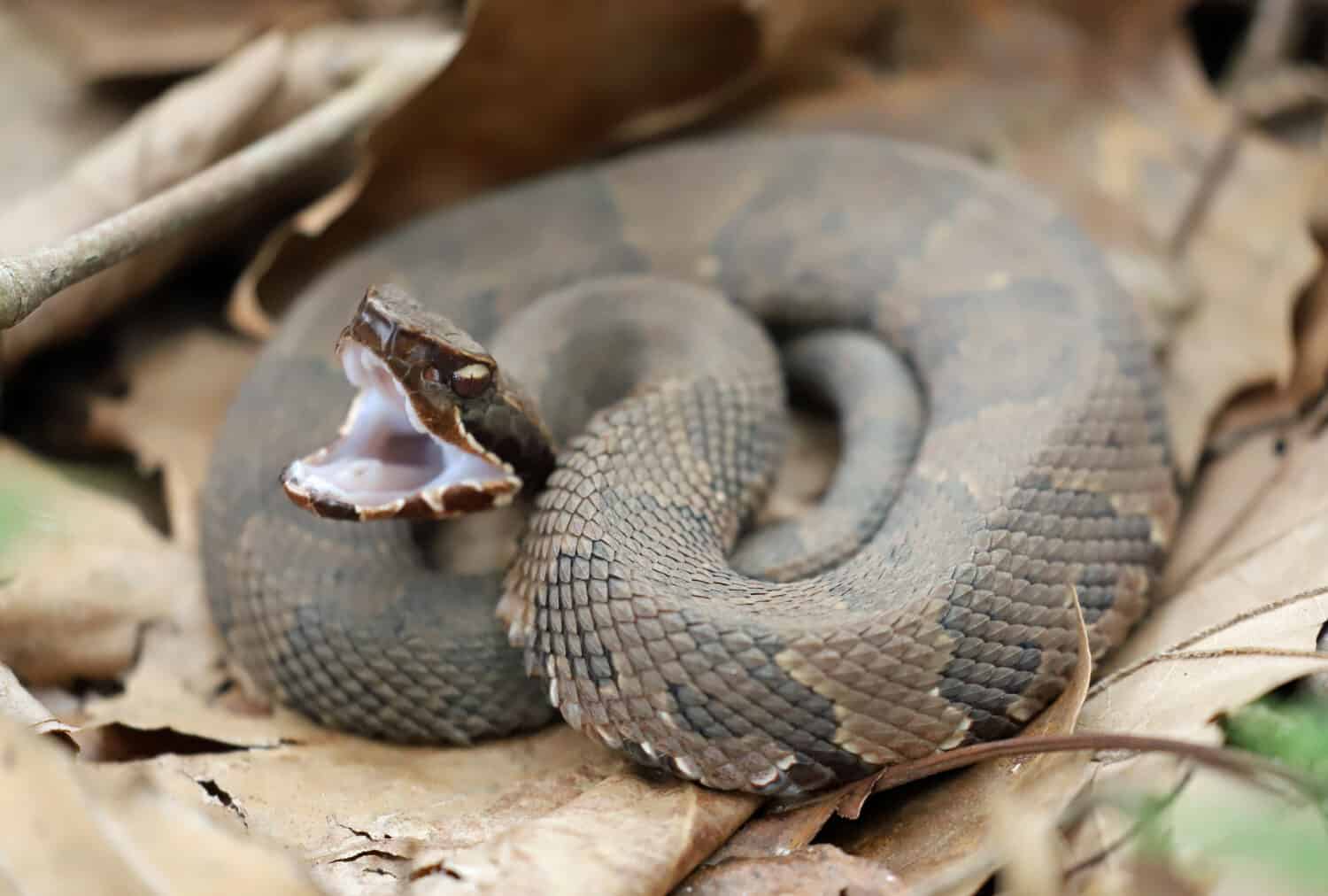
Cottonmouths show their distinctive white mouth to warn would-be aggressors.
©Marcum Havens/Shutterstock.com
Out of the two species, only the cottonmouth is venomous. Cottonmouths are pit vipers, like rattlesnakes and copperheads, with venom glands located just under their eyes. The Florida banded watersnake, though frequently confused with the cottonmouth, has no venom. A bite from either will hurt, but only the cottonmouth is capable of delivering venom.
Cottonmouths have hollow, curved fangs to inject venom into prey. They are not naturally aggressive and typically only bite if they are mishandled or accidentally stepped on. Some bites do not contain venom at all, as the snake reserves its venom to kill prey and begin digestion. In humans, cottonmouth venom is cytotoxic and causes bleeding and tissue death at the site of the bite. Cottonmouth bites rarely cause systemic issues in humans, but they can be serious and should be treated by medical professionals immediately.
Which Is More Dangerous Between a Florida Banded Watersnake and a Cottonmouth?
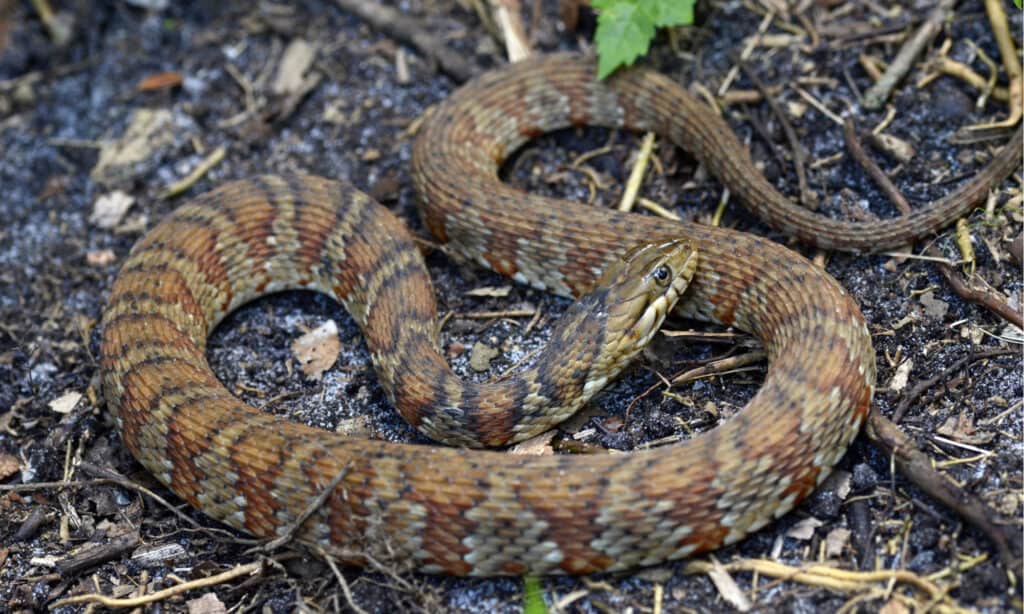
Florida banded watersnakes can bite, but unlike the cottonmouth, they have no venom.
©Patrick K. Campbell/Shutterstock.com
Without question, the cottonmouth is more dangerous than the banded watersnake. Banded watersnakes may look intimidating, and they can deliver a painful bite, but they lack venom and cannot do any serious damage to humans.
Cottonmouth venom can be dangerous to both humans and pets. If you do sustain a bite from a cottonmouth, do not attempt to kill or capture the snake. Instead, seek medical attention immediately. Do not apply ice or heat to the bite or try to extract the venom. Similarly, there is no need to use a tourniquet. Medical personnel will monitor the bite, and, if there are signs of envenomation, administer antivenom.