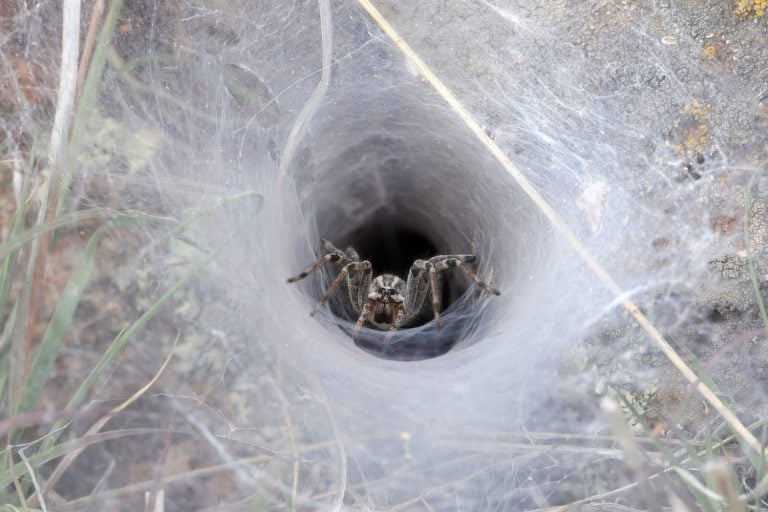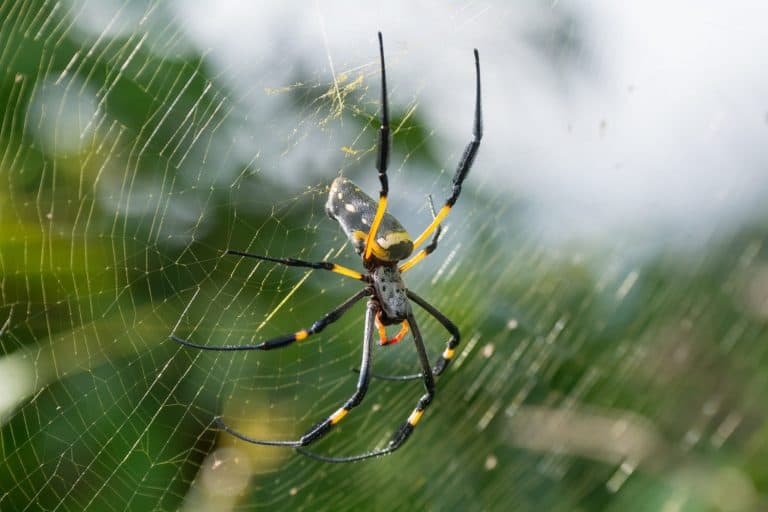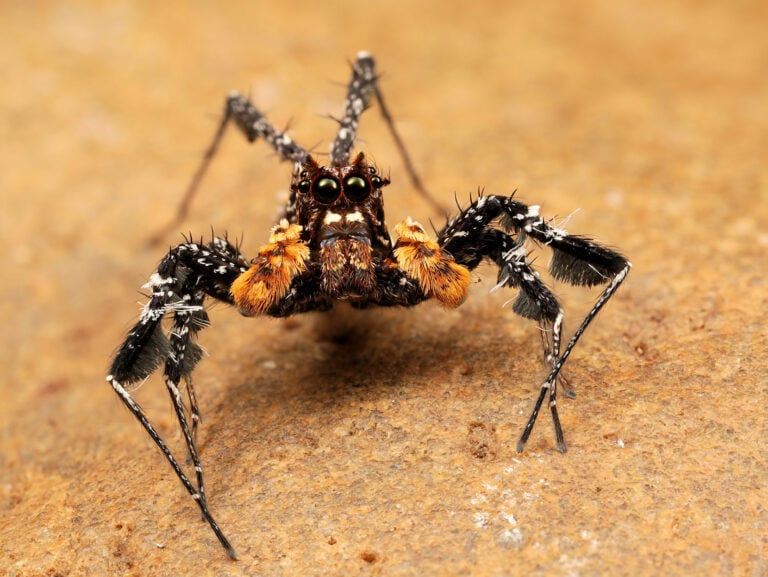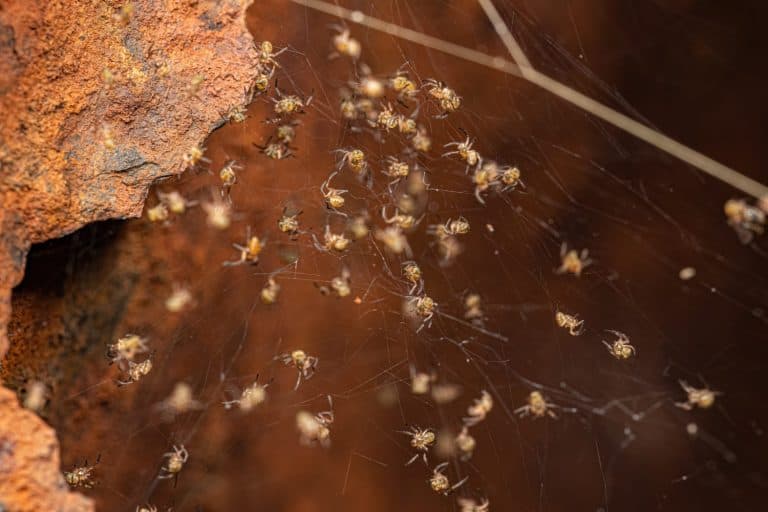

The hackled orb weaver, native to the western United States, is a spider so small and delicate it can perch atop your finger. Yet, despite its tiny body, the spider constructs webs of remarkable complexity. Eight spindly legs move with the grace of a nimble dancer. Three claws help it to maneuver around its gossamer home. Eight eyes perceive the world; however, in the dark, this spider relies on touch to build its intricate web.
It is this intricacy and the ability to construct it blindly that attracted researcher Andrew Gordus, senior author of a recent study into the methodology of web weaving. Gordus, who works at Johns Hopkins University’s Department of Biology at Krieger School of Arts and Sciences, became fascinated by the complex structures built by creatures with such small brains. “After seeing a spectacular web, I thought, ‘if you went to a zoo and saw a chimpanzee building this, you’d think that’s one amazing and impressive chimpanzee,’” he said. Yet, for a creature smaller than a fingertip, the feat was even more astounding.
So Gordus set about investigating the inner workings of spiders to determine how they manage their impressive constructions. With the help of technology, including artificial intelligence, his team successfully mapped the spider’s choreography for the first time.
Designing the Arena
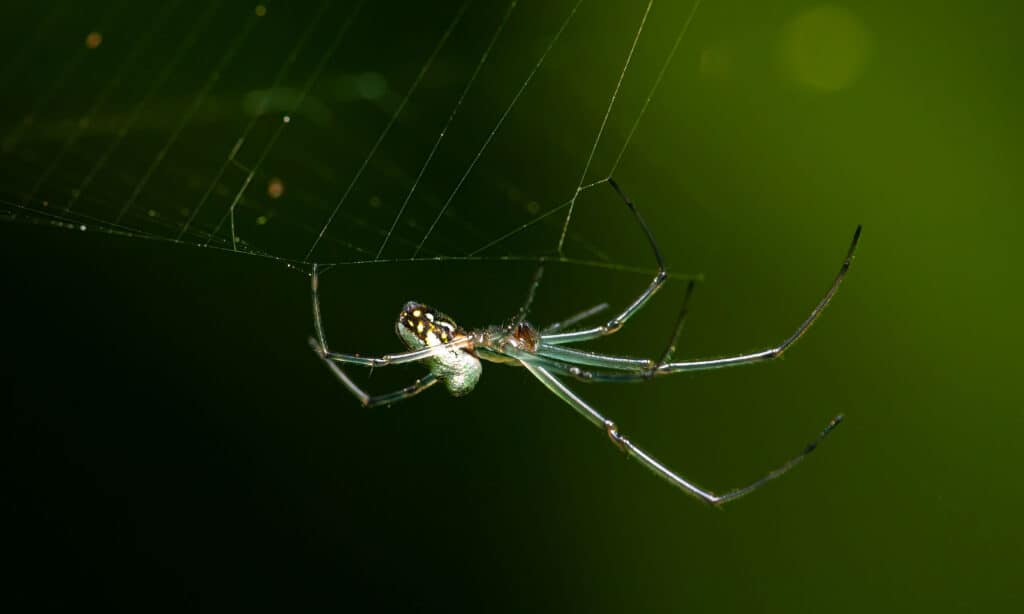
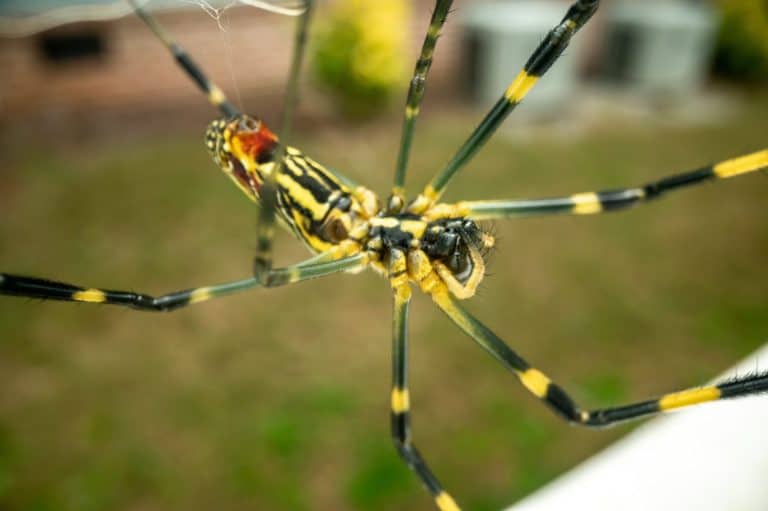
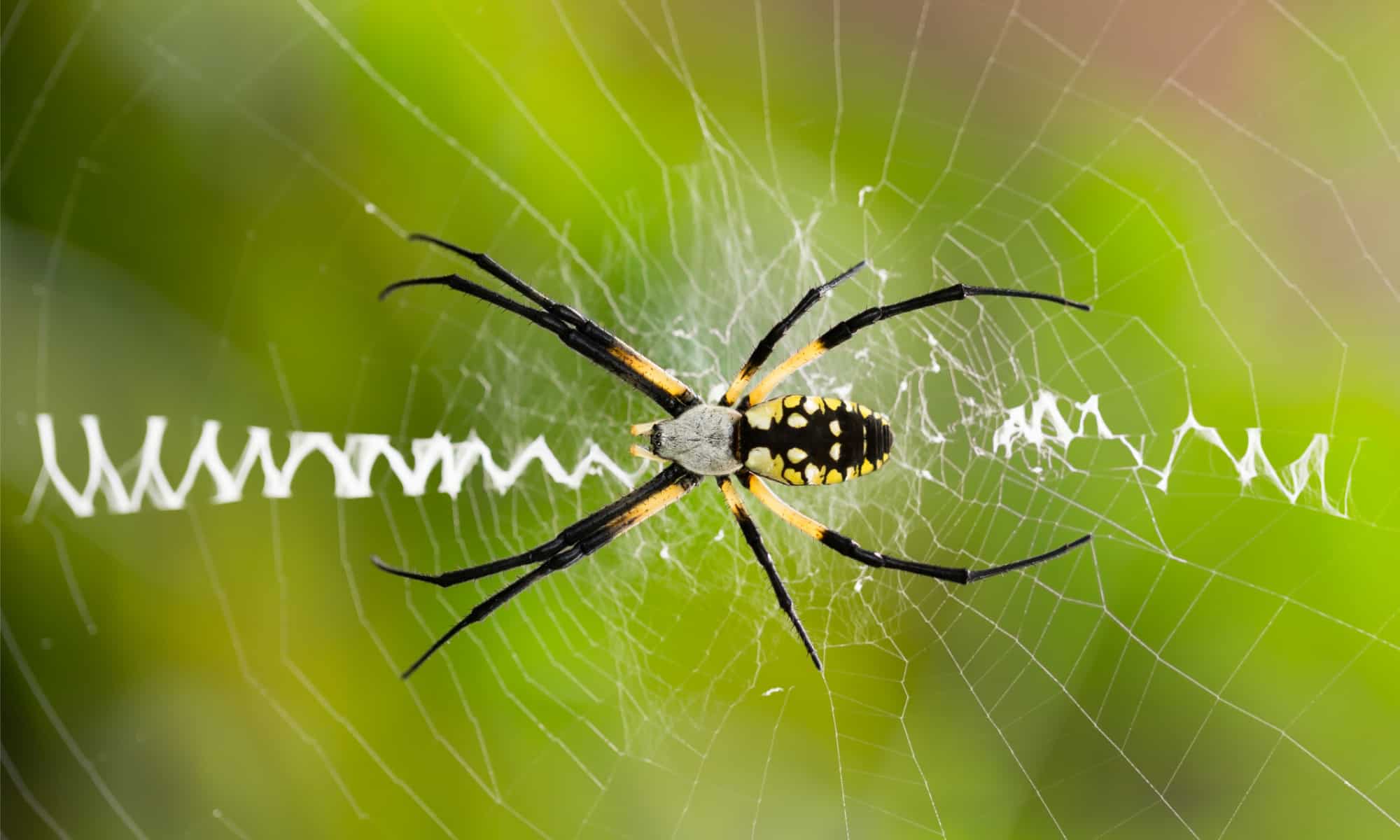
Researchers documented and analyzed the behaviors and motor skills involved in web-building.
©iStock.com/Tanuza
The trouble in tracking a spider’s web-building lies in both its complexity and its chosen hour. Hackled orb weavers build at night, creating an obstacle for Gordus and his team. To resolve that issue, they set up an infrared-lit space and cameras with the capability to record infrared light. The cameras recorded at a high frame rate in order to capture each individual leg’s motion. However, this produced an immense amount of data.
That presents the second problem. “Even if you video record it, that’s a lot of legs to track, over a long time, across many individuals,” said Abel Corver, a graduate student and a lead author of the paper. The study included six spiders across multiple nights. That amounts to millions of frames that require annotation. What is a dataset nightmare for students becomes a treasure trove for an AI algorithm.
Using AI to Track Spiders’ Movements
Rather than poring over the images, they designed a computer program to track each individual spider leg. The program also tracked each leg’s relation to the others to record the web weaver’s posture. The results were remarkable. AI was capable of predicting which phase of the construction process a spider was engaged in just by reading its leg positions.
By analyzing the data processed by artificial intelligence, researchers uncovered interesting findings. All the spiders in their study operated more or less in the same manner. The web-building process was the same across individuals of the species. This suggests that the rules for web-building are hardwired into their brains. Reacting to the findings, Gordus said, “Now we want to know how those rules are encoded at the level of neurons.”
Spider Brains
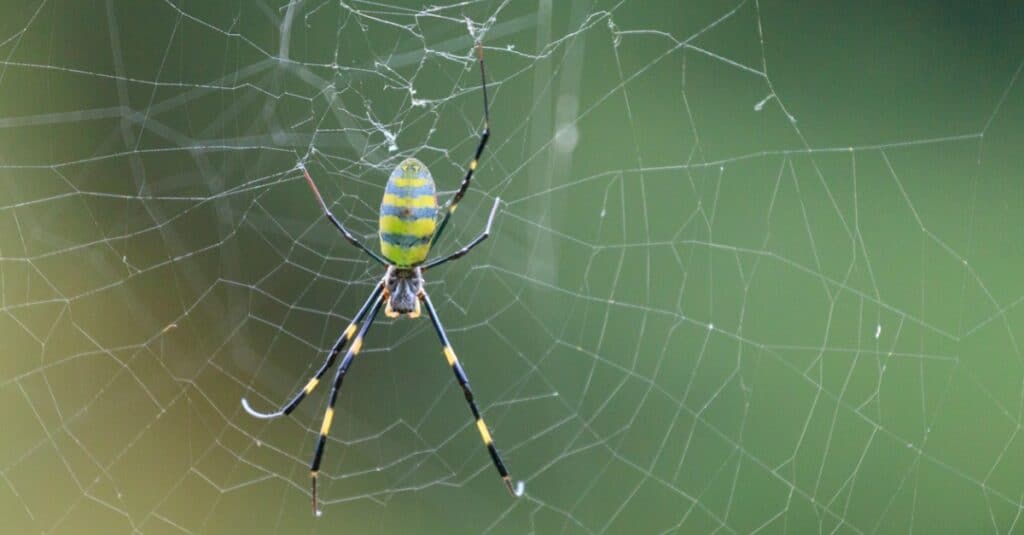
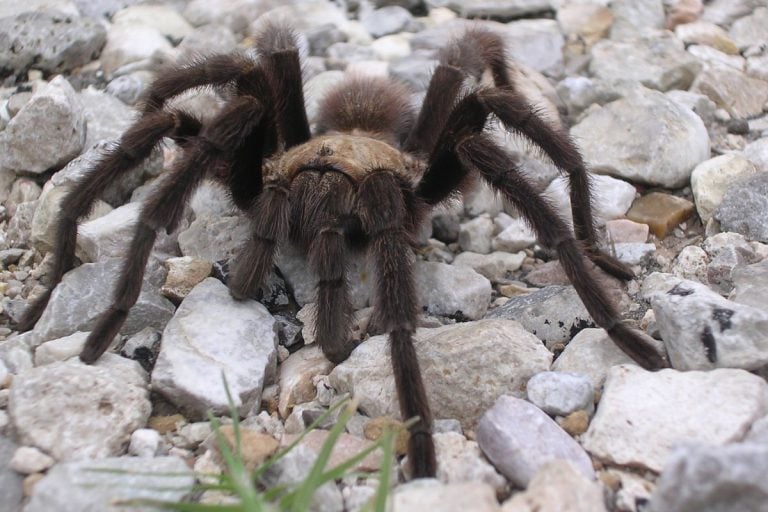
Spiders may be small, but they have more brain mass per unit of body mass than many larger animals.
©iStock.com/Jef Wodniack
The ability for tiny creatures like spiders to construct such complex webs illustrates something in biology known as Haller’s rule. It states that the smaller the creature, the greater the proportion of brain mass in comparison to body mass. So, while spiders’ brains are much smaller, they retain greater capability than would be expected of their size. This evolutionary principle demonstrates the vitality of the brain.
This process is known as brain miniaturization, which is similar to how technological advancements allow more complex computational power to fit into increasingly smaller devices. Brains become even more compact as species evolve. William Eberhard, a spider researcher at the Tropical Research Institute, explained to Scientific American how spider brains got creative with space in smaller arachnids. “In the tiny ones they were going into the legs, and the sternum was bulging out, and it was full of brain,” he said.
Testing Spiders of Different Sizes
To research this phenomenon, Eberhard studied web-making spiders of different sizes. He wanted to see whether larger spiders made fewer mistakes on account of having larger brains. The results surprised him. No matter the size of the spider, nor even the space in which they made their web, the number of mistakes remained constant.
Haller’s rule has been observed in many small animals, particularly arthropods, indicating that as body size decreases, the brain-to-body mass ratio increases, helping maintain brain complexity despite miniaturization. This functions in a variety of ways, from thinning the skull to shrinking the size of brain cells and their connecting axons. In the case of spiders, this can mean fitting brain matter into other parts of the body.
Future Research
Following their recent study, Gordus and his team hope to further their research by peeking into the brains of spiders as they set about their task. With the use of various drugs, they wish to observe the circuitry of the brain to determine which switches correspond to each part of the web-building process.
By exploring the functionality of these small yet complex brains, researchers may unravel some of the mysteries of our own minds. It may also contribute interesting solutions for computer scientists who increasingly look to nature for inspiration.