
Quick Take
- Common swifts can sleep while flying, but the way they pull it off defies how we think sleep works. How unihemispheric sleep works →
- Landing on the ground isn't just unusual for a common swift. It's a death sentence, and the reason why is built into its body. Why landing is fatal →
- Drinking should be the one thing that forces a swift to land, but the bird has a workaround that comes with its own risk. See the risky workaround →
- A swift does have legs, but they evolved into something that makes the bird almost helpless the moment it touches ground. How their legs evolved →
It’s hardly news that birds are good at flying! But when it comes to avian skills, not all birds are equal. While some birds spend relatively little time in the sky, the common swift is one of the most determined flyers on the planet. Sometimes, it flies for 10 months without stopping. Here we share more about this incredible airborne expert.
What Type of Birds Are Common Swifts?
Common swifts (Apus apus) are members of the Apodiformes order of birds, which also includes hummingbirds. During the breeding season, they are found from western Europe to eastern Asia and from northern Scandinavia and northern Siberia to North Africa, the Himalayas, and central China. Over the winter months, they migrate to Southern Africa, from Zaire and Tanzania south to Zimbabwe and Mozambique.
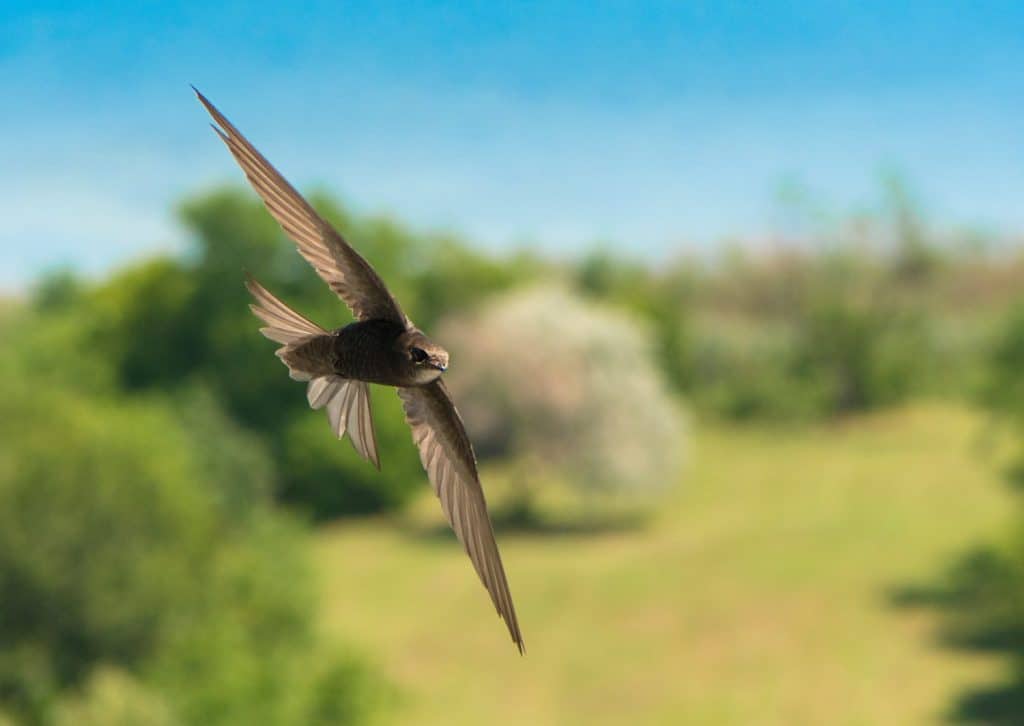
Common swifts have a slim body and wide wingspan.
©Dilomski/Shutterstock.com
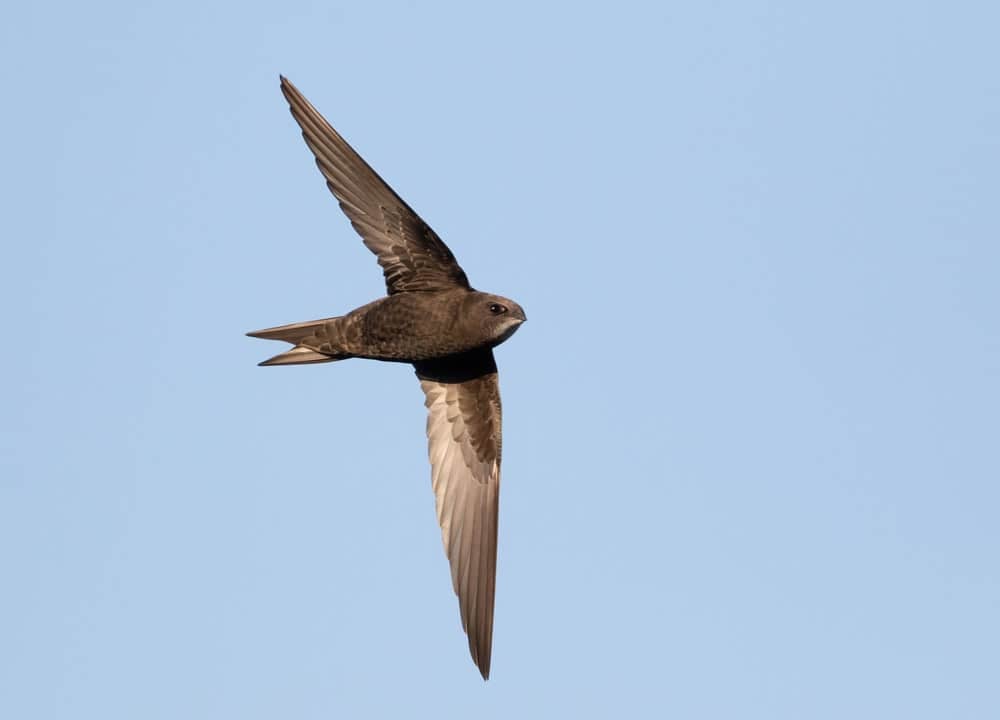
These birds are around 6 inches long with a wingspan of between 16 inches and 19 inches. They weigh just 1.5 ounces. Most of their body is a black-brown color but they have a white to cream colored chin and throat. Their tail is moderately forked.
Common swifts breed from late April to early May through to mid-September when the young are fledged. They can mate in flight, although it can also take place on the nest.
Extreme Flying Feats
Common swifts can pull off some extreme feats of flying, spending most of their life in the air. They eat, drink, gather nesting materials, and mate without setting a foot on land. These guys even sleep on the wing. The only time they land is to nest, and even that is often done on vertical surfaces such as rocky walls and chimneys.
During migration, common swifts can cover an average of about 354 miles (570 kilometers) per day, with some individuals reaching up to 517 miles (832 kilometers) in a single day, flying at heights that can reach up to 8,000 feet. They are among the fastest birds in terms of daily migration distance covered. What’s more, research has found that swifts are airborne for around 99 percent of their 10-month non-breeding period. Some individuals were in the air for the whole 10 months. During the day, they tend to glide more, taking advantage of soaring in thermal air currents.
Spending so much time on the wing is a great strategy for avoiding predators on the ground and an extremely efficient way of getting around and covering long distances. However, it does come with some logistical challenges.
What Adaptations Do Common Swifts Have?
You cannot spend that long in the sky without having some very finely tuned adaptations. Firstly, common swifts have long, narrow, sickle-shaped wings with stiff feathers that help them to stay airborne with minimum effort. Their silhouette is like a bow and arrow, their small head is hidden between powerful shoulders, and their body is torpedo shaped.
Though they have legs and feet, these limbs do not work very well and have atrophied to reduce their weight. Common swifts cannot perch on branches or wires but can cling to vertical surfaces. If they do land on the ground, their wings are too long, and their legs are too weak for them to take off again!
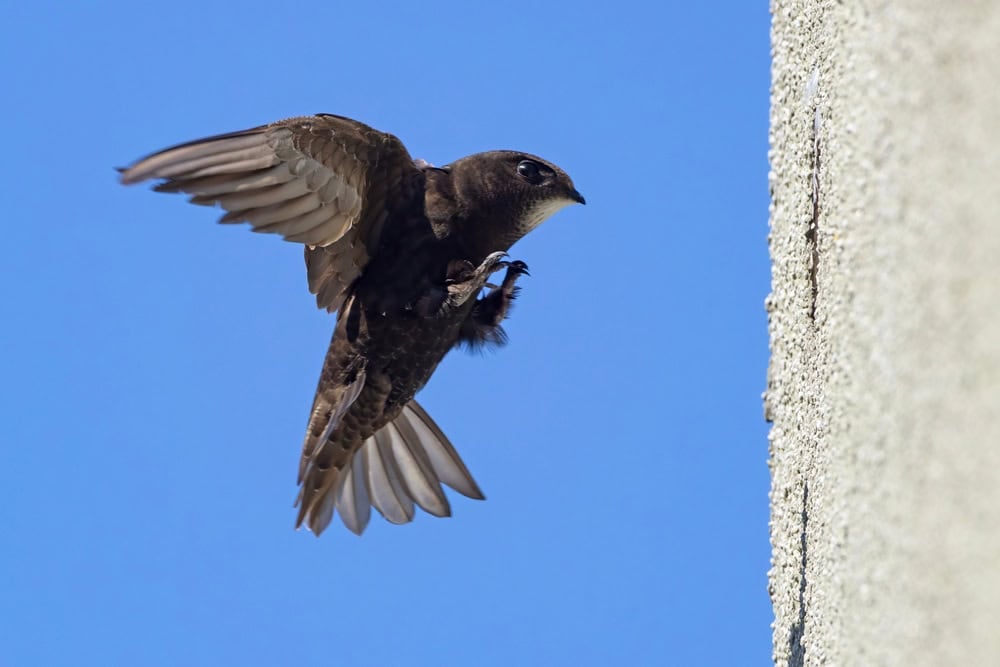
Common swifts can cling to vertical surfaces.
©gergosz/Shutterstock.com
Eating on the wing is relatively easy for them as they have a large mouth. They are insectivorous and feed on aerial insects and spiders that they gather in their mouths as they move through the air. Their most common prey are aphids, wasps, bees, ants, beetles, and flies. The birds use a product from their salivary glands to form a bolus (food ball) made up of around 300 insects in their throat. Their preference is for swarms of insects, as this makes food collection a lot easier. These guys also collect airborne material such as dried herbs and feathers, which they mix with saliva to make their nests.
At night, they rise to higher altitudes, taking advantage of warm air masses and avoiding obstructions such as buildings and trees. They beat their wings for four seconds, then rest for three seconds or so. They sleep by switching off one half of their brain through a process known as unihemispheric slow wave sleep (USWS); one side of the brain can rest while the other stays active.
How Do Swifts Drink Without Landing?
Drinking is one of the few requirements that ties common swifts to the earth. They cannot land to drink due to their long wings that do not retract well. Rather, they have to skim across the top of bodies of water with their beak open.
Scientists have studied the fine-tuning of this behavior by using 3D optical tracking to record swift drinking trajectories. Interestingly, the birds do slow down before they reach the water, even though this means that they lose mechanical energy. They adopt a ‘braking’ behavior where they make sharp turns; they also use headwind and postural adjustments to lose both height and speed. This slowed flight is costly in terms of energy loss, but the alternative is dangerous. If they approach the water at high speed, they increase their chances of falling; if this happens, they are unlikely to be able to get out!