Quick Take
- Only one black spider in California can actually hurt you, and it is probably not the one you would guess first. Meet the dangerous female →
- One of these spiders builds a hidden door to its home and uses it as a trap, with a construction technique that is more sophisticated than most people realize. See the burrow-building technique →
- The spider with the boldest name is actually the most likely to run away from you, and its behavior defies everything its reputation suggests. Discover its surprising behavior →
- Two spiders on this list live in Los Angeles and San Diego neighborhoods right now, and most residents have no idea. Find tarantulas in urban areas →
California’s mild weather is a perfect haven for many creatures, including insects and arachnids. Spiders typically elicit strong responses in humans, with many of us running the opposite direction when a spider is spotted. Just the mention of spiders often brings to mind scary-looking images of tarantulas and black widows, both of which are on our list. Fortunately, California’s only black spider with dangerous venom is the black widow. Read on to learn more about black spiders in the Golden State, including how to identify them, where they can be found, and which ones are dangerous.
1. Western Black Widow
Western black widows (Latrodectus hesperus) can be found across California. They usually inhabit debris-littered environments close to the ground, such as underneath rocks and woodpiles. On occasion, they make their way indoors, but that’s not typically their preference, as they would rather create sneaky homes in crevices and holes outdoors. These spiders have potent venom that is medically significant to humans. Luckily, they are not aggressive and only bite if they feel threatened. Only the female black widows are dangerous to humans. They measure up to 1.5 inches including the legs, and have glossy black bodies with a red hourglass on the underside of the abdomen. Males are about half the size of females and are brown, tan, or grey, with one central abdominal stripe and a set of diagonal stripes on each side.
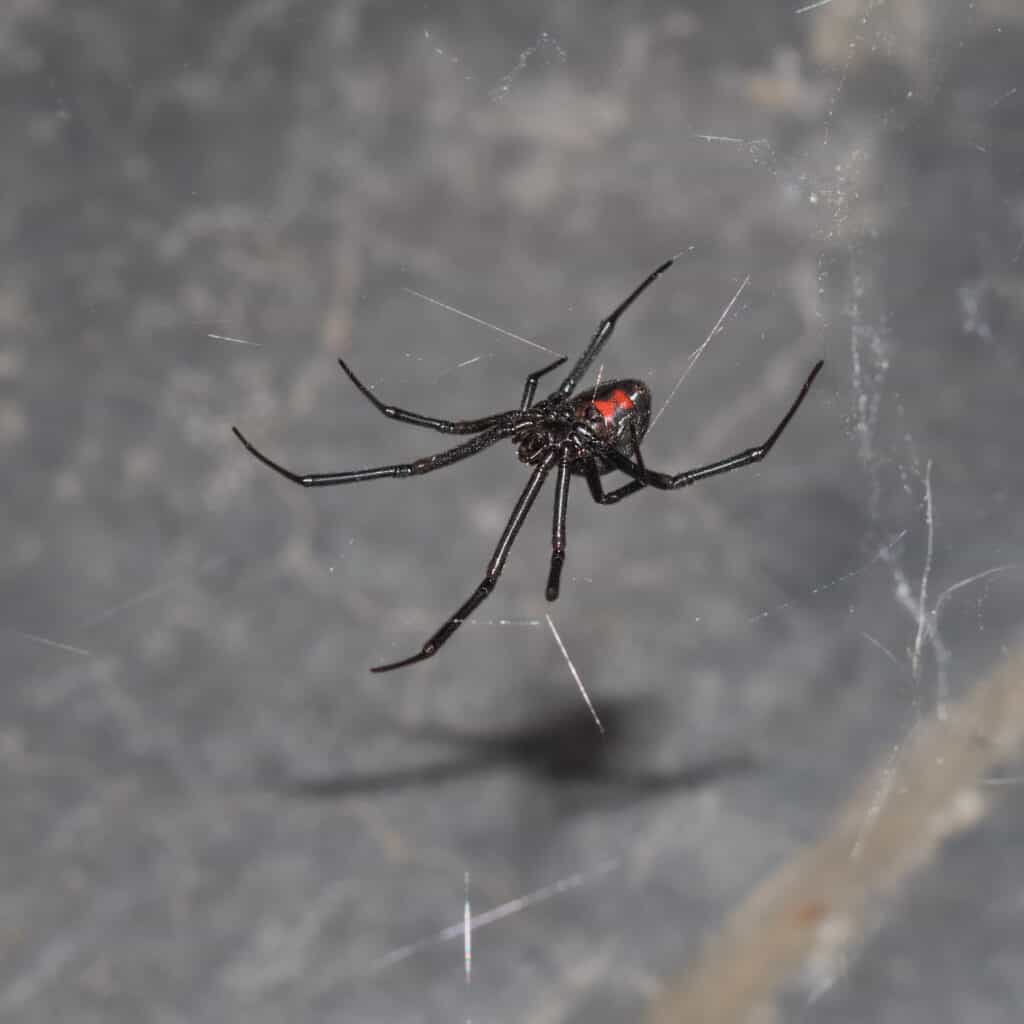
The females have black bodies, and typically a red hourglass-shaped mark in the center of their bellies.
©iStock.com/Shravan Sundaram Photography
2. California Trapdoor Spider
California trapdoor spiders (Bothriocyrtum californicum) are experts in home construction, neatly lining their space with silk and creating a D-shaped lid or “door,” which they keep closed most of the time. These little burrows are cylindrical and may be as deep as 8 inches and as wide as 0.75 inches. They open the door to retrieve trapped prey. These spiders look a lot like tarantulas, with stocky bodies and legs, but they are smaller and lack hair. Their glossy cephalothoraxes and legs are typically black or dark brown, while their abdomens are more of a rusty brown. They measure up to 1.25 inches in body length and have leg spans of up to around 3 inches, with males being smaller. They are primarily found in Southern California, including coastal areas and inland cliffs and hillsides. Their fangs may pierce the skin, but they are not dangerous to humans.
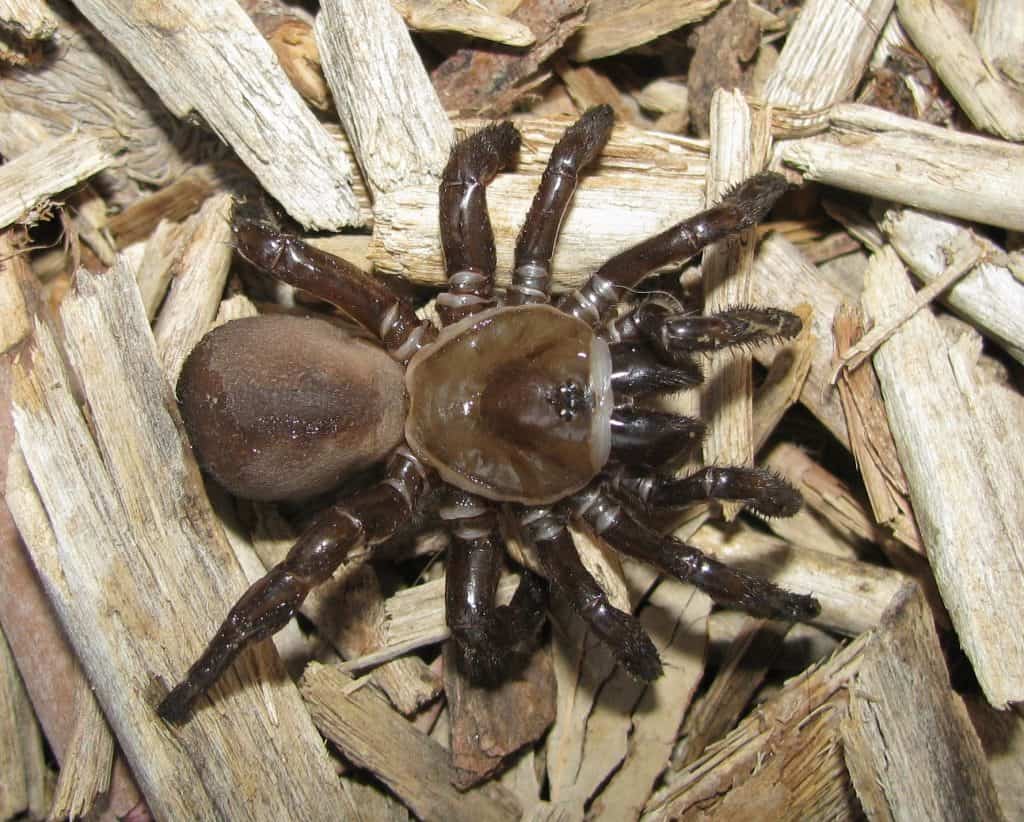
California trapdoor spiders typically have glossy dark brown to black bodies.
3. Bold Jumping Spider
Despite their name, bold jumping spiders (Phidippus audax) generally retreat if a human approaches them. These are hunting spiders that don’t build webs. They use daylight and their incredible stereoscopic vision to stalk prey. They can jump 10 to 50 times their own body lengths. These spiders are black and hairy with metallic, blue-green iridescent chelicerae (mouthparts). Their abdomens have white or yellow colored spots (orange if they’re young). The males look like they have eyebrows. They measure 0.24 to 0.75 inches, with females being larger. Bold jumping spiders live in a variety of different environments throughout California, including gardens, backyards, barns, on fences and windowsills, and other sunny outdoor areas. Bites can cause mild pain, but these spiders are not harmful to humans.

Bold jumping spiders are black and hairy, and their abdomens have colored spots.
©Gill Thompson/Shutterstock.com
4. Johnson’s Jumping Spider
Johnson’s jumping spider (Phidippus johnsoni) is also known as the red-backed jumping spider, for obvious reasons. These spiders actively hunt for prey during the day and the females weave a funnel-shaped web when it’s time to lay their eggs. They look for crevices and concealed environments, like under stones, or in low foliage, shrubs, and grass to remain hidden. They are stocky spiders with fine, dense hairs and iridescent metallic green or blue chelicerae. Their legs and cephalothoraxes are all black, but males have a solid red belly, while females have a black line that runs through their red abdomens. They are capable of jumping great distances to snatch their prey. They measure about 0.3 to 0.6 inches, with females being larger. Johnson’s jumping spiders are found throughout California. Bites may sting, but they are harmless.
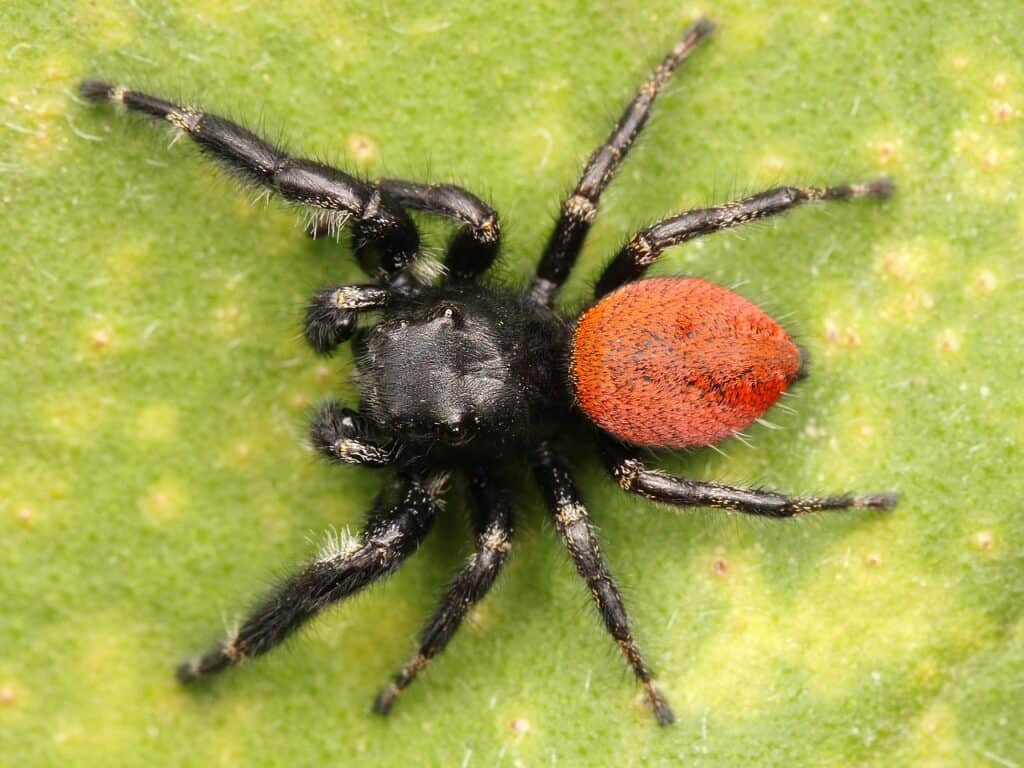
The red-backed jumping spider is easily identifiable due to its bright red abdomen.
5. Ribbon Jumping Spider
The ribbon jumping spider (Metacyrba taeniola) is a tiny, flat-bodied spider measuring between 0.17 and 0.28 inches, with females being larger. They have flattened, dark brown or black bodies with relatively broad carapaces. These spiders also have long abdomens with pale longitudinal lines and other markings. Ribbon jumping spiders are widely distributed across the U.S. from coast to coast, with confirmed sightings throughout California. They are typically found outdoors on trees, rocks, leaves, and on vertical structures, but they sometimes find their way inside homes. These spiders are not dangerous to humans.
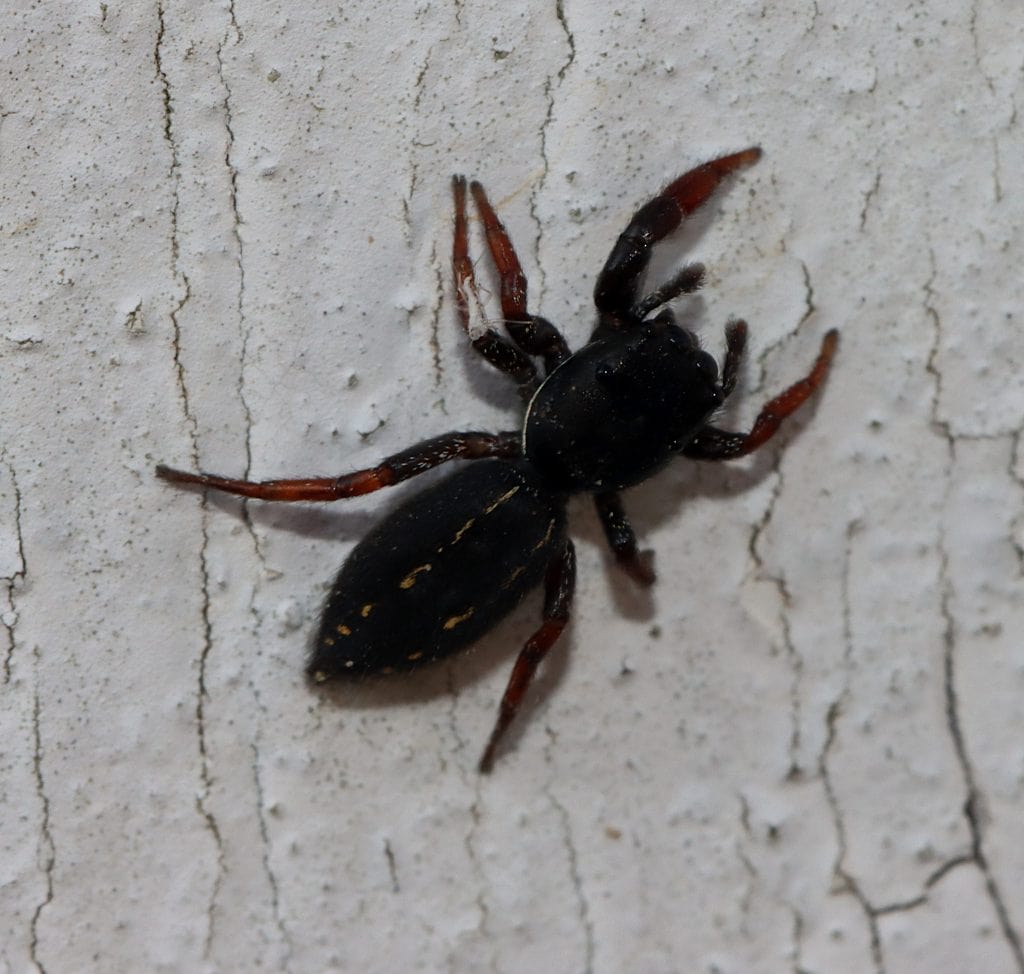
The tiny ribbon jumping spider is widely distributed across the U.S.
6. California Black or Ebony Tarantula
The California ebony tarantula (Aphonopelma eutylenum) lives in underground burrows, rarely leaving except to hunt for prey or mate. They are relatively large tarantulas that are almost completely dark brown, grey, or black with darker femurs and covered in light brown hairs. They have a leg span of about 5 inches. These tarantulas are widely distributed across Southern California, primarily west of the Mojave Desert down the southern California coast. Their range includes urban areas such as Los Angeles and San Diego. Due to their fangs, bites can be painful, but they pose no threat to humans.

California ebony tarantulas are widely distributed across Southern California.
©Adam Mustafa/ via Getty Images
7. Steindacher’s Ebony Tarantula
Steindacher’s ebony tarantula (Aphonopelma steindachneri) has the typical build of many Aphonopelma species. This heavy-bodied spider reaches leg spans of up to 5 inches. It can be found across Southern California in coastal mountain ranges, as well as urban areas like Los Angeles and San Diego. These tarantulas are terrestrial opportunistic burrowers that spend most of their time underground. Steindacher’s ebony tarantula is black with black hairs on its legs and body and longer, reddish-orange hairs on its abdomen. Bites can cause localized pain and swelling, but they are not dangerous to humans.
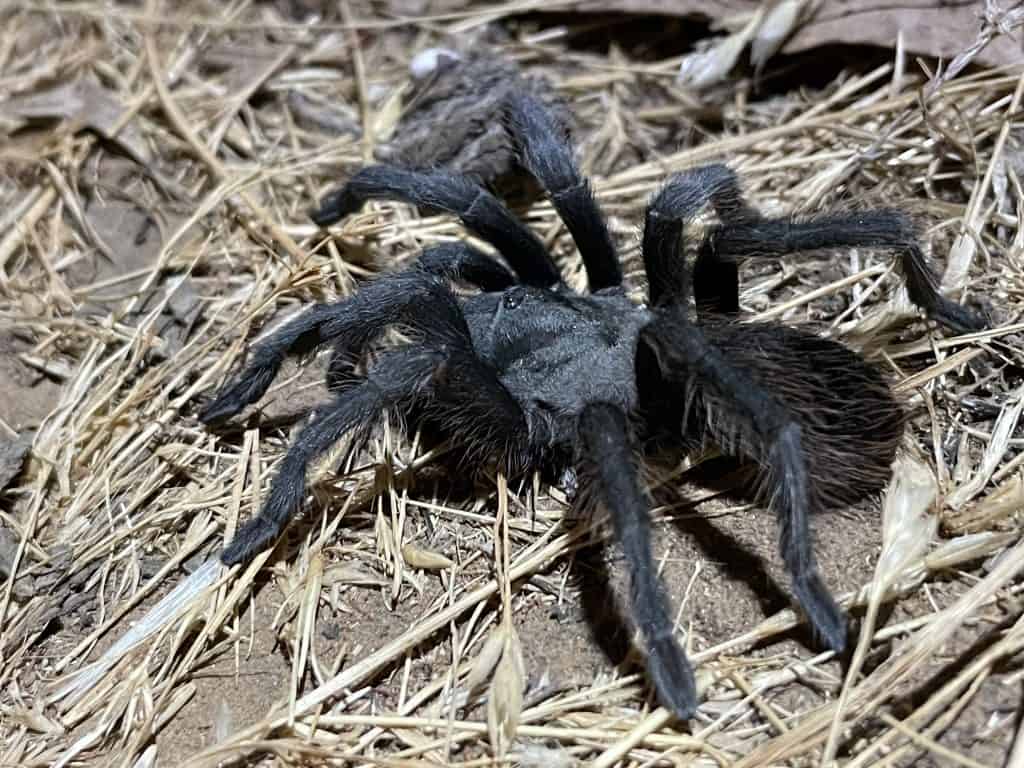
Steindachner’s ebony tarantula is a velvety black color with black and reddish hairs on its body.