Quick Take
- A spider the size of a fingernail has figured out how to make other spiders walk into its grip.
- Portia spiders play a different game depending on how the prey responds and the hunt unfolds.
- Scientists gave these spiders a problem they'd never encountered, and the results refuted a long-held assumption about small brains.
- When Portia's usual hunting signal stops working, it doesn't give up. Instead, it tries a new strategy.
Picture an animal with three pairs of motion-sensing secondary eyes arranged around its head to detect moving prey, and two large frontal principal eyes for gauging their size, distance, and position. Once prey is assessed, this animal uses hydraulic legs to propel itself many times its body length. Behold the jumping spider (scientific family Salticidae)!
Jumping spiders are venomous, and most are generalist predators that go after various insects, but those in the genus Portia actively hunt other spiders as a dietary mainstay. The approximately 17 species of Portia that range from Africa eastward through Southeast Asia reach no more than a half inch in length, but they take down spiders many times their own body size. This “araneophagous” feeding habit requires remarkable adaptations that have come to light over decades of study.
Continue reading
Studying the Portia Jumping Spider
A 1982 study that tracked the behavior of Portia fimbriata, a jumping spider from Queensland, Australia, ascertained that Portia invaded the webs of many other spider species. Once on a foreign web, a Portia spider vibrated the strands with its legs and front appendages (palps), often causing the resident spider to approach as if a prey item had gotten caught. A quick stab and injection of venom through fangs immobilized the resident spider, after which the Portia invader consumed it, stole any prey ensnared in its web, and/or ate its eggs.
The P. fimbriata was not limited to capturing spiders on webs; it could also hunt on the ground for spiders and insects. However, the adjoining clusters of webs hanging in the rainforest allowed Portia to move from web to web, hunting other spiders and nabbing insects along the way. In their paper, the study authors hypothesized that Portia spiders evolved keen vision for picking out spiders in their webs, which ultimately “allowed vagrant predation en route to more distant webs,” and helped find prey outside of webs.
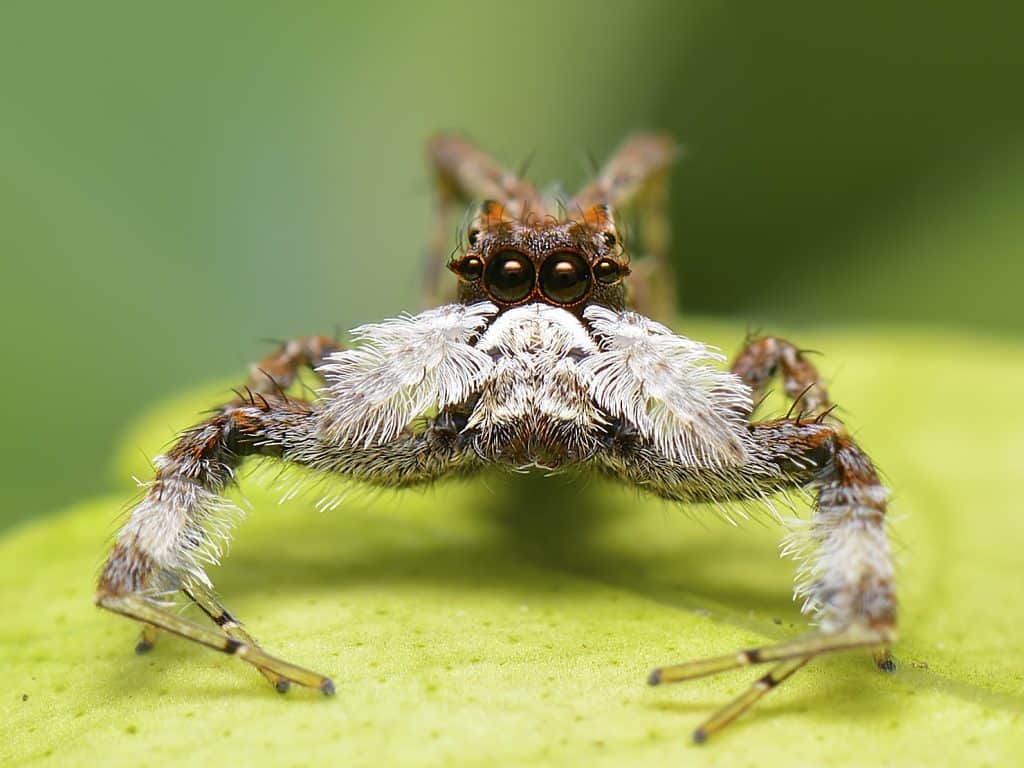
The white mustache jumping spider (Portia labiata) may help it camouflage among web debris.
A follow-up study of five species of Portia from Australia, Kenya, Malaysia, and Sri Lanka further elaborated on its hunting adaptations. When in motion, they walked “with ease” on various types of webs, including both sticky and non-sticky varieties. During hunting, they vibrated the web rhythmically by fluttering it, striking it, or even plucking it like banjo strings with their legs. Portia invaders also twitched their abdomens back and forth, presumably to generate low-amplitude vibrations that transmitted through the legs.
Depending on whether prey spiders were lured by the vibrations, Portia either stayed in place to grab them or slowly moved toward them. The study authors concluded that the vibrations serve to attract the host spider by mimicking prey caught in the web, but also to provoke the host spider to move, making it more visible to the Portia hunter. Because the prey favored by Portia (according to a 1998 paper) tend to have less keen vision, they’re especially responsive to web vibrations.
A Smart Game of Aggressive Mimicry
A 1993 study characterized the behavior of hunting Portia spiders as “aggressive mimicry,” or “a game of deceit in which a mimic, a predator, broadcasts misinformation interspecifically to potential prey.” Furthermore, the study authors reported evidence that Portia spiders used trial-and-error in selecting the best signal for specific prey. Portia try a variety of vibrational signals, then settle on the one that gets the prey to respond.
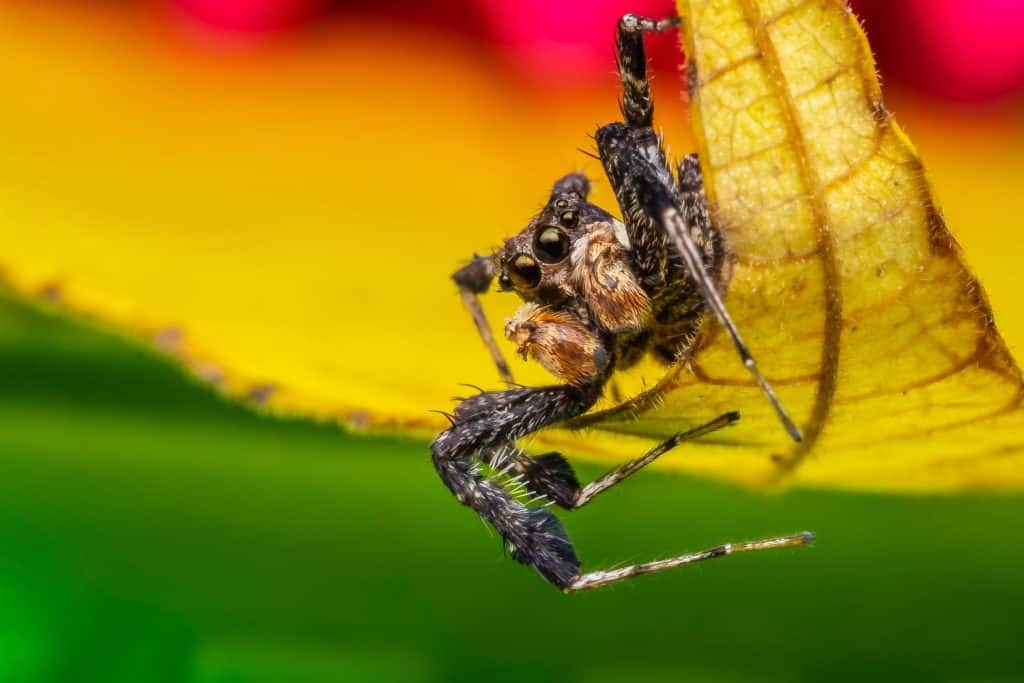
Portia jumping spiders adapt their hunting strategies depending on prey species.
©BAUSRIYOSTHIYA/Shutterstock.com
The way a Portia approaches its prey also appears to vary strategically. A 2020 study identified distinct approaches depending on whether the prey spider (a spitting spider) was carrying eggs or not. Spitting spiders (in this case Scytodes pallidus) immobilize prey by hurling a sticky, venomous substance at them. Typically, Portia stays out of their line of fire by coming from behind, even if it means taking long detours. However, when a female spitting spider was carrying eggs—which blocked her spitting apparatus—Portia spiders approached from the front, taking a shorter route.
So, even with poppyseed-sized brains, Portia spiders demonstrate strategic thinking and risk assessment. A 2020 study attributes them with “intelligence” akin to the flexible problem-solving abilities of vertebrate animals. In laboratory experiments, Portia appeared to use planning, rather than trial-and-error, to solve problems. Each spider was presented with a novel setup: From atop a tower, they could see two boxes, one with prey and the other with leaves. To access either box, they had to descend the tower and then ascend one of two walkways. Out of 266 test spiders, 251 chose the right walkway, even though the prey/leaves were removed as soon as they left the tower, eliminating the visual cue.
Such intelligent, adaptable behavior demonstrates a level of spatial planning and cognitive processing that defies small-brain stereotypes. Portia spiders’ capabilities “give us a rather emphatic warning that intuition related to the consequences of small brain size can be misleading,” concluded the study authors.