
Quick Take
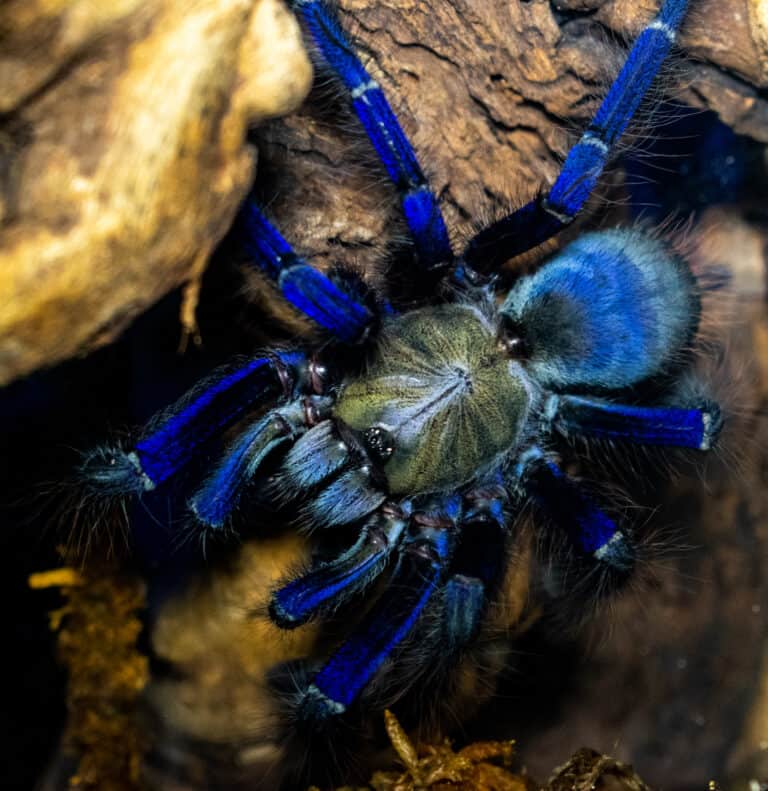
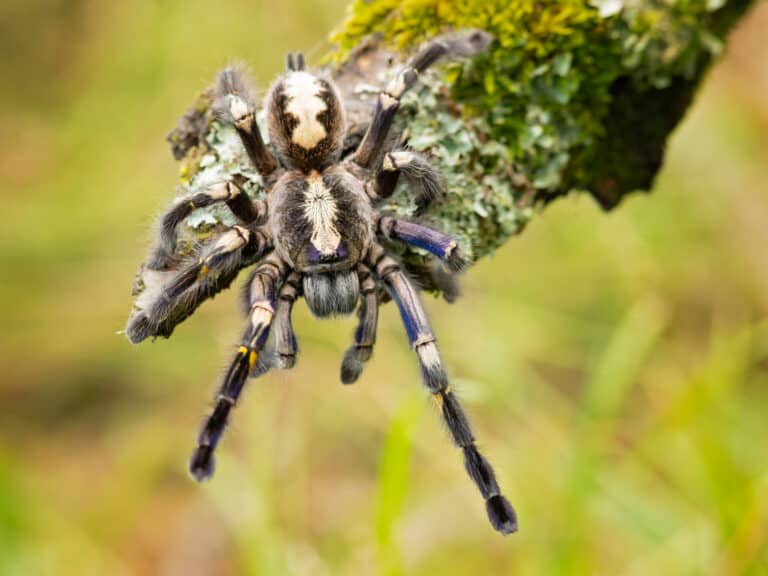
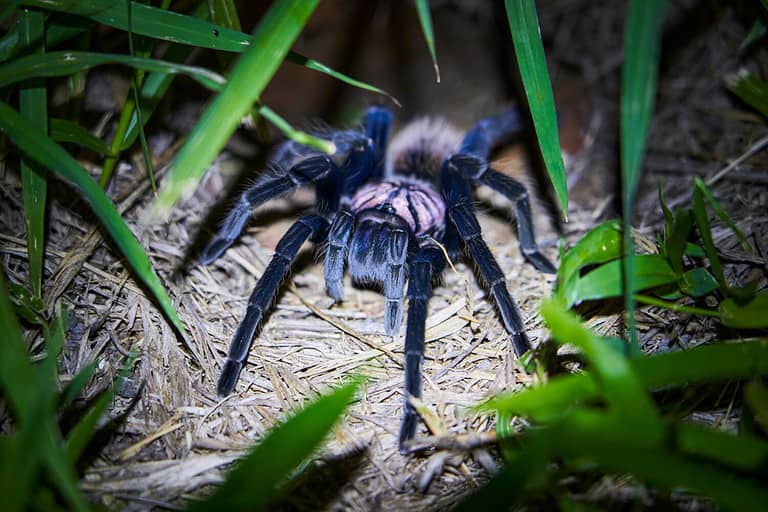
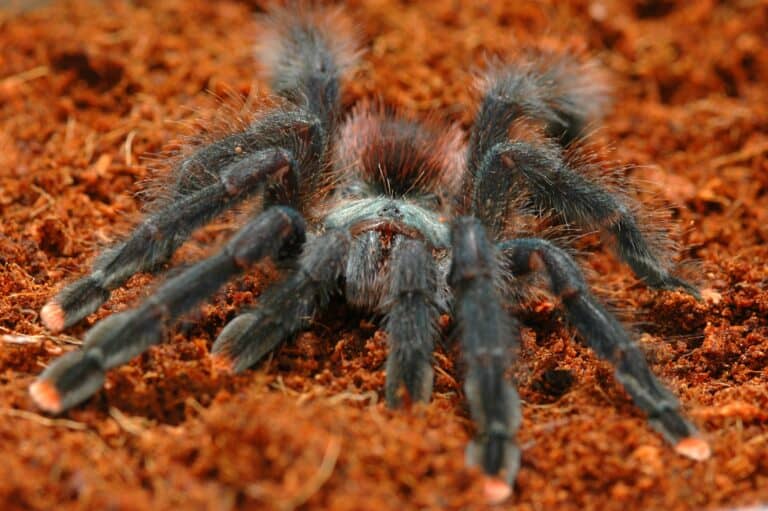
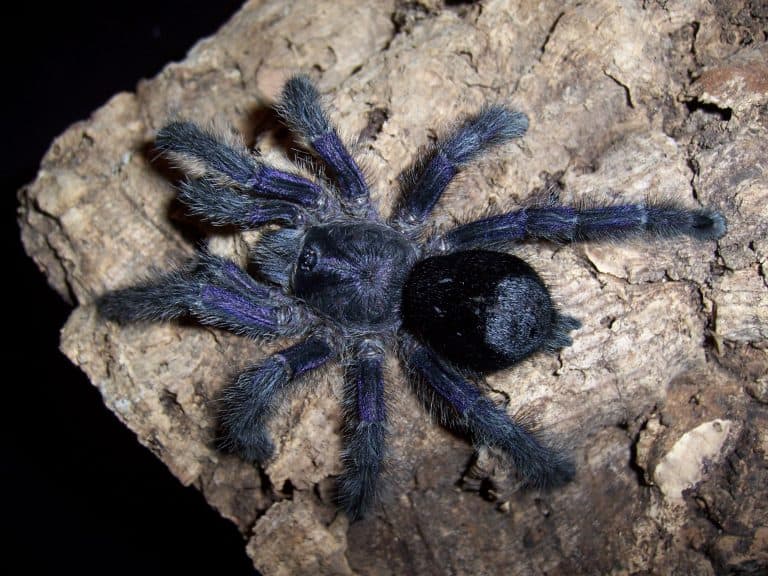
- The Caribbean is home to many arboreal species from the Antillena, Avicularia, Caribena, Psalmopoeus, and Tapinauchenius genera.
- Trichopelma tarantulas have an 18-spot pattern on their abdomens that distinguish them from other genera.
- In 2023, Thalerommata underwent a paradigm shift, moving from trapdoor spiders to true tarantulas.
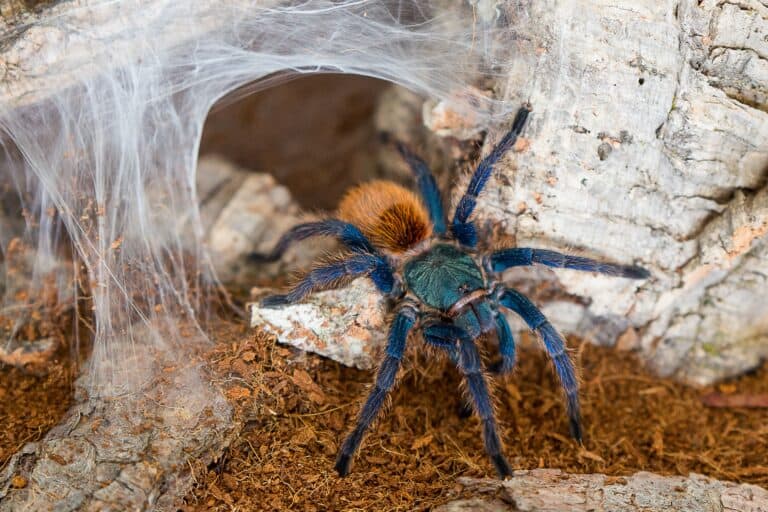
- Citharacanthus cyaneus, the Cuban orange and violet tarantula, is popular in the pet trade for its vivid metallic violet and coppery-orange coloring.
There are over 700 islands in the Caribbean Sea, formed by volcanic activity and tectonic shifts. Many diverse ecological regions are found throughout the region and across individual islands, particularly among those in the Lesser Antilles. From the mountains to the beaches, these islands include ecoregions such as tropical and subtropical moist and dry broadleaf forests, coniferous forests, deserts and shrublands, flooded savannas and grasslands, and mangroves. Millions of years of physical separation caused the unique flora and fauna on these islands to evolve in isolation, leading to high biodiversity.
Nearly 100 tarantula species inhabit the islands of Antigua, the Bahamas, Barbados, Cuba, Dominica, Dominican Republic, Guadeloupe, Grenada, Haiti, Hispaniola, Jamaica, Puerto Rico, Martinique, Montserrat, Saint Barthélemy, Saint Kitts and Nevis, Saint Lucia, Saint Martin, Saint Vincent and the Grenadines, and the Virgin Islands. Trinidad and Tobago is also included here, although it is historically part of the South American continent. The following list includes all currently recognized tarantula species in the Caribbean based on the World Spider Catalog as of December 2025. An asterisk indicates the type species. For a comprehensive reference of all tarantula species, see our complete list of tarantula species.
Acanthoscurria Ausserer, 1871
Acanthoscurria tarantulas are large, terrestrial spiders with leg spans of 7-8 inches. They often excavate burrows in soil and leaf litter or under rocks and fallen logs in the humid tropical forests of the Lesser Antilles. They are partially distinguished by stridulating, or noise-making, hairs (setae) on the back side of the palpal trochanter (the second segment). The holotype female of A. maga has a total length of 2.17 inches and its longest legs (pair IV) measure 2.72 inches. It was originally described as being covered in olive-brown setae with a pair of light-colored markings on the head that are likely pink after freshly molting. Its legs have pale longitudinal stripes, indistinct banding, and short, grey bristles.
- Acanthoscurria maga Simon, 1892
- Common name: Antilles pink patch
- Distribution: Lesser Antilles (St. Lucia, Dominica, Martinique)
Antillena Bertani, Huff & Fukushima, 2017
Scientists created the genus Antillena to house former Avicularia species. They are primarily distinguished from other Aviculariinae species by the morphology of the male and female reproductive organs and the spiny setae on the prolateral and/or retrolateral side of coxae I–IV (the first segment). These are small, arboreal spiders. Both species have a dark carapace, chelicerae (mouthparts), and legs covered with dense, metallic, pinkish setae. A. miguelangeli has a dark gray abdomen with pink setae. It has a light pattern with one patch toward the back of the abdomen and four stripes on the sides. A. rickwesti has a black abdomen with pinkish setae and a lighter colored leaf pattern. Both species have type II urticating setae on their abdomens. Researchers have recorded A. miguelangeli building silk tubes in the branches of the trees, while A. rickwesti primarily builds retreats in tree trunks.
- Antillena miguelangeli Santos & Bertani, 2024
- Common name: N/A
- Distribution: Dominican Republic
- Antillena rickwesti* (Bertani & Huff, 2013)
- Common name: N/A
- Distribution: Dominican Republic
Avicularia Lamarck, 1818
Tarantulas in the genus Avicularia are arboreal, making silk tunnels in the mid-to-upper layers of the rainforest canopy. They are generally small to medium-sized tarantulas. A. avicularia typically has a leg span reaching up to 4.75 inches. These spiders are primarily black overall with a greenish, iridescent sheen on their carapace and femora. They have long, pinkish setae on their legs and abdomen, and the end of each leg is pink, giving them their common name: Guyana pinktoe or pink-toed tarantula.
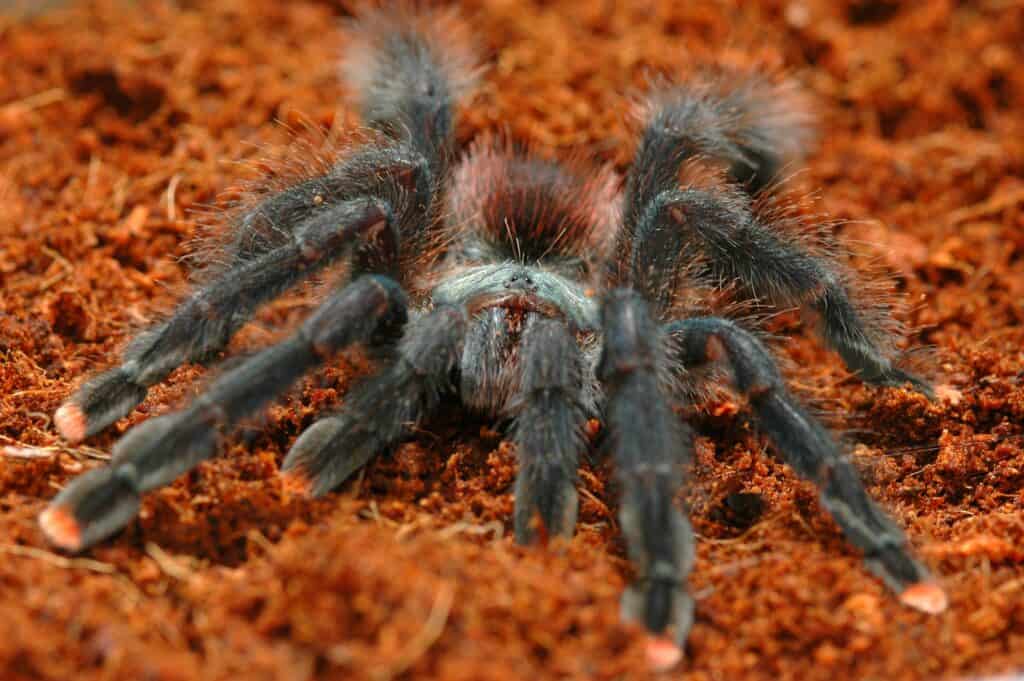
The pink-toed tarantula, Avicularia avicularia, is an arboreal spider that spins silk tunnels in the rainforest canopy
©D. Kucharski K. Kucharska/Shutterstock.com
- Avicularia avicularia (Linnaeus, 1758)
- Common name: Guyana pinktoe or pink-toed tarantula
- Distribution: Venezuela, Guyana, Suriname, French Guiana, Trinidad and Tobago, Brazil, Peru, Bolivia
Caribena Fukushima & Bertani, 2017
Caribena was created to accommodate former Avicularia species. They are distinguished from other Aviculariinae genera by the patch of type II urticating setae on top of the abdomen. They are small to medium-sized arboreal spiders that build retreats among leaves, inside bamboo trunks, between branches, or under bark. C. laeta is shades of brown with short, greenish-tinted gold setae on the body and legs. It has pale leg bands and orange, U-shaped markings on the tarsi (feet), longer brown setae on the legs and abdomen, and a small, gold patch of urticating hair. C. versicolor is brown and has short, gold setae with a vivid green sheen on its body and legs. The legs and palps also have longer, brown setae with an iridescent sheen. The dark abdomen has long, bright red setae with an iridescent sheen and a bronze patch of urticating setae.
- Caribena laeta* (C. L. Koch, 1842)
- Common name: Puerto Rican pinktoe
- Distribution: Puerto Rico, Cuba, U.S. Virgin Islands
- Caribena versicolor (Walckenaer, 1837)
- Common name: Antilles pinktoe, Martinique pinktoe, and Martinique red tree spider
- Distribution: Martinique
Caribothele Sherwood, Gabriel, Peñaherrera-R., Rollard, Leguin & Privet, 2025
As a result of molecular analyses, the genus Caribothele is newly described to accommodate its type species, Caribothele culebrae, transferred from its sister group to Holothele. Researchers also transferred four other species from Holothele, primarily based on the morphology of the male genitalia, the structure of the apophysis (protrusion) on tibia I, and the biogeography of the type localities. Like Holothele species, members of Caribothele are small burrowing spiders. C. culebrae, C. denticulata, C. maddeni, and C. sulfurensis inhabit moist forests, while C. shoemakeri inhabits dry shrublands.
- Caribothele culebrae (Petrunkevitch, 1929)
- Common name: N/A
- Distribution: Puerto Rico
- Caribothele denticulata (Franganillo, 1930)
- Common name: N/A
- Distribution: Cuba
- Caribothele maddeni (Esposito & Agnarsson, 2014)
- Common name: N/A
- Distribution: Dominican Republic
- Caribothele shoemakeri (Petrunkevitch, 1926)
- Common name: N/A
- Distribution: U.S. Virgin Islands (St. Thomas)
- Caribothele sulfurensis (Maréchal, 2005)
- Common name: N/A
- Distribution: Guadeloupe
Citharacanthus Pocock, 1901
Tarantulas of the genus Citharacanthus are small to medium-sized terrestrial spiders. They are distinguished from other genera by the morphology of the male genitalia and thread-like feathery setae on the bases of the forward-facing sides of trochantera and femora I-II. Citharacanthus species often excavate their burrows on steep hillsides with dense vegetation. There is little information about most Citharacanthus species in Cuba, but C. cyaneus is popular in the pet trade for its striking coloration. It has a metallic violet and coppery-orange carapace, violet legs with brownish-orange femora, and a coppery-orange abdomen covered in orange setae. It is a smaller, or dwarf, species with a leg span that only reaches up to 4 inches.
- Citharacanthus alayoni Rudloff, 1995
- Common name: N/A
- Distribution: Cuba
- Citharacanthus cyaneus (Rudloff, 1994)
- Common name: Cuban orange and violet, orange-violet dwarf, Cuban violet, or orange and violet masked tarantula
- Distribution: Cuba
- Citharacanthus niger Franganillo, 1931
- Common name: N/A
- Distribution: Cuba
- Citharacanthus spinicrus (Latreille, 1819)
- Common name: N/A
- Distribution: Cuba, Hispaniola
Cubanana Ortiz, 2008
The genus Cubanana is monotypic, including only the species Cubanana cristinae. It is primarily diagnosed by the morphology of the genitalia, urticating setae types I and III on the abdomen, and a pad of urticating setae on the retrolateral side of femora IV. The C. cristinae holotype male has a total length of 0.62 inches, and its longest legs (pair IV) measure 0.99 inches. Its carapace is dark brown and covered in short, dense, reddish-brown setae with yellowish-green tones. The legs are covered with setae of the same color, but the tibiae, metatarsi, and tarsi are darker. It has a dark brown abdomen with long, reddish-colored setae on the top. C. cristinae is found in Holguín province, where it inhabits semi-deciduous forests, excavating burrows under stones.
- Cubanana cristinae* Ortiz, 2008
- Common name: N/A
- Distribution: Cuba
Cyriocosmus Simon, 1903
Cyriocosmus tarantulas are typically small, or dwarf, tarantulas, but some species may grow to medium-sized. Total lengths range from 0.39 inches to 1.25 inches, not including the chelicerae (mouthparts) and spinnerets. C. elegans has a bicolored carapace of copper and black. It has a dark abdomen with grey stripes on the sides and a glossy cream and reddish-brown patch of type III urticating setae. Its legs are grey with black femora and have long, dark setae. These spiders favor tropical rainforests and lowland grasslands. Burrows may be found under rocks or other forest debris, as well as inside fallen logs.
- Cyriocosmus elegans (Simon, 1889)
- Common name: Trinidad dwarf Tarantula
- Distribution: Venezuela, Trinidad and Tobago
Cyrtopholis Simon, 1892
Members of the genus Cyrtopholis are only distributed in the islands of the Caribbean. The genus is characterized by the presence of stridulatory setae on the trochanter (the second segment) of the palps and legs I. Some species, such as C. bryantae, C. gibbosa, and C. regibbosa, have a foveal protuberance, which is a bump instead of a depression in the carapace. They are relatively small burrowing tarantulas, with total body lengths reaching only up to 1.57 inches. Cyrtopholis species range in color from chestnut brown to greyish-black bodies and femora with the other segments being lighter brown to grey. The legs and body are covered in longer, yellowish-brown setae with type I urticating setae on the abdomen.
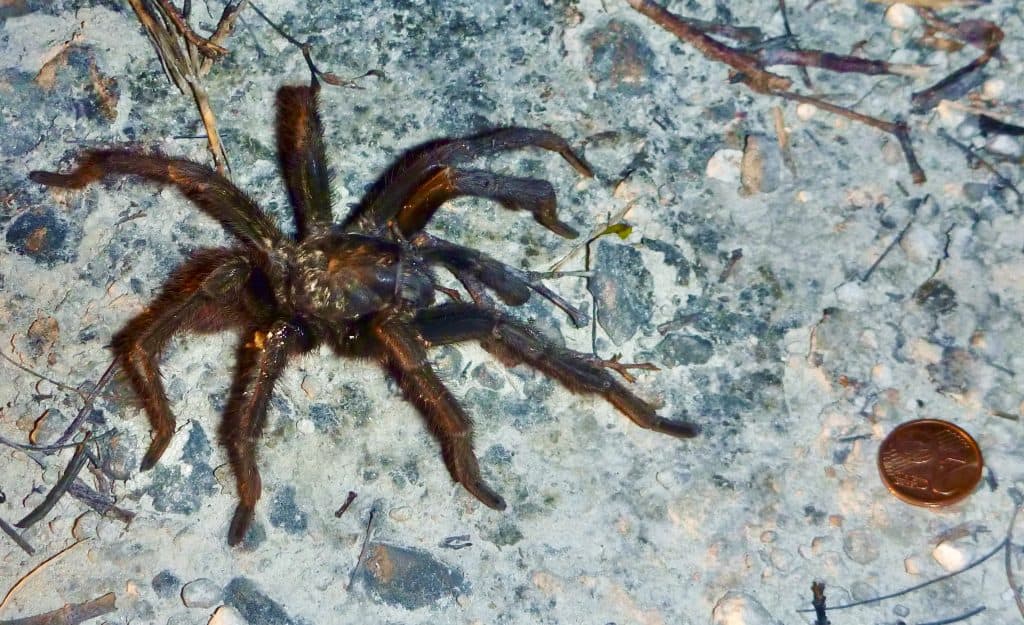
Cyrtopholis bonhotei is native to the Bahamas.
- Cyrtopholis agilis Pocock, 1903 – Hispaniola
- Common name: N/A
- Distribution: Hispaniola (Haiti, Dominican Republic)
- Cyrtopholis anacanta Franganillo, 1935 – Cuba
- Common name: N/A
- Distribution: Cuba
- Cyrtopholis annectans Chamberlin, 1917
- Common name: N/A
- Distribution: Barbados
- Cyrtopholis antillana Thorell, 1894
- Common name: N/A
- Distribution: Guadeloupe (St. Barthélemy)
- Cyrtopholis bartholomaei (Latreille, 1832) –
- Common name: N/A
- Distribution: St. Thomas, St. Barthélemy, Antigua
- Cyrtopholis bonhotei (F. O. Pickard-Cambridge, 1901)
- Common name: N/A
- Distribution: Bahamas
- Cyrtopholis bryantae Rudloff, 1995
- Common name: N/A
- Distribution: Cuba
- Cyrtopholis culebrae (Petrunkevitch, 1929)
- Common name: N/A
- Distribution: Puerto Rico
- Cyrtopholis cursor (Ausserer, 1875)
- Common name: N/A
- Distribution: Hispaniola
- Cyrtopholis femoralis Pocock, 1903
- Common name: N/A
- Distribution: Montserrat
- Cyrtopholis flavostriata Schmidt, 1995
- Common name: N/A
- Distribution: Virgin Islands
- Cyrtopholis gibbosa Franganillo, 1936 – Cuba
- Common name: N/A
- Distribution: Cuba
- Cyrtopholis jamaicola Strand, 1908
- Common name: N/A
- Distribution: Jamaica
- Cyrtopholis major (Franganillo, 1926) – Cuba
- Common name: N/A
- Distribution: Cuba
- Cyrtopholis montserrat Sherwood, Gabriel, Questel, Rollard & Leguin, 2024
- Common name: N/A
- Distribution: Montserrat
- Cyrtopholis plumosa Franganillo, 1931
- Common name: N/A
- Distribution: Cuba
- Cyrtopholis portoricae Chamberlin, 1917
- Common name: N/A
- Distribution: Puerto Rico
- Cyrtopholis ramsi Rudloff, 1995
- Common name: N/A
- Distribution: Cuba
- Cyrtopholis regibbosa Rudloff, 1994
- Common name: N/A
- Distribution: Cuba
- Cyrtopholis unispina Franganillo, 1926
- Common name: N/A
- Distribution: Cuba
Encantarana Sherwood, Gabriel, Peñaherrera-R., Rollard, Leguin & Privet, 2025
Encantarana is a recently described genus created to house Encantarana hamiltoni. The holotype of E. hamiltoni has a total length of 0.78 inches with the longest legs (pair IV) measuring 1.15 inches. This tarantula is a medium brown color overall with darker brown femora and long, pale setae on its legs and abdomen. Females may have a dark brown carapace and a brown abdomen covered in long, yellow-ish setae. These burrowing spiders inhabit dry forests. The holotype is known from Guanica State Forest in Guanica, Puerto Rico.
- Encantarana hamiltoni* Sherwood, Gabriel, Peñaherrera-R., Rollard, Leguin & Privet, 2025
- Common name: N/A
- Distribution: Puerto Rico
Holothele Karsch, 1879
Tarantulas in the genus Holothele are generally small, with leg spans measuring 3-4 inches. These spiders lack urticating setae, which is atypical in New World tarantulas. H. longipes has a wide distribution, including the Caribbean and South America. It has been observed in a wide variety of environments, from areas near sea level to high elevation regions over 14,000 feet. These spiders are known to dig elaborate burrows with heavy webbing. H. longipes has a densely covered cephalothorax of long, pinkish-orange setae. Its abdomen is covered with short, black setae mixed with longer orange setae. It has dark legs covered in black, orange, and blue setae, and its femora are darker than the rest of its legs. However, researchers have recorded substantial variations in color depending on geographical location.
- Holothele longipes* (L. Koch, 1875)
- Common name: Trinidad pink
- Distribution: Venezuela, Bolivia, Trinidad and Tobago, French Guiana, Suriname, Brazil
Neoholothele Guadanucci & Weinmann, 2015
Neoholothele tarantulas are small terrestrial spiders found in northeastern Venezuela and Trinidad and Tobago. Both males and females are characterized by a dark carapace with a gold cephalic (head) region. Females also have a pattern of yellow and dark stripes on the top of the abdomen, but the pattern is less sharp in N. incei than in other Neoholothele species. The legs are covered with light brown setae with gold setae on the femora. The N. incei female used for the species description has a total length of 1.17 inches, and the longest legs (pair IV) measure 1.31 inches.
- Neoholothele incei* (F. O. Pickard-Cambridge, 1899)
- Common name: Trinidad gold
- Distribution: Trinidad and Tobago, Venezuela
Nesipelma Schmidt & Kovařík, 1996
The diagnosis of the genus Nesipelma is based on the morphology of the genitalia and stridulatory organs. Researchers note raised cephalic (head) regions and the presence of long, dense, beige setae around the edges of the carapace of both Nesipelma species. N. insulare was also recorded to have striping on the patellae. N. insulare and N. medium have a black patch on the abdomen with type I urticating setae. These medium-sized burrowing spiders are only known from the islands of St. Kitts and Nevis.
- Nesipelma insulare* Schmidt & Kovařík, 1996
- Common name: N/A
- Distribution: St. Kitts and Nevis (Nevis)
- Nesipelma medium (Chamberlin, 1917)
- Common name: N/A
- Distribution: St. Kitts and Nevis (St. Kitts)
Phormictopus Pocock, 1901
Phormictopus tarantulas are typically large spiders, reaching leg spans of 7-8 inches, although some females may grow larger. They are primarily found on the islands of Cuba and Hispaniola. These spiders tend to excavate silk-lined burrows in forested areas, often beneath rocks. Some Phormictopus species, such as P. atrichomatus, P. auratus, and P. cautus, exhibit iridescent or metallic coloration. These spiders are distinguished by club-like stridulatory setae on the trochanters and coxae of palps and legs I.
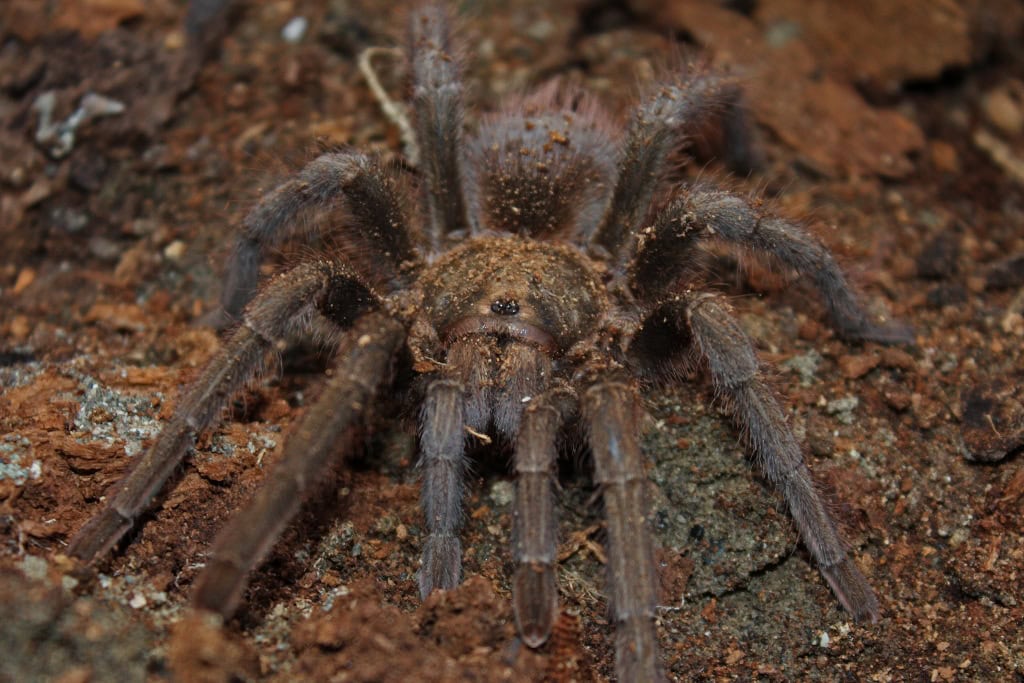
Phormictopus auratus is commonly called the Cuban bronze tarantula.
- Phormictopus atrichomatus Schmidt, 1991
- Common name: Red Island birdeater
- Distribution: Probably Hispaniola
- Phormictopus auratus Ortiz & Bertani, 2005 – Cuba
- Common name: Cuban bronze or Caribbean bronze
- Distribution: Cuba
- Phormictopus bistriatus Rudloff, 2008 – Cuba
- Common name: N/A
- Distribution: Cuba
- Phormictopus cautus (Ausserer, 1875) – Cuba
- Common name: Dominican purple or Caribbean purple
- Distribution: Cuba
- Phormictopus cochleasvorax Rudloff, 2008 – Cuba
- Common name: Snail eating or snail munching tarantula
- Distribution: Cuba
- Phormictopus cubensis Chamberlin, 1917 – Cuba
- Common name: Cuban brown
- Distribution: Cuba
- Phormictopus fritzschei Rudloff, 2008 – Cuba
- Common name: N/A
- Distribution: Cuba
- Phormictopus jonai Rudloff, 2008 – Cuba
- Common name: N/A
- Distribution: Cuba
- Phormictopus melodermus Chamberlin, 1917
- Common name: N/A
- Distribution: Hispaniola
- Phormictopus platus Chamberlin, 1917
- Common name: Caribbean gold
- Distribution: U.S. or Hispaniola
- Phormictopus schepanskii Rudloff, 2008 – Cuba
- Common name: N/A
- Distribution: Cuba
Psalmopoeus Pocock, 1895
Tarantulas in the Psalmopoeus genus are arboreal. They are distinguished by a single row of rough, rigid stridulatory setae on their mouthparts and the lack of urticating setae. Psalmopoeus tarantulas live in the rainforests of Trinidad and Tobago, making their retreats under loose bark or in tree cavities. These are medium to large spiders with a leg span of 5-7 inches. P. cambridgei females are brown with a green-tinted carapace and femora. They have dark, chevron-shaped markings on the abdomen and reddish-orange markings on the legs. Males are generally a more uniform color. These tarantulas are covered in long, light-colored setae, giving them a furry appearance.
- Psalmopoeus cambridgei* Pocock, 1895
- Common name: Trinidad chevron tarantula
- Distribution: Trinidad and Tobago
Schismatothele Karsch, 1879
Members of the genus Schismatothele are relatively small terrestrial tarantulas without urticating setae. Little is known about these spiders aside from taxonomic descriptions. S. caeri is known from the Northern Range on Trinidad Island. The female paratype has a total length of 1.07 inches, and the longest legs (pair IV) measure 0.94 inches.
- Schismatothele caeri Moeller, Weinmann & Guadanucci, 2023
- Common name: N/A
- Distribution: Trinidad and Tobago
Scopelobates Simon, 1903
An examination of the holotype of Holothele sericea uncovered a patch of urticating setae type I and III on the top of the abdomen, making it representative of the sub-family Theraphosinae. Researchers also noted the absence of a stridulatory organ. The genus Holothele lacks urticating setae, like all species in the Ischnocolinae sub-family. So scientists removed H. sericea from Holothele and revalidated the genus Scopelobates to house Scopelobates sericeus. It is generally believed to be a dwarf species, with a leg span of up to 3 inches. The name “sericeus,” meaning silky, likely refers to the silky appearance or texture of its setae, but there is little other information available.
- Scopelobates sericeus* Simon, 1903
- Common name: N/A
- Distribution: Dominican Republic
Spinosatibiapalpus Gabriel & Sherwood, 2020
Tarantulas in the genus Spinosatibiapalpus are distinguished by the strong spination on the forward-facing side of the male palpal tibia and the morphology of the genitalia. Tibia I lacks apophysis (protrusions) in males of S. tansleyi and S. trinitatis. These burrowing tarantulas also have type I urticating setae, which are small, fine hairs with pointed ends and reversed barbs. The holotype male of S. tansleyi has a total length of 1.5 inches, and its longest legs (pair IV) measure 2.28 inches. S. trinitatis can be distinguished from S. tansleyi by its much smaller size. The holotype male has a total body length of 0.76 inches, with its longest legs measuring 1.24 inches.
- Spinosatibiapalpus tansleyi Gabriel & Sherwood, 2020
- Common name: N/A
- Distribution: Trinidad
- Spinosatibiapalpus trinitatis* (Pocock, 1903) (type)
- Common name: Trinidad copper top
- Distribution: Trinidad and Tobago
Tapinauchenius Ausserer, 1871
Tapinauchenius tarantulas are typically medium-sized arboreal spiders, reaching a leg span of 4-5 inches. Their silk-lined retreats are frequently found under loose tree bark and in tree cavities in warm, humid forests and tropical rainforests. These spiders lack both stridulatory organs and urticating setae. T. polybotes is larger than other Tapinauchenius species. It is generally described as black with reddish setae on the abdomen and legs that are densely covered in bluish-black setae. T. rasti females are distinguished by a bright, metallic green cephalothorax, a blue to violet abdomen and legs, and longer reddish setae on legs III and IV. The original type material for T. sanctivincenti has been lost, but contemporary sightings indicate it is dark grey with long, reddish-colored setae on its legs and abdomen.
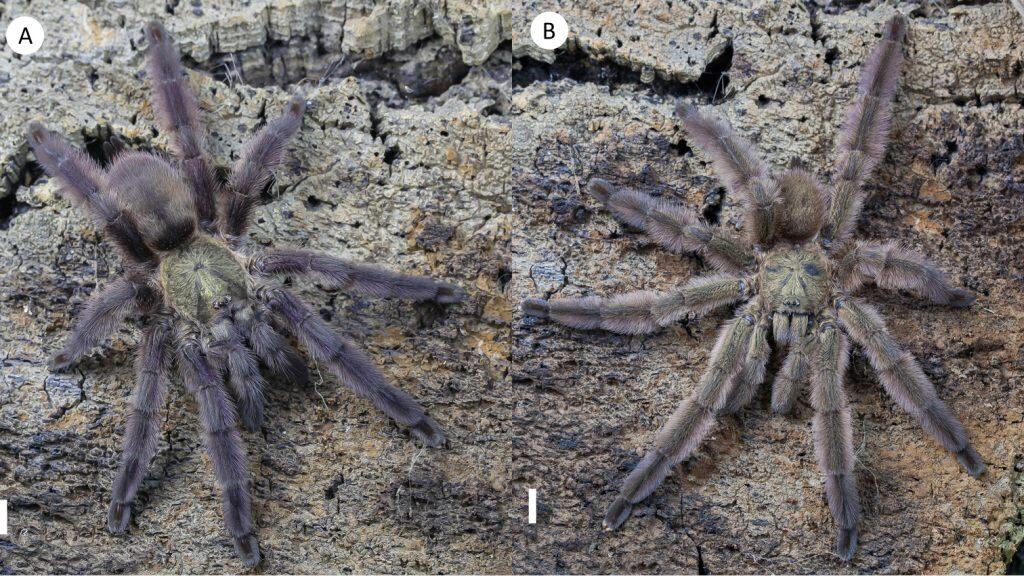
Tapinauchenius rasti have unusual violet and metallic green coloring. The female is on the right and the male holotype specimen is on the left.
- Tapinauchenius polybotes Hüsser, 2018
- Common name: St. Lucia giant Tappy
- Distribution: Lesser Antilles (St. Lucia)
- Tapinauchenius rasti Hüsser, 2018
- Common name: Caribbean diamond
- Distribution: Lesser Antilles (St. Vincent and the Grenadines)
- Tapinauchenius sanctivincenti (Walckenaer, 1837)
- Common name: St. Vincent’s tree spider
- Distribution: St. Vincent
Thalerommata Ausserer, 1875
Researchers transferred the genus Thalerommata from the family Barychelidae, brushed trapdoor spiders, to the family Theraphosidae in 2023. Thalerommata species are very small arboreal tarantulas that rarely reach leg spans of over 2 inches. They are distinguished from other genera by the presence of flattened, iridescent setae on the abdomen and sometimes on the legs.
- Thalerommata anae Ríos-Tamayo, 2024
- Common name: N/A
- Distribution: Cuba
- Thalerommata gertschi Bertani & Raven, 2023
- Common name: N/A
- Distribution: Bahamas
- Thalerommata pecki Bertani & Raven, 2023
- Common name: N/A
- Distribution: Jamaica
- Thalerommata splendens Bertani & Raven, 2023
- Common name: N/A
- Distribution: Jamaica
Trichopelma Simon, 1888
Trichopelma is a genus of small tarantulas, with the largest species, T. grande, measuring between 0.33 and 0.44 inches in carapace length. These spiders are generally shades of greyish-brown to dark brown with an 18-spot pattern on the top of the abdomen. Information on the ecology and biology of specific spiders is scarce, but members of this genus are known to excavate trapdoor burrows in the ground.
- Trichopelma affine (Simon, 1892)
- Common name: N/A
- Distribution: St. Vincent
- Trichopelma baracoense Ríos-Tamayo, 2024
- Common name: N/A
- Distribution: Cuba
- Trichopelma bimini Mori & Bertani, 2020
- Common name: N/A
- Distribution: Bahamas
- Trichopelma cheguevarai Ríos-Tamayo, 2024
- Common name: N/A
- Distribution: Cuba
- Trichopelma citma Ríos-Tamayo, 2024
- Common name: N/A
- Distribution: Cuba
- Trichopelma coenobita (Simon, 1889)
- Common name: N/A
- Distribution: Venezuela, Trinidad and Tobago
- Trichopelma cubanum (Simon, 1903)
- Common name: N/A
- Distribution: Cuba
- Trichopelma fidelcastroi Ríos-Tamayo, 2024
- Common name: N/A
- Distribution: Cuba
- Trichopelma fulvum (Bryant, 1948) – Haiti
- Common name: N/A
- Distribution: Haiti
- Trichopelma gabrieli Mori & Bertani, 2020
- Common name: N/A
- Distribution: Dominican Republic
- Trichopelma goloboffi Mori & Bertani, 2020
- Common name: N/A
- Distribution: Cuba
- Trichopelma grande Ortiz & Fonseca, 2024
- Common name: N/A
- Distribution: Cuba
- Trichopelma granmense Ríos-Tamayo, 2024
- Common name: N/A
- Distribution: Cuba
- Trichopelma huffi Mori & Bertani, 2020
- Common name: N/A
- Distribution: Dominican Republic
- Trichopelma insulanum (Petrunkevitch, 1926)
- Common name: N/A
- Distribution: St. Thomas
- Trichopelma juventud Mori & Bertani, 2020
- Common name: N/A
- Distribution: Cuba
- Trichopelma laurae Mori & Bertani, 2020
- Common name: N/A
- Distribution: Cuba
- Trichopelma loui Mori & Bertani, 2020
- Common name: N/A
- Distribution: Jamaica
- Trichopelma maculatum (Banks, 1906)
- Common name: N/A
- Distribution: Bahamas
- Trichopelma nitidum* Simon, 1888
- Common name: N/A
- Distribution: Hispaniola
- Trichopelma platnicki Mori & Bertani, 2020
- Common name: N/A
- Distribution: Jamaica
- Trichopelma rudloffi Ríos-Tamayo, 2024
- Common name: N/A
- Distribution: Cuba
- Trichopelma soroense Ríos-Tamayo, 2024
- Common name: N/A
- Distribution: Cuba
- Trichopelma tostoi Mori & Bertani, 2020
- Common name: N/A
- Distribution: Dominican Republic