
Quick Take
- Vampire bats are the only mammals that exclusively consume blood.
- Vampire bats do not suck blood; they lap it up with their specialized tongues.
- Due to their liquid diet, vampire bats have fewer teeth than other bats.
- Most scientists believe that vampire bats evolved from an insectivorous ancestor.
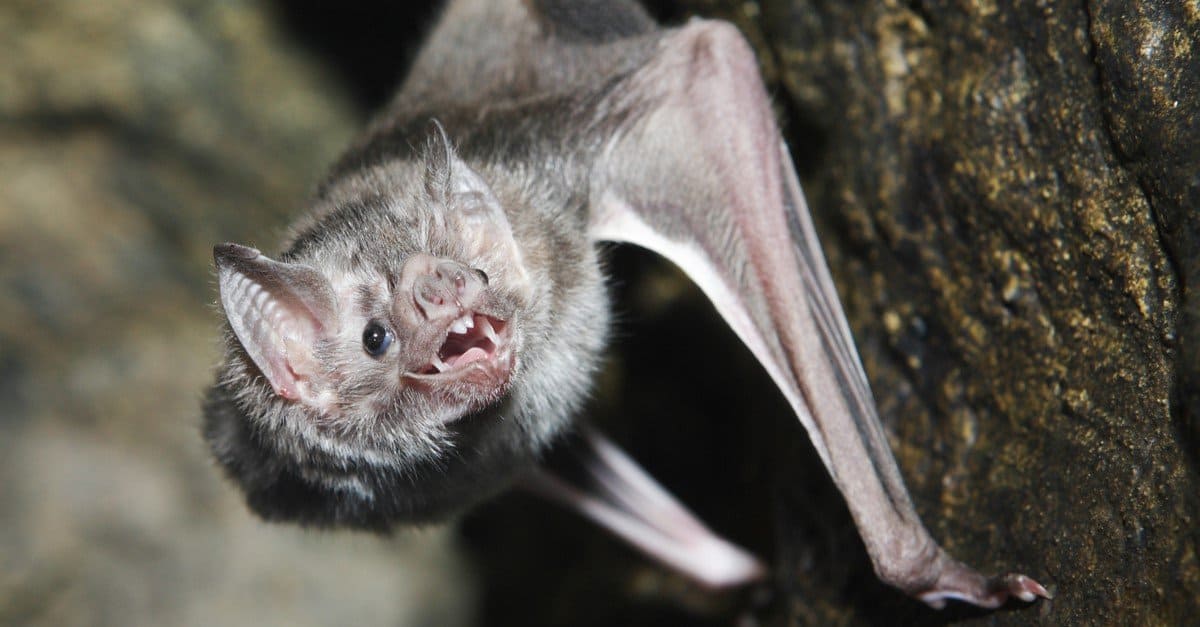
Vampire bats are small, leaf-nosed bats that belong to the bat subfamily, Desmodontinae. There are three recognized species of vampire bats: the common vampire bat (Desmodus rotundus), the hairy-legged vampire bat (Diphylla ecaudata), and the white-winged vampire bat (Diaemus youngi). They favor the warm climates of Mexico, Central America, South America, and parts of the Caribbean. These bats are sanguivores, feeding exclusively on the blood of other animals such as cattle, wild pigs, and birds. But if they consume blood, do they have teeth? Read on to learn the truth about vampire bat teeth.
Do Vampire Bats Have Teeth?
Like all bats, vampire bats do have teeth. Bats have all four types of teeth that humans do: incisors, canines, premolars, and molars. However, because of their liquid diet, vampire bats have fewer teeth than other bats. The common vampire bat has the fewest teeth of any bat species at 20, followed by the white-winged bat with 22, and the hairy-legged vampire bat with 26.
The canines and upper incisors of vampire bats are large, flat, thin, and blade-like. Unlike most mammals’ teeth, vampire bat teeth do not have enamel, which allows their teeth to remain sharp. Vampire bats have few molars and they are very small. The common vampire bat is the only bat with just a single small upper and lower molar on each side. Vampire bats do not consume any solid food, so normal molars that are used to grind and crush solid food are unnecessary. In vampire bats, premolars remove tiny patches of their prey’s hair or feathers to prep the area before biting.
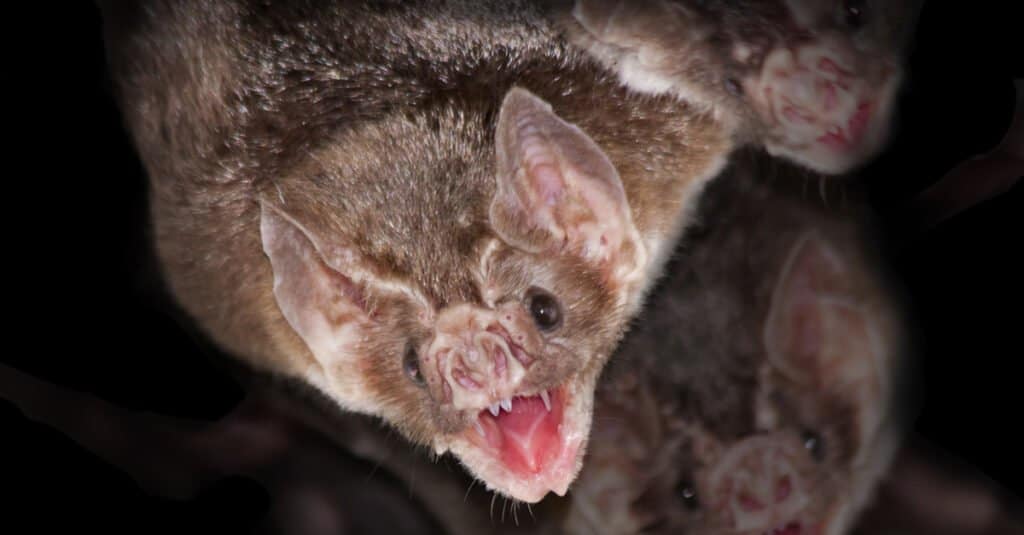
The common vampire bat has 20 teeth, the fewest among all bat species.
©belizar/Shutterstock.com
How Vampire Bats Consume Blood
Vampire bats generally land on the ground near a potential sleeping victim. Then, they use their clawed thumbs to climb onto the animal to find a place to bite. Vampire bats have short, cone-shaped muzzles with thermoreceptors near their noses. These thermoreceptors detect infrared radiation, allowing the bats to sense changes in body temperature that indicate blood flow just beneath the skin. As noted above, the premolars help prep the area before biting by removing the animal’s hair. The bat uses its razor-sharp, blade-like incisors to make a tiny incision up to 0.20 inches deep in the animal’s skin. Its teeth are so sharp that the victim rarely knows it has been bitten, and special proteins in vampire bat saliva also serve as painkillers.
Contrary to popular belief, vampire bats do not suck blood. They lap it up with their specialized tongues. Vampire bats have two lateral grooves on the underside of their tongues, which expand and contract to help draw in blood as they feed. They also have anticoagulant proteins in their saliva that prevent the animal’s blood from clotting so that the bats can feed as long as they require. Vampire bats need about 0.70 ounces of blood each day and can survive only a few days without feeding.
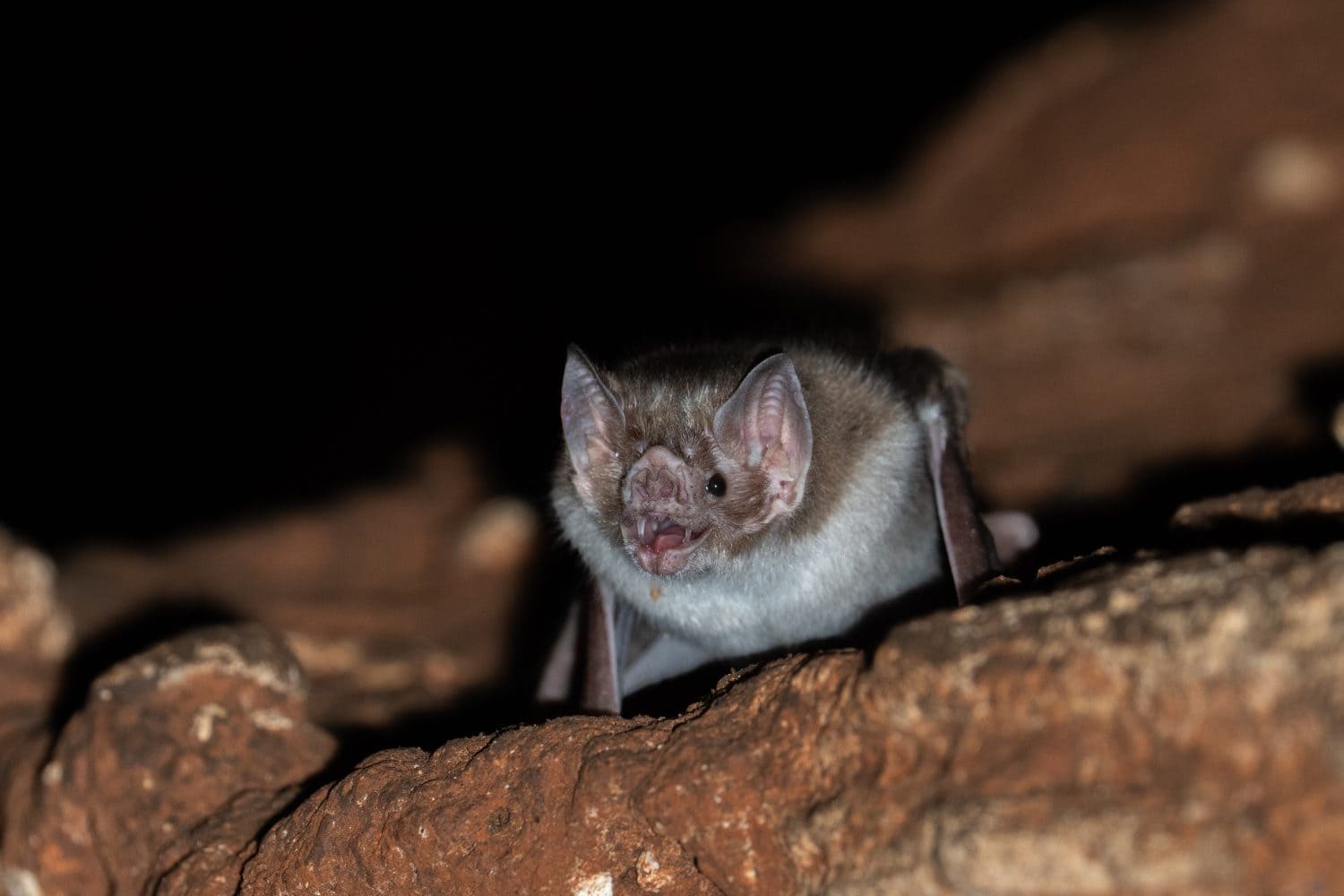
Vampire bats have teeth that are designed for cutting.
©Griffin Gillespie/Shutterstock.com
When and How Did Bats Evolve to Drink Blood?
Vampire bats diverged from other Phyllostomidae bats about 26 million years ago. Although sanguivory is not unheard of in the animal world, vampire bats are the only mammals that feed exclusively on blood. There is no genetic evidence that vampire bats have a frugivorous, or fruit-eating, past, and researchers state that it is difficult to visualize the behavioral changes necessary to evolve from frugivory to sanguivory.
Most scientists believe that vampire bats evolved from an insectivorous ancestor. Evolutionary progress may have occurred through ectoparasite-eating, wound-feeding, or a combination of both, as these behaviors are also found in some blood-feeding birds. Researchers have also discovered that vampire bats have lost 13 genes, including one gene for sweet and two genes for bitter taste receptors. They believe these gene losses may help vampire bats deal with the challenges of their blood-based diet.